How to Choose the Right Warehouse Storage Solution for Your Business

Choosing the right warehouse storage solution starts with the business, not the building. Before comparing a monthly rent, define what you store, how quickly stock moves, how much space you need at peak periods, where orders must go, and how often your team needs access. A small retailer, an e-commerce seller, a distributor and an industrial operator can all need very different storage arrangements.
The most useful comparison is total operating cost rather than rent alone. Loading, unloading, transport, handling, picking, packing, access restrictions, unused capacity and long contract commitments can change the economics of an apparently cheap warehouse. A good solution should also leave room for growth without forcing you to pay for peak inventory all year.
Quick Answer: What Makes a Warehouse Storage Solution “Right”?
The right solution balances five things: usable capacity, location, access, service level and total cost. Start with your inventory profile, calculate average and peak demand, choose a location that supports your delivery pattern, confirm security and handling responsibilities, and then compare flexible storage with a conventional lease.
Storage model | Best fit | Main decision check |
Business warehousing | SMEs, retailers, distributors, overflow stock | Flexible space, access, security, handling |
On-demand warehousing | Variable demand, launches, seasonal peaks | How quickly space can be added or released |
E-commerce warehousing | Online sellers with frequent dispatches | Inventory visibility, pick-pack-ship workflow |
Industrial warehousing | Heavy, bulky or high-volume goods | Floor capacity, loading, clear height, compliance |
Self storage | Smaller quantities, equipment, documents or mixed-use needs | Unit size, access and service boundaries |
1. Start With the Inventory, Not the Square Footage
First document what is actually going into storage. Record approximate quantity, carton or pallet dimensions, weight, packaging type, turnover speed, sensitivity to moisture or temperature, and how frequently each category is retrieved. The objective is to understand storage behaviour, not just volume.
Fast-moving SKUs need easy access and clear movement paths. Slow-moving stock can sit in denser zones. Bulky goods may need floor storage and wider handling areas, while smaller products are often easier to organise with shelving and labelled locations. This is why an inventory storage warehouse should be assessed on retrieval workflow as well as capacity.
Do not assume two warehouses with the same advertised area have the same usable capacity. Columns, aisles, loading areas, stairways, lifts, fire-access requirements and handling zones can reduce the space that is genuinely available for stock.
2. Calculate Current, Peak and Growth Requirements
Use three numbers instead of one: current stock, peak stock and expected growth. This prevents a common mistake—sizing the entire storage arrangement around the busiest month and then paying for idle space for the rest of the year.
Lozy’s current site presents business-storage examples from compact units through larger 20 ft x 20 ft and 25 ft x 25 ft spaces. Those examples show why storage sizing should be based on the actual items and workflow rather than a generic “small business” label. A business with documents and small cartons has a very different requirement from one holding bulky inventory. For a practical sizing check, see Lozy’s storage unit size guide
When demand is uncertain, flexible monthly storage can reduce the cost of overcommitting. When inventory remains stable and highly utilised, a larger dedicated footprint can become more efficient.
3. Choose the Storage Model That Fits the Business
Business warehousing is a practical starting point for companies that need dedicated inventory space without wanting to turn their office or retail premises into a stockroom. It is also useful for overflow when existing space becomes constrained.
On-demand warehousing is more suitable when storage demand changes materially. Instead of planning for the maximum requirement all year, the business can evaluate how quickly space can be added, reduced or moved as demand changes.
E-commerce warehousing deserves separate consideration because storage is only one part of the job. Pick accuracy, dispatch timing, returns, stock visibility and order handling can matter as much as the physical footprint.
Industrial warehousing is a different use case again. Heavy or bulky inventory requires the right loading access, floor capacity, clear height and handling plan. A low-cost shed is not automatically an economical solution if it makes every inbound or outbound movement slower.
4. Compare Flexible Storage With a Traditional Lease
A traditional lease can work well when inventory is predictable, the warehouse will remain highly utilised and the business expects to stay in one location for years. But the headline rent does not capture the cost of unused space during slower periods.
Flexible storage can have a higher apparent unit rate while reducing the annual cost when demand is volatile. The correct comparison is therefore based on expected annual utilisation, not simply rent per square foot for one month.
Ask practical questions: Can you add space during a peak? Can you release unused space? Is there a minimum term? Are transport, loading and manpower separate charges? What happens if the business needs to exit earlier than planned?
5. Evaluate Location by Delivery and Replenishment
Warehouse location affects transport time, last-mile economics and replenishment reliability. The best site is not automatically the one with the lowest rent or the one closest to the business owner.
For Delhi NCR businesses, compare Delhi, Gurgaon, Noida, Faridabad, Ghaziabad and Greater Noida against the actual destination mix. For businesses selling across India, a multi-location approach can sometimes reduce delivery distance more effectively than one large warehouse.
When comparing a warehouse in Delhi or another major city, check approach roads, loading restrictions, operating hours, vehicle access, distance from customer clusters and whether the quoted price includes handling. For Gurgaon-focused decisions, Lozy also has a dedicated 2026 warehouse-rent guide that can be used as a market-specific reference. Read the Gurgaon warehouse rent guide.
6. Verify Security, Storage Conditions and Responsibility
A warehouse should not be judged by vague phrases such as “fully secure.” Ask what controls actually exist: CCTV, controlled access, unit-level access, pest control, documentation, incident procedures and insurance options. Also establish who is responsible for moving stock, recording it and handing it over.
Lozy’s current service and location pages describe measures such as CCTV monitoring, PIN-based access in applicable facilities, barcoding or inventory documentation in certain services, and flexible access arrangements. Because facilities differ, the correct practice is to confirm the controls for the specific site and service being quoted rather than assuming every location is identical.
For higher-value or sensitive inventory, document the condition of goods at intake, define permitted storage conditions and make sure the insurance position is clear before the stock is moved.
7. Use Technology Where It Reduces Real Work
Technology is valuable when it solves a specific operational problem. Businesses with many SKUs or frequent movements should be able to identify what is stored, where it is stored and what has moved without relying entirely on memory or spreadsheets.
For e-commerce, inventory visibility, barcode processes, order status, dispatch coordination and returns handling can be more important than adding a few extra square feet. The test is simple: does the system reduce manual errors, search time or unnecessary labour? If not, it may be technology for appearance rather than performance.
8. Plan for Seasonal Demand and Business Growth
Growth changes storage requirements. Before committing, model what happens if stock doubles, a new product line launches, demand drops, or a seasonal campaign creates a temporary spike. A scalable provider should have a clear answer for adding or reducing capacity.
Seasonal inventory is often a poor reason to lease permanent space at peak volume. Seasonal warehousing can be more logical when stock is only high for a few months. In contrast, stable inventory and predictable demand may justify long-term warehousing when the utilisation and commercial terms work in your favour.
9. Compare the Full Cost, Not the Advertised Rent
When comparing quotes, put every cost into one sheet: rent, deposit, minimum term, loading and unloading, transport, manpower, racking or shelf charges, packing, insurance, taxes, retrieval, dispatch and peak-season fees. Then calculate the expected annual cost.
This is especially important when comparing a traditional warehouse for rent with a managed or flexible model. A lower monthly number can become more expensive when the business has to add transport, labour or unused capacity on top of it.
10. Score the Final Options
Once you have shortlisted providers, score each from 1 to 5 for usable capacity, location, access, security, flexibility, handling support, total cost and scalability. This removes some of the sales language from the decision.
A provider that wins on rent but loses on access, retrieval speed and flexibility may be more expensive after operations begin. The best warehouse is the one that makes the business easier to run, not simply the one with the lowest quoted rate.
Which Storage Option Should You Choose?
For most small and growing companies, business warehousing is a sensible starting point because the space can be matched to stock and workflow. Businesses with uncertain demand should review on-demand warehouse space. Online sellers should compare e-commerce warehousing with ordinary storage because fulfilment requirements can change the economics. Heavy or bulky inventory should be assessed against industrial warehousing. Smaller quantities may fit self storage better than a full warehouse footprint.
For a direct rental requirement, review the current warehouse / godown for rent option and compare the quoted space and services. Businesses focused on stock management can also review inventory warehousing before deciding how much floor area they actually need.
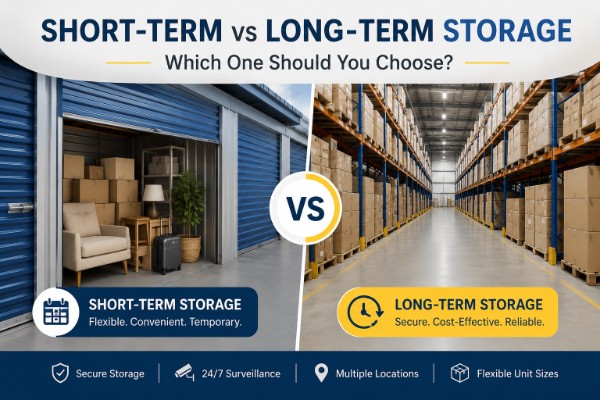
For Delhi NCR, start with the New Delhi storage location when delivery geography supports it. For seasonal peaks, evaluate seasonal warehousing. For stable long-duration requirements, compare long-term warehousing. Temporary projects can be a better fit for short-term storage.
Need warehousing or storage in India?
Request a free, tailored quote in under 2 minutes — free pickup, no lock-in.