Short-Term vs Long-Term Storage: Which One Should You Choose?
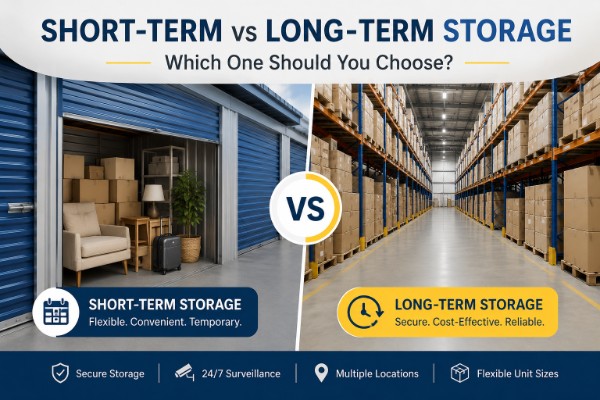
Choosing between short-term vs long-term storage comes down to three practical
questions: how long you need the space, what you are storing, and how often you
need access. If you are moving homes, renovating, travelling, or handling a
temporary business overflow, short-term storage can give you the
flexibility to store your belongings without taking on a long commitment. For
furniture, household belongings, seasonal items, or stock that needs to stay
protected for months, household storage or business storage may make
more sense.
Short-Term vs Long-Term Storage: What’s the Difference?
There is no universal number of days that
turns short-term storage into long-term storage. In practice, short-term
usually means a temporary requirement lasting days or a few weeks to several
months. Long-term storage is chosen when the belongings or inventory will
remain in storage for an extended period and access is less frequent.
The better choice is therefore not simply
the cheaper monthly rate. Think about the total arrangement: commitment,
access, security, space, handling and how likely your storage needs are to
change.
|
Factor |
Short-Term Storage |
Long-Term Storage |
|
Typical need |
Moving, renovation, travel, temporary overflow |
Seasonal belongings, archives, furniture, ongoing inventory |
|
Commitment |
Flexible; useful when dates may change |
Better suited to a stable, extended requirement |
|
Access |
Often needed more frequently |
Usually less frequent, planned access |
|
Cost focus |
Flexibility and convenience |
Better value when space is needed for longer |
|
Best for |
Transitions and temporary storage |
Extended household or business storage |
When Is Short-Term Storage a Better Choice?
Short-term storage is useful when the end
date is relatively close or uncertain. A common example is moving between
homes. Your new property may not be ready when you leave the old one, so
storing furniture and boxes for a few weeks can prevent a rushed move.
It can also help during home renovations.
Rather than covering furniture and leaving it in the middle of construction,
you can move it out temporarily and bring it back when the work is complete.
The same logic applies to travel, temporary accommodation, staging a home for
sale, or clearing space for an event.
For businesses, short-term storage can
absorb a seasonal stock increase, a large order, or a temporary shortage of
warehouse space. This is especially useful when you do not want to sign a long
commercial lease simply to solve a short-lived capacity problem.
When Does Long-Term Storage Make More Sense?
Long-term storage works better when you
already know the items will stay put for months or longer. Families may use it
for furniture, documents, seasonal belongings, or possessions kept during a
relocation. Businesses may need it for archived records, equipment, packaging
material, spare inventory, or stock that does not need daily access.
The main advantage is stability. Once
everything is packed, labelled and organised, you do not have to keep moving
the same items from one temporary location to another. If the provider offers
longer-duration pricing, the monthly cost may also become more predictable.
The Five Differences That Actually Matter
1. Duration and commitment
Start with your timeline. If you need
storage for one month while a house move is completed, flexibility matters more
than a long-term discount. If you are storing business inventory for a year,
stability and total cost become more important.
2. Access frequency
Think honestly about how often you will
open the unit. Items you need every week should be stored where access is
convenient and the unit is easy to navigate. Items you rarely touch can be
packed and positioned for longer-term storage.
3. What you are storing
Household furniture, documents, appliances,
business stock and seasonal goods all have different storage requirements. Ask
how the facility handles security, ventilation, pest management and fire
safety. If a provider offers different unit sizes, choose the smallest
practical space rather than paying for empty floor area.
4. Total cost
Do not compare storage providers only by
the headline monthly price. Check whether pickup, handling, access, trolleys,
insurance, packing materials or other services are included. A slightly higher
rate can be better value if it removes costs you would otherwise pay
separately.
5. Flexibility
Storage needs change. A family may need
less space after a move. A business may need more space before a sales season.
Flexible monthly plans can reduce the risk of paying for unused capacity or
being trapped in a long commitment.
How Much Storage Space Do You Need?
Choosing the right storage unit size is one
of the easiest ways to control your cost. Start with the items you actually
need to store, then think about how they will be packed and accessed. A room
full of loosely stacked furniture can require more space than the same
belongings dismantled and packed efficiently.
Before booking, review Lozy’s storage options and
size guidance and match the space to your actual volume rather than
choosing a larger unit “just in case.”
What Should You Look for in a Storage Provider?
A good storage decision is about more than
getting an empty room. Look for clear pricing, straightforward terms,
controlled access and a facility that is clean and properly managed.
·
Security measures such as CCTV
and controlled or logged entry.
·
A clear agreement covering
billing, notice periods, access and cancellation.
·
Flexible plans if you are
unsure how long you will need storage.
·
Suitable loading and unloading
arrangements for furniture, boxes or business stock.
·
A practical unit-size range so
you do not pay for unnecessary space.
·
Protection measures such as
ventilation, pest management and fire-safety provisions where applicable.
Short-Term Storage for Moving vs Long-Term Household Storage
Moving is one of the clearest examples of
why storage duration matters. If you are between homes, short-term storage
keeps furniture and boxes out of the way until the move is complete. If you are
relocating to another city, downsizing, or keeping belongings that you do not
currently have room for, long-term household storage may be the better fit.
For household belongings, see Lozy
Household Storage for information on flexible plans, unit sizing and
storage access.
Short-Term vs Long-Term Storage for Businesses
Businesses often need storage for a
different reason: inventory changes faster than their premises. A retailer may
need extra stock space before a busy season. An e-commerce seller may need
overflow space after a product launch. A growing company may need storage
before it is ready to commit to a larger warehouse.
In these cases, flexible business storage
can act as a buffer. It can be easier to increase or reduce space than to
renegotiate a conventional warehouse lease every time inventory changes.
If your requirement is larger-scale
inventory or a dedicated warehouse, read Lozy’s Warehouse & Godown for Rent in India: The Complete
2026 Guide.
How to Prepare Items for Longer Storage
The longer your belongings stay in storage,
the more important preparation becomes. Clean and dry items before packing
them. Use sturdy boxes for documents and smaller household goods, protect
furniture with appropriate covers, and label every box clearly. Keep an
inventory so you know what is stored without opening everything.
Avoid storing prohibited materials such as
perishables or hazardous substances. For valuable, fragile or sensitive items,
ask the storage provider about its specific facility conditions and rules
before booking.
Which Storage Option Is Right for You?
Choose short-term storage when your
requirement is temporary, your move date may change, or you expect to need
regular access during a transition. Choose long-term storage when the items can
stay packed for an extended period and you want a stable place for belongings
or inventory.
If you are still unsure, estimate the
storage period first and then compare the total cost and flexibility of each
option. The right storage solution is the one that fits your actual timeline
without forcing you to pay for space or commitment you do not need.
Why Lozy Can Be a Practical Option
Lozy provides household, business and
warehousing solutions with flexible storage plans. Its website highlights
monthly billing, 24/7 CCTV, unique PIN access, free move-in trolleys and pallet
trucks, and storage options designed for both homes and businesses.
Availability and features can vary by facility, so confirm the specific unit
before booking.
If you are comparing storage options,
Lozy’s approach is particularly useful when you want flexibility rather than
committing to a traditional long-term warehouse arrangement.
Suggested Reads
·
Warehouse & Godown for Rent in India: The Complete
2026 Guide
·
Warehouse for Rent in Gurgaon
Final Takeaway
There is no single best storage option for
everyone. Short-term storage is usually the smarter choice for temporary
transitions and uncertain timelines, while long-term storage is better when you
need a stable place for belongings or inventory over a longer period. Before
booking, compare the duration, total cost, access, security, unit size and
flexibility. That will tell you far more than the monthly price alone.
Ready to store? Request a free, tailored quote from
Lozy. Get a Quote
Need warehousing or storage in India?
Request a free, tailored quote in under 2 minutes — free pickup, no lock-in.