Storage Units vs Warehouse for Business: Which Is the Better Choice in India?
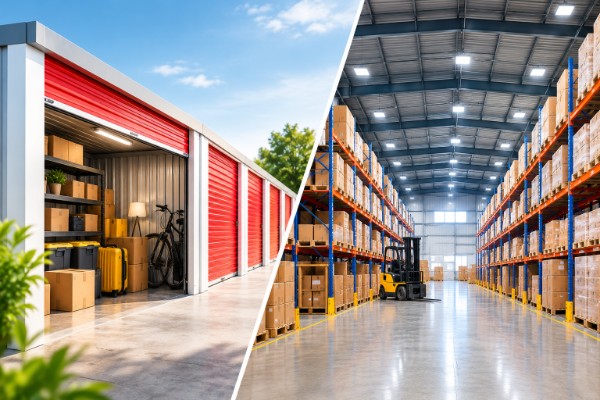
Indian businesses are rethinking how they store inventory, equipment and business records. For years, renting a traditional warehouse was the default solution when a company needed more space. But a large warehouse can also mean a long lease, a high deposit, unused capacity and additional operating costs. This is why the question of why businesses are switching to storage units instead of warehouses has become increasingly relevant. Storage units give smaller and growing businesses a way to rent the space they need today, keep commitments manageable and increase capacity as the business grows.
Why the Traditional Warehouse Model Does Not Work for Every Business
A warehouse is still the right choice for many businesses, especially companies handling high inventory volumes or daily dispatches. The issue is that not every business needs a large operational facility. A startup may have 100 cartons today and 500 cartons during a seasonal campaign. A retailer may need overflow space for only a few months. A D2C brand may need inventory storage without running a full warehouse operation.
Traditional warehouse agreements can also involve security deposits, lock-in periods, utilities, maintenance, racking, security and labour. Lozy's current India guide notes that traditional leases commonly run for several years, while flexible storage can be offered on monthly terms.
For a business whose storage requirement is changing, flexibility can therefore matter as much as the headline rent.
1. Businesses Can Rent Only the Space They Need
One of the biggest reasons businesses are switching to storage units is simple: they do not want to pay for empty space.
A large warehouse may look cost-effective when measured only by the price per square foot. But if half the warehouse remains unused, the business is still paying for that capacity. Storage units allow businesses to choose a smaller footprint and increase it later when inventory actually grows.
Lozy's business storage options currently include units from 5 x 5 ft through larger 25 x 25 ft spaces, giving businesses several capacity points instead of forcing every customer into a full warehouse. See Lozy's business storage options
2. Flexible Storage Reduces Long-Term Commitment
Business conditions change. Sales forecasts change, product ranges change and expansion plans change. A long warehouse commitment can become expensive when the original storage requirement no longer matches reality.
Flexible storage allows a business to test a location, manage seasonal inventory or handle temporary overflow without immediately committing to a large long-term facility. Lozy currently promotes flexible warehouse plans, monthly payments and short-term or long-term options.
3. Storage Units Can Be Easier for Startups and SMEs
Startups and small businesses often need storage before they are ready for warehouse-level operations. They may need space for product inventory, office equipment, documents, packaging material, samples or seasonal stock.
A smaller managed storage unit can solve the immediate space problem without requiring the business to build a complete warehouse setup. This can be particularly useful when the company is still validating demand or entering a new market.
4. Better Scalability When Inventory Changes
Inventory rarely stays constant throughout the year. E-commerce brands may see spikes during festive campaigns. Retailers may need additional space before a new collection launches. Importers may need temporary space while goods are waiting for distribution.
With a flexible storage model, the business can increase or reduce its storage footprint as requirements change. That makes storage capacity a variable business expense instead of a permanently fixed commitment.
5. Security and Managed Facilities Matter
Businesses are not simply renting empty rooms. They also need security, access control and a facility that is suitable for storing commercial goods.
Lozy's Dwarka Sector 26 facility offers individually locked storage units, CCTV and controlled access, with unit sizes ranging from 25 sq ft to 200 sq ft. View the Dwarka self storage facility.
6. The Total Cost Can Be More Important Than Rent Per Sq Ft
Businesses should not compare storage options using rent alone. A warehouse may require additional spending on electricity, security, racking, maintenance, equipment, labour and deposits. There can also be a cost associated with unused space.
A storage unit can have a higher rate per square foot but still produce a lower overall commitment because the business rents less space and avoids some of the infrastructure costs of operating a larger warehouse.
The better comparison is total monthly storage cost plus the operational costs created by the facility.
7. E-commerce and D2C Brands Have a Strong Use Case
For e-commerce and D2C businesses, storage requirements can change quickly. A product launch can increase stock requirements, while a slow period can leave excess inventory sitting for months.
Storage units can work as inventory buffers for cartons, finished products, packaging material, returns and seasonal stock. Once the business needs daily picking, packing, pallet positions and fulfilment support, a larger warehouse becomes more appropriate.
Lozy's warehouse facility near IGI Airport supports larger operational requirements and lists services such as racked and bulk storage, pick and pack, kitting, labelling and order fulfilment. Explore the warehouse near IGI Airport.
8. Storage Units Are Not Always Better Than Warehouses
The switch to storage units does not mean warehouses are becoming unnecessary. A warehouse is usually the better fit when a business has high-volume inventory, frequent truck movement, palletised goods, dedicated loading requirements or staff working on-site every day.
For larger requirements, businesses can consider industrial warehousing options rather than trying to fit a high-volume operation into small storage units.
Storage Units vs Warehouse: Which One Should a Business Choose?
Business Requirement | Storage Unit | Warehouse |
Small or moderate inventory | Usually suitable | May be excessive |
Seasonal or temporary stock | Very suitable | Can create unused capacity |
Long-term high-volume inventory | May be limiting | Usually suitable |
Daily loading and dispatch | Depends on facility | Usually better |
Need to scale space quickly | Strong advantage | Less flexible |
Need pallet handling and fulfilment | Limited to facility | Usually better |
How to Choose the Right Storage Model
Before choosing a storage unit or warehouse, answer five questions:
1. How much inventory do I have now?
2. What is my peak inventory requirement?
3. How often will I access or dispatch stock?
4. Do I need racking, forklifts, loading bays, picking or packing?
5. How much flexibility do I need in the rental period?
If the business mainly needs secure space and occasional access, a storage unit can be a practical choice. If the operation depends on daily movement of goods and warehouse infrastructure, a warehouse is likely the better fit.
Suggested Reading
Warehouse & Godown for Rent in India: The Complete 2026 Guide - Covers warehouse rent, lease terms, space planning and flexible storage options.
Warehouse for Rent in Gurgaon: 2026 Rates & Micro-Markets - Useful for businesses comparing warehouse costs and location factors in Gurgaon.
Lozy Business Storage - Explore business storage sizes, flexible plans and managed storage facilities.
The reason businesses are switching to storage units instead of warehouses is not that warehouses have stopped being useful. The shift is mainly about flexibility. A growing business does not always know how much space it will need next year, and paying for a large warehouse before that space is actually required can tie up money unnecessarily.
Storage units can work well for startups, SMEs, retailers, D2C brands and businesses with seasonal or moderate inventory. Warehouses remain the stronger option for high-volume operations that require frequent movement, pallet storage and dedicated logistics infrastructure.
The right decision comes down to actual storage volume, access frequency, operational needs and how quickly the business is changing.
Need warehousing or storage in India?
Request a free, tailored quote in under 2 minutes — free pickup, no lock-in.