7 Situations Where Renting a Storage Unit Makes Life Easier
Renting a
storage unit can make a surprisingly big difference when your home, office,
shop, or routine temporarily needs more room. Whether you are between homes,
renovating a flat, trying to declutter, storing business inventory, or keeping
belongings safe while you travel, having a dedicated place for things can
remove a lot of unnecessary pressure. The key is choosing storage for a genuine
space problem not using it as an excuse to keep everything forever.
At Lozy, the
need for flexible storage generally falls into two broad categories: household
belongings that need a safe place outside the home, and business stock or
equipment that is taking up operational space. Lozy offers household storage,
self storage, business warehousing and larger warehouse solutions, with options
designed to scale according to the amount of space and duration required.
At a Glance: When Does Renting
a Storage Unit Make Sense?
A storage unit
is worth considering when keeping everything at home or in your current
workplace creates a practical problem. The most common situations are:
·
You are moving and the dates do
not line up.
·
You are renovating and need
furniture out of the work area.
·
Your home or office is
overloaded with items you still need.
·
Your business needs more room
for inventory, documents, or equipment.
·
You are a student or
professional leaving town temporarily.
·
You need a place for seasonal
belongings that are rarely used.
·
You are dealing with a major
life transition such as marriage, downsizing, inheritance, or an overseas move.
For household
belongings, compare Lozy's household storage options before deciding how
much space you actually need.
1. You Are Moving and the Dates Do Not Line Up
One of the
strongest reasons for renting a storage unit is a gap between leaving one
property and moving into another. This happens more often than people expect: a
lease ends before the new home is ready, a possession date moves, a family
member is travelling, or a relocation happens in stages.
Without
temporary storage, people often end up squeezing furniture into a friend's
garage, leaving boxes in hallways, or paying for rushed transport and
unnecessary handling. A dedicated storage space gives you a buffer. You can
move non-essential belongings out first and bring them into the new home when
the timing is right.
The decision is
especially useful when you are downsizing. Instead of forcing every item into
the new home immediately, you can separate essentials from things you need more
time to sort.
For a home
move, renovation or temporary transition, Lozy's household warehousing is designed around
flexible storage for furniture and personal belongings.
2. You Are Renovating or Repairing Your Home
Renovation
creates a different kind of storage problem: the items are not unwanted, but
they cannot safely remain where the work is happening. Furniture can block
contractors, dust can settle on surfaces, and repeated movement around a work
area increases the chance of accidental damage.
Moving bulky
pieces into a storage unit can create a cleaner work zone and make the
renovation easier to manage. This is particularly useful for living-room
furniture, mattresses, appliances, décor, books, children's items, and other
belongings that would otherwise need to be shifted from room to room.
There is also a
practical planning benefit. When everything is stored in one controlled
location, you are less likely to mix tools, furniture and personal belongings.
Before storing anything, clean it, make sure it is dry, label cartons clearly,
and keep an inventory.
Lozy's household
storage service is relevant for renovation periods because the space
can be scaled to the amount of property you need to move out of the home.
3. Your Home or Office Is Too Cluttered, But You Are Not Ready to Throw Things Away
Decluttering
does not always mean getting rid of everything. Some belongings are valuable,
sentimental, useful later, or simply not needed every week. The problem is that
keeping all of them at home can gradually reduce usable living space.
A storage unit
can create a middle ground between 'keep everything here' and 'throw it away.'
This works especially well for items such as archived documents, extra
furniture, hobby equipment, luggage, children's furniture, seasonal décor, or
possessions you want to keep but rarely use.
The important
part is to be disciplined. Storage should solve a space problem, not hide an
accumulation problem. If you have not opened a box in years and have no
realistic reason to keep it, paying monthly rent simply to postpone a decision
may not make financial sense.
Lozy's household
storage solutions are built around freeing up living space while
keeping belongings accessible.
4. Your Business Needs Extra Room for Inventory, Documents, or Equipment
Storage is not
only a household problem. Small businesses often reach a point where cartons,
packaging material, spare equipment, archived files, display items, or
slow-moving stock start occupying valuable office or retail space.
Renting
dedicated storage can be cheaper and more flexible than moving into a larger
office simply to gain a few hundred square feet of storage. It can also
separate operational space from stock. That matters when your team needs a
clean workplace but still needs access to inventory or equipment.
Businesses
should size storage around their actual workflow. If stock is accessed every
day, space for movement, sorting and loading matters. If goods are only kept as
overflow, higher-density storage may be appropriate. And if your inventory is
growing quickly, it may be smarter to move from a small storage unit into
managed business warehousing rather than repeatedly upgrading.
For larger
business requirements, start with Lozy's storage and warehousing solutions and compare
the service that fits your stock volume and handling needs.
If your
requirement has moved beyond simple storage into larger stock holding, this warehouse and godown for rent guide can help
you compare flexible storage with traditional warehouse leasing.
5. You Are a Student or Working Professional Living Away From Home Temporarily
Students and
working professionals often have a temporary storage problem. A semester ends,
a project sends someone to another city, or a job posting requires a move for a
few months. Taking all your belongings with you is expensive, while leaving
them in an empty rented room may not be practical.
A small storage
unit can hold luggage, books, small furniture, appliances, clothing and
personal items until you return or decide where they are going next. This can
be particularly useful when the period away is fixed but the next housing
arrangement is not.
The calculation
is simple: compare storage rent plus transport with the cost of carrying,
replacing, or temporarily re-housing your belongings. For a short stay,
convenience can be as important as the monthly price.
6. You Need Space for Seasonal Items
Some belongings
simply do not deserve prime space in your home all year. Winter clothing,
festive decorations, extra bedding, sports gear, camping equipment, suitcases,
and certain business materials can take up a lot of room while being used only
for part of the year.
Seasonal
storage makes the rotation easier. Bring out what you need, store what you do
not, and keep your everyday living area focused on items you use regularly.
For businesses,
the same idea applies to seasonal inventory, promotional material and
peak-period stock. A flexible storage arrangement can prevent a temporary
demand spike from forcing a long-term expansion of your premises.
For business
stock that changes with demand, explore Lozy's business warehousing options through the
warehouse and service navigation.
For larger
inventory or operational requirements, bulk / industrial warehousing may be more
appropriate than a small personal unit.
7. You Are Going Through a Major Life Transition
Some of the
most useful applications of storage have nothing to do with moving house in the
normal sense. Marriage, separation, downsizing, inheritance, an overseas
assignment, a family member moving into care, or an unexpected change in living
arrangements can all create a sudden need for extra space.
These
situations are difficult because the quantity and timing of belongings are
often uncertain. You may need to keep furniture, documents, household goods or
personal possessions for a few months while decisions are being made.
In these cases,
flexibility matters more than choosing the absolute cheapest storage option.
Look for a provider that can accommodate the amount of space you need now and
let you increase or reduce it as your situation becomes clearer.
Lozy's household
storage service offers scalable storage so customers can change the
amount of space as needs change.
When Is Renting a Storage Unit
Better Than Keeping Everything at Home?
The answer
depends on the value of the space you are giving up. If boxes are occupying an
entire bedroom, blocking a parking area, reducing usable office space, or
making a renovation harder, the monthly storage cost may be reasonable because
it effectively buys back that space.
A useful test
is to ask three questions: Do I need the items? Do I need them right now? Is
the cost and inconvenience of keeping them here higher than storing them
elsewhere? If the belongings are worth keeping but do not need to be in your
immediate environment, off-site storage can be sensible.
The other
factor is duration. Short-term storage is easier to justify when you know why
the items are being stored and when you expect to retrieve them. Long-term
storage requires a more disciplined cost-benefit check.
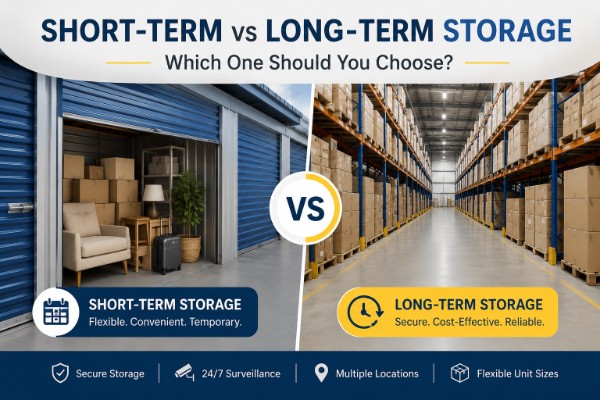
Storage Unit vs. Warehouse:
Which One Should You Choose?
These terms are
often used interchangeably, but the best option depends on what you need the
space to do.
|
Requirement |
Storage Unit / Self Storage |
Warehouse |
Best Fit |
|
Household belongings |
Excellent |
Usually more than needed |
Household storage |
|
A few cartons / personal items |
Excellent |
Poor fit on cost |
Self storage |
|
Office overflow |
Good |
Good for larger volume |
Business storage |
|
Growing inventory |
Possible |
Better scalability |
Business warehousing |
|
Pallets / high volume |
Usually limited |
Better suited |
Warehouse / industrial |
|
Daily pick-pack-dispatch |
Not ideal |
Better suited |
E-commerce warehousing |
The mistake is
choosing based on the word 'warehouse' or 'unit' alone. Choose based on volume,
access frequency, handling needs and how quickly your storage requirement may
change.
If your
business is at the larger end of the spectrum, Lozy's warehouse and godown
options are a better place to compare capacity and service
requirements.
What Should You Look for
Before Renting a Storage Unit?
·
Security: Ask about CCTV
coverage, access control and who can enter the storage area.
·
Access: Confirm access hours,
loading arrangements, lifts, trolleys and vehicle access.
·
Cleanliness and pest control:
This matters for furniture, textiles, documents and household items.
·
Flexibility: Check whether you
can change your unit size or storage duration.
·
Billing: Understand the monthly
price, deposits, taxes, notice period and any additional fees.
·
Protection and insurance: Ask
what is included and what coverage you need for valuable belongings.
·
Unit conditions: Confirm
whether climate-controlled or otherwise controlled storage is available for
items that need it.
·
Prohibited items: Do not assume
every household or business item is acceptable. Ask the provider for its
current list.
Lozy highlights
monitored facilities, controlled access, flexible plans and monthly billing.
You can review its current storage and warehousing services before
booking.
How to Make a Storage Unit
Easier to Use
·
Label boxes on more than one
side.
·
Keep an inventory of what is
stored and where it is placed.
·
Put frequently needed items
near the front.
·
Disassemble furniture when safe
and practical to save floor space.
·
Use sturdy, similarly sized
cartons for better stacking.
·
Keep heavy items low and
fragile items protected.
·
Avoid storing damp belongings;
moisture trapped in packaging can create problems over time.
·
Leave a small access path when
you expect regular retrievals.
·
Review stored items
periodically so unused belongings do not become a permanent monthly expense.
How Much Storage Space Do You
Actually Need?
Do not choose a
storage unit based only on the number of boxes. Large items beds, wardrobes,
sofas, refrigerators, office furniture and equipment—usually determine your
minimum footprint. Make a quick inventory, separate bulky items from cartons,
and estimate how often you need access.
Lozy's current
household guidance shows storage ranges by household size, from compact 25-50
sq ft requirements for a 1-2 bedroom apartment to larger ranges for bigger
homes. Its Dwarka facility also currently lists units from 25 sq ft to 200 sq
ft. These are useful starting points, but your actual requirement depends on
the size of your belongings and how they are packed.
For a more
location-specific option, see Lozy's self storage in Dwarka.
Is Renting a Storage Unit
Cost-Effective?
It can be but
only when the space solves a real problem. Compare the monthly storage charge
with the alternative costs you would otherwise face: a larger home or office,
extra transport trips, temporary furniture rental, business premises expansion,
or replacing items you cannot safely keep where you are.
Also compare
total cost, not just the headline rent. Ask about deposits, pickup or delivery
charges, access fees, insurance, packing, taxes and other services. For
businesses, add the cost of transport and labour because a cheap storage site
far from customers or staff can be expensive operationally.
Final Takeaway
Renting a
storage unit makes sense when you need space without making a permanent
commitment to a bigger home, office, shop or warehouse. The strongest use cases
are straightforward: a move with a timing gap, a renovation, a cluttered home,
excess business stock, a temporary relocation, seasonal belongings, or a major
life change.
The best
storage decision is not simply about finding the cheapest unit. Look at the
amount of space you need, how often you need access, what you are storing, how
long you expect to store it, and what level of security and service matters to
you.
For flexible
personal or business storage, explore Lozy's storage solutions and request a
quote based on your actual storage requirement.
Need warehousing or storage in India?
Request a free, tailored quote in under 2 minutes — free pickup, no lock-in.