Best Storage Practices for Pharmaceutical Products: A Complete Pharmaceutical Warehousing Guide
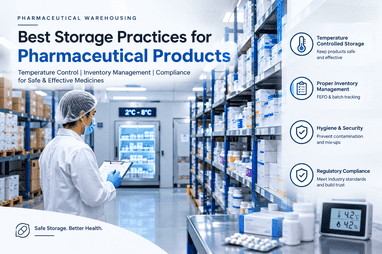
Proper pharmaceutical warehousing
is critical for protecting medicines, healthcare products and related inventory
from temperature excursions, excess humidity, light exposure, contamination,
damage and stock-control errors. A pharmaceutical warehouse is not simply a
large room with racks. It needs clearly defined storage conditions, disciplined
inventory processes, trained staff, documented procedures and monitoring
systems that match the requirements of the products being stored.
For businesses comparing business warehousing
options, the right facility should be selected based on product requirements,
storage volume, turnover, access, security and operating processes. The goal is
to keep products within their specified conditions from receipt to dispatch
while making inventory easy to identify, inspect and rotate.
Quick Answer: What Makes Pharmaceutical Warehousing
Different?
Effective pharmaceutical warehousing
combines temperature and humidity control where required, suitable shelving,
FEFO-based stock rotation, segregation of damaged or quarantined products,
hygiene and pest control, controlled access, monitoring and accurate records.
The exact controls depend on the product label, manufacturer requirements and
applicable quality or regulatory obligations. WHO guidance and India's Schedule
M both emphasize appropriate storage conditions, monitoring, segregation and
orderly warehousing practices.
1. Maintain the Right Temperature for Pharmaceutical Storage
Temperature is one of the biggest risks in pharmaceutical
storage. Different products can have different storage
requirements, so the warehouse should never use one generic temperature
assumption for every SKU. Storage conditions should follow the approved product
information and manufacturer instructions.
A robust temperature-controlled warehousing
process can include calibrated data loggers, defined monitoring points, alarms
or alerts, documented excursions and procedures for investigating out-of-range
events. Temperature mapping is also important in controlled environments
because a single thermostat reading does not prove that every part of a storage
area stays within the required range. WHO states that temperature mapping and
monitoring are integral to appropriate pharmaceutical storage and recommends
regular mapping for warehouses where applicable.
2. Control Humidity, Light and Airflow
Temperature gets most of the attention, but
pharmaceutical storage also depends on controlling other environmental factors.
Excess humidity can damage some packaging and products, while direct sunlight
can affect light-sensitive items. Warehouses should therefore minimise exposure
and provide sufficient space between stored goods, walls and other structures
to support ventilation, inspection and cleaning.
Products should remain in appropriate
protective packaging until they are needed for picking or dispatch. A storage
area should be clean, dry and organised, with environmental conditions reviewed
against the requirements of the products rather than against a generic
warehouse standard.
3. Use FEFO for Pharmaceutical Inventory Management
Expiry control is a central part of pharmaceutical inventory management.
In many pharmaceutical operations, FEFO (First Expiry, First Out) is more
useful than relying only on FIFO because the products with the nearest expiry
can be prioritised for distribution, subject to the organisation's procedures.
An organised inventory system should
capture the product name, batch or lot number, expiry date, storage location,
quantity, stock status and movement history. Barcode or digital inventory tools
can reduce picking mistakes and make it easier to locate individual batches.
For businesses that need structured stock
handling, Lozy's inventory
warehousing offering supports barcode-based inventory
visibility, organised storage and flexible access. The exact service
suitability for regulated pharmaceutical products should still be confirmed
against the products and the customer's quality requirements.
4. Segregate Quarantine, Recalled, Damaged and Expired Products
Usable inventory should never be mixed
casually with products that are damaged, returned, recalled, expired or
awaiting a release decision. A controlled pharma
warehouse should define physical or system-based status controls so
employees can immediately tell what can be picked and what cannot.
Common storage statuses include available
stock, quarantine, rejected stock, returned stock and expired stock. India's
Schedule M requires clear segregation for quarantine and for rejected, recalled
or returned materials or products, with restricted access where applicable.
This is not just an organisational preference; it is a core risk-control
practice.
5. Keep the Pharmaceutical Warehouse Clean and Pest-Controlled
A clean warehouse helps protect packaging,
labels and product integrity. Cleaning procedures should cover floors,
shelving, handling areas, waste removal and spill response. Pest-control
measures should be documented, and food, drinks and smoking should be kept out
of pharmaceutical storage areas.
Stored products should remain off the floor
and should be positioned so staff can inspect and clean around them. Pallets,
racks and storage fixtures should also be maintained in a condition that does
not create avoidable contamination or damage risks.
6. Use the Right Racking and Warehouse Floor Plan
Space planning affects both product safety
and operational efficiency. A warehouse for pharmaceutical products should have
clear aisles, labelled storage locations, accessible batch positions and
adequate separation between different stock categories. The layout should
support receiving, put-away, picking, checking and dispatch without creating
unnecessary product movement.
If you are comparing storage models or
facility sizes, Lozy's guide on how to choose
the right warehouse storage solution for your business can help
with the broader space-planning decision. For large-volume operations, the same
principle applies: buy or rent space based on workflow and inventory needs, not
square footage alone.
7. Maintain Controlled Access and Warehouse Security
Pharmaceutical inventory can have high
financial and operational value, so access control matters. A secure pharmaceutical warehouse should define
who can enter storage areas, who can handle inventory and how movement is
recorded.
Useful controls can include CCTV
monitoring, unique access credentials, visitor procedures, restricted areas for
sensitive stock and incident reporting. Lozy highlights 24/7 CCTV, controlled
access and monitored facilities across its warehousing model. Businesses
handling regulated products should still confirm the exact controls and service
scope required for their inventory before booking.
8. Monitor, Record and Review Storage Conditions
Monitoring without records is incomplete. A
strong pharmaceutical storage system
should retain temperature and other relevant environmental records according to
the applicable procedure. Devices should be maintained or calibrated as
required, and staff should know what to do when a reading falls outside the
defined limit.
Electronic monitoring can make this easier
by generating alerts and creating a traceable history. For cold-chain products,
the control process should extend beyond the storage room to packaging, staging
and transportation where applicable. WHO guidance emphasises appropriate
environmental control and documentation across pharmaceutical storage and
distribution.
9. Train Staff and Control Receiving and Dispatch
Employees handling pharmaceutical inventory
should understand FEFO, product segregation, environmental monitoring, hygiene,
documentation and escalation procedures. Receiving teams should verify shipment
details, packaging condition, batch information and storage requirements before
products enter stock. At dispatch, the correct batch should be selected and the
required storage conditions maintained until handover. Written SOPs and
refresher training help make these controls consistent.
Can a Regular Warehouse Store Pharmaceutical Products?
Not automatically. A standard warehouse may
provide secure space and shelving but still be unsuitable for medicines that
require controlled temperature, humidity, cold-chain handling or stricter
segregation. The correct answer depends on the product requirements and the
controls the facility can reliably provide.
Before choosing a warehouse for pharmaceutical products, ask whether the facility can
provide the required environmental conditions, monitoring, access control,
inventory visibility, hygiene and documentation. The cheapest space is not the
cheapest option if product damage, expired stock, compliance issues or
fulfilment errors follow.
Choosing a Flexible Warehousing Partner
Lozy offers flexible business and inventory
storage options for organisations that need scalable space, monitored
facilities, controlled access and monthly plans. For pharmaceutical inventory,
the service should be assessed against the products’ exact temperature,
segregation, monitoring, handling and documentation requirements. Businesses
can review Lozy’s warehousing services or use
the contact page to discuss
inventory type, volume, access and storage requirements.
Pharmaceutical Warehousing Checklist
·
Product-specific temperature
and humidity requirements are documented.
·
Temperature monitoring and
mapping are implemented where required.
·
Products are protected from
direct sunlight, moisture and contamination.
·
FEFO is used for appropriate
inventory rotation.
·
Batch, lot, expiry and
stock-status information are traceable.
·
Quarantine, rejected, recalled,
returned and expired products are segregated.
·
Storage areas are clean, dry
and protected from pests.
·
Products are kept off the floor
with adequate inspection and cleaning space.
·
Access to storage areas is
controlled and monitored.
·
Receiving, picking and dispatch
procedures are documented and followed.
·
Staff are trained on SOPs,
hygiene, monitoring and escalation procedures.
Suggested Reads from Lozy
·
How to Choose
the Right Warehouse Storage Solution for Your Business
·
On-Demand
Warehousing in India: How It Works & Pricing
·
Godown vs
Warehouse vs Self-Storage: What’s the Difference?
Need warehousing or storage in India?
Request a free, tailored quote in under 2 minutes — free pickup, no lock-in.