Document Storage Guide: Archiving Records, Boxes and Retrieval (2026)
Short answer: Document storage is off-site, indexed archival storage for business records — invoices, contracts, employee files, client and patient records — kept in boxes that are logged on arrival and found again by their number. At Lozy it starts at ₹49 per box per month, and the final rate depends on how many boxes you keep, how long you keep them and how often you need them back. The rule of thumb: if a record exists to prove something later rather than to work on this week, it belongs in the archive.
Key takeaways
- Priced per box, not per square foot. At Lozy it starts at ₹49 per box per month, so the bill follows what you keep rather than the room the paper used to occupy.
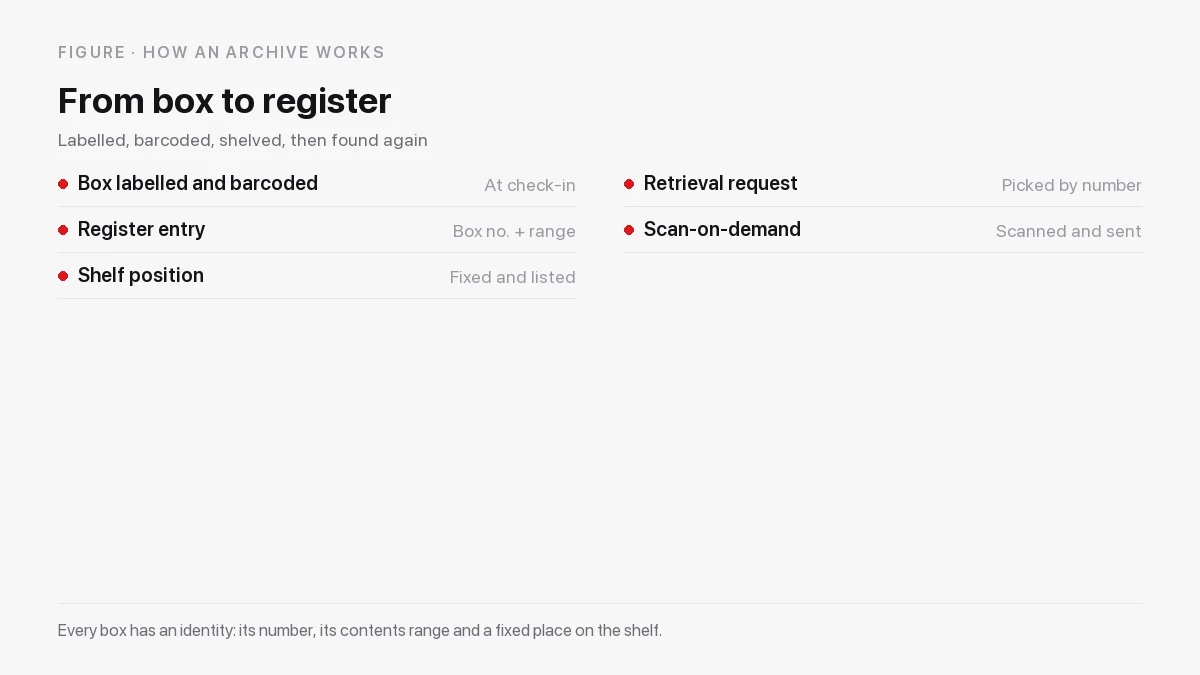
- Every box is labelled and barcoded at check-in and held against a register, so a request is picked rather than hunted.
- Retrieval works two ways: scan-on-demand sends the pages while the box stays in place, or the box itself is delivered across Delhi NCR.
- Records carry statutory retention periods and privacy duties, so an indexed archive with documented shredding is a compliance tool, not just storage.
- Lozy runs 77+ warehouses and more than 1M+ sq ft of live space across 9 city hubs — Delhi NCR, Jaipur and the surrounding NCR belt.
What document storage actually is
Document storage is archival storage for paper: an off-site, indexed place where business records are held in boxes, listed in a register and produced again on request. What changes is not the records. What changes is that they stop occupying your best floor space and start being findable — the only thing an office actually needs from an old file.
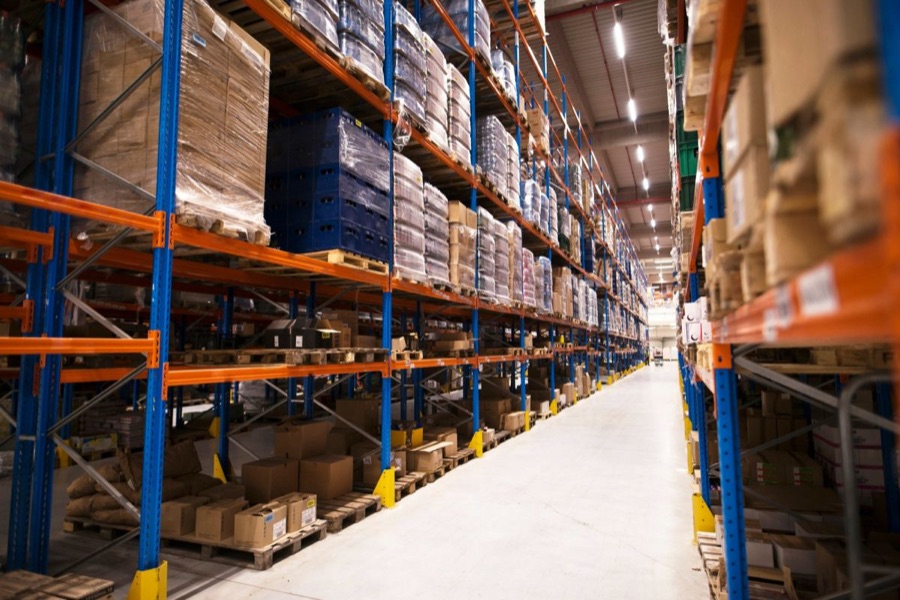
There are three parts. The physical store: access-controlled, fire-safe units where boxes sit on shelving, not on a damp floor. The index: the register recording what each box holds, which number it carries and where it sits. And the service layer: retrieval on request, plus scan-on-demand for when you need a page rather than a box. A room of boxes without the index is not an archive.
It is also a different product from a walk-in unit. In a self storage unit you hold the key and do the carrying; here the register holds the description and a request goes to a numbered box rather than a search.
What counts as a record worth archiving
Most businesses keep more paper than they need on hand and less than they need on record. The test is not age, and it is not the cost of the filing cabinet. The test is whether a document has a job to do later: prove a payment, settle a dispute, satisfy an inspection, answer a notice, or show a trail to an auditor.
The paper that ends up in an archive looks similar across industries — invoices and purchase orders once the payment cycle closes, contracts and renewals, employee files for people who left years ago, client files for finished work, patient records retained for the required period, and KYC and loan documentation.
Sort quickly into three tiers. Active records are needed this week or this month and stay in the office. Statutory records must exist for a defined period and be producible on demand — the natural residents of an indexed archive. Evidence-only records are held in case a question is ever asked; many never need storing at all, only scanning once and then shredding under a documented process.
Who uses archive storage for records
Demand comes from organisations where paper accumulates by law, by client obligation or by transaction volume. Chartered accountants and tax practices hold client files across assessment years, and a practice with a few hundred clients outgrows its shelving quickly. Law firms manage case papers and court records: the matter goes quiet, the physical record does not.
Hospitals and clinics retain patient records for the required periods, where documented custody and documented destruction matter more than shelf space. Banks and NBFCs hold KYC and loan files, pulled only for verification or audit. HR departments keep former-employee records. Schools, colleges and housing societies keep admission archives, often needed decades later.
The pattern is consistent. The organisation does not want less paper; it wants the paper out of the way, still present and still findable. That is the job of Lozy document storage.
The box, the label and the register
Everything about document storage prices and behaves around one object: the box. It is the unit of cost, the unit of retrieval and the unit of the register. Standard archive boxes are labelled and barcoded at check-in, and each is given a position in the register.
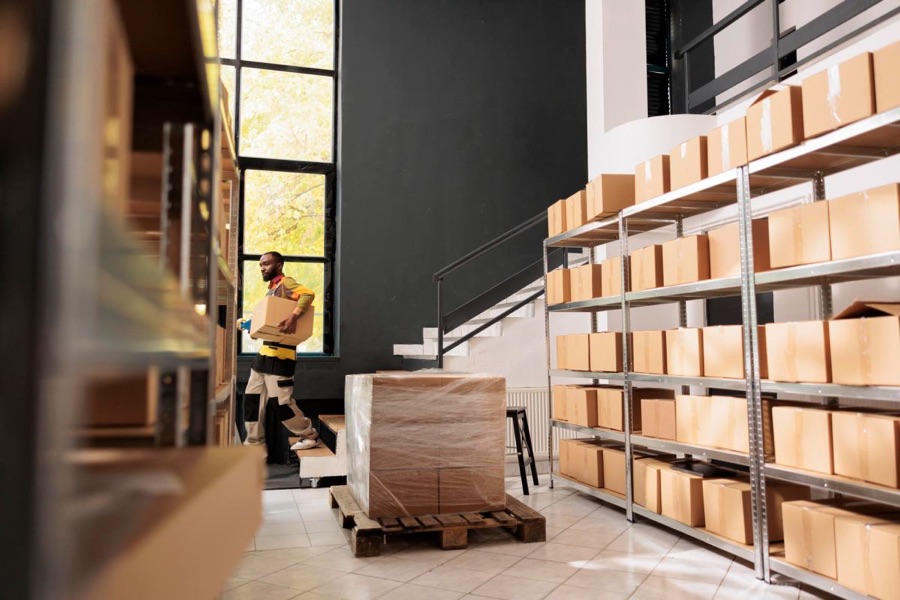
Check-in is where an archive is either built or lost. Boxes arrive, are counted against the collection note, labelled, barcoded and shelved against an entry covering years, departments or client ranges. That register is the difference between a warehouse and an archive: a request is picked from it, not searched for on the floor. The right box comes out, with no search party and no opening six cartons to find one invoice.
Every retrieval writes back to the register, so the next person looking for the same file sees when it was last pulled and why.
Scan-on-demand, and when it beats a delivery
Most requests are not requests for a box. They are requests for a page, a section, or a two-page annexure somebody needs to send onward. Scan-on-demand exists for that gap: the pages you need are digitised and sent, and the box never leaves its place in the register.
It is faster than a delivery and keeps the archive intact when several people are chasing parts of one file.
Retrieval in practice
A retrieval request should end with the document in hand, not with an apology. The file is somewhere in the building, and finding it costs an afternoon of somebody senior.
| What you need | How it is served | When it fits |
|---|---|---|
| One page or a short section | Scan-on-demand, sent to you | Verification, a notice, a copy to forward |
| A specific document set | Pages scanned from the box | Audit sampling, client queries |
| The original, in hand | Box picked and delivered | Court, inspection, statutory production |
| A whole year of records | Multiple boxes, scheduled | Full-scope audit or a handover |
Ask for retrieval and scan pricing alongside your storage quote. A per-box rate is only half the arithmetic; how often you pull the box is the other half. Start at the document and archive storage page.
Retention, destruction and the audit trail
Records carry statutory retention periods and privacy duties, and where they are kept matters the day an inspection or an audit arrives. Two questions decide whether your archive helps you that day. Can you produce a record on demand, with a date and a description, rather than a plausible story about a cupboard? And can you show that a batch was destroyed at the right time, by a documented process, and not simply lost?
Retention support is the discipline behind the register: schedules are honoured so nothing is destroyed early and nothing is kept overlong. The first is a compliance failure; the second is a cost and a privacy exposure that grows every year.
When a batch's period ends, confidential shredding closes the loop — the records go, and the fact that they went is recorded. An office that shreds without a record cannot prove destruction; an office that never shreds is holding documents it has no right to hold.
What document storage costs
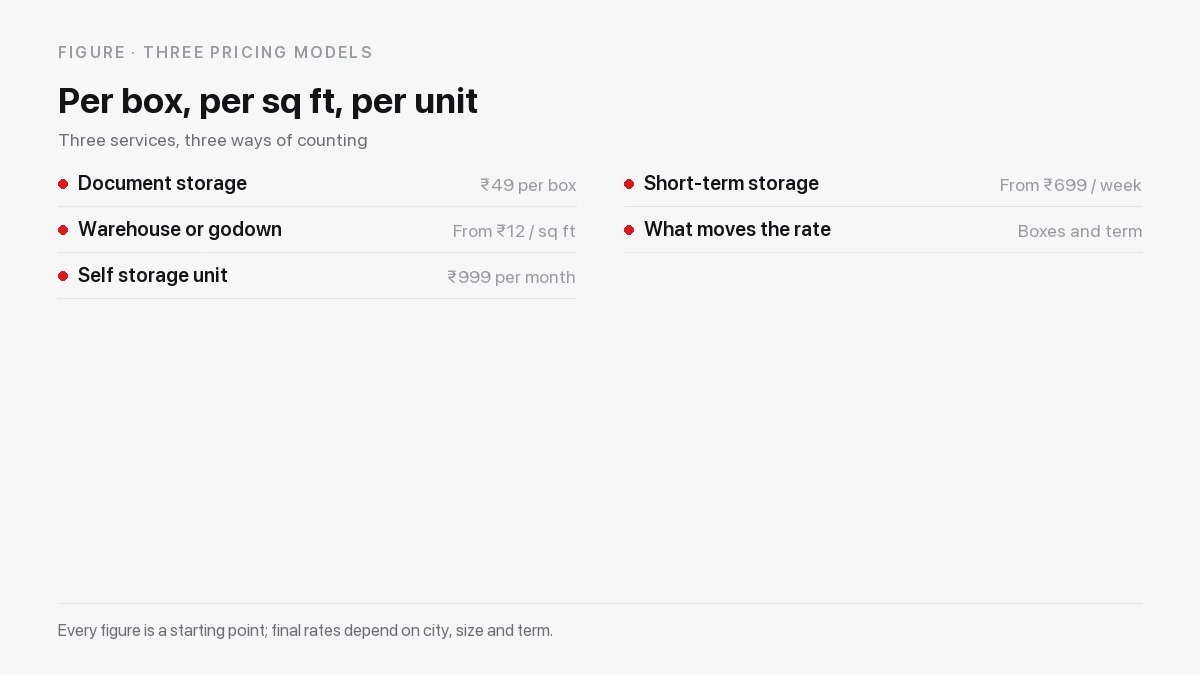
Document storage at Lozy starts at ₹49 per box per month. It is priced per box, so the cost scales with what you actually keep rather than the size of the room you were renting. Ask for retrieval and scan pricing alongside your quote; final rates depend on the number of boxes, the term and how often they are pulled.
The three starting prices on lozy.in answer three different needs. Warehouse and godown space starts at ₹12 per sq ft per month, built for pallet-scale goods. Self storage starts at ₹999 per month for a lockable unit you open yourself. Document storage starts at ₹49 per box per month — a third model entirely, an indexed managed archive where the operator holds the box and the register.
Compare that with the rent of the room the paper occupies, the risk one damp monsoon poses to a decade of records, and the hours lost every time an old file is hunted down.
What actually moves the per-box rate
Four things decide the bill, and only two are about your paper.
- How many boxes you keep. The main lever, and the one you control. Boxes a third full are the most common avoidable cost in any archive.
- The term. Records usually stay for years, and longer arrangements generally price better per box per month than a rolling monthly arrangement.
- How often you retrieve. Retrieval and scan-on-demand are services, not storage. A quiet archive is cheaper to run than an active one.
- Which facility. Rates vary by city and by facility, the way any rent does — and a facility on the wrong side of the city is one you will not use.
There is a fifth factor: how well the box is filled and described. Short-term storage suits a batch that only needs to sit for a few weeks.
Per box against the room the paper used to occupy
The comparison that decides most of these projects is not between two storage vendors. It is between storing the paper and housing it yourself.
| What you are comparing | In-office paper | Indexed archive |
|---|---|---|
| Pricing basis | Rent of the floor area it occupies | Per box per month, from ₹49 |
| Finding a file | An afternoon, by whoever is free | Picked from the register |
| Damp and pest risk | One monsoon away | Monitored, clean, dry storage |
| Confidentiality | A storeroom lock | Controlled access, written trail |
| End of retention | Undocumented disposal | Confidential shredding, recorded |
Only one row is a price and the rest are costs, which is why the in-office column rarely reaches the accounts. Where furniture moves with the records, the office warehousing route covers both.
Preparing files and deciding what to scan
Records arrive in whatever the office has: steel cupboards, shelf piles, old cartons with masking tape and hope. Giving every box an identity is work you do once.
Use banker boxes or sturdy cartons, packed flat and never overfilled, so the lid closes level and the box survives handling. Write a serial number and the range it covers on two sides — years, departments, client ranges — so it reads from the shelf without being pulled out. Keep a master index sheet with your own team, mirroring the register the operator keeps. Leave behind anything damp, mouldy or pest-damaged, because paper problems spread in storage.
Deciding what to store is its own pass, and it is where the cost comes down. Active files stay in the office, statutory records go to the archive against their schedule, and anything needed only as evidence is often better scanned once than stored for years. Originals of anything signed or stamped stay; routine correspondence, printouts and duplicate copies usually need no storage at all. The document storage page describes the same preparation.
Why off-site beats office cupboards
Every office pays for its paper in ways the accounts never itemise. Cupboards in prime floor space. A failing lock on a storeroom door. The slow sort-through every time an old file is needed. The file that is present but unfindable, which is the worst of both worlds.
Document storage moves the paper, and the problem, out. The shelf space comes back and becomes desk space, meeting space, or simply a room that works. The rest stays listed, monitored and retrievable instead of merely present.
The switch is rarely regretted, because the one thing an office needs from old records — the ability to produce them — survives the move intact. Everything else about them was only ever square footage. If you want a lockable space you visit yourself rather than a register, that is personal storage.
Compliance, privacy and the day an audit arrives
Records carry statutory retention periods and privacy duties, and both are easier to satisfy when the archive is indexed. The audit conversation changes shape when finding the 2019 contract becomes a request rather than an afternoon,
Two habits make that easy. Keep the register current, so every box has a description and a position. And keep destruction on schedule, so the archive only ever holds documents you are entitled to hold.
For businesses, the frame is worth knowing in outline. Storage rent attracts GST, and a registered business can claim input credit on it, so ask for a proper tax invoice. If the records relate to imported goods held before duty is paid, that is a different regime — duty-deferred storage under customs law, administered by the Central Board of Indirect Taxes and Customs — and customs bonded warehouse covers that route. Smaller firms will find the Ministry of MSME the official starting point, and government services sit on the National Portal of India.
Where Lozy runs document storage
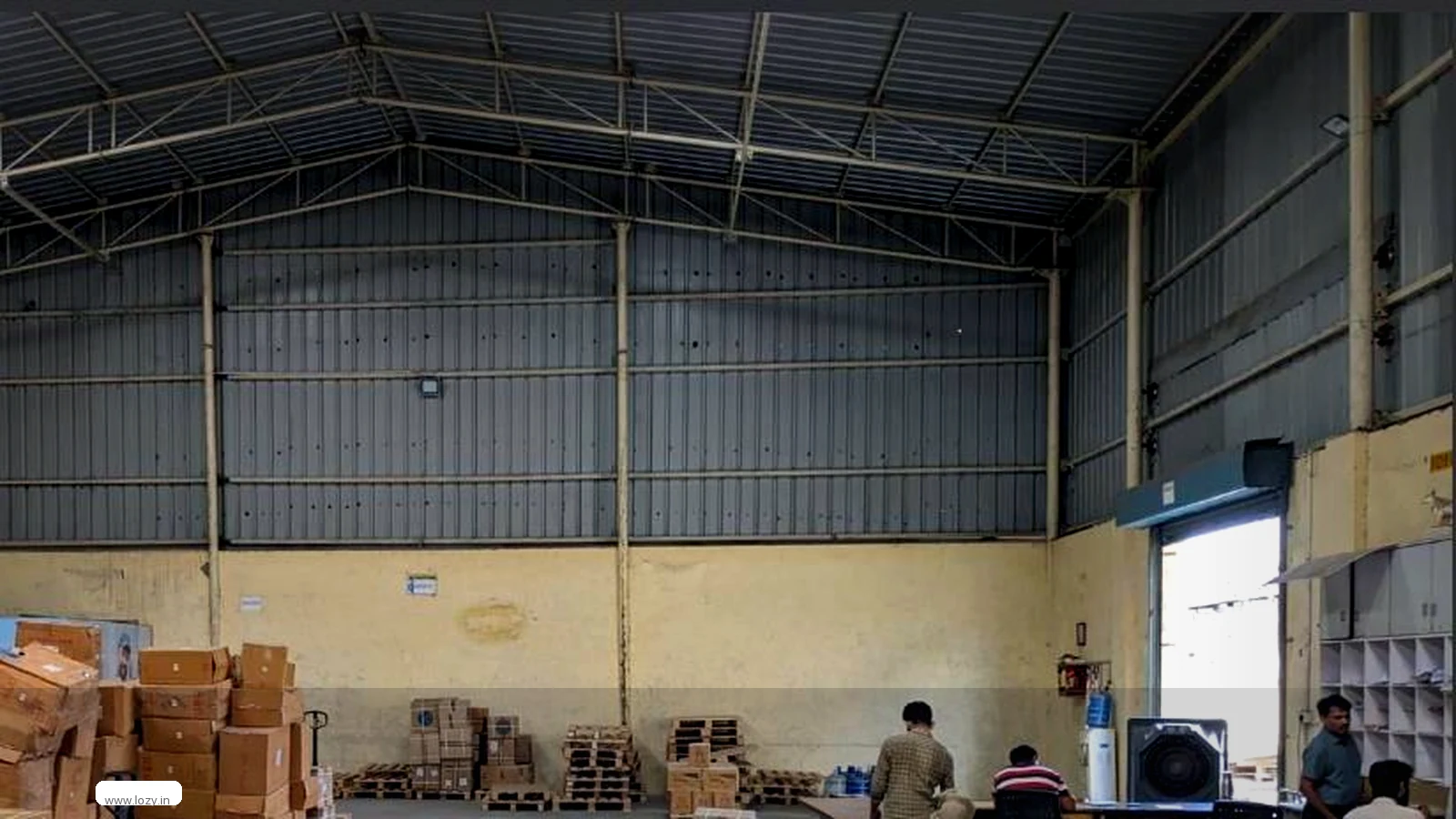
Lozy runs 77+ warehouses and more than 1M+ sq ft of live space across 9 city hubs — Delhi NCR, Jaipur and the surrounding NCR belt. Document storage follows that network rather than sitting in one building, and boxed records are collected across Delhi NCR.
The facilities you can point to today include Lozy Jamalpur Distribution Center in Haryana; Self Storage for Home and Business in Dwarka Sector 26 and Self Storage Unit in Dwarka Sector 27 in New Delhi; Warehouse in Dwarka for Business and 3PL, Warehouse in Ghevra Metro - Lozy Warehousing Company and Warehouse in Ghevra Metro 2 - Lozy Warehousing Company, both in New Delhi; Factory and Warehouse Space in Faridabad (DLF Industrial Area 2) in Haryana; Warehouse in Manesar Sector 8, Warehouse in Manesar Sector 8 (Shedded), Warehouse in Manesar M-Zone, Sector 9, Warehouse in Manesar, Gurugram, Warehouse in Kherki Daula, Gurugram and Warehouse in Gurugram for Business and 3PL in Gurgaon; and Storage Space in Jaipur.
Location matters more than it sounds. An archive on the wrong side of the city turns retrieval into a project. Start from the New Delhi location page, the Gurgaon locations or the Haryana locations, or compare sites on the warehouse listing.
Five mistakes that make an archive useless
Most failed archives fail for the same handful of reasons, and each one is decided before the first box is collected.
- No index. Boxes go into a room and nobody records what is in them. The paper is stored and lost at the same time.
- Vague or unlabelled boxes. Mixed years and departments in one carton make retrieval a guess even when a register exists.
- Sending the working files. Move the live file to storage and the office slows down. The archive is for the tail, not the working head.
- Ignoring retention. Keeping everything forever grows the bill and the privacy exposure every year.
- Choosing on rate alone. A cheap archive on the wrong side of the city is not cheap the day you need a document.
They need a decision at the start, which is why the box specification and the register matter more than the racking.
Moving an existing backlog into the archive
Most projects do not start from an empty shelf. They start from years of paper in cupboards, a loft and a back room, and the sensible instinct is to move it in batches rather than all at once.
Boxed records are collected across Delhi NCR, and a large backlog usually moves over a few visits rather than one. That is a feature, not a delay: sorting a decade of files in a single weekend produces badly described boxes, and badly described boxes are the ones that never get retrieved cleanly.
Start with the oldest closed years, which carry the lowest retrieval risk, and work forward. Keep a running index sheet for your team as boxes leave the office. Once the backlog is in, the archive stays current the way office files always did — new boxes go in as they fill, against the same register.
Checks before you hand anyone your records
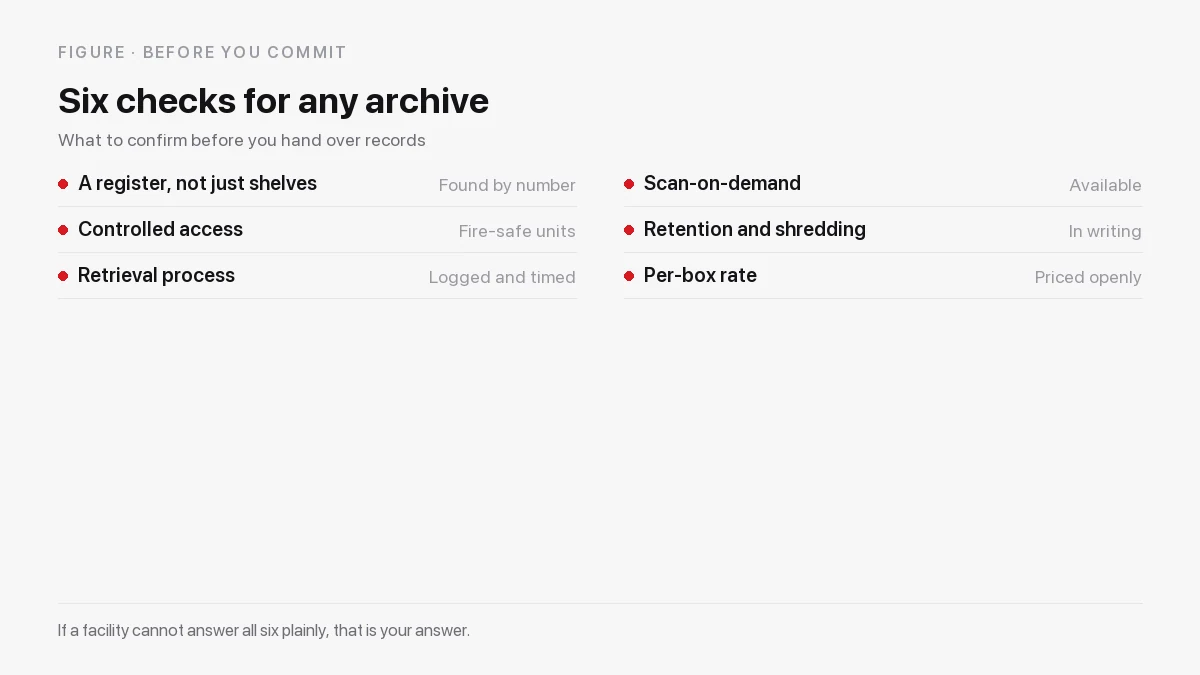
Records are the least negotiable thing a business owns. Whether you book with Lozy or compare options, six checks separate a proper archive from a rented room.
- An index, not just shelving. Ask how a box is described at check-in and how it is found three years later.
- Controlled access and fire-safe units. Records should not sit on an open floor anyone can walk.
- A clear retrieval process. Ask what happens when you request a page, how long it takes, and whether it is logged.
- Scan-on-demand available. If the only answer is that boxes come out, every small query becomes a delivery.
- Retention and destruction in writing. Holds, notice before destruction, and a documented shredding record.
- A per-box rate you can reason about. Retrieval and scanning priced transparently, not bundled invisibly.
If a facility cannot answer all six plainly, that is your answer. The documents storage page sets out the same points, and the wider range sits on the services page.
How Lozy helps
Lozy's document and archive storage is secure record and document archival with retrieval on demand. Records are held in barcoded boxes inside access-controlled, fire-safe units, with scan-on-demand whenever you need a page rather than a box. It starts at ₹49 per box per month, and the final rate depends on how many boxes you hold, the term and how often you pull them.
Practically that means four things. Boxes are labelled and barcoded at check-in and held against a register. Requests resolve either way — pages scanned and sent, or the box delivered across Delhi NCR. Retention schedules are honoured alongside confidential shredding when a batch's period ends. And it all sits inside a network running 77+ warehouses and more than 1M+ sq ft of live space across 9 city hubs.
If you want a lockable space you open yourself, that is self storage. If the paper moves along with the furniture, see household warehousing. If the requirement is pallets and stock rather than records, the warehouse side of the Lozy network is the right start, and the about us page covers who we are.
Storing something, or just comparing?
Tell us what you need to store and where. We reply with availability and a price — usually the same working day.
The bottom line
Document storage is not a cupboard you rent. It is an index with boxes attached: records labelled and barcoded at check-in, held against a register, produced on demand and destroyed on schedule. That is why it returns more than shelf space — the paper comes back as a capability rather than a liability.
Start from ₹49 per box per month, keep the box specification tight, decide early what to scan once instead of storing for years, and choose a facility on the right side of the city. Begin at document storage in Delhi NCR, or browse the Lozy blog for the rest of the warehousing guide series.
About the author
Lozy Editorial Desk. This guide was written by the Lozy Editorial Desk, the in-house team that covers warehousing, self storage, logistics and customs/EXIM topics for lozy.in. We write from Lozy's own facility and pricing information and from public, citable sources; we do not publish invented statistics, ratings or reviews.
Last updated: 11 October 2026. Have a question the FAQ below does not answer? Call +91 93547 12345 or email care@lozy.in.
Need warehousing or storage in India?
Request a free, tailored quote in under 2 minutes — free pickup, no lock-in.