
Short-Term Storage: By the Week, Not the Year (2026 Guide)

Short answer: Short-term storage is secure space booked for weeks rather than years — a week between flats, a month during a renovation, three weeks while the new furniture arrives. At Lozy it starts at ₹699 per week, on weekly or monthly plans with no lock-in, so the storage ends when the gap does. The rule of thumb is simple: if you can name the date you want your goods back, book short-term. If the horizon runs into seasons, a long-term plan will cost less.
Key takeaways
- Short-term storage is space for the in-between moments — a move, a renovation, a semester break, a long trip — billed by the week or the month rather than the year.
- Lozy short-term storage starts at ₹699 per week; the final rate depends on the city, the size and the term you book.
- Plans run weekly when the return date is close and monthly when the gap stretches, with no lock-in, no setup charges and GST billing throughout.
- Free pickup runs across Delhi NCR, with the goods returned on your call once you have landed.
- A mini unit holds a few boxes; the same service scales to a full household's worth, so the plan fits the gap.
- When the horizon moves from dates to seasons, switching to a long-term plan saves real money — one conversation, not a new contract.
What short-term storage is
Short-term storage is secure space booked for a short, known window. A week between two flats. A month while floors and paint are finished. Three weeks while the new furniture makes its way to you. The plan runs weekly or monthly and it ends when the gap ends — that is the entire product.
It is worth being precise about what this is not: not a smaller long lease with an early-exit penalty, and not a friend's spare room with a tarpaulin over the suitcases. It is genuine, monitored storage on the same floors other Lozy customers use, sized and priced for a short horizon rather than a season. The product as it stands is set out at Lozy short-term storage.
The scale runs from a mini unit, enough for a few boxes and a couple of suitcases, up to a full household's worth of furniture. Pickup can be arranged, and everything is returned when you are ready.
By the week or by the month
Two plan lengths cover almost every short gap, and the choice comes down to one question: how well do you know your return date?
A weekly plan is the right call when the return date is close and known — the flat is ready on the 15th, the semester starts on the 20th. A monthly plan suits a longer gap and flexes within the month you are in. Both price the same way, for the space and the time you use, which is why a two-week gap costs like a two-week gap rather than like a quarter.
| What you are comparing | Weekly plan | Monthly plan |
|---|---|---|
| Best when | The return date is close and fixed | The gap is longer and still moving |
| Billing basis | Per week of use | Per month of use |
| If your date moves | Rolls into a monthly plan | Flexes within the month you are in |
| Lock-in | None | None |
| Setup charges | None | None |
| Starting price | From ₹699 per week | Priced the same way, by space and time |
Because there is no lock-in, the two are not a fork in the road: weekly bookings can roll into monthly ones if the gap stretches.
When a short gap needs storage
The reasons people need storage for weeks rather than months are practical, and they arrive all at once.
- House moves with a gap between possession dates, when one lease ends before the next begins.
- Renovation windows — furniture out for a few weeks while floors and paint happen.
- Students between hostels, semesters or cities, moving with a room's worth of belongings and nowhere to put them yet.
- Travel, posting or a long trip where the room will not wait and the lease has already run out.
- Event and exhibition teams storing sets and display stock between shows.
- Sellers staging festive stock before an online sale, holding goods until the sale week opens.
Every one of those situations has the same shape: a date on each end. The goods need somewhere steady to sit between two fixed points.
Who books it, and for how long
The thread running through that list is a known return date. If you can say when you want the goods back, short-term storage is built for you; if you cannot, the plan simply flexes until you can.
The typical booking runs one to six weeks. Past that, the arithmetic starts to lean towards a monthly arrangement, and past a few months towards the long-term side of the site.
What short-term storage costs
Short-term storage with Lozy starts at ₹699 per week. Weekly and monthly plans price the same way — for the space you occupy and the time you use — so a two-week gap costs like a two-week gap, not like a quarter. The final rate depends on the city, the size and the term.
It helps to see the number against the alternatives, because the three starting prices on lozy.in answer three different needs. Self storage starts at ₹999 per month for a private unit you open yourself. Warehouse and godown space starts at ₹12 per sq ft per month for pallet-scale goods. Short-term storage starts at ₹699 per week for the case in between: weeks rather than months, and a return date already on the calendar. The plans themselves are at short-term storage.
Rent attracts GST, and plans are billed with a proper tax invoice, so a registered business can claim input credit on what it pays. Ask for the invoice rather than a receipt, and file it the way you file any other business cost; general government services for citizens sit on the National Portal of India.
What actually moves the price
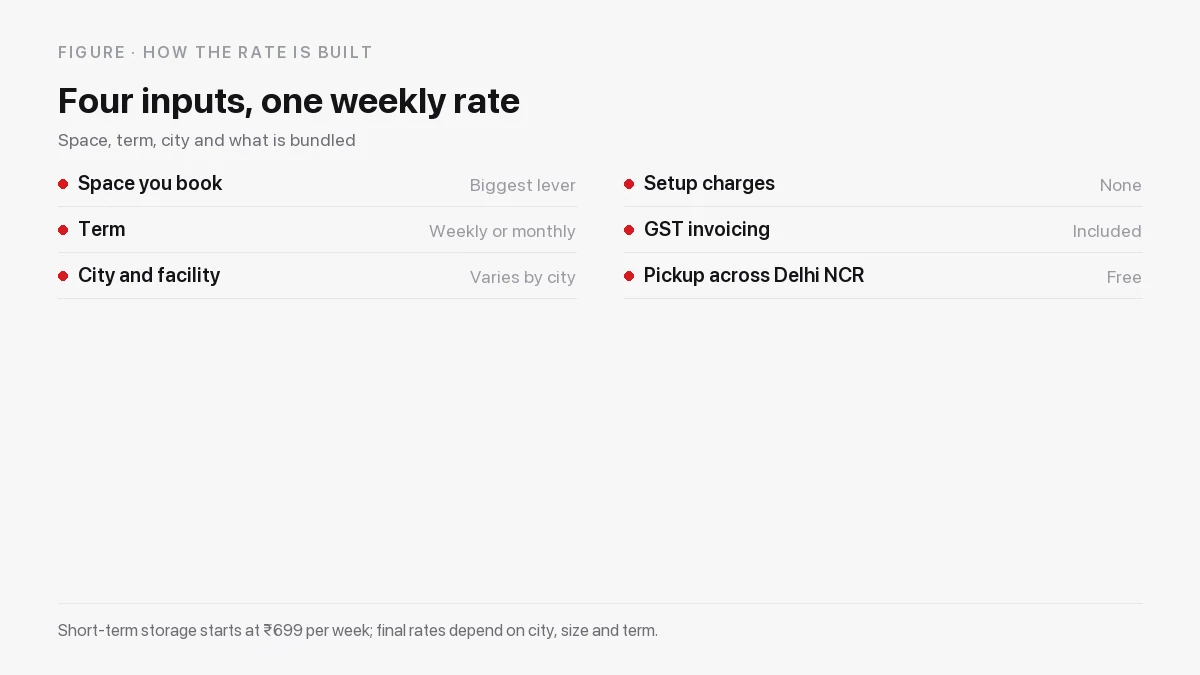
Four things decide what a short booking costs, and only the first is really about your goods.
- The space. A mini unit holding a few boxes costs less than a full flat's worth of furniture. This is the biggest lever you control.
- The term. Weeks price by the week and months by the month, so the length you book changes the rate you land on.
- The city. Rates vary by city and by facility, the way any space rent does.
- What is bundled. No lock-in and no setup charges are part of the deal rather than extras, and free pickup applies across Delhi NCR — but confirm those for any facility you compare, because an unbundled place can look cheaper and cost more in total.
The mistake that inflates a short bill is rarely the rate. It is booking a space too small to use: the goods come back out and get moved twice, and that second move costs more than the next size up would have.
Short-term and long-term: where the line sits
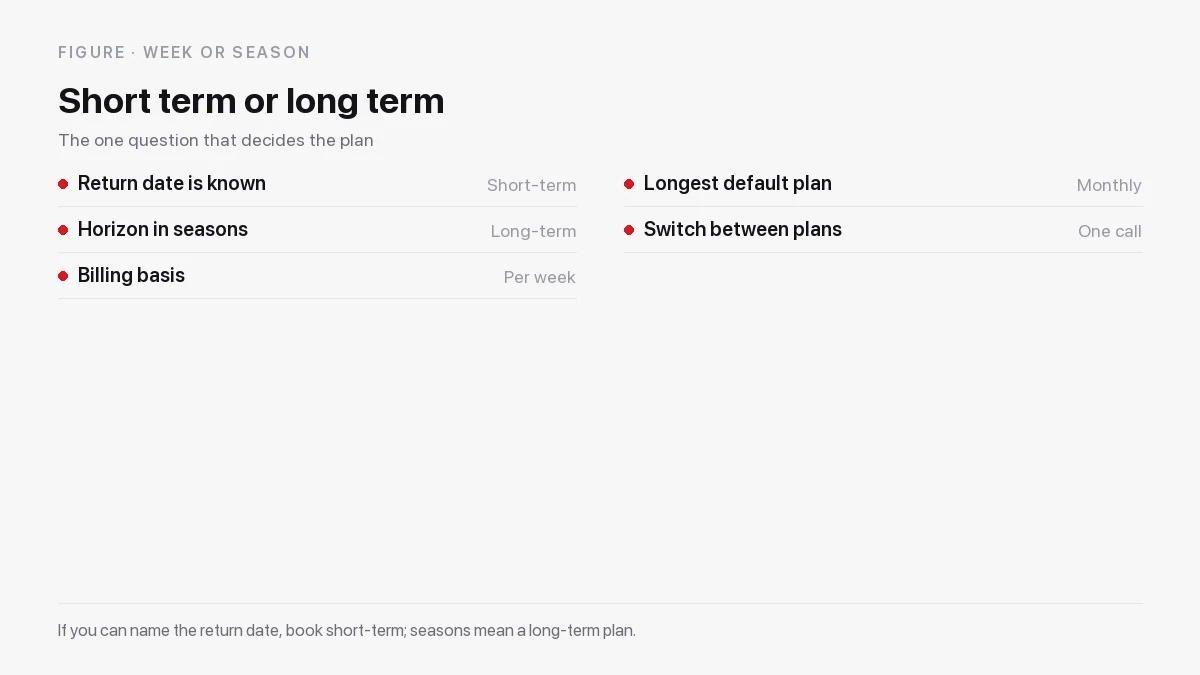
Most short-term bookings come with a date attached: the flat is ready on the 15th, the renovation ends in August. When that date moves — and it moves often — the plan flexes rather than rolling into a penalty. Weekly bookings can roll into monthly ones if the gap stretches, and the change is a conversation rather than a new contract.
The line people cross without noticing is the horizon. Dates are short-term; seasons are not. If the return date stops being a date and starts being "sometime next year", you are paying short-term rates for a long-term need, and a long-term warehousing plan will save real money. The switch stays on the same network, so it is one conversation rather than a move to a stranger.
A rough rule holds up: weeks or a month or two means stay short-term; seasons means look at the long-term side.
Short-term storage vs self storage and a warehouse
Self storage is a private lockable unit you rent by the month and open yourself — the fit when the term is open-ended and you want walk-in access to your own goods. Warehouse space is priced per square foot for pallet-scale trade stock. Short-term storage is the one built around a known, near return date, with collection and redelivery on a short clock.
| What you are comparing | Short-term storage | Self storage unit | Warehouse or godown |
|---|---|---|---|
| Typical term | Weeks to a couple of months | Month to month, open-ended | Months to years |
| Pricing basis | Per week, or per month | Per unit per month | Per sq ft per month |
| Starting price | From ₹699 per week | From ₹999 per month | From ₹12 per sq ft per month |
| Goods it suits | A room's worth up to a full household | Boxes, cupboards, personal belongings | Pallets, cartons in the hundreds, trade stock |
| Access | During access hours, or goods brought out | Your own access, any day | Managed, with dispatch by the operator |
| Who handles the goods | We collect and redeliver, or you drop off | You | The facility team |
Read the table by the first row: weeks means short-term, months with walk-in visits means a unit, pallets means a warehouse. The whole range sits together on the Lozy services page.
Choosing the space for a short gap
Size is the decision most people get wrong on a short booking, and usually in the same direction: they book small to save a little, then find they cannot reach anything without unpacking half the space.
Lozy short-term storage runs from a mini unit — a few boxes and suitcases — up to a full household's worth of furniture. The quickest way to land on the right size is not to estimate anything in your head. Tell us your big items — beds, sofas, fridge, washing machine, cycles — and let the space be matched around them, with room left to walk in and pull things out.
Say also how you want the goods to move: collected from your address, or dropped off by you. Free pickup runs across Delhi NCR, and redelivery follows when you call for the goods back. And say whether the volume might grow, because starting one size up is cheaper than moving twice. The available space is described at short-term storage.
Packing for a short window
Short storage changes one piece of packing advice: what you might need comes out first, and everything else can be packed properly for the weeks ahead.
- An open-first box stays with you — chargers, documents, a change of clothes, the kettle.
- Label boxes by the room they will land in, not the room they left.
- Pack the slow items deep and the maybe-items by the door of the unit.
- Keep the inventory list on your phone, not in a box you cannot reach.
A week or a month passes quickly, so pack the light things to the ceiling and keep a walkway to the back.
The open-first box, in practice
Build it the night before the goods go out, not on the morning. Everything you would reach for in the first seventy-two hours belongs in it: chargers, medicines, documents, a change of clothes, toiletries, and whatever the first week of cooking needs. Keep it out of the pile, because on a short booking the pile is leaving and the box is staying.
Label by destination room — kitchen, bedroom, study — so the first boxes you open settle the room you are standing in. Where heavy furniture is mixed into the load, household warehousing handles the bulky items a short booking otherwise leaves to you.
Week one: how a short booking runs
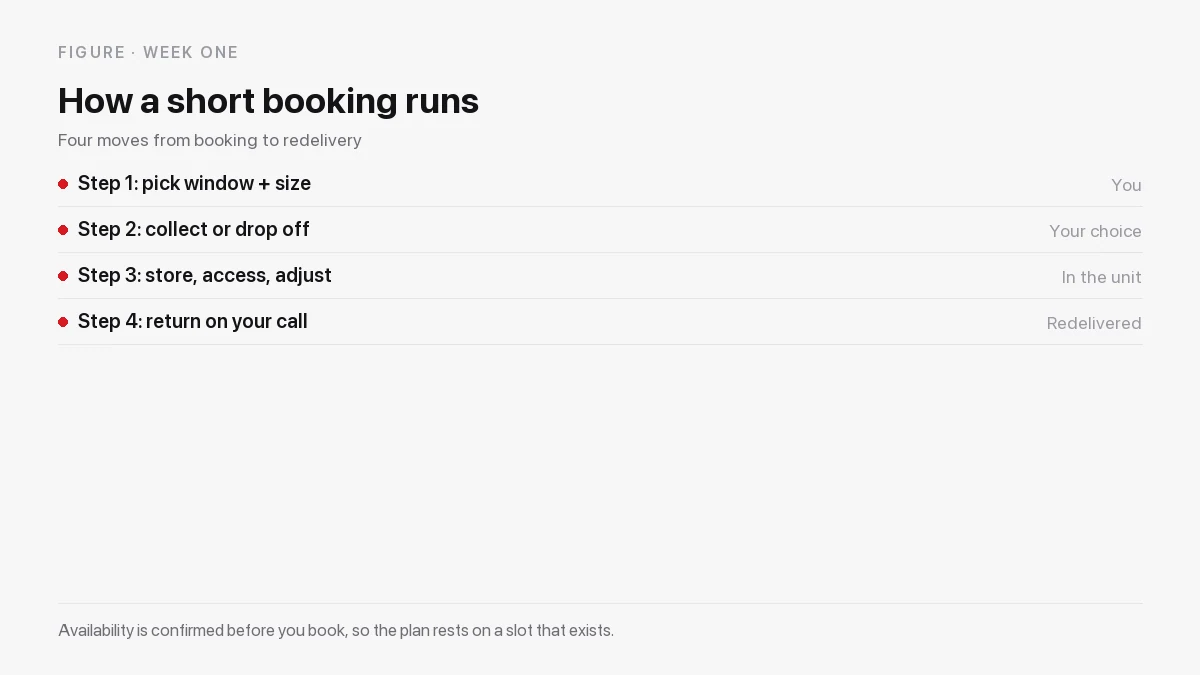
When the gap is already open, the booking conversation is short and specific, and it happens in four moves.
- Pick the window and the size — a few boxes or a full flat's worth, with the dates on each end.
- We collect, or you drop off — whichever the week allows, with free pickup across Delhi NCR.
- Store, access, adjust — reach into the unit during access hours, or ask for items to be brought out.
- Return on your call — redelivery wherever you have landed, when you are ready for it.
Availability is confirmed before you book. When you get in touch at book short-term storage, four details keep it quick: the dates the goods leave and return, the volume you are storing, any access constraints at the pickup address such as lift timings, parking and hours, and the address the goods should come back to.
Where Lozy has short-term storage
Lozy runs 77+ warehouses and more than 1M+ sq ft of live space across 9 city hubs — Delhi NCR, Jaipur and the surrounding NCR belt. Short-term availability follows that network rather than sitting in one building, so the practical question is which facility is on your route.
The facilities you can point to today include Self Storage for Home and Business in Dwarka Sector 26 and Self Storage Unit in Dwarka Sector 27 in New Delhi; Warehouse in Dwarka for Business and 3PL, Ghevra Metro and Ghevra Metro 2 in New Delhi; Warehouse in Manesar Sector 8, its shedded site at Manesar Sector 8, Manesar M-Zone Sector 9 and Kherki Daula in Gurugram; the Factory and Warehouse Space in Faridabad (DLF Industrial Area 2) in Haryana; Lozy Jamalpur Distribution Center in Haryana; and Storage Space in Jaipur.
Location matters more than it sounds on a short booking. If the facility is not on your side of the city, a return visit becomes a project of its own. Start from the New Delhi location page, the Gurgaon locations or the Haryana locations.
Access, security and the day to day
What you are paying for is a building that behaves while you get on with the move. Goods sit in monitored storage rather than a spare room or a damp garage, and nothing about a short booking needs managing: the goods sit, the plan bills, and the redelivery happens on your date.
During the booking you can reach into the unit in access hours, or ask for items to be brought out. That is the difference between packing for a fortnight and packing for a year: what you may want stays reachable.
Confirm two things at booking on any short plan: how access works during your window, and what paperwork comes with it — orderly billing with GST invoices, and an inventory at intake.
Six checks before you book short-term space
These checks separate a facility from a shed.
- Access during your window. Confirm how and when you can reach the unit, and get it in writing.
- Monitored storage. Ask how the space is watched and secured, and expect a straight answer.
- Housekeeping and pest control. Ask when the last treatment ran.
- Collection and redelivery. Confirm who moves the goods, and whether pickup is in the price.
- Billing terms. Weekly or monthly, invoiced, with no hidden setup fee and no lock-in.
- Paperwork. An inventory at intake, and insurance made available rather than assumed.
If a facility cannot answer all six plainly, that is your answer.
Six mistakes that cost money on a short booking
- Booking a year to bridge a month. Paying for a long commitment to cover four weeks is the biggest waste in a move.
- Booking too small. A space you cannot walk into gets unpacked and moved twice, and the second move costs more than the next size up.
- Not naming the return date. The plan flexes best when the booking conversation starts with dates on both ends.
- Packing nothing for the first week. Without an open-first box, the items you need most sit in a stack you have to dismantle.
- Ignoring the route. A facility across the city turns a quick visit into a day out. Pick the one near the life you are moving from or to.
- Letting a short need run on unexamined. If the return date keeps slipping, review the plan; past a few months the arithmetic favours long-term.
What not to put into short-term storage
A few categories should not go into stored goods at all. Anything perishable, living or that decays will not survive a sealed space. Explosives, fuels, chemicals and anything with a strong solvent smell create a risk for every load on the floor. Illegal goods are an obvious exclusion. And cash, jewellery and uninsured valuables are usually better off in a bank locker than in storage — if you do store valuables, photograph them and check the insurance position first.
One distinction is worth knowing before you book. If your goods are imported and they are being stored before customs duty is paid, you are in a different regime entirely: duty-deferred storage sits under customs law and is administered by the Central Board of Indirect Taxes and Customs. Short-term storage is not that product. For documents and archives specifically, document storage is a better fit than a general load of household goods.
How Lozy helps
Lozy's short-term storage runs on the same network that carries 77+ warehouses and more than 1M+ sq ft of live space across 9 city hubs. Plans are weekly or monthly, priced from ₹699 per week, with no lock-in and no setup charges and GST billing throughout.
Practically, that means three things. The space scales from a mini unit to a full household's worth, so the plan fits the gap. Free pickup runs across Delhi NCR, with redelivery when you call for the goods. And the plan flexes if your date moves — a weekly booking can roll into a monthly one, and a gap that stretches into seasons can become a long-term plan without a move.
Around it sit the neighbouring services. A few months with walk-in access points to a self storage unit; a peak season of stock points to seasonal warehousing; a home move with heavy furniture points to household warehousing; an office fit-out or a records clear-out points to office warehousing; and a full trade requirement is set out on the warehouse listing.
For a small business holding festive stock or spare equipment between two selling seasons, the same short plan works, and the Ministry of MSME is the official starting point for the registration questions that come with it.
Storing something, or just comparing?
Tell us what you need to store and where. We reply with availability and a price — usually the same working day.
The bottom line
A gap is not the only expensive part of a move — doing the gap badly is. Goods rushed into an unsecured room, a friend's spare corner or a damp garage come back with the price in repairs and replacements. A short, tidy, monitored stop costs a fraction of that and returns your things ready for use.
If you can name your return date, price the weeks and book short-term. If the date keeps moving, let the plan roll. And if the horizon turns into seasons, move to long-term and pocket the difference. Space starts at ₹699 per week, booked on short-term storage in Delhi NCR and Jaipur, or browse the Lozy blog for the rest of the warehousing guide series.
About the author
Lozy Editorial Desk. This guide was written by the Lozy Editorial Desk, the in-house team that covers warehousing, self storage, short-term storage, logistics and customs/EXIM topics for lozy.in. We write from Lozy's own facility and pricing information and from public, citable sources; we do not publish invented statistics, ratings or reviews.
Last updated: 11 October 2026. Have a question the FAQ below does not answer? Call +91 93547 12345 or email care@lozy.in.
Need warehousing or storage in India?
Request a free, tailored quote in under 2 minutes — free pickup, no lock-in.