Self Storage vs a Warehouse: Units, Sizes and Prices (2026 Guide)
Short answer: Self storage is a lockable unit inside a secure facility that you rent by the month and open with your own PIN. It is not a warehouse floor you share. At Lozy, self storage starts at ₹999 per month, and the final rate depends on the city, the unit size and the term you book. The rule of thumb: if your requirement is measured in boxes and cupboards rather than pallets and truckloads, you are on the self storage side of the split.
Key takeaways
- Self storage is a private, lockable unit billed per unit per month, with walk-in access — not a shared warehouse floor priced by the square foot.
- Units start at 10 sq ft, about a couple of wardrobes' worth of boxes, and rise to sizes that hold a full household's furniture.
- Plans at Lozy start at ₹999 per month, billed monthly with GST invoicing, no setup charges and no long lock-in.
- You hold the access PIN, so you decide what goes in and when you visit — any day of the week, without booking a slot.
- Self storage suits homes, students, hobbyists and small businesses; a godown or warehouse rental suits pallet-scale trade and distribution stock.
- Lozy units sit inside CCTV-monitored, pest-controlled warehouses, with free doorstep pickup across Delhi NCR on bookings of 30 days or more.
What self storage actually is
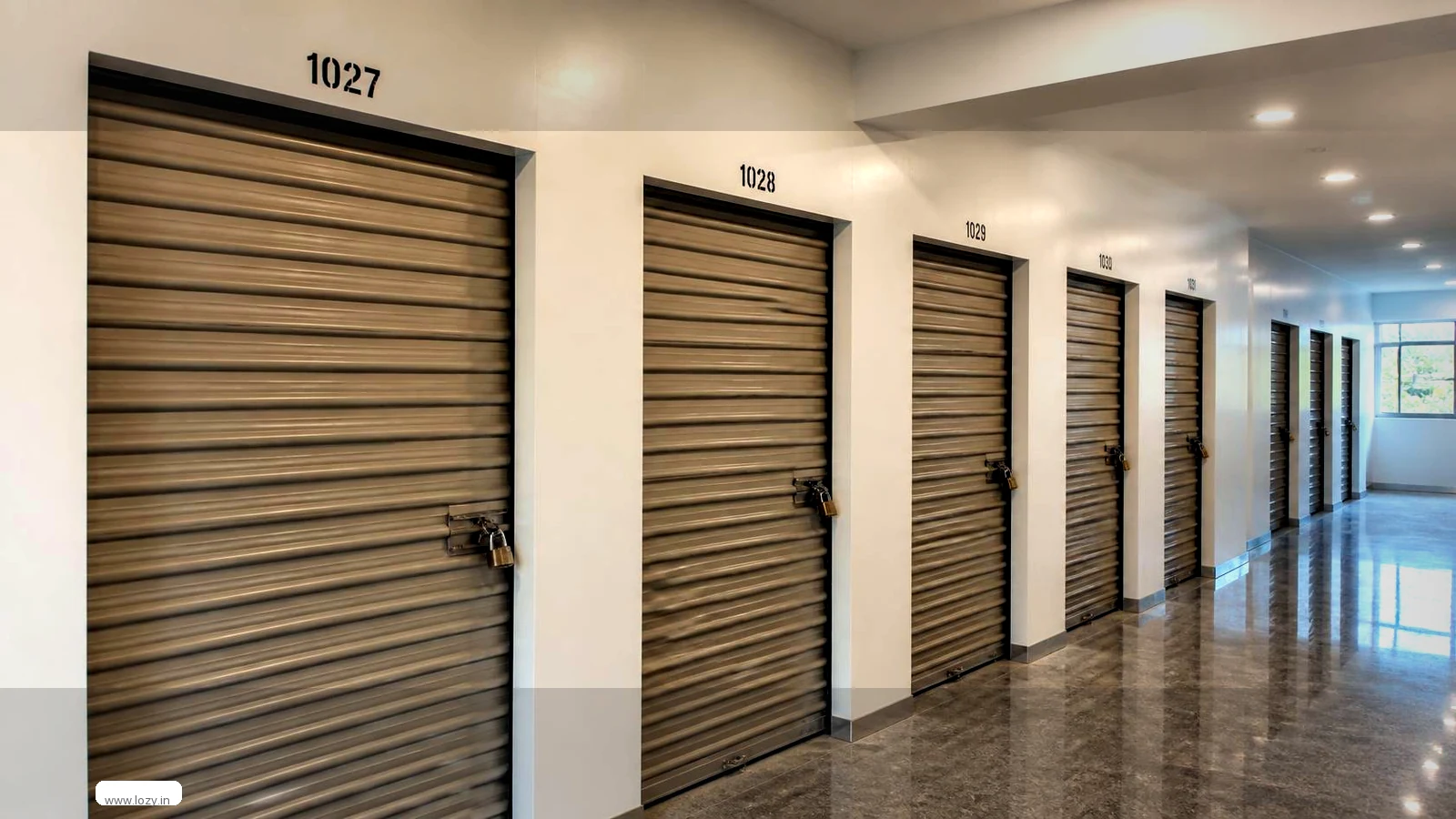
Self storage is a lockable unit inside a secure facility, rented by the month, for anything from a few boxes to a whole home's contents. You hold the access PIN, you decide what goes in, and you can visit seven days a week. The space is yours alone — nobody else rearranges your goods while you are away.
The word "storage" gets used loosely in India. A godown, a commercial warehouse, a managed 3PL facility and a lockable unit are four different products with four different price models, and the gap between them is large. This guide is about the last one: the small-format, private, walk-in kind. The product itself lives at Lozy self storage, where units start at 10 sq ft and are priced by the unit rather than the square foot — you are buying a private box, not an area of somebody else's floor.
Self storage vs a warehouse or godown
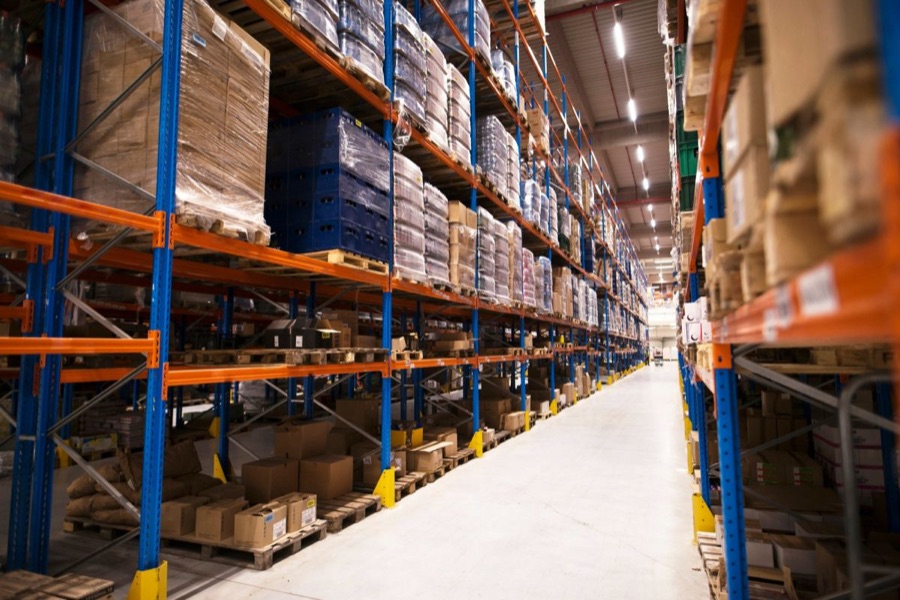
The terms sound interchangeable and are not. A godown or warehouse rental is sized in hundreds or thousands of square feet and built for pallet-scale goods: a trader's stock, a manufacturer's inventory, a distributor's volume. A self storage unit is the small-format version of the same idea — private, lockable, sized for household or personal goods, with walk-in access rather than a dock schedule.
The three differences that decide it
Size. Units start at 10 sq ft — roughly a couple of wardrobes' worth of boxes — and rise to sizes that hold a full household's furniture. Warehouse space is measured in hundreds or thousands of square feet.
Pricing basis. A warehouse is quoted per square foot per month. A storage unit is quoted per unit per month as a flat figure, which makes comparison easy: you are buying a box with a known capacity, not an area whose usable space depends on how well you stack.
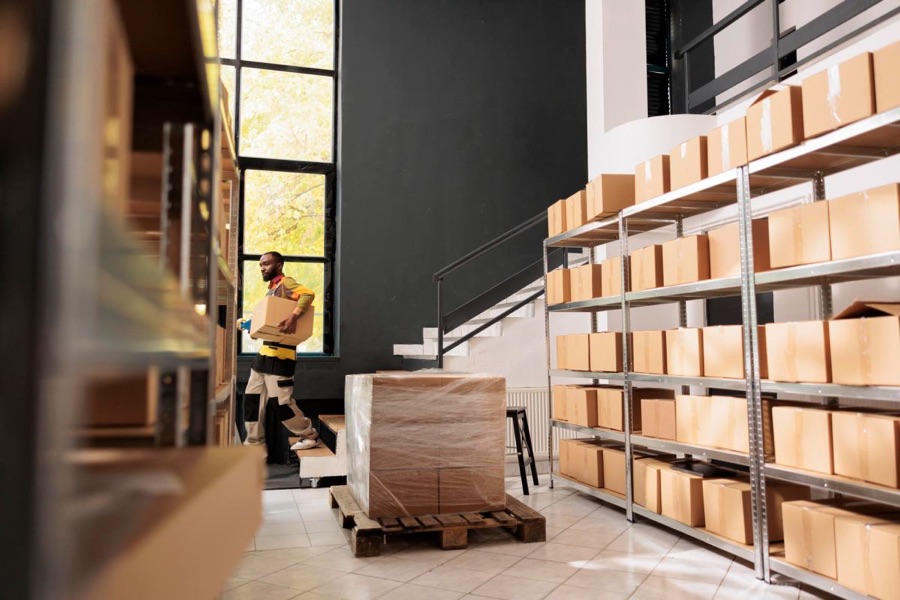
Who handles the goods. In a warehouse, a team handles inward movement, picking, packing and often dispatch. In self storage, you do the work — carry it in, arrange it, lock it, come back for it. That is why it costs less for small volumes: you are not paying for labour your goods do not need.
Which side of the split your goods fall on
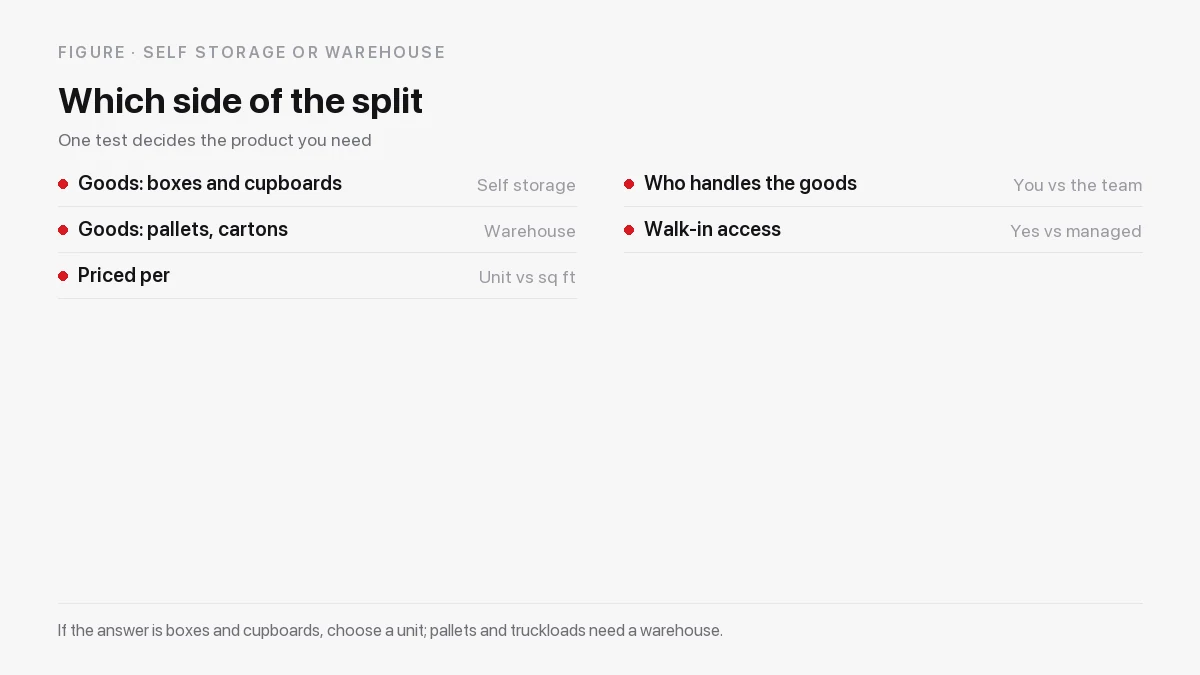
Run the honest test. If the answer is boxes, cupboards, a fridge, a bed, cycles, or a room's worth of belongings between addresses, self storage is built for you. If the answer is pallets, cartons in the hundreds, or stock that moves in and out every week, you want the other side of the split.
The useful middle case is the small business. A trader holding spares, a studio holding equipment, a shop holding off-season stock — all often need a private lockable unit rather than a shared warehouse floor, because the volume is small but the access needs to be personal. Where goods need regular dispatch by someone else, a managed arrangement with pick-and-pack suits better. See the range on the Lozy services page and compare facilities on the warehouse listing.
Choosing a unit size
Size is the decision most people get wrong, and usually in the same direction: people book small to save a little each month, then find they cannot walk in and pull things out.
Units start at 10 sq ft, which holds about a couple of wardrobes' worth of boxes, and rise through the sizes most homes and small businesses use — up to units that hold a full household's furniture during a move. The quickest way to get it right is not to estimate square feet at all. Tell the facility your big items — beds, sofas, fridge, washing machine, cycles — and let them match a unit, with room left to walk in and pull things out.
One rule saves a second move. If your needs might grow, start one size up rather than renting two units in six months; the extra cost of the next size is almost always smaller than moving everything twice. If you are unsure, see the facility first — standing inside a 10 sq ft unit for thirty seconds tells you more than any size chart. The units are set out on the self storage page.
| What you are comparing | Self storage unit | Godown or warehouse |
|---|---|---|
| Typical size | From 10 sq ft, up to a full household's furniture | Hundreds to thousands of square feet |
| Goods it suits | Boxes, cupboards, appliances, personal belongings | Pallets, cartons in the hundreds, trade and distribution stock |
| Pricing basis | Per unit per month | Per sq ft per month |
| Starting price | From ₹999 per month | From ₹12 per sq ft per month |
| Access | Your own PIN, any day of the week | Managed access, with dispatch handled by the operator |
| Who handles the goods | You | The facility team |
Who rents a unit, and who should not
The reasons are practical and rarely complicated. Shifting homes — storing part of the household while the new place gets ready. Renovations that need rooms cleared out for weeks, not days. Students and bachelors parking a room's worth of belongings between addresses. Small businesses holding stock, spares or equipment close to where they operate. Hobbyists with gear that deserves better than a cupboard: cycles, camping kit, instruments, collections. NRIs and travelling professionals who want their things secure in one place.
The thread running through that list is that the goods are personal, or personally managed. The owner wants to reach their things without an appointment and is happy to do the carrying. That is what separates a self storage customer from a warehouse customer.
Who should not rent one? If your goods arrive and leave on a pallet, if you need a pick-and-pack team dispatching orders, or if your volumes run to truckloads, a unit will frustrate you inside a month. Those needs are better served by business warehousing, by inventory warehousing, or by a rental on the warehouse and godown side of the site.
What self storage costs
Plans at Lozy start at ₹999 per month, and the exact rate follows the unit size and the duration you book. Units bill monthly with GST invoicing, there are no setup charges, and you are never locked in. Rent attracts GST, and a registered business can claim input credit on it, so ask for a proper tax invoice rather than a receipt.
See the number against the alternatives, because the three starting prices on lozy.in answer three different needs. Warehouse and godown space starts at ₹12 per sq ft per month and is built for pallet-scale goods. Short-term storage starts at ₹699 per week when you need weeks rather than months. Self storage starts at ₹999 per month — a flat unit rate, so what you pay does not change because you stacked your boxes badly.
Renting a unit tends to be the cheaper route when you need occasional, walk-in access to your own goods. If the goods need to move in and out often, or someone else should handle dispatch, a managed arrangement with pick-and-pack may suit better — tell us how you plan to use the space. Treat every figure as "from" and "starts at"; final rates depend on the city, the size and the term. Starting plans are on Lozy self storage.
What actually moves the price
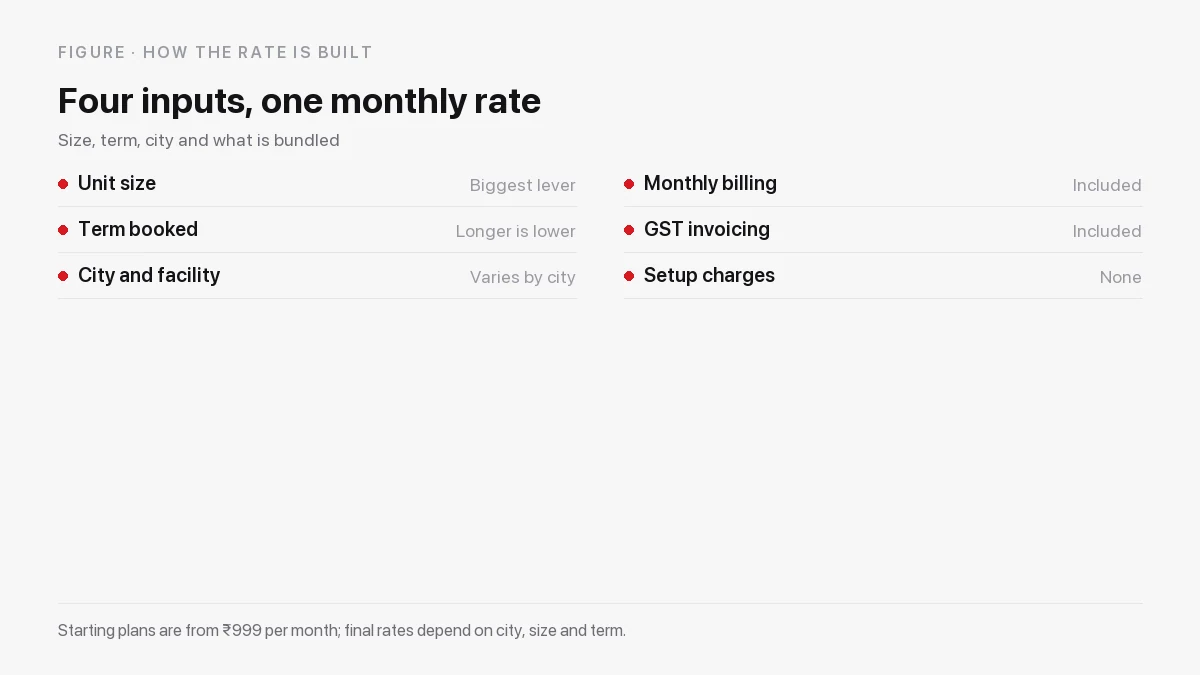
Four things decide what you pay, and only the first is really about your goods.
- Unit size. The larger the unit, the higher the monthly rate. This is the biggest lever you control.
- Term. How long you book for changes the rate. A longer commitment usually prices better per month than a rolling monthly arrangement.
- City. Rates vary by city and by facility, the way any rent does.
- What is bundled. Monthly billing, GST invoicing, no setup charges and no lock-in are part of the deal rather than extras — but confirm that for any facility you compare, because an unbundled one can look cheaper and cost more in total.
Where Lozy has self storage
Lozy runs 77+ warehouses and more than 1M+ sq ft of live space across 9 city hubs — Delhi NCR, Jaipur and the surrounding NCR belt. Self storage availability follows that network rather than sitting in one building, so the practical question is which facility is near your route.
The self storage facilities you can point to today are Self Storage for Home and Business in Dwarka Sector 26 and Self Storage Unit in Dwarka Sector 27, both in New Delhi. Around them sit the business and household facilities that make the same corridors useful: Dwarka for business and 3PL, Ghevra Metro and Ghevra Metro 2, Manesar Sector 8 and the shedded site at Sector 8, Manesar M-Zone Sector 9, Kherki Daula in Gurugram, DLF Industrial Area 2 in Faridabad, Lozy Jamalpur Distribution Center in Haryana, and Storage Space in Jaipur.
Location matters more than it sounds. If the unit is not on your side of the city, you will not visit it — and a unit you never visit is an expensive cupboard. Check the facility against your route to work or home before you check the rate. Start from the New Delhi location page, the Gurgaon locations or the Haryana locations.
Booking a unit and moving in
Booking is deliberately simple, and it happens in four moves.
- Pick a unit. See the facility first, then confirm the size that fits.
- Book monthly. No lock-in — stay a month or stay a year.
- Move in your way. Free doorstep pickup across Delhi NCR on bookings of 30 days or more, or drop the goods off yourself with help from the free trolleys on site.
- Access it. Your own PIN unlocks the gates, the lifts and your unit. Visit any day of the week, or ask the facility to bring items out for delivery.
Two details are worth pulling out. The PIN is yours, so access control runs on a unique credential rather than a shared gate. And monthly terms mean the commitment is genuinely one month at a time, which matters when your plans are still moving. You can start at book a self storage unit.
Access, security and the day to day
What you are paying for, beyond floor area, is a building that behaves. Every Lozy unit sits inside a CCTV-monitored, pest-controlled warehouse with security on site, and the unit is opened with your own PIN across the gates, the lifts and the door. You can visit any day of the week, or ask for items to be brought out for delivery.
The practical rhythm is simple. Keep a labelled inventory, put the things you need most near the door, and photograph anything valuable once so the record matches the goods. If your use is occasional, one visit a month is normal; if you run a small business out of the unit, weekly visits are normal too. The point of a PIN is that neither rhythm needs an appointment.
Two questions are worth asking before you book: what climate options exist if the goods are humidity-sensitive at all, and what paperwork comes with the unit — monthly invoicing, an inventory at intake, and insurance made available rather than assumed.
Five checks before you book any facility
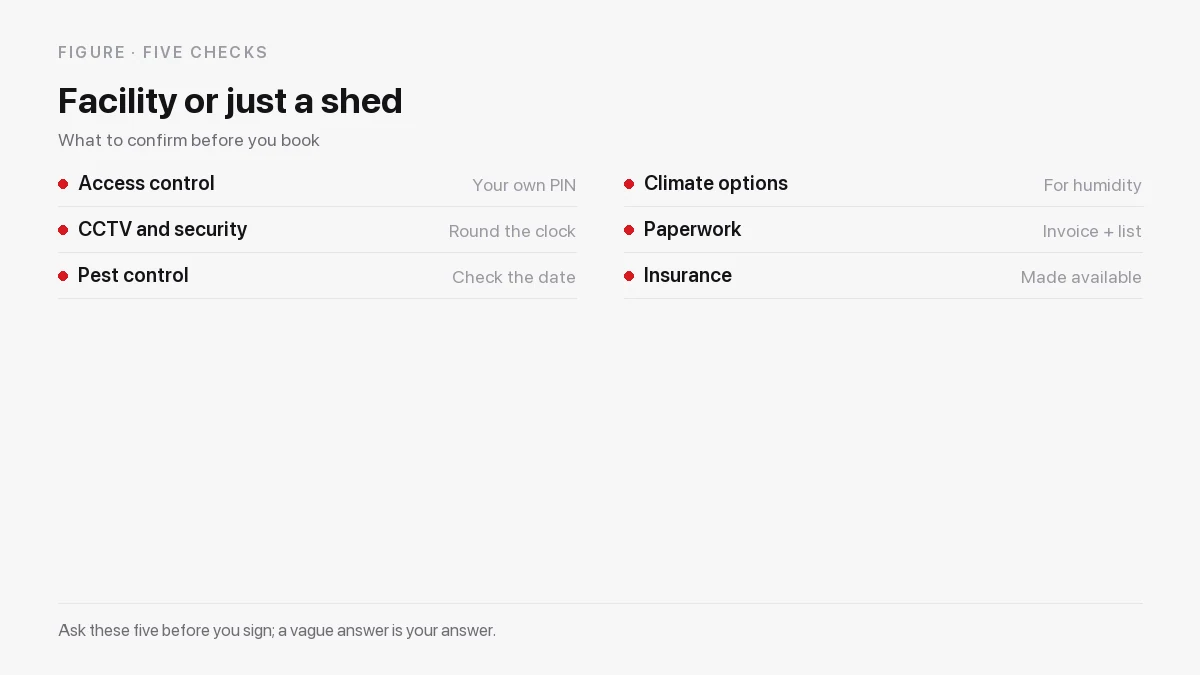
Whether you book with Lozy or compare options, five checks separate a facility from a shed.
- Access control. A unique PIN or key, not a shared gate.
- Round-the-clock CCTV and on-site security. Not a camera at the main gate and nothing else.
- Pest control and housekeeping. Ask when the last treatment ran, and expect a straight answer.
- Climate options. Needed for anything humidity-sensitive.
- Paperwork. Monthly invoicing, an inventory at intake, and insurance made available rather than assumed.
Seeing that list written down is half the reason to book a visit, and the same list applies to any operator. If a facility cannot answer all five plainly, that is your answer. The self storage units page sets out the same points alongside the sizes and the starting price.
What not to put in a unit
A few categories do not belong in a storage unit, for your sake as much as the facility's.
Anything perishable, living, or that decays will not survive a sealed unit. Explosives, fuels, chemicals and anything with a strong solvent smell create a risk for every unit on the floor. Illegal goods are an obvious exclusion. And cash, jewellery and uninsured valuables are usually better off in a bank locker than a storage unit, however good the CCTV is; if you do store valuables, photograph them and check the insurance position first.
The test is easy. If the item would be a problem in a shared building, it is a problem here. For documents and archives specifically, document storage is the better fit. For a home move, the household warehousing route includes handling that a self storage unit deliberately leaves to you.
Preparing what goes into the unit
Ten minutes of preparation buys months of easy storage.
- Clean and dry everything before it goes in. Damp is the enemy of anything stored for a season.
- Pack books flat in small boxes, because books get heavy fast and a large box full of them is immovable.
- Keep a labelled inventory of what went into which box.
- Electronics travel best in their original boxes, with cables bagged separately.
- Mattresses stand on edge rather than flat, so they keep their shape.
- Photograph anything valuable once, so the record matches the goods.
- Store the fragile and the frequently-needed items where you can reach them without unpacking half the unit.
Furniture is its own small project. Beds and sofas take more space than people expect, which is why the size conversation should start with big items rather than box counts. If furniture is the bulk of what you are storing, furniture warehousing is built for that mix.
Six packing mistakes that cost you space
- Big boxes for heavy things. A large carton full of books is immovable and unsafe to lift. Small boxes for dense items, large for light ones.
- No inventory. Without a list on the box, the unit becomes a guessing game inside a month.
- Storing things wet. A washing machine or kettle put away damp will smell the whole unit out.
- Leaving the top of the unit unused. Stack to the ceiling where the boxes are light, and keep a walkway.
- Labels facing the wall. Labels should face the walkway, not the back wall, because those are the ones you will read.
- Packing things you have not decided about. If you are unsure whether to keep something, that is a question for before the move, not after.
Insurance and what happens if something goes wrong
Ask plainly what happens if goods are damaged by fire, water or handling, and get the answer in writing. Insurance should be made available rather than assumed — for stored and, where relevant, in-transit goods. If the answer is vague, arrange your own cover instead of hoping.
Two habits make any claim straightforward: an inventory at intake, and photographs of anything valuable before it goes in. Both settle most arguments about what was stored.
One distinction is worth knowing before you book. If your goods are imported and you are storing them before customs duty is paid, you are in a different regime — duty-deferred storage sits under customs law and is administered by the Central Board of Indirect Taxes and Customs. Self storage is not that product. If you run a small business, the Ministry of MSME is the official starting point for registration, and government services generally sit on the National Portal of India.
How Lozy helps
Lozy's self storage is the small-format, walk-in end of the same network that runs 77+ warehouses and more than 1M+ sq ft of space across 9 city hubs. Units start at 10 sq ft and run up to a size that holds a full household's furniture. Plans start at ₹999 per month, billed monthly with GST invoicing, with no setup charges and no long lock-in.
Practically, that means three things. You get a private unit opened by your own PIN, inside a CCTV-monitored, pest-controlled warehouse. You get free doorstep pickup across Delhi NCR on bookings of 30 days or more, with trolleys on site if you would rather bring the goods yourself. And you get someone to talk to about the one decision that matters — the size — based on your big items rather than your guess.
Around it sit the neighbouring services, so nobody pushes you towards the wrong one. Short-term storage fits a few weeks, seasonal warehousing fits peak stock, office warehousing fits business furniture and records, and full warehouse space covers a requirement that changes shape entirely.
Storing something, or just comparing?
Tell us what you need to store and where. We reply with availability and a price — usually the same working day.
The bottom line
Self storage is not a small warehouse, and a warehouse is not a large self storage unit. One is priced per unit, for personal goods you handle yourself and reach any day of the week. The other is priced per square foot, for trade goods a team handles and dispatches for you. Getting the side of that split right is most of the decision.
If your requirement is boxes, cupboards and a room's worth of belongings, start at 10 sq ft and size up from there. If it is pallets and truckloads, go to the warehouse side of the site. Space starts at ₹999 per month, billed monthly, with no long lock-in. See the units at self storage in Delhi NCR and Jaipur, or browse the Lozy blog for the rest of the warehousing guide series.
About the author
Lozy Editorial Desk. This guide was written by the Lozy Editorial Desk, the in-house team that covers warehousing, self storage, logistics and customs/EXIM topics for lozy.in. We write from Lozy's own facility and pricing information and from public, citable sources; we do not publish invented statistics, ratings or reviews.
Last updated: 11 October 2026. Have a question the FAQ below does not answer? Call +91 93547 12345 or email care@lozy.in.
Need warehousing or storage in India?
Request a free, tailored quote in under 2 minutes — free pickup, no lock-in.