Seasonal Warehousing: Off-Season Storage Guide for 2026
Short answer: Seasonal warehousing is storage for things that live on a calendar — summer coolers and winter quilts, festive stock, school gear, sale inventory — kept safely off-site through their off months and delivered back when the season turns. Lozy runs seasonal storage on 3, 6 and 9-month plans for households and for retailers carrying festive or weather-driven inventory, starting at ₹1,299 per month; the final rate depends on city, size and term. You pay for the window, not for a year.
Key takeaways
- Seasonal warehousing matches storage to a calendar rather than a lease: you book the months your goods sit idle and take them back when the season turns.
- Lozy runs three, six and nine-month seasonal plans for households and for retailers carrying festive or weather-driven stock, starting at ₹1,299 per month; the final rate depends on city, size and term.
- Households store coolers through the winter and quilts through the summer, while festive decor can sit for eleven months and come out for one.
- Retailers use it as buffer space before Diwali and staging room after the January sales, without a lease on the extra space.
- Pickup is free in Delhi NCR, units are dust-free and pest-controlled, and returns are scheduled — tell us a fortnight before the season turns.
- The network runs 77+ warehouses and 1M+ sq ft of live space across 9 city hubs in Delhi NCR, Jaipur and the surrounding NCR belt.
Every home and every shop keeps things that live on a calendar. The cooler is wanted for four months and sits in a corner for eight. The quilts are the mirror image of that year. A retailer's festive stock needs rack space in October and none at all in February. Seasonal storage answers one narrow question: where should those goods live in the months nobody uses them?
This guide covers how the three, six and nine-month windows work, what the service costs, how to pack goods that will not be opened for months, and how pickup and return run — all from Lozy's own facility and pricing information for seasonal warehousing.
What seasonal warehousing means
Seasonal warehousing is storage for things that live on a calendar — summer coolers and winter quilts, festive stock, school gear, sale inventory — kept safely off-site through their off months and delivered back when the season turns. You pay for the storage window, not for a year.
Lozy runs seasonal storage on 3, 6 and 9-month plans for households and for retailers carrying festive or weather-driven inventory. The plan is sized to the season you are storing across, which is why the same service fits a festival cycle and the long hibernation of bulky items.
It is not the same product as short-term storage, which exists for gaps measured in weeks; seasonal storage exists for the months in the middle of the year when a whole category of your goods is out of use. Both are flexible; only one is built around the calendar.
Who stores seasonally
Almost every seasonal booking starts from one of six places. If you recognise yours, you are the standard case, not an unusual one.
- Households — coolers through the winter, quilts and woollens through the summer.
- Festive decor — Diwali lights, idols and decorations, stored between seasons.
- Retailers — festive stock and sale inventory before and after peak weeks.
- Apparel stores rotating summer and winter lines.
- Agri-linked stock moving with sowing and harvest cycles.
- Caterers and event teams storing chairs, crockery and sets off-season.
For shops in NCR's markets and malls, the warehouse also shortens restocking: the extra stock is a short drive away, not in another city. A festive week is won or lost on whether the third size is on the shelf on the last evening. The live space is on the warehouse listing page.
How the seasonal cycle works
- Pick the window. Three, six or nine-month plans match the season you are storing across.
- We collect. Free pickup in Delhi NCR — the bulky items leave your home or shop floor.
- We store. Dust-free, pest-controlled units, monitored throughout the window.
- We return. Goods come back for the season, on schedule and on call.
Everything else in this guide sits inside one of those four steps: the window sets the price, the storage sets the condition, and the return decides whether the season starts smoothly. Because the billing underneath runs monthly, a window that shifts — an early summer, a late Diwali — shifts with it.
Picking the window: three, six or nine months
Plan length is a description of your calendar. This is the rule of thumb we use when a customer is unsure.
| What you are storing | Window that usually fits | Why |
|---|---|---|
| Festive decor and lights | Three months | One festival cycle, out again before the next |
| Coolers, fans and summer goods | Six months | Covers the winter they miss entirely |
| Quilts, woollens and winter wear | Six months | The mirror image, stored through the summer |
| Bulky items kept off-season | Nine months | The long hibernation bulky goods deserve |
| Retail festive or sale stock | Three to six months | Set by your buying and clearing dates |
Three months for a festival cycle, six for a half-year swap, nine for the long hibernation of bulky items. Be honest about the return date when you book: a window that ends early means paying for unused storage, and one that ends late means the goods arrive after you needed them.
What seasonal storage costs
Seasonal warehousing with Lozy starts at ₹1,299 per month, with the plan length matched to the season you are storing across. That is cheaper than keeping a bigger home or a bigger shop for things that sit idle half the year, and far cheaper than replacing them. The final rate depends on city, size and term.
Costing a requirement is mostly about quantity and window. Tell us what is going in, how long the window is and the city, and the quote follows. The requirement check costs nothing and commits you to nothing.
It helps to see seasonal storage next to the other shapes of space on the site. Self storage starts at ₹999 per month for a private lockable unit you run yourself, and warehouse and godown space starts at ₹12 per sq ft per month for pallet-scale goods. Seasonal storage is the one whose length is set by a season, which is why the plan comes in three, six and nine-month shapes.
Seasonal storage versus keeping it at home
A garage or a loft seems free until the maths includes what it costs. It steals space — a garage corner, a loft, a guest room that stops being a guest room. It runs hot in May and damp in July, which is exactly the weather seasonal goods sit through. And it costs labour nobody counts: the annual lifting out of awkward corners, the pile rebuilt twice to reach one box.
A clean, dry, monitored unit changes what comes back: the same cooler and the same quilts, without the dust, rust and repairs a loft quietly produces. Because seasonal storage is billed monthly over a finite window, you are paying for months rather than for a room you feel obliged to keep filling.
What people actually store
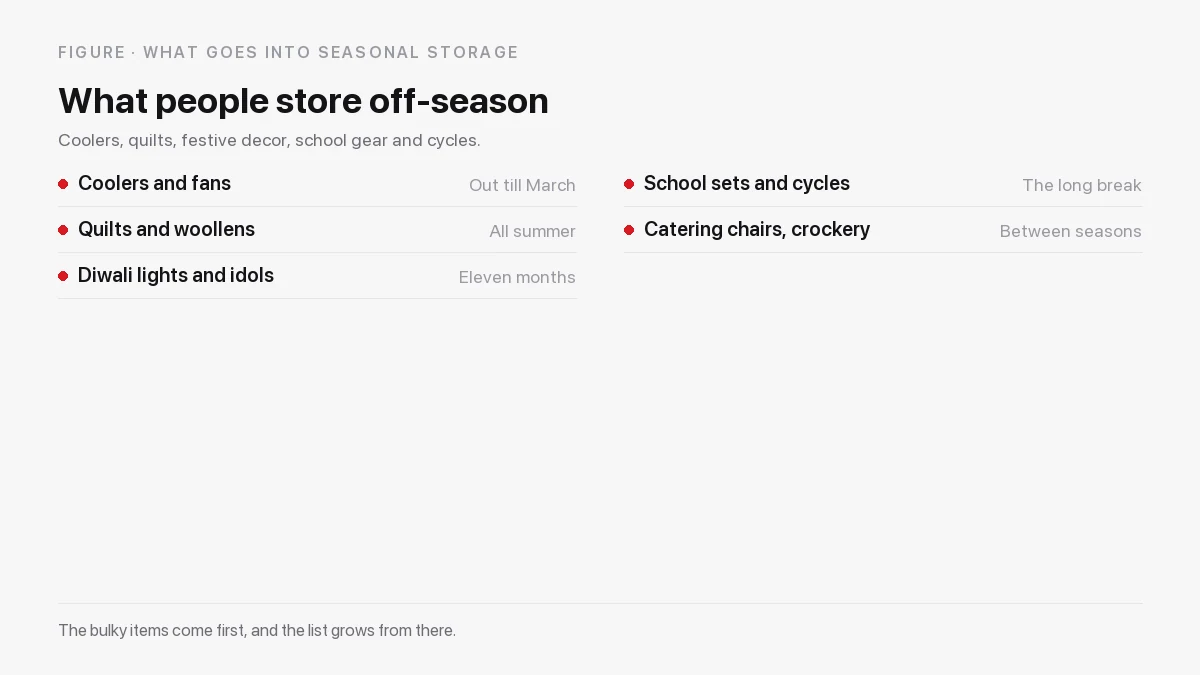
Almost every seasonal booking starts with one item and grows. The bulky things come first, because they are the ones that hurt at home.
By the time the list is finished it usually covers coolers, fans and air coolers; quilts, blankets, woollens and winter wear; Diwali lights, idols and decorations; exam-season gear, cycles for the off-season and school sets in the long break; electronics used only in one part of the year; and catering kit — chairs, crockery and sets — for teams that need it only in season.
Festive decor is the category that surprises people: rarely large, almost always fragile, and needing a home for eleven months of the year. Where the list is furniture rather than boxed goods, furniture warehousing handles the same window with wrapping and padding built in.
Packing seasonal goods for the off-season
The off-season is when goods need the most care going in: nothing will be opened until the season turns. A cooler packed damp in October is a mould problem by March, and nobody finds out until it is too late to fix cheaply.
- Coolers. Drained completely, dried in the sun, and the fan blades cleaned before the unit leaves.
- Quilts and woollens. Washed before boxing, with a moisture absorber inside the box and a label on the outside.
- Festive decor. Bubble-wrapped by fragility, not by festival — lights coiled flat, idols padded, glass packed separately.
- Electronics. Dry, dusted, and stored with the cables bagged to their device.
Packing before pickup is worth the evening it takes. A cooler drained and dried at home costs nothing; the same cooler shut away wet comes back with rust on the frame, and woollens that go in unwashed arrive with the season's stains set in the weave.
Label every box by season
Label each box with the season it beats: winter, Diwali, monsoon. When the calendar flips, the boxes answer before the memory does.
The habit pays off three times: the pickup team knows which stack belongs to which window, the return is quicker, and a mid-window request points you straight at the right box.
One plan, a year of seasons
A household running on seasonal storage usually spreads across several short windows rather than one long one.
- Coolers and fans go out in October and come back in March — a six-month window that misses the winter entirely.
- Quilts and woollens are the mirror image, stored through the summer.
- Festive decor sits tucked away for eleven months and takes centre stage for one.
- Exam-season gear, cycles and school sets each run on their own window.
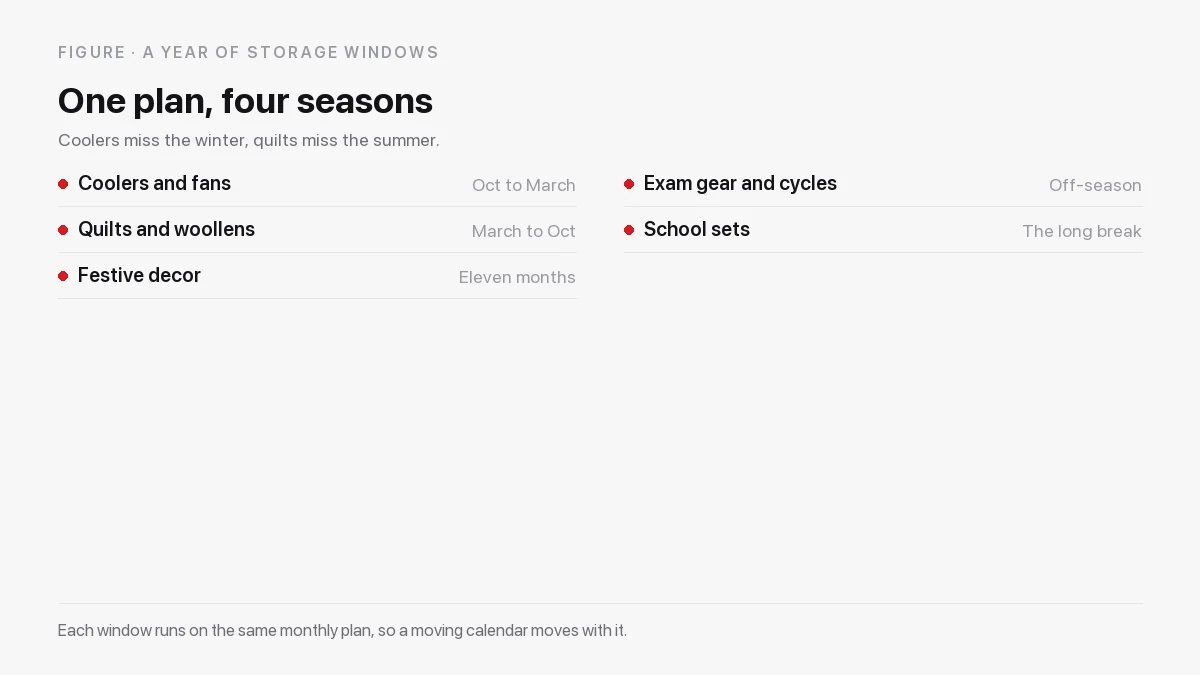
Because the plans run monthly underneath, a window that shifts with the calendar shifts with your booking: you are adjusting a month, not renegotiating a contract. If the volume starts to look like a whole home rather than a season, the fuller service is household warehousing.
Pickup, storage and return
Pickup is free in Delhi NCR, so the bulky items leave your home or shop floor without a van hire and without a weekend of lifting. Once the goods are in, they sit in dust-free, pest-controlled units, monitored throughout the window.
Returns are scheduled, not improvised. Tell us a fortnight before the season turns and the delivery lands in the week you choose, cleaned and checked before it goes back on the truck. The fortnight matters because the return run is planned like the pickup run, and a week's notice rarely leaves room for the day you want. If a season's start shifts, the pickup slot moves with it.
For retailers: the festive calendar
Retail's year has mountains and plains. Festive inventory needs rack space before Diwali, sale clear-outs need staging room in January, and the between-times need a home for what is not selling yet. Seasonal warehousing gives each phase its own space, with no lease attached.
That is the difference from a bigger shop. A lease is priced for the peak and paid through the trough: the twelve-month commitment that made sense in September looks expensive in June, when the racks are half empty and the rent is not.
For shops in NCR's markets and malls the extra stock is also a short drive away, which turns a stock-out into a delivery. If you sell online as well, the same stock behind a fulfilment operation sits under e-commerce warehousing.
Agri stock, event kit and imports
Two smaller categories behave exactly like the big ones. Agri-linked stock moves with sowing and harvest cycles, so it needs space in the months between the two rather than a permanent shed. Caterers and event teams store chairs, crockery and sets off-season, when the wedding calendar and the corporate calendar are both quiet. Both share one shape: a known, dated window, a volume that would crowd out the space it is used from, and a return date set by a season rather than by a contract.
Some festive inventory arrives from abroad, and then storage and customs become one problem rather than two. Duty on imported goods is administered under the Central Board of Indirect Taxes and Customs (CBIC), and customs filings move through ICEGATE. Plan the clearance and the storage window with the same dates in mind: a shipment that clears late does not lengthen the season it was bought for.
Seasonal versus short-term and self storage
Four products on the site answer four different needs, and mixing them up is the fastest way to pay for space you do not use.
| Type of space | Built for | Length |
|---|---|---|
| Seasonal warehousing | Goods that live on a calendar, for a home or a shop | 3, 6 or 9 months |
| Short-term storage | A gap between two addresses or two projects | From ₹699 per week |
| Self storage | A private lockable unit you run yourself | From ₹999 per month |
| Warehouse and godown space | Pallet-scale and trade goods at volume | From ₹12 per sq ft per month |
The practical question is not which is cheapest but how long the goods are actually asleep. Weeks point to short-term storage, a season points to the seasonal plan, and a commitment running past a year, with goods that never come home, is a long-term warehousing conversation.
What keeps stored goods in condition
Goods stored seasonally are not looked at for months, which is exactly why the condition of the space decides the condition of what comes back. A dust-free unit, pest control and monitoring through the window are not extras in this service; they are the reason it works.
Dust is the obvious risk. Rust, mould, insect damage and rodent damage are the ones that cost real money, and all four follow from where goods sit, not from how they were packed. That is the case for a monitored unit over a loft even when the loft is free.
For a business storing trade stock, the standards are the same: what comes back has to be sellable. Where that stock belongs to a company rather than a home, the commercial version runs through business warehousing.
Sizing a seasonal booking
Sizing is a description, not a measurement. Four things decide the plan.
- What is going in — an item list in plain words: one cooler or twelve, a wardrobe of woollens or a shop's worth.
- The rough volume — how much floor or house the goods take up today.
- The window — three, six or nine months, set by when the season turns for those goods.
- The return date you want — the week you need the goods back, stated as a date.
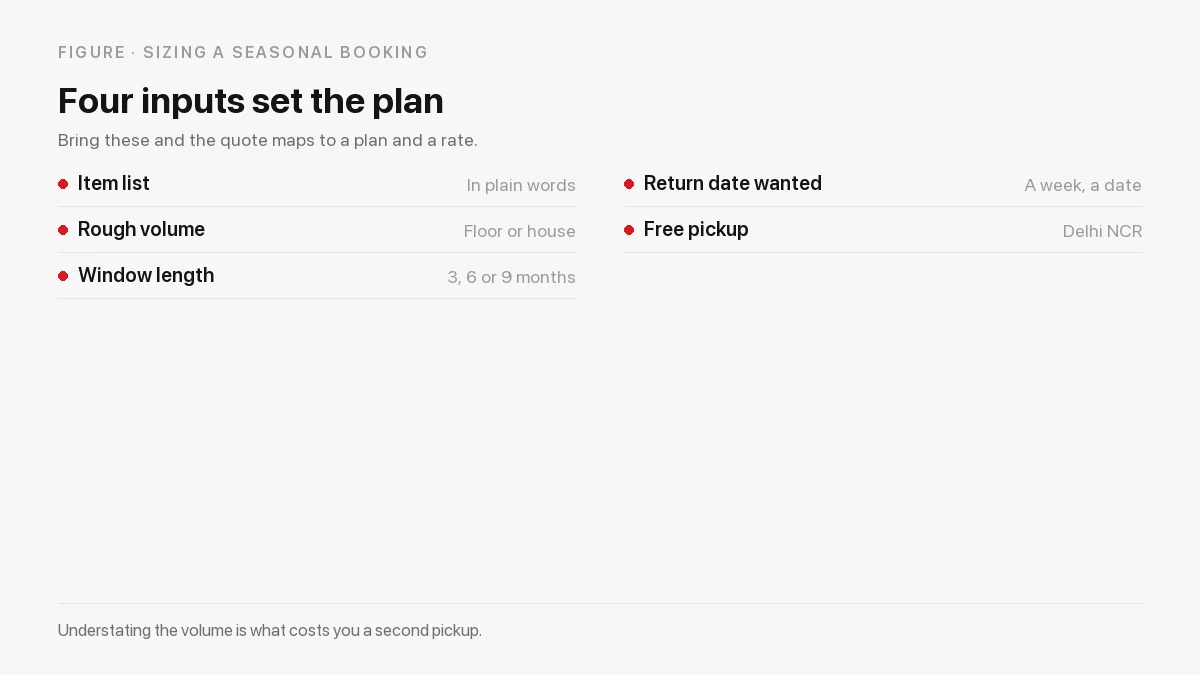
Bring those four and the answer is a plan and a rate rather than a guess. The input people understate is volume — the one that causes a second trip. See the space on the warehouse listing, or ask for the closest facility to your home or shop for seasonal warehousing.
Mistakes that cost money
Most of the problems we see come from the same short list, and all of them are avoidable before pickup day rather than after.
- Packing goods damp. A cooler shut away wet or a quilt boxed before it dried shows up months later as rust or mould.
- Storing without cleaning first. Dust and food residue are what insects come for. An hour of cleaning before packing is the cheapest pest control you will ever buy.
- Mixing seasons in one box. Quilts with festive decor means opening two windows' worth of boxes to reach one thing.
- Leaving the return too late. Returns are planned runs: tell us a fortnight before the season turns.
- Understating the volume. A booking sized to half the load means a second pickup, a second bill and a second morning lost.
- Treating a loft as free. The space it steals, the damp it holds and the annual lifting are real costs. Compare them with the monthly rate before deciding.
Where Lozy stores seasonally
Seasonal storage is a local business: pickup, return and drive time all depend on the facility nearest you.
Lozy runs on 77+ warehouses and 1M+ sq ft of live space, with 9 city hubs live across Delhi NCR, Jaipur and the surrounding NCR belt, and free pickup in Delhi NCR. In the belt, facilities include the Lozy Jamalpur Distribution Center in Haryana, Dwarka and Ghevra Metro in New Delhi, the DLF Industrial Area 2 space in Faridabad, the Manesar sheds and Kherki Daula in Gurugram, and a Storage Space in Jaipur. The New Delhi, Gurgaon and Haryana location pages set out what sits where.
For a household, the closest site decides the pickup day; for a retailer, it decides whether buffer stock can be called the same morning.
How Lozy helps
Lozy runs seasonal warehousing on 3, 6 and 9-month plans for households and for retailers carrying festive or weather-driven inventory. The plan is sized to the window you describe, and the billing underneath runs monthly, so a calendar that moves does not become a contract to renegotiate.
You get free pickup in Delhi NCR, dust-free and pest-controlled units monitored throughout the window, and a scheduled return, with goods cleaned and checked before they go back on the truck. Plans start at ₹1,299 per month, and the final rate depends on city, size and term.
The network behind it runs 77+ warehouses and 1M+ sq ft of live space across 9 city hubs. The full list of services sits on the services page, and related warehousing and customs guides are on the Lozy blog.
Storing something, or just comparing?
Tell us what you need to store and where. We reply with availability and a price — usually the same working day.
How to choose a plan
Work through this list before you book. It is the same checklist we would want a customer to apply to us.
- Write the item list first. Everything going in, in plain words, before you think about space.
- Set the window from the calendar. Three months for a festival cycle, six for a half-year swap, nine for bulky goods that sleep long.
- Name the return date. A week, not a season. Returns are planned runs and a date is what gets a slot.
- Ask how the billing runs underneath. Monthly billing under a seasonal plan is what lets a moving calendar move with your booking.
- Clean and dry everything before pickup. The condition goods go in is the condition they come back in.
- Label by season. It speeds up the pickup, the return and any mid-window request.
- Confirm what the pickup covers. Free pickup applies in Delhi NCR — check the city and the address before assuming.
- Ask who to call when plans change. One named contact beats a call centre on the week the season turns.
Then compare what you have found against the storage you already own. If the loft is dry, reachable and free of costs you have not counted, it may serve. If it is none of those, a plan starting at ₹1,299 per month is usually cheaper — see seasonal warehousing with Lozy for the plan sizes.
About the author
Lozy Editorial Desk. Written by the in-house team that covers warehousing, self storage, logistics and customs/EXIM topics for lozy.in. We write from Lozy's own facility and pricing information and from public, citable sources, and we do not publish invented statistics, ratings or reviews.
Sources. Facility and pricing details are Lozy's own, drawn from the seasonal warehousing service page. The GST framework that applies to a trading business and its records is published on the GST portal, and food businesses operate under a licence issued through FSSAI. Customs references point to the CBIC and ICEGATE portals.
Last updated: October 2026. Have a question the FAQ below does not answer? Call +91 93547 12345 or email care@lozy.in.
Need warehousing or storage in India?
Request a free, tailored quote in under 2 minutes — free pickup, no lock-in.