Industrial Warehousing: Bulk Storage Guide for 2026
Short answer: Industrial warehousing is high-volume, racked space built for goods that move by the pallet and the truckload, with loading bays, material-handling equipment and trained staff on site. Bulk and industrial warehousing with Lozy starts at ₹12 per sq ft per month, billed monthly with GST invoicing and no long lock-in, and the final rate depends on city, size and term. If your goods arrive or leave by the truck, renting ready racked space usually beats running your own shed.
Key takeaways
- Industrial warehousing adds the infrastructure light storage does not: racking rated for heavy loads, wide aisles, loading bays and on-site manpower.
- Lozy runs bulk and industrial warehousing in Delhi NCR and across PAN India, including Mumbai's Bhiwandi belt, Chennai, Kolkata, Jaipur and Ahmedabad.
- Space starts at ₹12 per sq ft per month, billed monthly, with GST invoicing and no long lock-in; the final rate depends on city, size and term.
- The network runs on 77+ warehouses and 1M+ sq ft of live space, with 9 city hubs live across Delhi NCR, Jaipur and the surrounding NCR belt.
- For heavy goods, location often costs more than rent, so park close to the highways, ICDs and docks your trucks already use.
- Size a booking on three numbers: pallet count and load height, monthly turnover, and an honest buffer for overlapping stock.
Industrial warehousing is the part of storage that has to keep up with production and dispatch, not just hold things. The goods are heavy, the volumes are large, and the clock matters: a truck that waits costs money, and a pallet that cannot be found stalls an order.
This guide explains what industrial warehousing is, who it suits, what a set-up includes, what it costs and how to size a first booking. It is written for manufacturers, importers, traders and brands that move stock by the truckload.
What industrial warehousing is
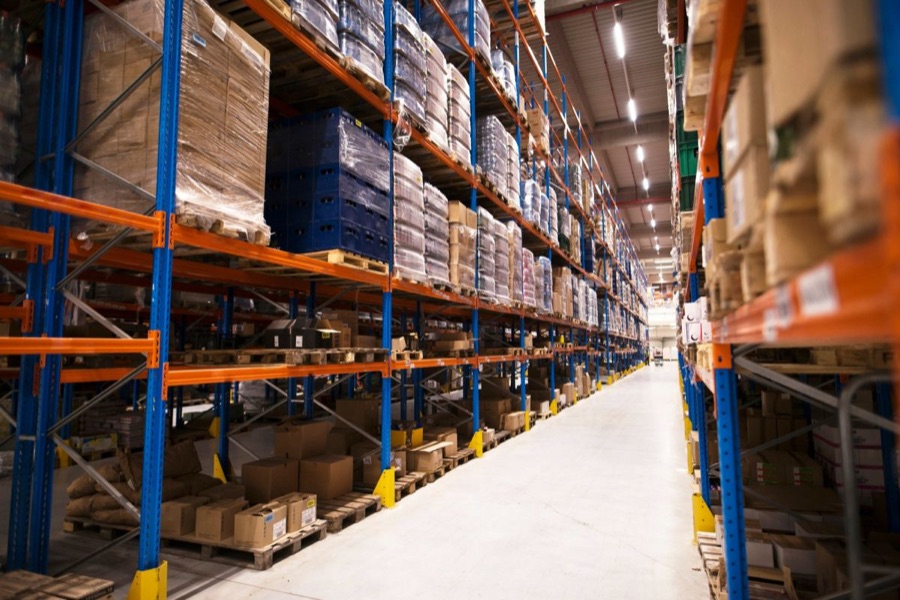
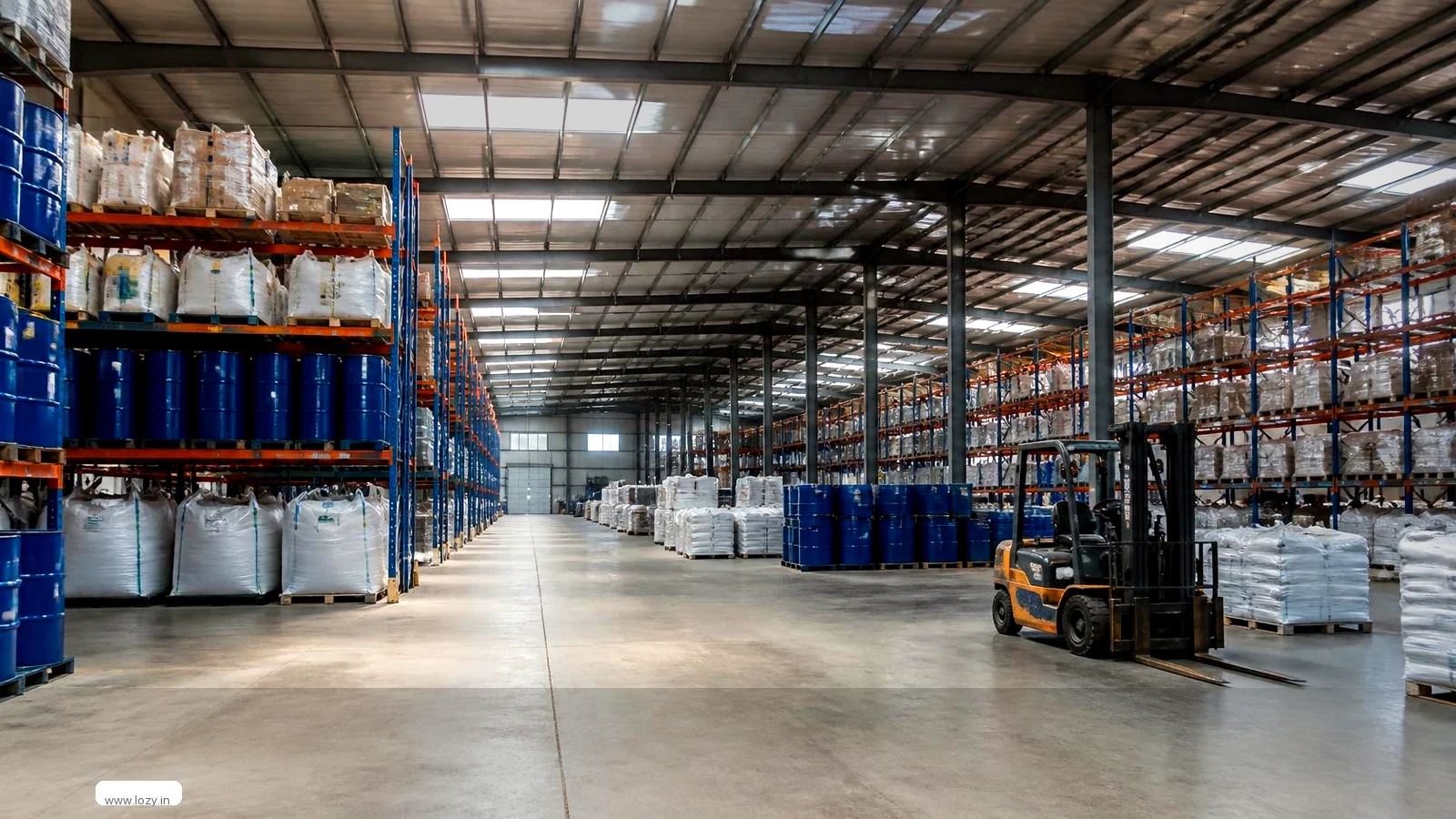
Industrial warehousing is high-volume, racked and material-handling-ready space for manufacturers, importers and brands that move stock by the pallet and the truckload. Where light storage stops at shelves, industrial warehousing adds the infrastructure — racking rated for heavy loads, wide aisles, loading bays and manpower — to keep goods moving in and out.
The difference is not only size. A racked, high-density industrial block is engineered around handling: the floor takes the weight, the aisle is wide enough for equipment to pass, the bay lets a truck load at dock level, and a trained team counts, stacks and dispatches against documents. Lozy runs bulk and industrial warehousing in Delhi NCR and across PAN India — including Mumbai's Bhiwandi belt, Chennai, Kolkata, Jaipur and Ahmedabad — as dedicated blocks or shared high-density racking, with the handling and documentation that B2B stock control expects.
Who bulk warehousing suits
If your goods arrive or leave by the truck, the flexible model fits better than a self-owned shed:
- Manufacturers holding raw material, packaging and finished goods between production and dispatch.
- Importers and traders staging container loads close to ICDs, ports and highways.
- FMCG and retail brands splitting bulk consignments into regional dispatches.
- Businesses with clean-handling needs, such as packaged pharma and speciality goods.
- 3PL operators and distributors wanting overflow capacity without another lease.
- E-commerce brands storing deep inventory behind their fulfilment operations.
Most teams arrive here for one of two reasons: they have outgrown a smaller unit, or they have outgrown the idea of owning a shed. Renting racked space carries no land, no construction and no fixed crew, so you pay for what you use and scale it as volumes change.
What the industrial storage set-up includes
A working industrial set-up is more than four walls and a roof. These are the parts that decide how much stock the block can hold and how fast it moves.
| What the block provides | What it means for you |
|---|---|
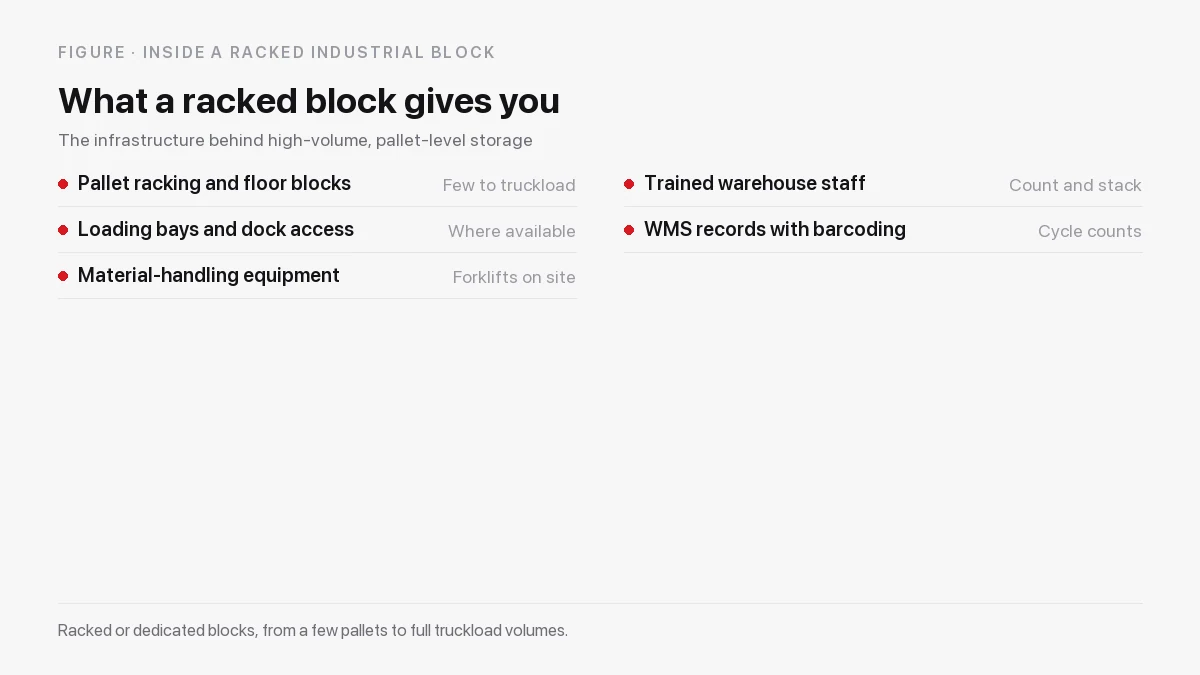
| High-density pallet racking and floor blocks | More storage positions per square foot, from a few pallets to full truckload volumes |
| Loading bays and dock-level access | Trucks load at dock height where the facility supports it |
| Pallet trucks and material-handling equipment | Forklift movement inside the shed, so stock is not lifted by hand |
| Trained warehouse staff | Inbound unloading, stacking, counting and outbound loading |
| WMS-backed inventory records | Barcoding and periodic cycle counts, so stock is found and audited |
| 24/7 CCTV, access control and pest control | A monitored, controlled and clean site across the facility |
Each item earns its place. Racking multiplies the positions a square foot holds, a dock keeps loading off the street, and a barcoded record lets you answer "how much is left?" without walking the racks.
Racking or floor: choosing the right mix
Not every commodity wants to be racked. Racking suits uniform pallets and goods that need a picking face; floor blocks suit oversized, heavy or odd-shaped loads that will not sit safely on a beam. Most industrial operations run a mix, with fast movers at ground-level pick faces, slower stock deeper or higher, and bulky items on the floor.
When you share the requirement, the pallet dimensions, the load height and the rate at which stock turns over decide the mix. That is why a quote built on a pallet count and a load height is more useful than one built on square feet alone: it maps to real positions, not an estimate.
Inbound to outbound: how bulk stock moves
Industrial warehousing lives or dies on turnarounds, so the operating rhythm matters as much as the square footage. The sequence is simple, and discipline at each step is what keeps it fast.
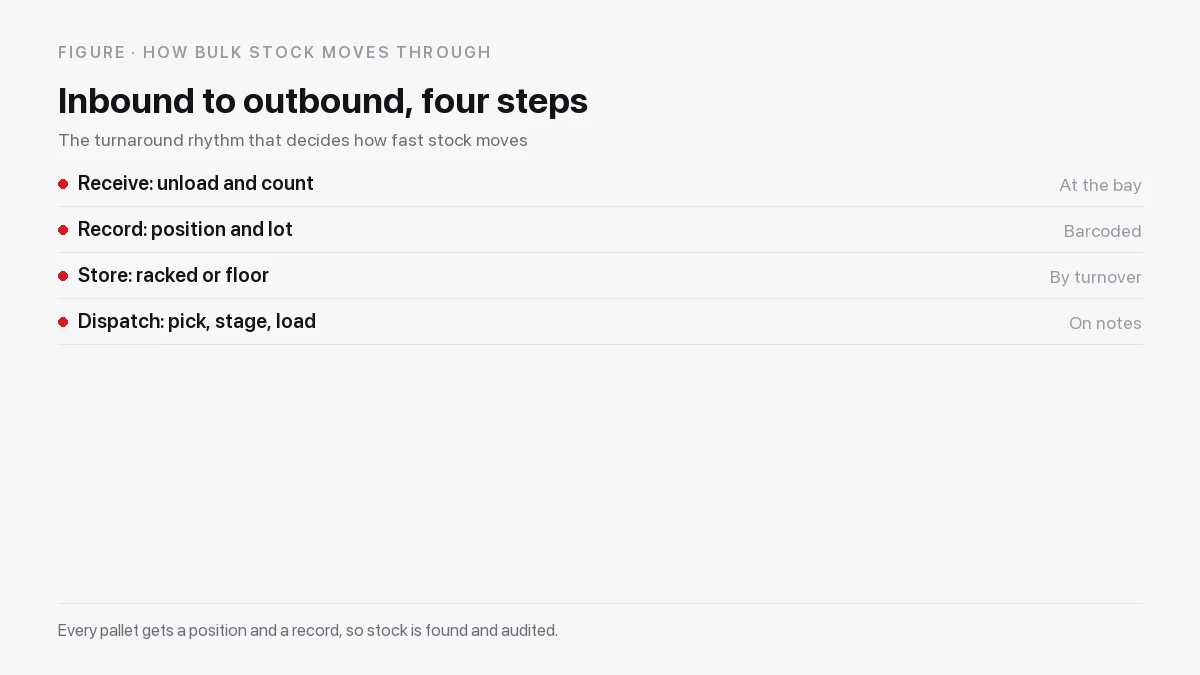
- Receive. Trucks unload at the bay, and goods are counted against the delivery documents.
- Record. Every pallet or lot gets a storage position and a record, so stock can be found, counted and audited without guesswork.
- Store. Goods go to racked or floor positions matched to their dimensions, weight and turnover.
- Dispatch. Requirements come in, picking notes go out, and consignments are staged and loaded for delivery or onward transport.
The loop repeats without a break, which is why the records matter as much as the racks. If the count at receiving is wrong, every step after it inherits the error. If the storage position is not recorded, a picker walks the aisles instead of going straight to the pallet. A well-run block makes each step visible, so a discrepancy is caught at the bay rather than at the customer's gate.
For businesses that also sell online, deep inventory behind a racked block pairs naturally with e-commerce warehousing, where bulk stock feeds a pick-and-pack operation inside the same network. Where demand is seasonal, a rack is easier to add than a building — see seasonal warehousing for the peak-time case.
Records and documentation
In a bulk operation, paperwork is not overhead; it is the memory of the warehouse. A pallet can be moved in minutes, and once it is among hundreds of others, only the record explains where it went and what lot it belonged to. This is why WMS-backed records, barcoding and cycle counts sit inside the industrial set-up: the physical rack and the digital record are supposed to agree.
Handling follows your instructions — lot numbers, rotation and batch segregation — so the physical warehouse keeps the discipline your stock system assumes. If your business has its own stock rules, bring them to the requirement check; a block should be able to follow your labels and rotation rather than impose its own.
What industrial warehousing costs
Bulk and industrial warehousing with Lozy starts at ₹12 per sq ft per month. The rate moves with the location, the racking density you need and the term — a long-run block rate in the Manesar belt prices differently from a short burst in a metro. As with any rate, the final figure depends on city, size and term.
Costing a bulk requirement comes down to quantity. Tell us the pallet count, the load heights and the monthly turnover, and we will quote the racked or floor space it actually needs — with GST invoicing and no lock-in on the monthly plan.
What moves the rate
Three things move the number more than anything else.
- Location. Space near a metro core or a working dock commands more than a shed further out along a highway belt.
- Racking density. The more storage positions you need per square foot, the more racking and handling the block carries.
- Term. A long-run block prices differently from a short burst, because the operator can plan capacity around it.
Ask for the rate with its inclusions in writing. A lower headline rate that leaves racking, handling or electricity to you is not the same product as a slightly higher rate that bundles them, and the cheapest-looking quote is often the one with the longest list of extras.
Industrial warehousing vs lighter storage
Not every bulk-looking requirement is really industrial, and it helps to know which shelf you are shopping on, because the price and the capability differ sharply.
| Type of space | Built for |
|---|---|
| Industrial warehousing | Heavy, palletised, truckload volumes with racking, bays and handling |
| Business and commercial warehousing | Monitored racked units for trade stock and small-to-mid teams |
| Self storage | A private lockable room a household or small business runs itself |
| Short-term storage | A short, flexible burst of space rather than a long footprint |
If you need a monitored unit with racking but not a full industrial block, the closer fit is business warehousing or commercial warehousing. For pure stock holding, inventory warehousing is the right frame. If you would rather run the space yourself and keep it private, look at self storage, which starts from ₹999 per month. And for a short, flexible burst, short-term storage starts from ₹699 per week. Comparing on inclusions, not just the headline rate, is what keeps the choice honest.
Choosing a location that keeps your freight bill down
For heavy goods, location often costs more than rent. Industrial warehousing pays for itself when it cuts secondary freight, so park close to where the trucks already go. A block that is a little dearer per square foot but saves an extra run per consignment is usually the cheaper block.
Lozy's industrial belt locations sit near Delhi NCR's logistics corridors — Manesar, Farrukhnagar and Garhi Harsaru along the expressway and ICD belt, Faridabad's industrial areas, and the Dadri side of Greater Noida — alongside facilities in Mumbai, Chennai, Kolkata and Jaipur. If your inbound is container-led, a customs-bonded facility can cut a full trip out of the chain.
Three questions sort one location from another: how far is the nearest highway or ICD, what are the dock and floor specs for your commodity, and is there room to expand when volumes rise. A site that fits this year but has no adjacent space forces a second move, and a second move costs downtime as well as transport.
When imports are part of the picture
If your inbound is container-led, storage and customs are one problem, not two. A licensed customs-bonded space can hold container-led goods and cut a full trip out of the chain, which matters most when your containers clear through a port or ICD far from your customers. Lozy provides customs bonded warehouse space alongside customs clearance services, so the warehouse and the clearance sit with one partner rather than three.
The regulatory side is public. Customs duty and clearance are administered under the Central Board of Indirect Taxes and Customs (CBIC), customs EDI filings run through ICEGATE, and import-export licensing sits with the Directorate General of Foreign Trade (DGFT). A trading entity can keep the goods, the paperwork and the duty moving together by planning the storage and the clearance as one requirement.
Sizing your first bulk booking
Bulk space is measured, not guessed. Three figures set the requirement before any visit:
- Pallet count and standard load height — how many storage positions the stock needs, floor-stacked or racked.
- Turnover — ground-level pick faces for fast movers, deeper storage for slower stock.
- Buffer — room for stock landing before the last batch moves out.
Bring those numbers to the requirement check and the quote maps to a real footprint instead of an estimate. If the operation later outgrows the block, adjacent racking or floor space can be added as volumes rise.
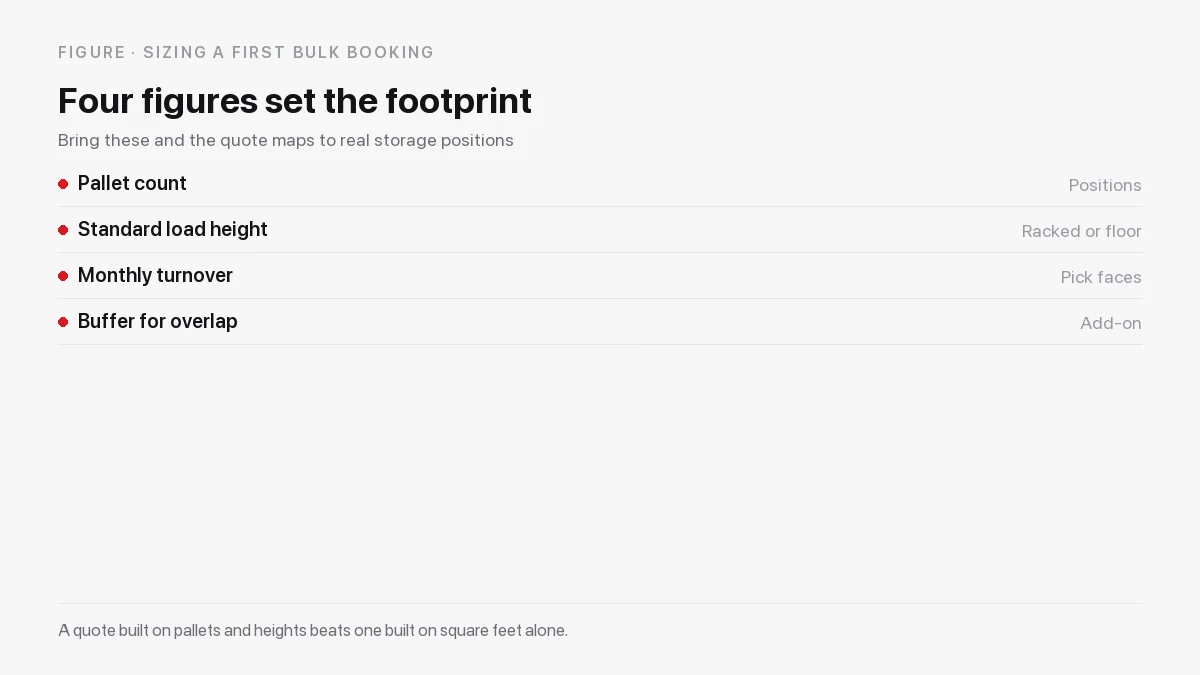
The buffer is the number people leave out, and it is the one that causes overflow. Inbound does not stop while the last batch clears, so if you plan to the last pallet, the first unexpected container has nowhere to land. Size for the overlap and the block stays workable.
Scaling up and down without moving
Bulk demand rarely sits still. A tender win, a festive season or a slow quarter can move your requirement by a third in either direction, and a shed you own cannot follow that. This is the case for a racked, shared facility over a private building: capacity is added and released in positions rather than in property.
Start with the footprint your current pallet count needs, keep the buffer honest, and ask how adjacent racking or floor space can be added as volumes rise. Shared high-density racking is built for exactly this. When demand falls back, you release the space instead of paying for a shed that is half empty, and both the growth and the pull-back stay inside the same industrial warehousing set-up.
Site discipline: handling, safety and housekeeping
Industrial stock is heavy, and facilities that move it well run on simple, strict habits: goods move at the bays with equipment rated for the load, aisles stay clear so forklifts and trolleys keep working, and access control means nobody wanders into the racks.
Handling follows your instructions — lot numbers, rotation and batch segregation — so the physical warehouse keeps the discipline your stock system assumes. Pest control and housekeeping run on schedule across the facility, which matters as much for packaging and labels as it does for the goods. A clear aisle is not tidiness for its own sake; it is cycle time, and a recorded lot number is the difference between a batch you can trace and one you cannot.
How Lozy helps
Lozy runs bulk and industrial warehousing for manufacturers, importers, traders and brands that need high-volume, racked space with handling included.
You get racked or floor space sized to your pallet count, loading and dock access where the facility supports it, material-handling equipment and a trained crew on site, WMS-backed records with barcoding and cycle counts, and 24/7 CCTV, access control and pest control. The space is offered as dedicated blocks or shared high-density racking, so a growing operation can start small and add positions as volumes rise.
The network behind it runs on 77+ warehouses and 1M+ sq ft of live space, with 9 city hubs live across Delhi NCR, Jaipur and the surrounding NCR belt. Because the same group also handles customs and EXIM work, an importer can keep storage and clearance with one partner — bonded space where it helps, cargo liability cover for stored and in-transit goods, and GST invoicing on the monthly plan.
If you would rather start from the full list of space, the warehouse listing page and the services page set out what is available, and you can read the other guides on the Lozy blog for related warehousing and customs topics.
Storing something, or just comparing?
Tell us what you need to store and where. We reply with availability and a price — usually the same working day.
How to choose an industrial warehouse
Work through this list before you commit. It is the same checklist we would want a customer to apply to us.
- Match the space to the goods. Uniform pallets suit racking; oversized or odd loads may want a floor block. Bring dimensions, not just a square-foot guess.
- Check the drive time to your customers and your inbound. Measure the run to your main delivery area, and to the nearest highway, ICD or dock your trucks use.
- Confirm the dock and floor specs. Bay height, floor loading and aisle width decide what equipment and vehicles the block can take.
- Get the inclusions in writing. Racking, material-handling equipment, labour, security, housekeeping and pest control are separate line items in many facilities.
- Compare the rent basis properly. Per square foot per month against what is bundled, and whether GST applies and is claimable.
- Ask about the minimum term and escalation. Monthly billing with no long lock-in is worth more if your volume moves up and down.
- Look at security and insurance. CCTV, access control, entry records, and what happens to goods damaged by fire, water or handling.
- Test the reporting before you sign. Ask for a sample stock report. If you cannot read it, it will not help you run the block.
- Meet your contact. One named person who answers beats a call centre when a dispatch is late.
If you would rather skip the search, tell us the pallet count, the load heights and the monthly turnover for industrial warehousing, and Lozy will match a facility and a rate — including bonded space if your inbound is imported.
Mistakes to avoid
Most problems we see come from the same short list. All of them are avoidable with questions asked before signature, not after.
- Renting on rate alone. The cheapest square foot in the wrong spot costs more in secondary freight than it saves in rent. Measure the run to your actual delivery points.
- Sizing to today's volume. If the block cannot give you the next bay on the same site, growth means a second move and a second round of downtime.
- Forgetting the buffer. Stock lands before the last batch leaves. Plan for the overlap or lose aisle space to temporary stacking.
- Ignoring how trucks reach the door. A block on a tight lane with low clearance is unusable for a large trailer, however good the racking looks inside.
- Leaving racking and handling vague. If the quote does not say who provides what, assume you will be asked to pay for it.
- Skipping insurance. Ask plainly what happens if goods are damaged. If the answer is vague, get it in writing or arrange your own cover.
Industrial warehousing across India's hubs
Bulk storage is a local business dressed in national clothes. The rate, the access and the freight economics change from belt to belt, so match the facility to the lanes your trucks actually run.
In Delhi NCR, the industrial belt runs along the expressway and ICD corridor — Manesar, Farrukhnagar and Garhi Harsaru — with Faridabad's industrial areas to the south and the Dadri side of Greater Noida to the east. The New Delhi, Gurgaon and Haryana location pages set out what sits where, and this belt is where Lozy's Jamalpur Distribution Center, the Manesar sheds, the Faridabad industrial-area space and the Kherki Daula block sit.
Beyond NCR, Lozy operates across PAN India, with space in Mumbai's Bhiwandi belt, Chennai, Kolkata, Jaipur and Ahmedabad. Bhiwandi serves the Mumbai port and western trade lanes; Chennai and Kolkata anchor the south-east and east coast; Jaipur covers the north-west trade into and out of the NCR belt. For an importer, the choice of hub is usually the choice of which port or ICD your containers clear through.
Where the need is lighter — a few pallets rather than a truckload — the square-foot route on warehouse for rent starts smaller, and the same industrial warehousing set-up can scale up a block along the belt. Wherever you land, the rule holds: bring the pallet count, the load height and the buffer, and the space maps to a real footprint.
About the author
Lozy Editorial Desk. This guide was written by the Lozy Editorial Desk, the in-house team that covers warehousing, self storage, logistics and customs/EXIM topics for lozy.in. We write from Lozy's own facility and pricing information and from public, citable sources. We do not publish invented statistics, ratings or reviews.
Sources. Facility and pricing details are Lozy's own, drawn from the industrial warehousing service page. Customs and trade authority references point to the CBIC, ICEGATE and DGFT portals, and GST invoicing references the GST portal.
Last updated: October 2026. Have a question the FAQ below does not answer? Call +91 93547 12345 or email care@lozy.in.
Need warehousing or storage in India?
Request a free, tailored quote in under 2 minutes — free pickup, no lock-in.