Office Storage in Delhi NCR: A Complete 2026 Guide
Short answer: Office storage is warehousing for the things a workplace needs but cannot keep on site — surplus furniture, IT assets, files, branding material and equipment — kept secure and inventoried until they are needed again. Lozy office storage starts at ₹4,999 per month, and the final rate depends on the volume of items, the size you take and the term, so a furniture-only clear-out and a full-office relocation are quoted differently.
Key takeaways
- Office storage holds what a workplace owns but cannot keep on site: desks, chairs, workstations, IT assets, files, branding material and event gear.
- Lozy office storage starts at ₹4,999 per month, with pricing following the volume of items and the duration of the stay.
- Every item is logged on an inventory list you can request at any time, so nothing is lost between a clearance day and a redelivery.
- Across Delhi NCR the same team loads, transports and unloads, and redelivery can include reassembly where the plan asks for it.
- Units are monitored and PIN-controlled, and there is no lock-in if your fit-out finishes early — or slips.
- Storage costs far less than an interim serviced office, because a team needs somewhere safe for the things not yet in use, not rooms rented to pile things in.
What is office storage?
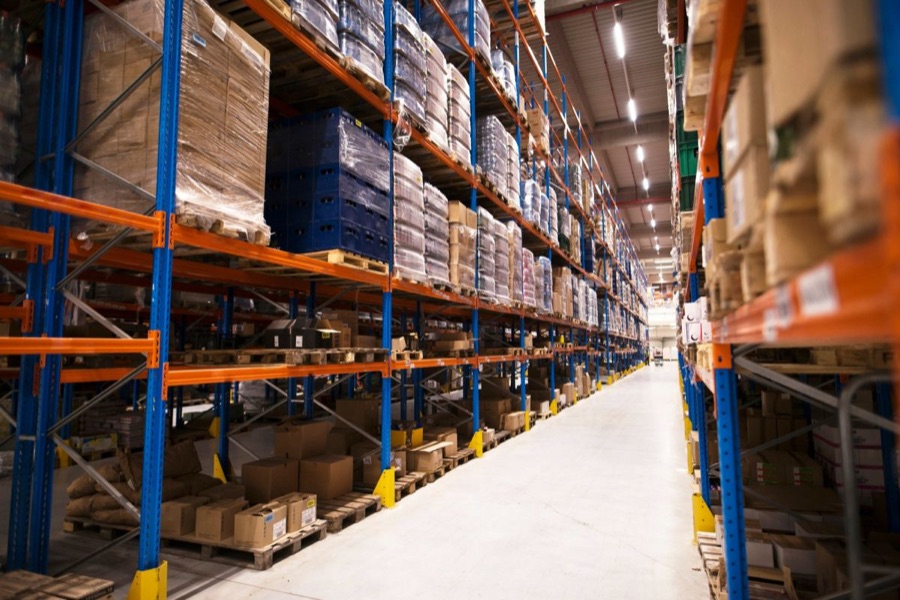
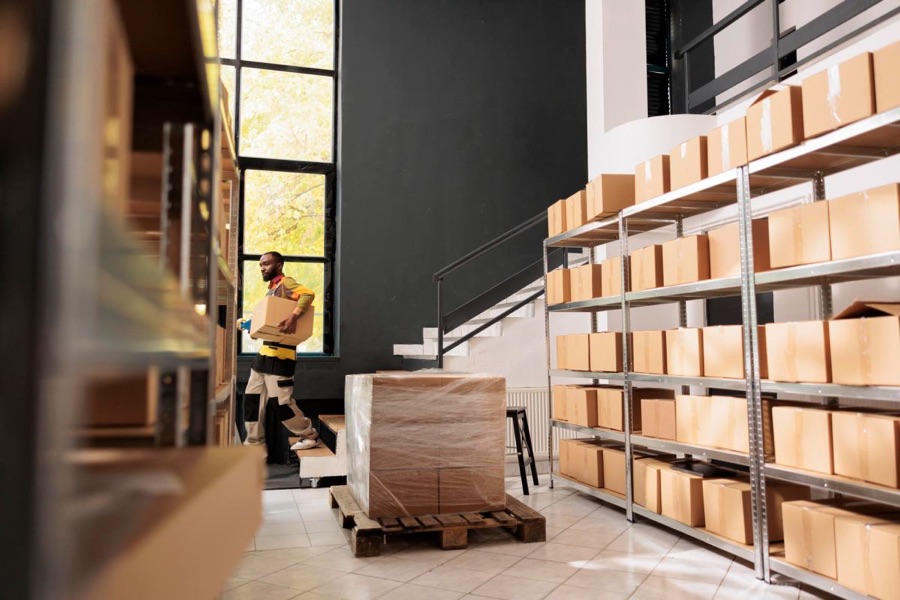
Office storage is warehousing for the things a workplace needs but cannot keep on site — surplus furniture, IT assets, files, branding material and equipment — kept secure and inventoried until they are needed again.
Lozy office storage handles the office version of a move: desks and chairs out, safe storage through the fit-out, everything delivered back and reassembled where needed once the new space is ready.
The difference from ordinary warehouse space is the list, not the building. An office stores a fixed set of things it already owns, at a known count, and that list is what gets quoted, tracked and returned.
When an office needs storage
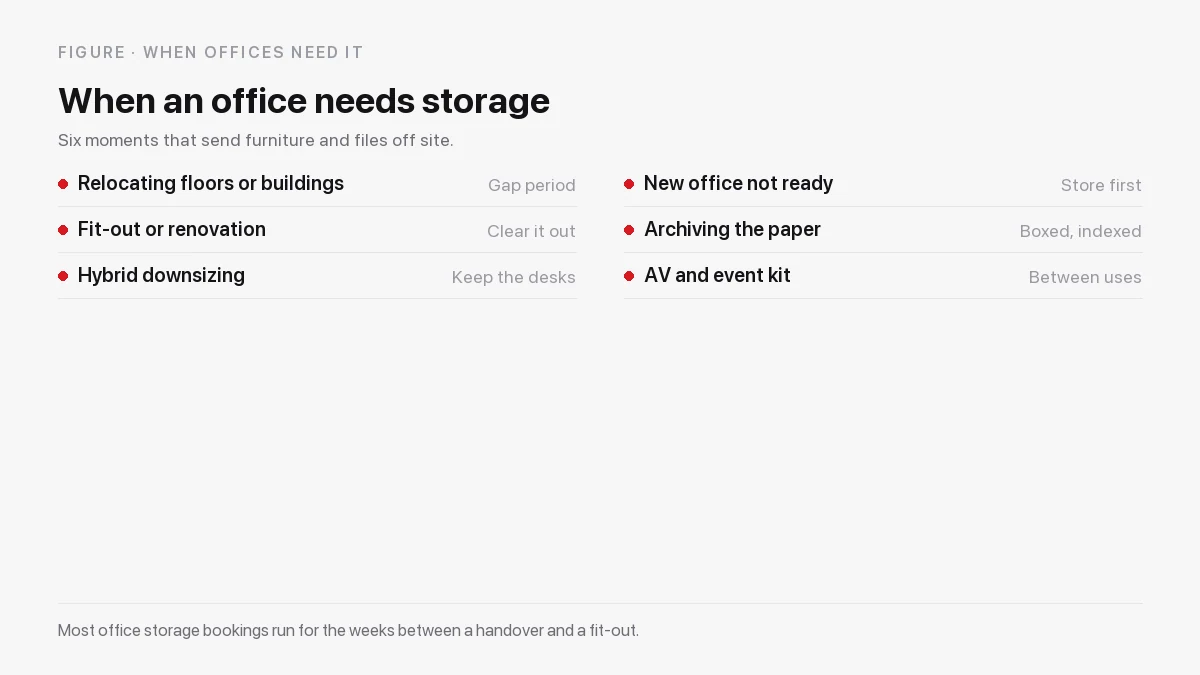
Six situations cover almost every booking, and most workplaces recognise themselves in one of them:
- Relocating to a new floor or building, with a gap between handovers.
- Fit-outs and renovation — the furniture leaves before the work starts.
- Hybrid downsizing: keeping desks for the days the team is in.
- A new office that is not ready when the equipment is.
- Archiving the paper a move shakes loose — old files, branding, records.
- Storing AV, event and training gear between uses.
The common thread is timing, not size: something has to leave before something else is ready. Office storage in Delhi NCR is built for exactly that gap, which is usually measured in weeks rather than days.
What can be stored
Four categories cover nearly every list an office hands over, and each is handled a little differently:
- Furniture — desks, chairs, workstations and storage units.
- IT assets — desktops, monitors, servers and peripherals, asset-tagged to your list.
- Files and records — boxed and indexed for retrieval.
- Branding and marketing material — safely flat-packed.
How your items are tracked
Every item is logged on an inventory list you can request at any time. That single sentence separates storing office furniture, IT assets and files from asking a favour of someone with a spare room: the list tells you what left, what sits in the unit today, and what should arrive at the new address.
Asset tags matter most for the expensive end of the list. Desktops, monitors, servers and peripherals are tagged against your own register, so the serial numbers you audit match the ones that come back. Files are boxed and indexed, which means a specific year or department can be pulled without opening the whole stack, and branding material is flat-packed so banners and standees do not crease.
What office storage costs
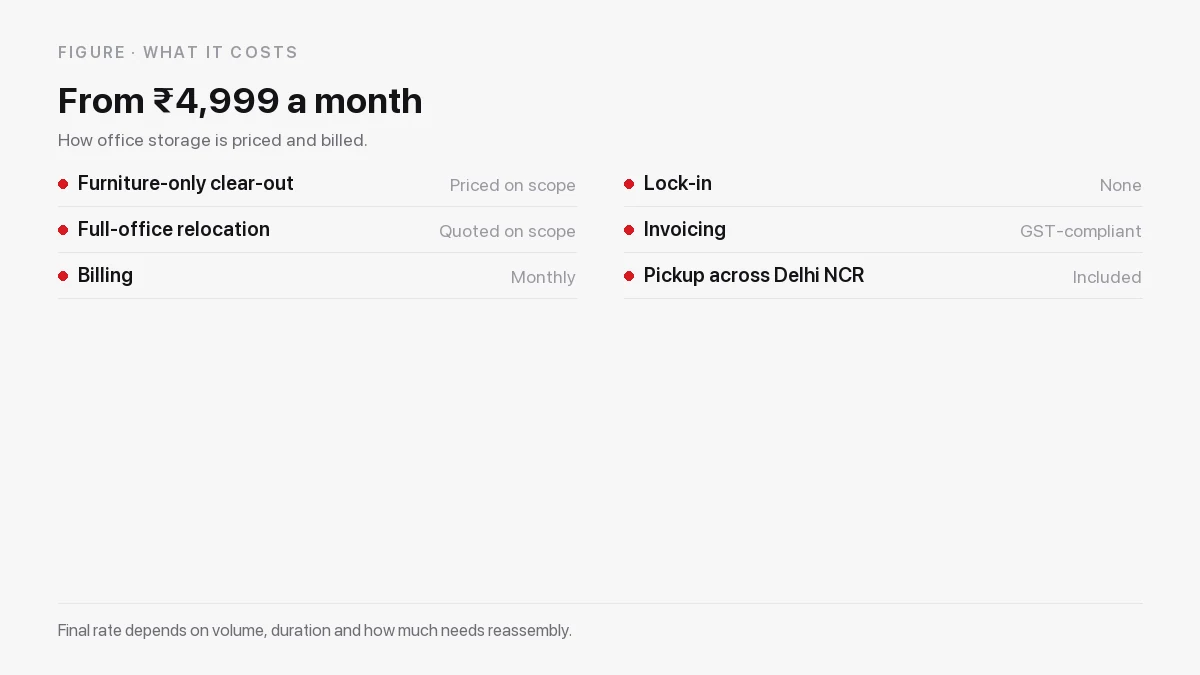
Office storage with Lozy starts at ₹4,999 per month, priced on the volume of items and the duration of the stay. That figure is where the range begins, not a flat rate for every office: a floor's surplus desks and a building's worth of workstations, servers and archives are different amounts of space held for different lengths of time.
A furniture-only clear-out and a full-office relocation quote differently, because one is a van and a corner of a unit while the other is a project with disassembly, transport, storage and rebuild. Share the scope and the quote is precise — the final rate depends on city, size and term.
What drives the cost of an office move
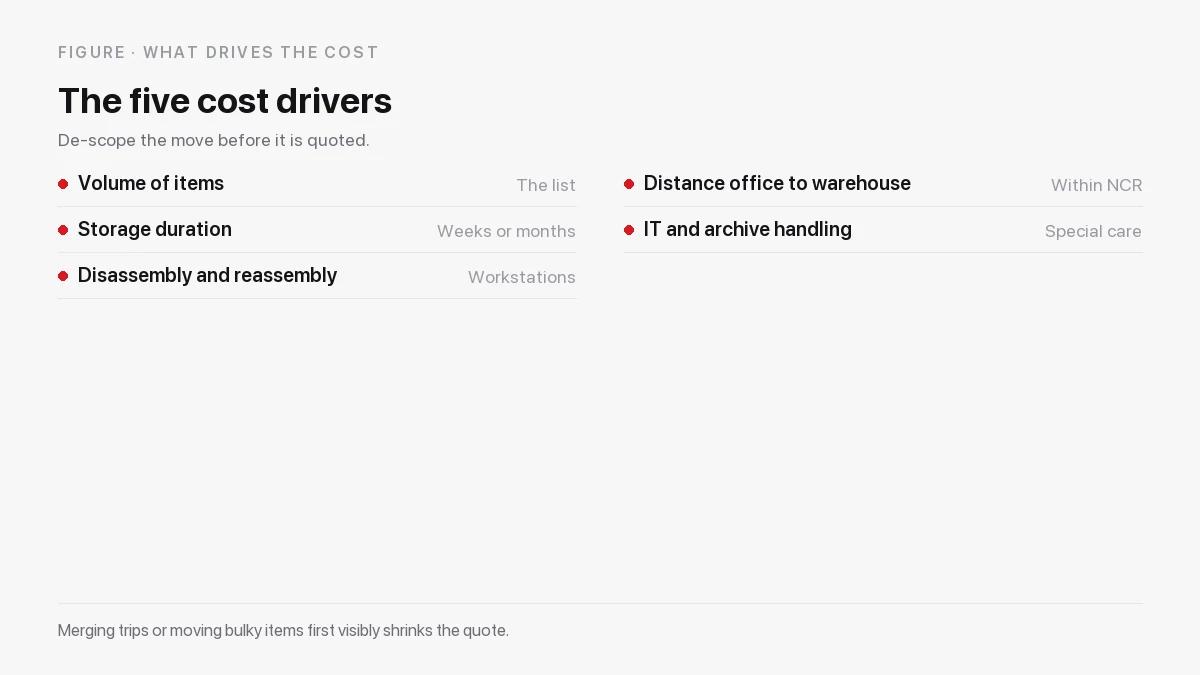
Five variables move the number, and all five are worth confirming before you accept a quote:
- The volume of items. The list you hand over is the list that gets priced — desks, chairs, workstations, boxes, screens.
- The storage duration. Weeks or months, billed for the time the goods actually sit in the unit.
- Disassembly and reassembly. Workstations, large tables and storage units that come apart have to be put back together.
- The distance between office and warehouse within NCR — a move across the city and a move across the road are not the same trip.
- Special handling for IT or archive material, which is packed and tagged rather than stacked.
Knowing the variables lets a move de-scope itself before it is quoted. Merging two trips into one, timing a pickup around a lift service, or moving the bulky items out first and working in the shell of the office until the fit-out finishes — each of those shows up in the price.
| Service | Billing | Starts at |
|---|---|---|
| Office storage (furniture, IT assets, files, branding) | Monthly | ₹4,999 per month |
| Self storage (lockers through room-sized units) | Monthly | ₹999 per month |
| Short-term storage | Weekly | ₹699 per week |
| Warehouse and godown space | Monthly | ₹12 per sq ft per month |
Two things matter as much as the headline rate. GST-compliant invoicing keeps the line item clean in the books rather than sitting in someone's personal account, and the rules on tax invoices are published on the official GST portal. Then there is the absence of a lock-in: if the fit-out finishes early you close the plan, and if it slips you keep the month running.
Storage vs a temporary office
When a fit-out runs long, the reflex is to rent interim space. An interim serviced office is the expensive answer to a storage question, because you are paying for desks, meeting rooms and a receptionist to hold furniture you are not using.
Most teams do not need desks during a fit-out; they need somewhere safe for the things not in use yet. Office warehousing covers that need without renting rooms to pile things in — the team works wherever it works, and the furniture waits in a monitored unit.
There is a quieter version of the same mistake: signing a longer lease on the old floor just to keep the furniture somewhere, which keeps an entire floor alive to shelter some chairs.
How an office passes through storage
An office move is a project with a small number of moving parts, which is why it works better as one:
- Plan. Share the item list or floor plan and get a space sized and a pickup slot booked.
- Clear out. Pickup across Delhi NCR — the same team loads, transports and unloads.
- Store. Monitored, PIN-controlled units; gaps of weeks or months are normal here.
- Restore. Redelivery to the new office, with reassembly where needed.
Between those steps there is very little for the office to do, which is the point — the people moving are the people with day jobs.
The clearance timeline, list to lift
The plan runs in four moves. List and scope: the item list or floor plan goes to us, the space is sized and the quote follows. Clearance day: the team loads, labels and moves everything — workstations come apart, cables get bagged to their desk. In storage: items sit inventoried and monitored for as long as the fit-out runs. Redelivery: the new office receives its furniture back, assembled and placed where the plan says.
Labelling is the part worth doing properly on clearance day. A workstation whose cables leave in an unmarked bag returns as a mystery; one whose parts are labelled with a desk number comes back whole.
Redelivery and reassembly
Redelivery is the half of the job offices judge the service on, and it is the half that goes wrong when storage is bought piecemeal. Furniture is placed to the new floor plan, workstations are rebuilt, and boxes are stacked where the receiving team can open them rather than in the middle of a walkway.
Timing it well is a matter of sequencing. Arriving before the carpets and the network puts the goods in the way of the trades, while arriving after both means the team walks into a working office.
Storage for hybrid teams
Hybrid working created a category of office storage that has nothing to do with a move. A team that is in for two or three days a week does not need the same desk count as before, but it does not want to throw desks away either — the pattern could still change back.
The practical answer is to keep the working set and store the surplus. Chairs, spare workstations, monitors and pedestals move into a unit, the floor stays generous instead of crowded, and the equipment stays yours for the week the team returns at full strength. Because the unit is monitored and PIN-controlled, the decision is reversible: it is furniture in reserve, not furniture donated.
If the surplus is a home's contents rather than an office's, household warehousing is the right starting point.
Storing IT assets and servers
IT assets are the part of an office move that cannot be improvised. Desktops, monitors, servers and peripherals get asset-tagged against your list, so the serial numbers that go into storage are the serial numbers that come out of it.
Hardware should be powered down, backed up and wiped before it is boxed, and a device with a battery is better off stored with a little charge than completely flat for months. Cables, docks and power bricks travel bagged with the machine they belong to, and servers and networking gear want their racks or cradles.
Two paperwork points come up often enough to plan for. If any of the hardware was imported rather than bought locally, duty and customs supervision sit with the Central Board of Indirect Taxes and Customs, and the import documents belong with the goods. If equipment is sent abroad for refurbishment and will return, the rules on what may move and on what basis are set out by DGFT. The standards that apply to electrical and electronic equipment are published by the Bureau of Indian Standards. Lozy also runs customs clearance for offices that move goods across borders as well as across cities.
Files, records and archiving
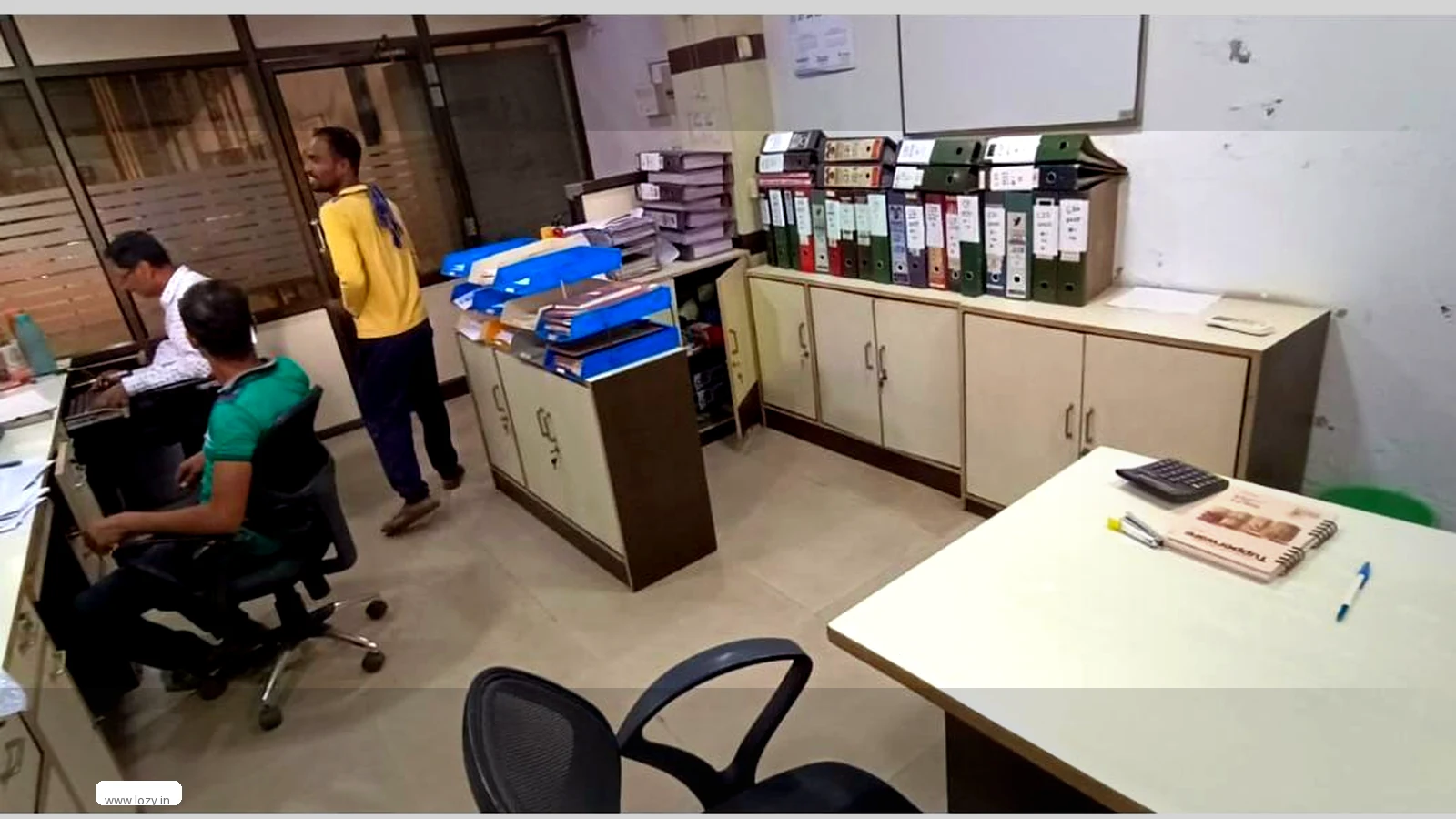
Every move shakes loose a quantity of paper, and the honest thing to do with most of it is to stop carrying it around. Files and records go into storage boxed and indexed, so a department, a financial year or a client file can be retrieved without opening the whole stack.
Indexing is the whole value here. A box is just a box; a box labelled with its function and years is a working archive. Keep one master list of the boxes, kept with the office rather than with the movers. If paperwork forms the bulk of what you are storing rather than a by-product of a move, the dedicated service is document storage.
Between moves: making storage earn its place
Not every booking is a move. Plenty are quieter versions of the same need: the event kit that lives somewhere between uses, the spare chairs for the busy weeks, the records that visit before they retire.
Office storage works for those too — a small, monitored footprint that keeps the workplace from turning into a warehouse, and shrinks the moment it stops earning its place. A unit can sit idle for a month between events or hold a floor's worth of overflow for a season; either way it bills like what it is, which is space in reserve. The quarterly test is simple: if the goods have not been touched since the last review and will not be touched before the next one, the unit is doing its job.
Off-peak needs follow the same logic. A seasonal push that needs extra desks or a temporary dispatch corner can be covered with short-term storage from ₹699 per week rather than a longer commitment, and handed back afterwards. Short terms and long terms are the same shelf rented for a different number of weeks.
Access, security and your PIN
Units are monitored and PIN-controlled, and the PIN is unique to you. You do not ask a manager for a key, you do not depend on someone being on duty, and you do not have to explain a Saturday collection to anyone.
What you should ask about before booking is access for more than one person, because an office rarely has a single keyholder. Decide whether the facilities manager, the IT lead and the office manager each need access while the goods are still being packed.
How much space an office needs
Sizing an office storage booking is easier than sizing a home move, because offices own a countable list. Start with the furniture that has to leave, add the boxed files, then add the IT. That total, not the floor area you are vacating, decides the unit.
The usual mistake is to size by the old office rather than by the list. Desks that travel flat do not fill the space they occupied standing up, and indexed boxes take far less room than the filing cabinets that held them. Where the count is unclear, over-list rather than over-book: a generous list costs a smaller unit, while a guessed unit costs two moves in one month. Office storage can be resized once the goods prove you wrong.
Planning storage around a fit-out
The most useful thing an office can do is let the fit-out timeline set the storage plan, rather than letting the storage plan chase the fit-out. Work backwards from the day the new space is signed off, and the pickup date, the storage duration and the redelivery slot all fall into place.
Two dates deserve care. The pickup should sit after the last working day on the old floor and before the trades arrive, so the two jobs never share a corridor. Redelivery should sit after the carpets, the network and the layout are settled, so the goods land in a finished room. Everything between those two dates is a storage duration, and monthly billing stops a slipping fit-out from becoming an expensive one.
Mistakes to avoid
Most of the trouble offices run into with storage comes from the same short list, and all of it is avoidable with questions asked before the first van is loaded:
- Sizing by the old floor instead of the list. Count the desks, the boxes and the screens. The floor area you are leaving tells you nothing about the space you are renting.
- No inventory list. If nothing is itemised, nothing can be checked. Ask for a list at pickup.
- Forgetting the IT list. Asset tags are the only reliable way to reconcile serial numbers on the way back, so keep the hardware sheet separate from the furniture sheet.
- Leaving the paper unindexed. An archive nobody can search is a pile with rent. Label every box with its function and its years.
- Assuming access works for the whole team. Settle who holds access before pickup, not on the day someone needs a monitor.
- Locking into a term longer than the fit-out. Monthly billing with no lock-in exists so that a finished project does not keep paying rent.
None of those decisions is expensive to take correctly, and every one of them is expensive to reverse.
Office storage and the other Lozy services
Office storage sits inside the same network as the rest of Lozy's warehousing, which matters when the list turns out to be wider than expected. If the bulky end of the list is furniture rather than a working set, furniture warehousing handles that job on its own. If you need space rather than a service — a floor area you will run yourself — start with warehouse for rent, where godown space begins at ₹12 per sq ft per month.
Where the need is a small private unit rather than a managed office move, self storage starts at ₹999 per month, and on-demand warehouse space suits an office that wants flexibility rather than a fixed unit. You can compare service types on the services page, and for an office that also ships goods, business warehousing covers pick, pack and dispatch rather than storage alone. Wider background on how the network is run sits on the Lozy blog.
Where Lozy office storage is
Lozy runs 77+ warehouses across the network with over 1 million square feet of live space, spread over 9 city hubs covering Delhi NCR, Jaipur and the surrounding NCR belt. Office storage is served from that same network, so you are booking space inside facilities that already run at scale rather than a one-off site.
For an office in New Delhi, the network includes the Warehouse in Dwarka for Business and 3PL, the Warehouse in Ghevra Metro and the Warehouse in Ghevra Metro 2, plus Self Storage for Home and Business in Dwarka Sector 26 and the Self Storage Unit in Dwarka Sector 27. In Gurgaon it holds the Warehouse in Manesar Sector 8, the Warehouse in Manesar M-Zone, Sector 9, the Warehouse in Manesar Sector 8 (Shedded), the Warehouse in Manesar, Gurugram, the Warehouse in Kherki Daula, Gurugram and the Warehouse in Gurugram for Business and 3PL. Haryana is served by the Lozy Jamalpur Distribution Center and the Factory and Warehouse Space in Faridabad (DLF Industrial Area 2), and Jaipur by Storage Space in Jaipur.
You can see the full list on the warehouse listing page and the city picture on the New Delhi, Gurgaon and Haryana location pages.
How Lozy helps
Lozy office storage takes a project most offices do once every few years and runs it as a single job: plan, clear out, store, restore. You share the item list or the floor plan, we size the space and quote it, the same team loads, transports and unloads across Delhi NCR, and the goods come back assembled where the plan asks for them.
Office storage starts at ₹4,999 per month, priced on volume and duration, with monthly billing, monitored and PIN-controlled units, an inventory list you can request at any time, GST-compliant invoicing and no lock-in if the fit-out finishes early. The full picture of what the service covers is on the office warehousing page, and every facility in the network, with its city and its size, is listed on the warehouse listing page. For a wider view of what Lozy runs, the about us page explains how the company is built.
Storing something, or just comparing?
Tell us what you need to store and where. We reply with availability and a price — usually the same working day.
About the author
Lozy Editorial Desk. This guide was written by the Lozy Editorial Desk, the in-house team that covers warehousing, self storage, logistics and customs/EXIM topics for lozy.in. We write from Lozy's own facility and pricing information and from public, citable sources. We do not publish invented statistics, ratings or reviews.
Sources. Pricing, inclusions and facility details are Lozy's own published information. External links point to official Indian government resources — the GST portal, the Central Board of Indirect Taxes and Customs, the Directorate General of Foreign Trade and the Bureau of Indian Standards — for the reader's reference, not as a substitute for professional advice.
Last updated: 11 October 2026. Have a question the FAQ below does not answer? Call +91 93547 12345 or email care@lozy.in.
Need warehousing or storage in India?
Request a free, tailored quote in under 2 minutes — free pickup, no lock-in.