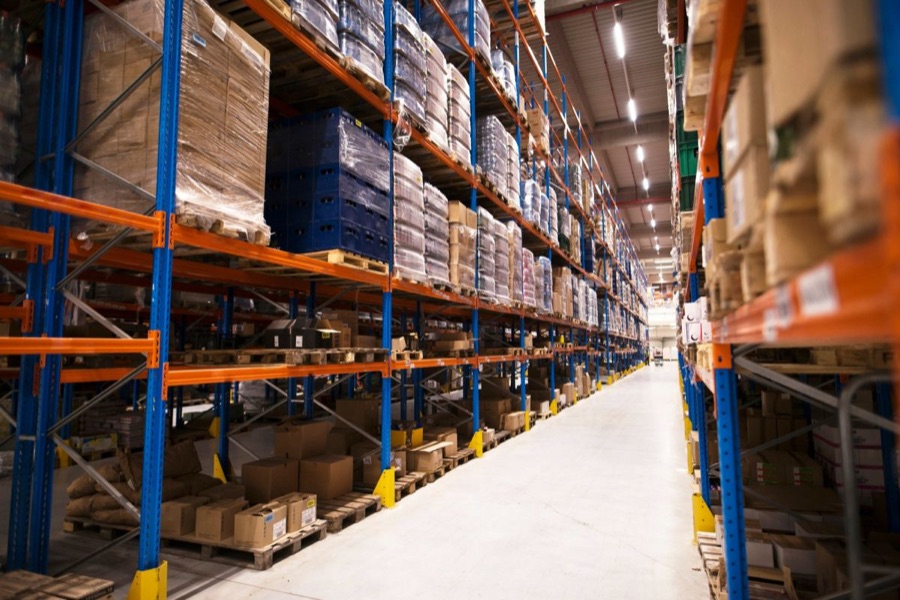
On-Demand Warehousing: Costs, Booking and How Flex Works (2026 Guide)
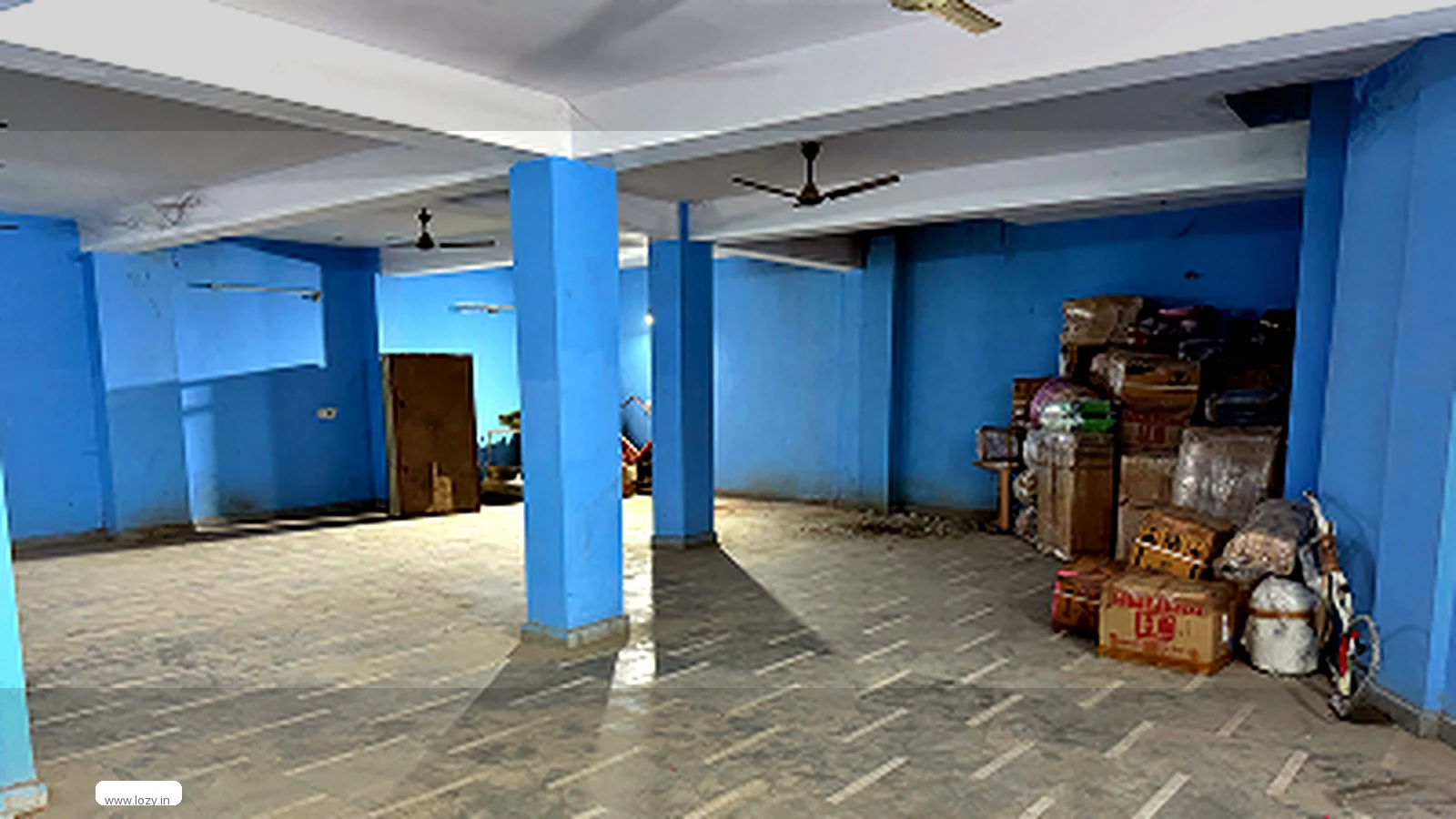
Short answer: On-demand warehousing is warehouse space you book by the month and hand back when you are done — no multi-year lease, no fit-out and no paying for empty racks. Lozy's on demand warehouse space starts at ₹14 per sq ft per month, and the final rate depends on city, size and term. Book it when a peak arrives; release it when the peak ends.
Key takeaways
- On-demand warehousing means paying for space by the month for as long as you need it, instead of funding the quiet months as well as the busy ones.
- Lozy's on demand warehouse space starts at ₹14 per sq ft per month, with monthly billing, GST invoicing and no setup charges.
- It fits variable demand — festive stock, a product launch, project material, one imported consignment, a new city trial, or overflow when your own godown is full.
- You can keep a steady baseline footprint on one plan, layer extra space over it for the peak weeks, then release it.
- Space is released when you say the requirement is done, not when a lease term expires: the plan renews monthly.
- Lozy's network runs 77+ warehouses and more than 1 million sq ft of live space across 9 city hubs, with space from mini units to full bulk blocks.
What on-demand warehousing is
On-demand warehousing is warehouse space you book when you need it and hand back when you do not. There is no multi-year lease to negotiate, no fit-out to fund, and no invoice for empty racks through a slow month. You take the space on a monthly plan and flex it to match real stock levels.
The difference from a conventional warehouse is really a difference in time. A standard lease is priced on the assumption that you will still be there in year three, so it arrives with a deposit, a fit-out, racking to buy and a minimum term you keep paying whether the goods move or not.
On-demand space turns that around. You pay for the footprint and the duration you actually use, and because the plan renews monthly you are never funding space you have stopped needing. The commitment is a month at a time, so the size of the bill follows the size of your stock.
It is worth being clear about what this is not. On-demand warehousing is not a self storage room and it is not a courier service. The space holds business stock, staff handle the goods, and there is a register that treats what you leave there as inventory. You can read how Lozy structures the model on the on-demand warehouse service page.
Who books on-demand space
On-demand space suits businesses whose storage needs move faster than they can predict them. The requirement is usually one of a small number of patterns, and naming your own pattern decides whether the model fits.
Seasonal and festive spikes
Festive inventory needs room for eight weeks, not eight years. A seller who carries a baseline assortment all year and then triples it for a festival season does not want a lease sized to the peak, because the peak is temporary and the lease is not. On-demand space lets the peak be a booking instead of a commitment. If your whole year is a series of peaks, see seasonal warehousing.
Overflow, launches and imported consignments
The other patterns are overflow and uncertainty. Your own godown or fulfilment warehouse hits capacity and the next few pallets need somewhere safe. A new product goes out and sell-through is still an estimate. A city is being tested before you commit to a physical set-up there. A consignment lands early and waits to be allocated.
Each of those is a space requirement with an end date, and an end date is what a monthly plan is built for. Online sellers find the same logic in e-commerce warehousing.
How booking works, step by step
The whole point of the on-demand model is that starting is quick. There is no build phase and nothing to install before your first delivery. Four steps cover it.
- Tell us the requirement. What the goods are, roughly how much room they take, and how long you need the space.
- Get a space matched. We recommend a unit or a racked area with a monthly price attached — from mini units through to full bulk blocks.
- Book online. Monthly billing, GST invoicing and no setup charges.
- Move in and flex. Scale up or trim down on the same monthly terms, or release the space when the requirement ends.
Because the price is attached to a space and a month rather than a signed term, nothing needs renegotiating when your stock changes shape. You can see what is available on the warehouse listing.
Getting your first consignment in
The first delivery sets the pattern, so it is worth doing once, properly. The consignment arrives at the bay, is counted against the delivery documents, and every lot is given a position and a record before it joins the shelf.
From that point the space behaves like any warehouse: goods move in, goods move out, and the register follows both. When the requirement ends, goods leave against the same record they entered on, and the space is handed back at the month's edge.
What on-demand warehousing costs
On demand warehouse space with Lozy starts at ₹14 per sq ft per month, and you pay for the footprint and the duration you actually use. Because the plan renews monthly, a slow month costs a slow month's rate rather than a year of committed rent.
Compare that with the running costs of a fixed lease: a deposit up front, a fit-out, racking to buy and a minimum term you keep paying through a quiet quarter. When the requirement is genuinely variable, the monthly model is usually cheaper across a full year.
What moves the rate
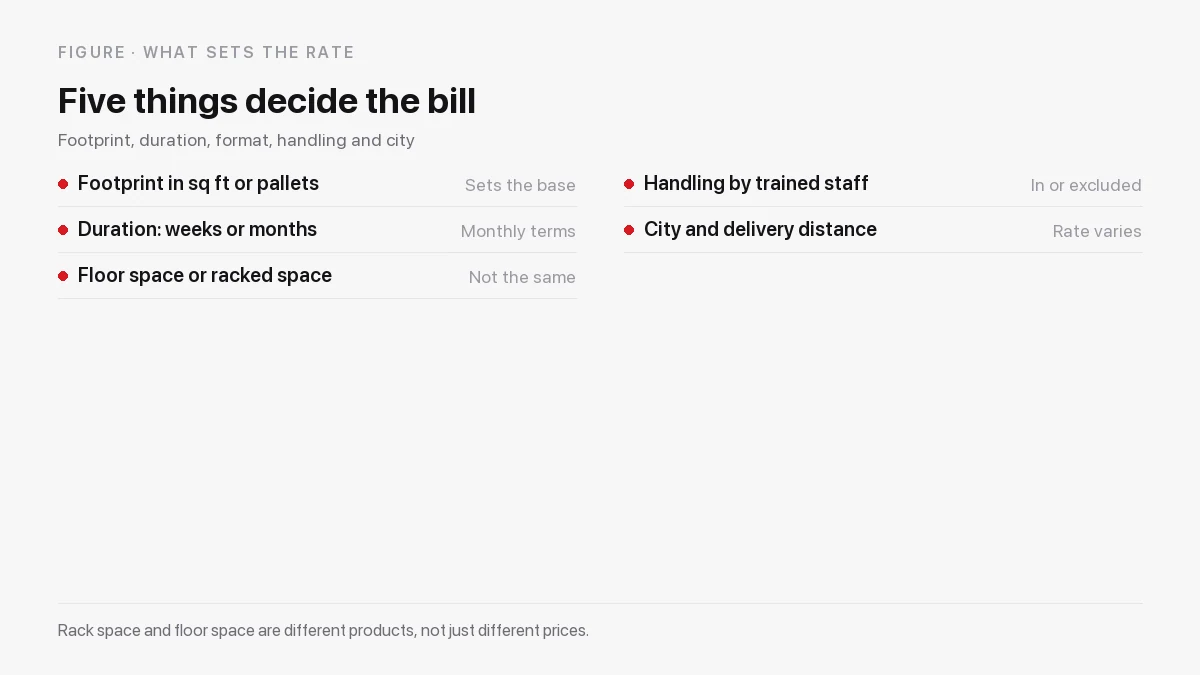
- Footprint. How many square feet, or how many pallet positions, the stock actually needs.
- Duration. Whether the space is needed for six weeks or six months, and whether it is likely to be extended.
- Format. Floor space and racked space are different products, and the cheaper one is not always the right one.
- Handling. Whether goods are taken in and out by trained warehouse staff, or carried by your own team.
- City and location. Rates are not uniform across the network, and the closest facility to your delivery routes usually matters more than the lowest rate.
Wherever a price appears in this guide, read it as a starting point. Final rates depend on city, size and term, and a mini unit and a full bulk block are not priced the same way. The four published starting points are below.
| Space | How it is billed | Pricing starts at |
|---|---|---|
| On-demand warehouse space | Per sq ft per month, renewed monthly | ₹14 per sq ft per month |
| Warehouse and godown space | Per sq ft per month | ₹12 per sq ft per month |
| Self storage unit | Per unit per month | ₹999 per month |
| Short-term storage | Per week | ₹699 per week |
The other three starting rates belong to neighbouring products: warehouse and godown space from ₹12 per sq ft per month, self storage from ₹999 per month and short-term storage from ₹699 per week. On-demand plans are billed monthly with GST invoicing. If your registrations and returns need attention, the GST portal is the official system for both.
Flexing up and down month by month
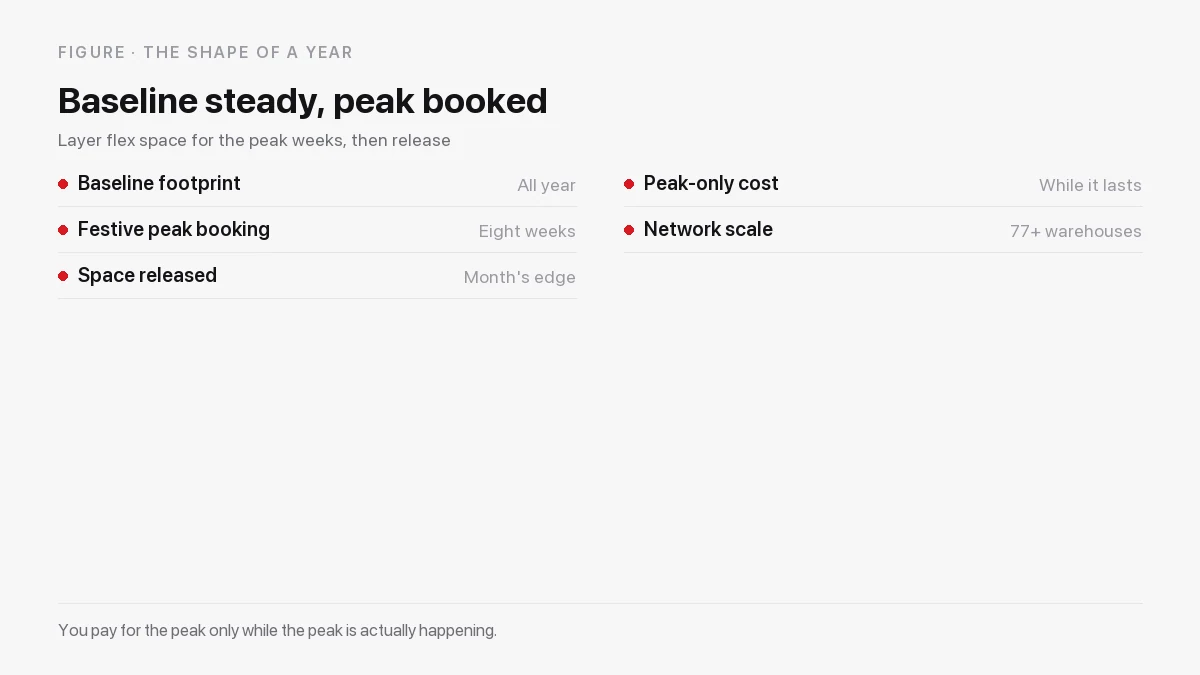
Flexing is the feature that pays for itself. Suppose you hold a baseline footprint on a stable plan and the festive season arrives. You layer extra on-demand space over the baseline for the peak weeks, then release it when the stock clears. You pay for the peak only while the peak is happening, and you never renegotiate a lease to do it.
Up and down is the same motion. Adding a unit or a racked block for six weeks is a booking. Handing one back at the month's edge is a note to your contact. Neither needs a new agreement, a deposit or a fit-out, which is what keeps a short requirement genuinely short.
The terms that make this work are deliberately invisible. Plans renew monthly, space is released when you say the requirement is done, and the records of everything stored travel with the booking. If your requirement is shorter than a month, short-term storage by the week will usually fit better than a monthly plan.
What can go into on-demand storage
On demand storage holds what a standard dry warehouse holds. In practice the list is familiar: palletised goods, cartons and cases, packaging material, equipment, shop fittings, furniture and records. A business holding stock as inventory gets the handling discipline it would expect from its own godown, which is the idea behind inventory warehousing.
Share your list before booking if anything needs special handling, and we will confirm the right facility before anything moves. Two categories are worth flagging early. The first is records, which have their own storage and retrieval habits — see document storage. The second is anything high in value, where the honest question before booking is what cover exists if goods are damaged in storage or between sites.
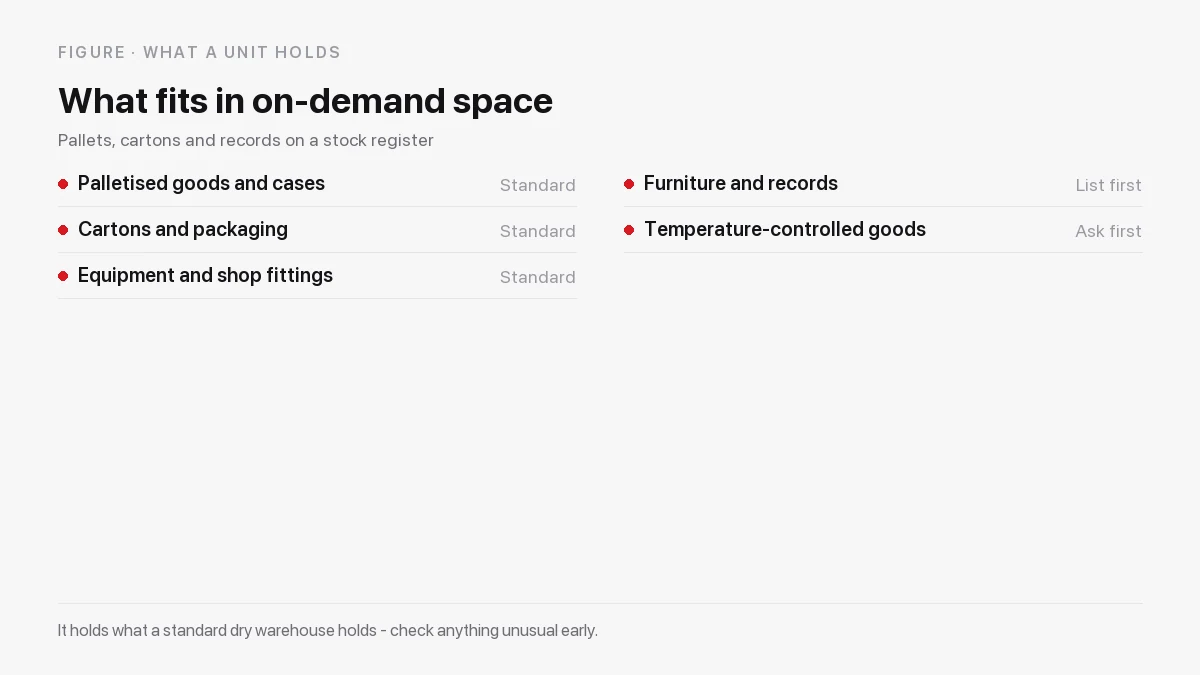
Anything that needs temperature control or a specialist licence should be mentioned in the first conversation rather than on the day the truck arrives. It is easier to solve before a delivery date than after one.
On-demand warehousing vs self storage and long leases
Flexible storage comes in sizes, and the right size depends on who handles the goods and how the goods arrive.
vs mini warehouses and self storage
A self storage unit suits personal scale — boxes, furniture, a room's worth of belongings — where you do the carrying and the counting. You hold the key, you know what is inside, and the unit is priced as a room rather than as a floor. That is the right product for a house move, a renovation or a small trader with a few dozen cartons.
On demand warehouse space picks up where that ends. Pallets instead of boxes, handling by trained staff instead of by you, and records that treat the goods as business stock rather than as possessions. A simple test decides it: if the goods arrive in a truck, you want the warehouse; if they arrive in a car boot, the storage unit will do.
When a long-term lease is the better answer
On-demand is not the answer to every storage question, and it is worth saying so plainly. If your stock profile is steady, the volume is predictable for years and the facility sits close to your customers, a fixed plan at a lower per-square-foot rate is often the cheaper route over a long horizon. You are trading flexibility for price, and if you never need the flexibility, that trade is a good one.
The monthly model earns its place when the requirement moves: peaks, launches, project stock, one-off consignments, a city being tested and overflow that has no end date yet. A business can hold both at once — a steady baseline on a fixed plan with on-demand space layered over it for the busy weeks.
| If your requirement is... | The closer fit |
|---|---|
| Steady stock, predictable for years | Long-term warehousing |
| An eight-week festive peak | On-demand space, then release it |
| A room's worth of household goods | Personal storage |
| Online orders to be picked and packed | E-commerce warehousing |
Every option sits side by side on the services page, which is the quickest way to see what else a requirement like yours could use.
Planning around peaks: where on-demand space fits
Most businesses do not need one fixed answer to warehousing. They need the shape of their year. Baseline stock can sit almost anywhere — a small godown, a racked corner of a friend's facility, a room at the back of the shop. The peaks need space on a known date, at a known size, with room for the truck to reach the door.
A workable pattern runs like this. Keep a baseline footprint on a stable plan for the stock you always carry. Layer extra on-demand space over it for the peak weeks. Release it when the peak clears. Do it once and the following year's peak becomes a booking in your calendar rather than a scramble in your busiest fortnight.
The same logic applies to a single consignment that lands early. An imported lot has to sit somewhere until it is allocated to orders, and the customs side of that journey runs through Indian Customs' electronic systems — ICEGATE is the trade portal used for those filings, and the CBIC is the customs authority behind it. Lozy runs customs bonded warehouse space and customs clearance alongside its storage, so the space and the paperwork can sit with one team instead of three.
Where on-demand space is available
Lozy's on demand warehouse space runs from mini units to full bulk blocks in Delhi NCR and across PAN India. The network is 77+ warehouses and more than 1 million sq ft of live space across 9 city hubs, which is why a requirement can usually be matched to a facility rather than to whichever single site is closest to head office.
Among the real facilities on the network, the ones most often used for flexible and business storage include:
- Lozy Jamalpur Distribution Center — Haryana
- Warehouse in Dwarka for Business and 3PL — New Delhi
- Warehouse in Ghevra Metro and Ghevra Metro 2, Lozy Warehousing Company — New Delhi
- Factory and Warehouse Space in Faridabad, DLF Industrial Area 2 — Haryana
- Warehouse in Manesar Sector 8, Manesar Sector 8 (shedded) and Manesar M-Zone, Sector 9 — Gurgaon
- Warehouse in Kherki Daula, Gurugram — Gurgaon
- Self Storage Unit in Dwarka Sector 27 — New Delhi
- Storage Space in Jaipur — Jaipur
For the wider view, the New Delhi and Gurgaon location pages set out what is live in each market, with the rest of the belt on the Haryana page. Businesses testing a new market often do it on the back of sales rather than exports, but if trade across borders is part of the plan, India's foreign trade regime and its licensing side are administered by the DGFT.
Mistakes that cost money on flexible space
Most problems with on-demand storage come from treating it like a lease, or from leaving one detail unasked. Six of them account for most of the waste we see.
- Sizing to the peak and paying for the trough. Booking a full-year block for a two-month spike pays the same rent in the quiet months. Book what this month needs and flex upward when the peak lands.
- Booking before the goods have a date. A launch can slip and a consignment can be delayed. A monthly plan can start on the day the first truck arrives.
- Not saying what the goods are. Special handling has to be known before the first delivery, not discovered at the bay with the vehicle waiting.
- Comparing per-square-foot rates without the inclusions. Floor space, racked space and handled storage are different products. A lower rate that excludes handling is not a lower rate.
- Letting the space roll on after the requirement ended. Monthly renewal is a feature only if you use it. Put the release date in the calendar on the day you book.
- Choosing a city with no route to your customers. The cheapest unit in the network is expensive if every delivery is a long drive.
None of this needs special knowledge, and none of it is a trick. It needs the questions asked on the day you book rather than the week you need to move, which is what the next section is for.
Questions to ask before you book
Eight questions cover almost everything worth knowing about a flex space before the first delivery.
- What is included in the monthly rate — handling, racking and access to the loading bay?
- Is the space floor or racked, and which of the two suits the goods I actually have?
- What is the smallest and the largest size I can flex to from here?
- How do I release the space, and from which month's edge does the release take effect?
- How are the goods recorded, and what does the stock report look like?
- Who counts the consignment in and out, and against which documents?
- Does anything on my list need special handling or a different facility?
- How is the billing raised, and does the invoice carry GST?
A good provider answers all eight without hesitating, and the answers should match the terms you are given in writing. If you would rather have the answers for your own requirement, send the goods list, a rough size and your dates, and availability and a price come back together.
How Lozy helps
Lozy's answer to flex is deliberately plain: book the space by the month, keep the terms short, and let the space change when the requirement does. On-demand warehousing should ask one question of you — what does this month need — and answer the rest itself.
In practice that means the following, on on demand warehouse space starting at ₹14 per sq ft per month:
- Units from mini to bulk. The first booking can be small, which matters when you are testing a market or holding one consignment.
- Monthly billing, GST invoicing and no setup charges. Nothing to install before the first delivery arrives.
- Handling by trained staff. Goods arriving on a truck are counted against the documents, given a position and recorded.
- Racked or floor space matched to the goods, so you are not paying for the wrong format because it was the only one free.
- A defined release. Space is handed back at the month's edge when you say the requirement is done, and the records travel with the booking.
- Related space for when the requirement changes shape. Warehousing for business, industry and households sits on the same network, so a peak that becomes a permanent footprint does not mean starting the search again.
Start with the on-demand warehouse page, browse every space available to book, or read more about the company on the about us page and on the Lozy blog.
The bottom line
On-demand warehousing is for the space requirement that has an end date. If your volume moves, if your peaks arrive in a known week, or if a consignment lands before you are ready for it, paying by the month and releasing when you are done is usually the cheaper and simpler answer. If your stock is flat and predictable for years, a fixed plan is likely to beat it on price, and it is worth saying so.
For everything in between, the monthly model removes the two costs that hurt most: the deposit and fit-out you pay before storing anything at all, and the rent on empty racks through a slow month. Space starts at ₹14 per sq ft per month, with monthly billing, GST invoicing and no setup charges. Tell us the goods, the rough footprint and the dates, and the rest is a booking.
Storing something, or just comparing?
Tell us what you need to store and where. We reply with availability and a price — usually the same working day.
About the author
Lozy Editorial Desk. This guide was written by the Lozy Editorial Desk, the in-house team that covers warehousing, self storage, logistics and customs/EXIM topics for lozy.in. We write from Lozy's own facility and pricing information and from public, citable sources. We do not publish invented statistics, ratings or reviews.
Sources. The definition, booking steps, intake process, inclusions and on-demand pricing are Lozy's own, taken from the live on-demand warehouse service page. External references point to official Government of India systems: CBIC and ICEGATE for customs, the GST portal, and the DGFT for foreign trade.
Last updated: 11 October 2026. Have a question the FAQ below does not answer? Call +91 93547 12345 or email care@lozy.in.
Need warehousing or storage in India?
Request a free, tailored quote in under 2 minutes — free pickup, no lock-in.