Warehouse in Delhi: Rent, Prices and Locations (2026 Guide)
Short answer: A warehouse in Delhi can be a small godown, a racked commercial unit, an industrial shed or a lockable self storage room. Space from Lozy starts at ₹12 per sq ft per month in Delhi and around it, billed monthly with no long lock-in. This guide covers locations, prices and how to choose.
Key takeaways
- A warehouse in Delhi is usually rented by the square foot per month, not bought, and rates fall sharply once you move a few kilometres outside the city boundary.
- Delhi's own warehouse belts are in the south-west (Dwarka, Dhulsiras, Ghevra, Mundka, Najafgarh) and the north-west (Narela, Bawana, Bakkarwala), with older clusters at Naraina, Mayapuri and Okhla.
- If you need a big floorplate, the space is almost always in the surrounding NCR — Gurugram, Ghaziabad, Sonipat, Jhajjar and Faridabad — not inside Delhi.
- Delhi has one of India's largest inland container depots at Tughlakabad, plus air cargo at IGI Airport. Importers should look at bonded storage, not just rent per square foot.
- Whatever rate you are quoted, ask what is included: GST, handling, minimum term, deposit and who pays for racking and labour.
Searching for a warehouse in Delhi usually starts the same way: a trader needs more space than the shop has, a distributor is drowning in cartons, or an online seller has run out of room at home. The next question is almost always "where, and how much?"
Delhi is a difficult city to store goods in. It is dense, land is expensive, and much of the affordable space sits just outside the city boundary rather than inside it. This guide explains what kind of warehouse you can actually get in Delhi, which areas have them, what rent looks like in 2026, and how to compare quotes without getting caught out. Everything here is drawn from Lozy's own verified facility and pricing information and from official Government of India sources.
What a warehouse in Delhi actually means
"Warehouse" is a loose word in India. When people search for a warehouse in Delhi, they are usually looking for one of five quite different things — and the price differences between them are large.
- A godown. The traditional Indian term for covered storage space. Often plain, sometimes older stock, usually the cheapest per square foot. Good for cartons, hardware, building material and non-perishable trade stock.
- A commercial or business warehouse. A monitored unit with racking, loading access and proper entry control. This is what most small and mid-sized businesses actually rent. See business warehousing and commercial warehousing.
- An industrial warehouse. Large floorplates, high ceilings, fork-lift access and space for truck movement. Suits manufacturing, bulk importers and distributors. See industrial and bulk warehousing.
- Self storage. A lockable room you alone can access, priced per unit per month rather than per square foot. Used by homes and small businesses that need a private space rather than a shared floor. See the storage unit size guide.
- A bonded warehouse. A licensed space where imported goods can be stored before customs duty is paid. A separate category with its own rules, covered further down.
Knowing which of these you need is the single fastest way to narrow your search — and to stop paying for handling, racking or security you will never use.
Where warehouses are in Delhi
Delhi's warehouse stock is not spread evenly. It clusters where trucks can move and where land is cheap enough to store things on, which in practice means the edges of the city and the older industrial pockets.
The main Delhi belts
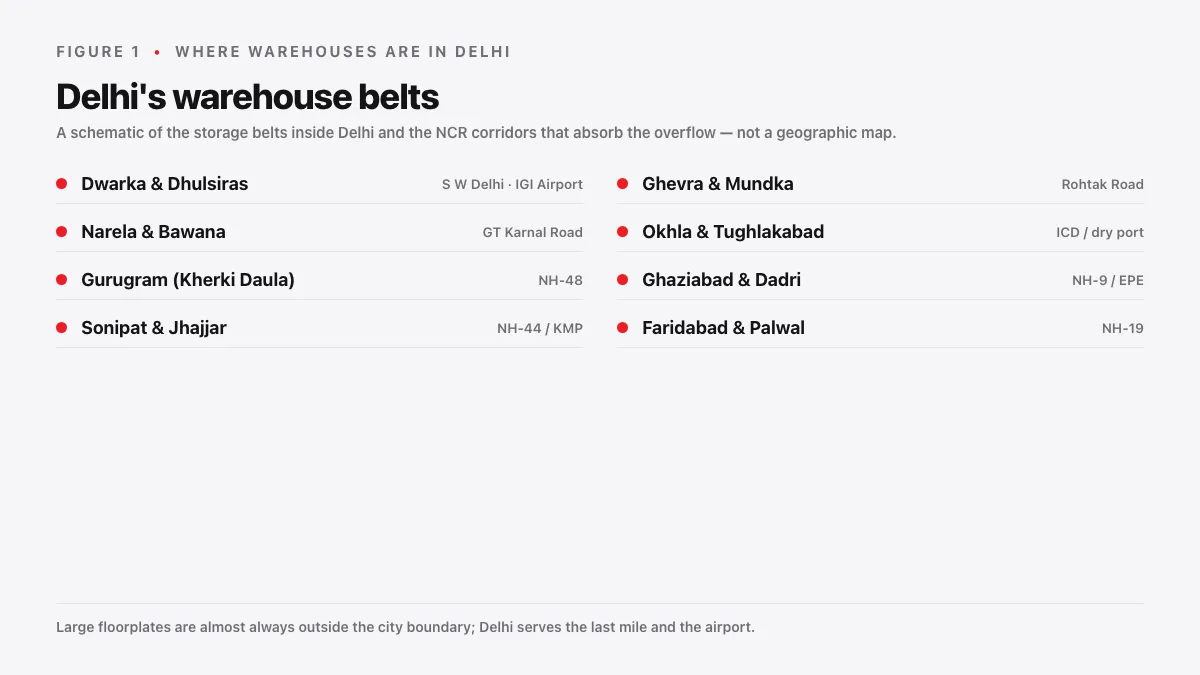
- South West Delhi — Dwarka, Dhulsiras and the IGI Airport belt. The strongest concentration of modern, well-run warehouse and self storage space in Delhi, and the most convenient if you move goods by air. Lozy runs a facility in Dwarka Sector 26 and a godown near IGI Airport at Dhulsiras, Dwarka Sector 24.
- North West Delhi — Ghevra, Mundka, Narela and Bawana, along Rohtak Road and the GT Karnal Road side. Traditionally the godown belt for grain, timber and trade stock. Lozy has units near Ghevra Metro station plus space at Ghevra and Mundka.
- West Delhi — Naraina, Mayapuri, Kirti Nagar and Peeragarhi. Older industrial estates close to the city centre; convenient, but typically older buildings and tighter access for large vehicles.
- South Delhi — Okhla and the Tughlakabad belt. Close to Delhi's inland container depot, which makes it relevant for importers, but capacity is limited and demand is high.
And the NCR edge, which is where the big space is
Inside Delhi, large floorplates are scarce and expensive. Most businesses that need more than a few thousand square feet end up in the surrounding National Capital Region, a short drive out but on the right side of the highways:
- Gurugram — Kherki Daula, Manesar and Garhi Harsaru, along NH-48. Lozy has space around Kherki Daula and near the ICD and expressway at Garhi Harsaru.
- Ghaziabad and Greater Noida — the Dadri belt, along NH-9 and the Eastern Peripheral Expressway. See Lozy's Uttar Pradesh locations.
- Sonipat and Jhajjar — Kundli and Murthal on NH-44, and the Jhajjar belt on the KMP Expressway, where the largest sheds are built.
- Faridabad — Ballabgarh and Palwal on NH-19. Lozy has warehouse space in Faridabad and in Manesar.
You can see the full picture on the Delhi location page and the Haryana location page. If you are unsure between a godown and a proper warehouse unit, our godown vs warehouse comparison sets out the difference.
Delhi land and building rules you should check
This is the part most renters skip, and it is the part that causes trouble later. Warehousing is a use of land, and in Delhi that use is controlled.
Land use in the city is governed by the Master Plan for Delhi and administered by the Delhi Development Authority, while the buildings themselves fall under the municipal building bye-laws. Delhi's Unified Building Bye-laws treat warehouses, cold storages, freight depots and transit sheds as "storage buildings" — a defined category with its own risk-based classification and a fast-track approval route for building plans (source: Municipal Corporation of Delhi, Unified Building Bye-laws).
What that means in plain terms, before you sign anything:
- Check the land use permits storage. A building can exist and still not be approved for warehousing use. Ask for the site's approved use in writing.
- Ask for the building's approval documents. For a storage building, that is a real, checkable file — not a verbal assurance.
- Understand what "non-conforming" means. A great deal of Delhi's older godown stock sits outside formally approved zones. That is a policy problem for the owner of the land, but it becomes your problem if the unit you rented is sealed or has to move. Prefer facilities inside organised, approved estates.
- Check goods movement rules. Delhi restricts the movement of heavy vehicles within the city at certain hours. If your operation depends on trucks arriving at a specific time, confirm access before you commit.
What is usually included, and what is not
The single biggest source of surprise on a warehouse bill is the gap between "rent" and "what you actually pay". These are the items that most often sit outside the headline rate.
- Racking and shelving. Sometimes installed and included, sometimes rented per pallet position on top of rent, sometimes left to you. Ask which, and get it in writing.
- Handling and labour. Inward unloading, outward loading, picking and packing are usually chargeable except in a self storage arrangement where you do the work yourself.
- Electricity and water. Rarely part of a square-foot rate unless the unit is metered and billed into the monthly invoice. For anything temperature-sensitive this becomes a major line, so confirm who carries it.
- Security and housekeeping. CCTV, guards, pest control and cleaning are often bundled in organised facilities, but not always. An unbundled facility can look cheaper on rent and cost more in total.
- GST. Rent attracts GST. Whether you can claim input credit depends on your own registration and how the invoice is raised, so ask for the GST treatment in writing rather than assuming.
- Deposit and notice. Most facilities ask for one to three months as a security deposit, and some charge a notice period before you leave. Both matter more than a small difference in rate if your plans might change.
- Pickup and delivery. Household and small-business storage often includes doorstep pickup; business warehousing usually does not unless you agree it separately.
None of this is unique to any one operator, and none of it is a trick — it is simply how the market is priced. The point is to compare like with like. A rate of ₹12 per square foot with racking included is not the same product as ₹9 per square foot with racking, labour and electricity billed on top.
Six mistakes to avoid when renting a warehouse
Most of the problems we see come from the same short list. All six are avoidable with questions asked before signature, not after.
- Renting on rate alone. The cheapest square foot in the wrong location costs more in transport hours than it saves in rent. Measure the drive time to your actual customers, not the distance on a map.
- Not checking the land use and building approval. A unit can be cheap precisely because the use was never approved. That is a risk you inherit, not the landlord's problem once your goods are inside.
- Assuming you can grow into it. If the facility cannot give you the next size up on the same site, a year of growth means a second move — and a second set of moving costs and downtime.
- Ignoring how trucks will actually reach the door. A unit on a narrow lane with a height restriction is unusable for a forty-foot trailer, however good the racking inside looks.
- Signing a term longer than your stock. Seasonal and project stock should not carry a multi-year escalation clause. If your volume moves up and down, monthly terms are worth paying a little more for.
- Skipping insurance. Ask plainly what happens if goods are damaged by fire, water or handling. If the answer is vague, get it in writing or arrange your own cover.
How to shortlist in a week
Renting storage tends to expand to fill whatever time you give it. A realistic sequence looks like this.
- Day 1. Write down three things: the kind of goods, the rough square footage or pallet count, and the two or three areas your deliveries actually go to.
- Day 2. Call two or three providers with those three facts. A good one will ask about access and handling, not just size. Ask each for a written rate with inclusions.
- Day 3–4. Visit the shortlisted ones. Look at the floor, the roof, the loading bay, the lane the truck has to use and who else is on site.
- Day 5. Compare the quotes line by line, not side by side on the headline number. Confirm GST, deposit, minimum term and notice.
- Day 6–7. Agree, sign, and schedule the move — ideally with a week of overlap so you are not paying for two places for a month.
If you would rather skip the search entirely, tell Lozy the three facts from Day 1 and we will shortlist for you.
What rent costs in Delhi
Warehouse rent in Delhi, like everywhere in India, is quoted in a few different ways. Mixing them up is the fastest route to a misleading comparison.
- Per sq ft per month — the standard basis for a warehouse or godown. You pay for floor area.
- Per pallet per month — common in shared and 3PL facilities; you pay for storage positions instead of area.
- Per unit or locker per month — typical for self storage, where a fixed-size room is yours alone.
- Handling charges — inward and outward handling, picking and packing are usually charged on top of rent. Always ask.
The figures we can stand behind: Lozy's warehouse and godown space starts at ₹12 per sq ft per month, billed monthly, and self storage units start at ₹999 per month. Your actual rate depends on the location, the size of the unit and how long you need it — a large shed on the KMP Expressway and a small unit in Dwarka are not priced the same way.
We deliberately do not publish a single "Delhi warehouse rate". Averages for the city and its NCR belt vary widely by micro-market, building grade and floorplate size, and a number repeated without its basis does more harm than good. Starting rates are set out on the pricing page.
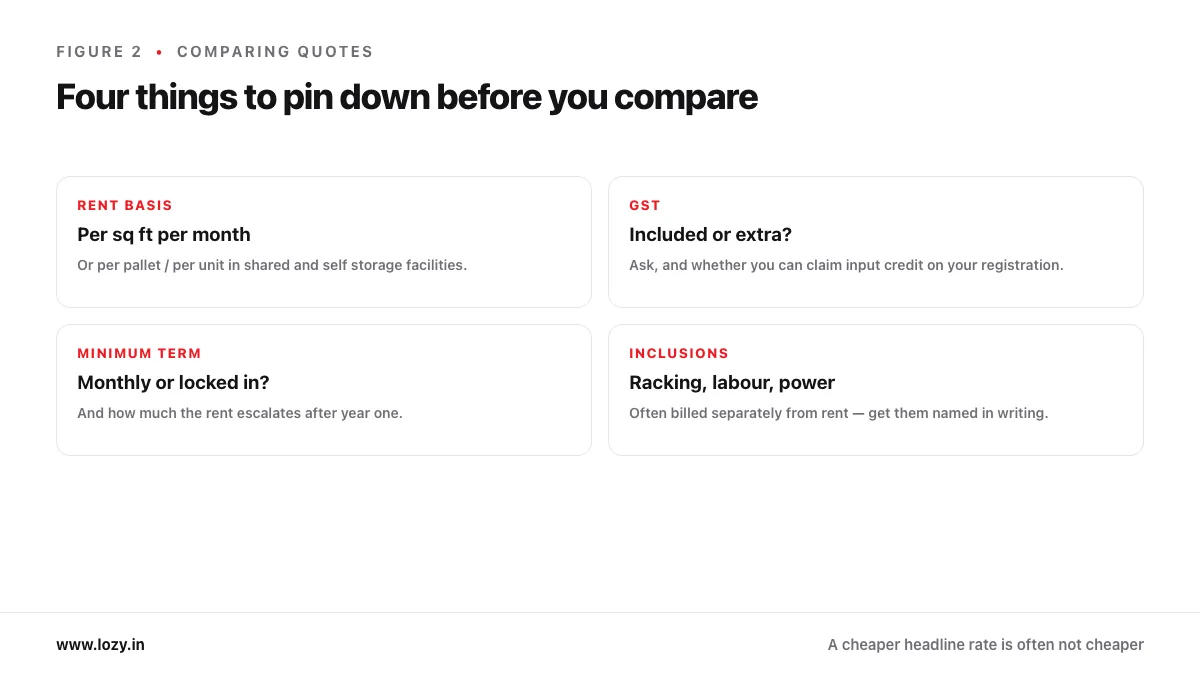
Three questions expose most of the gap between two quotes: Is GST included or extra, and can we claim input credit? What is the minimum term, and how much does the rent escalate afterwards? Are racking, forklifts and labour included, or billed separately? A rate that looks 20% cheaper often is not, once those are answered.
Imports and exports: the bonded warehouse route
If you import goods, storage and customs are not two problems — they are one. Duty is normally payable when goods are cleared, which locks up working capital from the moment a container lands.
Delhi is unusually well served here. ICD Tughlakabad is one of the largest inland container depots in the country: the Government of India describes it as the biggest inland dry port of North India, handling roughly 2,50,000 TEUs of EXIM cargo, connected by four full-length rail lines to gateway ports including Mumbai, Nhava Sheva, Chennai and Mundra, with around 16,000 sq m of covered shed space inside the customs bonded area for stuffing and de-stuffing (source: Press Information Bureau, Ministry of Finance). CONCOR, which runs it, describes its ICDs as dry ports that bring customs clearance to the hinterland, and its bonded warehousing as letting importers store cargo and take partial deliveries while duty stays deferred. Add IGI Airport for air freight and Delhi has both routes covered.
The legal basis is the same nationwide. Under the Customs Act, 1962 (Chapter IX), dutiable imported goods may be deposited in a licensed public, private or special warehouse without paying duty immediately; duty becomes payable when the goods are removed for home consumption. Store first, pay duty later.
So if you import regularly, look for a partner that handles both sides rather than stitching together a warehouse, a broker and a transporter yourself. Lozy provides customs bonded warehouse space alongside customs clearance services, and can cover cargo liability cover for stored and in-transit goods. Government policy has been moving the same way — the National Logistics Policy, GST and the paperless e-Sanchit process have all been aimed at cutting the time and paperwork involved in moving and clearing goods.
How to choose the right space
Work through this list before you sign. It is the same checklist we would want a customer to apply to us.
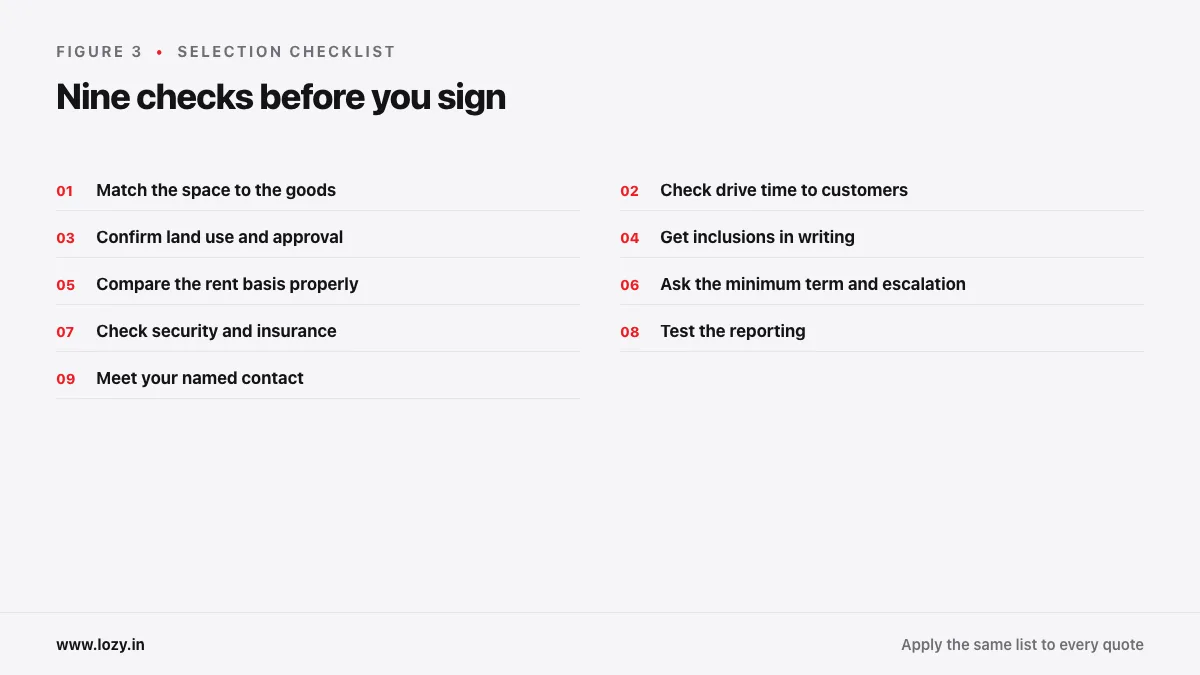
- Match the space to the goods. Cartons and trade stock do not need the same building as palletised stock or a chemical-free self storage room. If your goods are imported, read the imports section first.
- Check the drive time to your customers. A godown in Narela is not a substitute for one in Dwarka if your deliveries are in south Delhi. Ask for the distance to your main delivery area, and to the nearest ICD or the airport if you import.
- Confirm the land use and building approval. See the previous section — this is the check that protects you from a unit being sealed or moved.
- Get the inclusions in writing. Racking, forklifts, labour, security, housekeeping and pest control are often separate line items.
- Compare the rent basis properly. Per square foot per month, per pallet or flat unit rate — and whether GST applies and is claimable.
- Ask about the minimum term and escalation. Monthly, quarterly, or a multi-year lock-in that rises sharply in year two?
- Look at security and insurance. CCTV, access control, entry logs, and what happens if goods are damaged in storage or transit.
- Test the reporting before you sign. Ask for a sample stock report. If you cannot read it, it will not help you run the warehouse.
- Meet your contact. One named person who answers is worth more than a call centre.
Depending on what you are storing, the right starting page may be on-demand warehousing for seasonal peaks, e-commerce warehousing for online sellers, or household warehousing for a home move or renovation.
The bottom line
Getting a warehouse in Delhi is less about finding the cheapest square foot and more about finding the right one: the right area for your delivery routes, the right kind of space for your goods, and a rate you can actually compare against the next quote.
If you want a straight answer quickly, talk to Lozy. Tell us the area you work in, the kind of stock and roughly how much space you need, and we will match a facility and a rate — including bonded storage if your goods are imported. Space starts at ₹12 per sq ft per month and self storage from ₹999 per month, with monthly billing and no long lock-in.
Get a free warehouse quote in Delhi
Call +91 93547 12345 | Email care@lozy.in | or request a quote at www.lozy.in
About the author
Lozy Editorial Desk. This guide was written by the Lozy Editorial Desk, the in-house team that covers warehousing, self storage, logistics and customs/EXIM topics for lozy.in. We write from Lozy's own facility and pricing information and from public, citable sources. We do not publish invented statistics, ratings or reviews.
Sources. Customs and dry-port facts were taken from the Press Information Bureau (Ministry of Finance) release on ICD Tughlakabad, CONCOR's Right to Information disclosure, and the Customs Act, 1962 — Chapter IX (CBIC). Delhi building approval facts were taken from the Municipal Corporation of Delhi's Unified Building Bye-laws. Policy context came from Invest India's National Logistics Policy briefing. Pricing and facility details are Lozy's own.
Last updated: 10 October 2026. Have a question the FAQ below does not answer? Call +91 93547 12345 or email care@lozy.in.
Need warehousing or storage in India?
Request a free, tailored quote in under 2 minutes — free pickup, no lock-in.