Warehouse Rent Per Sq Ft in India: City-Wise Cost Breakdown (2026)

When businesses compare warehouse rent per sq ft in India, the headline number is only the starting point. A warehouse quoted at ₹20 per sq ft can have a very different final cost from another quoted at ₹22 once you account for chargeable area, maintenance charges, CAM, electricity and power backup, security, loading facilities and lease terms. For companies searching for warehouse space for rent on monthly basis, flexibility can change the economics again.
This 2026 guide brings together current market benchmarks and practical leasing factors so you can compare a conventional warehouse, an industrial shed or a flexible storage facility on the same basis. The goal is not to give one artificial “India average”, but to show how city, micro-market and building quality affect the number you actually pay.
Warehouse Rent Per Sq Ft in India: Quick Answer
Lozy’s current India guide places many warehouse and godown quotes in a broad ₹8–₹25 per sq ft per month range, with Lozy’s own flexible warehouse/godown plans starting at ₹12 per sq ft per month. Major-market institutional benchmarks can sit above or around that range depending on the asset segment and market definition.
For H1 2026, current market coverage of Knight Frank data places average rents at approximately ₹28.7/sq ft/month in Pune, ₹26.0 in Mumbai, ₹26.0 in Kolkata, ₹25.7 in Chennai, ₹24.0 in Bengaluru, ₹22.6 in NCR, ₹22.0 in Hyderabad and ₹19.4 in Ahmedabad. These are market benchmarks, not guaranteed asking rates for every warehouse.
Market | H1 2026 average (₹/sq ft/month) | What can move the quote |
Pune | ₹28.7 | Micro-market, Grade A supply, industrial demand |
Mumbai | ₹26.0 | MMR location, logistics access, land cost |
Kolkata | ₹26.0 | Cluster, building grade, access and demand |
Chennai | ₹25.7 | Industrial corridors, Grade A stock, connectivity |
Bengaluru | ₹24.0 | Last-mile demand, micro-market, building quality |
Delhi NCR | ₹22.6 | Manesar/Farukhnagar/Noida/other corridors |
Hyderabad | ₹22.0 | Pharma/manufacturing clusters and access |
Ahmedabad | ₹19.4 | Industrial belt, building grade and scale |
How to read the table: The city figure is a benchmark, not a live quote. A small conventional godown, a Grade A logistics park and a managed monthly warehouse can legitimately have different per-square-foot prices in the same city.
Why Two Warehouses in the Same City Can Have Different Rents
City-level averages hide the part that matters most to occupiers: the micro-market. A warehouse near a highway, airport, port, ICD, manufacturing cluster or dense customer base may command a premium because it can reduce transport time and operating friction. That is also why industrial belt rates can differ sharply within the same city.
Warehouse Rent in Delhi NCR Per Sq Ft
Delhi NCR is a broad warehousing market rather than one single rental zone. Current H1 2026 reporting puts the NCR benchmark around ₹22.6 per sq ft per month, while individual corridors can be meaningfully lower or higher depending on grade, size, accessibility and supply.
For businesses searching for a Warehouse in Delhi, Noida, Faridabad, Ghaziabad, Manesar or other NCR corridors, it is worth comparing the route to customers and suppliers alongside the rental rate. Lozy’s dedicated Self Storage & Warehouse Prices in Delhi NCR: 2026 Cost Guide gives a more focused view of the local market.
Gurgaon is a useful example of why micro-market matters. Lozy’s 2026 Gurgaon guide places warehouse rents broadly around ₹14–₹25 per sq ft per month and discusses a publicly reported Pataudi Road lease that works out to about ₹17.48 per chargeable sq ft. The same guide notes that corridor, building quality and clear height can materially change the number.
For a deeper Gurgaon-specific comparison, see Warehouse for Rent in Gurgaon (2026).
Godown Rent Price vs Warehouse Rent: Are They the Same?
Not necessarily. In everyday Indian usage, “godown” can refer to a basic storage shed, while a modern warehouse may offer higher specifications, formal loading infrastructure, better fire protection, controlled access and stronger operational systems. Because the terms are used loosely in property listings, the building itself matters more than the label.
That is why a godown rent price should always be read with the property specification. Ask about the floor, roof, clear height, loading arrangement, power, security, compliance, access hours and the exact rent-bearing area.
Carpet Area vs Built-Up Area vs Chargeable Area
This is one of the most important checks when comparing rent per square feet. Different landlords may describe area differently, and the amount on which rent is charged may not equal the area that can be used for storage.
Carpet/usable area: the space your operation can actually use for storage or working activity.
Built-up area: the covered area that can include structural and other components.
Chargeable/leasable area: the area used in the lease calculation.
Before signing, get all three definitions in writing where they are relevant. A warehouse advertised as 10,000 sq ft may not give you 10,000 sq ft of efficient storage. Columns, offices, passages, loading zones and other non-storage areas can reduce usable capacity.
Grade A vs Grade B Warehouse Rent
Grade A space generally comes with newer specifications and more formal logistics infrastructure, while Grade B facilities can be older or less standardized. The price difference reflects more than appearance: it can include clear height, flooring, docks, fire systems, access, power, security and site design.
What Is Included in Warehouse Rent?
Maintenance charges and CAM charges
Electricity, water and power backup
Security, CCTV and access control
Loading/unloading or handling
Racking or shelving
Manpower and 3PL services
Insurance or risk-related charges
GST and other applicable taxes
Maintenance Charges, CAM and Power Costs
Maintenance and CAM charges cover shared infrastructure and property-level services in facilities where those costs are billed separately. Depending on the property, the tenant may also pay for electricity, diesel for backup power, water or other utilities.
Security Deposit, Escalation Clause and Brokerage
For conventional warehouse leases, security deposit months—typically around 3–6 months’ rent is a commonly seen structure, but the exact requirement is negotiable and varies by landlord and transaction.
The escalation clause is equally important. A lease may start at a competitive rate and then increase annually according to the agreed formula. Model the rent over the full committed period instead of comparing year-one rates only.
Brokerage is another upfront cost that should be separated from monthly rent. When budgeting, include deposit, brokerage, fit-out, racking and moving costs so the first-year cash requirement is clear.
Warehouse Space for Rent on Monthly Basis: When Does It Make Sense?
Monthly warehouse rental is useful when a company has seasonal inventory, unpredictable demand, a short project, a new-city launch or temporary overflow stock. It can also suit smaller businesses that do not want a long lock-in.
The trade-off is that flexible space may have a higher per-square-foot price than a large conventional lease. But if you avoid paying for unused capacity for several years, the total business cost can still be attractive.
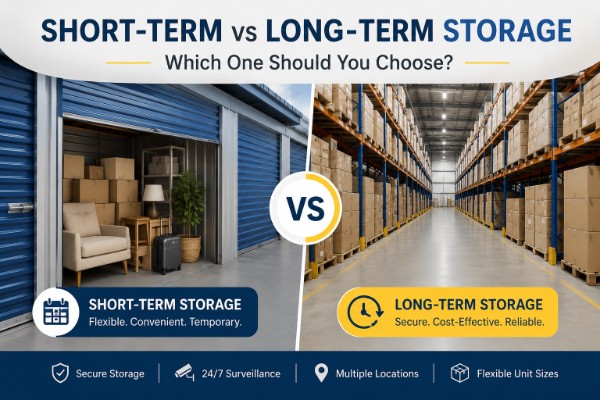
For a direct comparison of flexible versus committed storage, see Short-Term vs Long-Term Storage: Which One Should You Choose?. Businesses needing variable capacity can also review On-Demand Warehousing in India: How It Works & Pricing.
How to Calculate the Real Monthly Warehouse Cost
Start with the simple calculation: monthly base rent = quoted rate × chargeable area.
Example: at ₹22 per sq ft for 10,000 chargeable sq ft, the base rent is ₹2,20,000 per month. Now add recurring CAM or maintenance, electricity and backup power, security, handling and applicable taxes to estimate the real monthly occupancy cost.
Then divide the total by usable storage capacity. If the warehouse has poor space efficiency, a lower rent per sq ft may not produce a lower cost per pallet, carton or usable square foot.
This framework also applies to businesses searching for a warehouse on rent near me, business warehousing, inventory storage warehouse, ecommerce warehousing or an industrial warehouse for rent. The commercial question remains the same: match space, service level and lease flexibility to actual stock movement.
What Businesses Should Check Before Signing
Before signing, compare rent-bearing area, usable storage, clear height, floor load, loading access, fire compliance, power, CAM/maintenance, security, labour, lock-in, notice period, escalation, security deposit, brokerage, taxes and transport distance. A site visit and written cost sheet are safer than relying on listing prices alone.
Final Takeaway
There is no single India-wide warehouse rent per sq ft figure that applies to every property. Current 2026 market benchmarks show meaningful differences across major cities, while individual industrial belts can vary even more.
If you need flexible capacity without a long lease, compare conventional properties with warehouse for rent options that offer monthly billing and scalable space.
Need warehousing or storage in India?
Request a free, tailored quote in under 2 minutes — free pickup, no lock-in.