Warehousing in Kerala: The Kochi Port, the Rain and the Cost

Short answer: warehousing in Kerala is decided by water before it is decided by rent. The state takes one of the heaviest southwest monsoons in India, and a Kochi-side floor that keeps stock dry, raised off the deck and pest-free is worth more than a cheaper shed that does not. This network lists a single Kerala collection centre, named at Cochin, and it carries the port trades, the spice and marine exporters, and the households that need somewhere to keep a home while nobody is in the country. This guide covers that node, the harbour behind it, what space costs and how to choose a floor that is still usable in July.
Key takeaways
- Kerala carries 1 collection centre in Lozy's network list, named at Cochin — one intake point for a long, narrow coastal state, so the pickup run is part of the plan rather than an afterthought.
- The harbour is why this market exists: spices, tea, coffee, coir and marine products leave through Kochi, and export stock is normally held a short road run from the container terminal at Vallarpadam rather than on waterfront land.
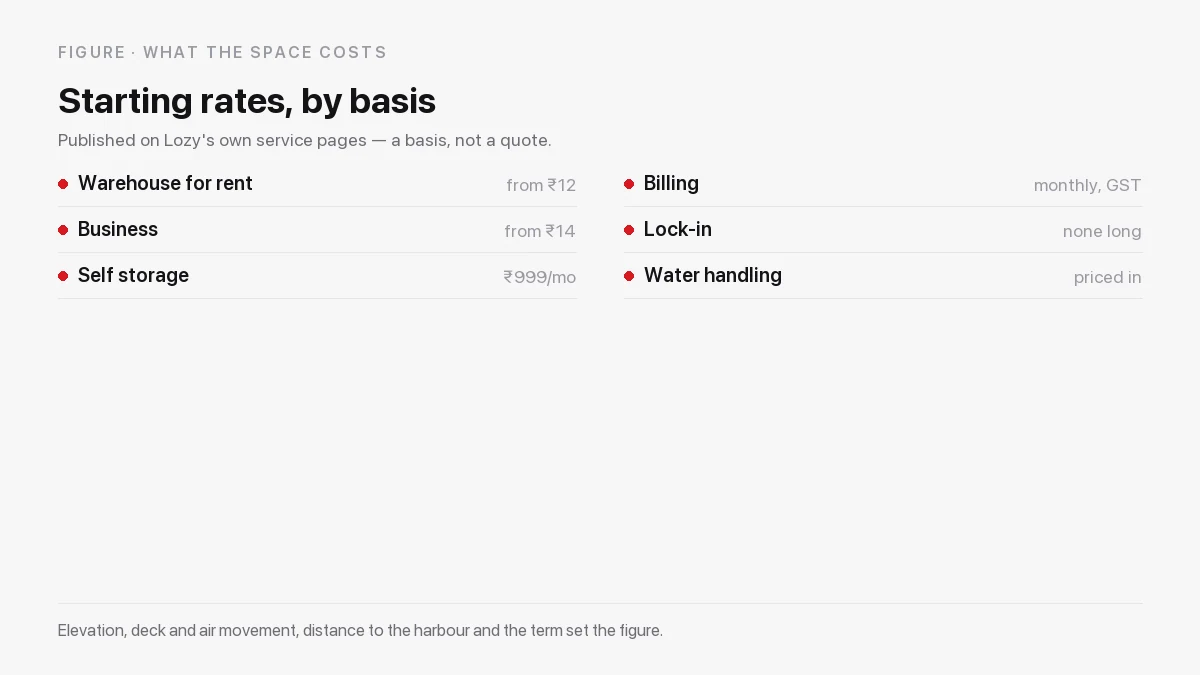
- Rates published on Lozy's own service pages start at ₹12 per sq ft per month for godown and warehouse space, ₹14 for a managed business floor, and ₹999 a month for a self-storage unit, each billed monthly on a GST invoice.
- The local risk that quietly costs money is the rain: months of it, a high water table and backwater ground, which is why plinth height, a paved apron and drainage settle whether a floor is usable at all.
Most storage markets answer to a highway, a port or a rent curve. Kerala answers to rain, and the rain arrives every year on schedule. The southwest monsoon runs from roughly June into September and lands on a state that is a narrow strip of land between the Western Ghats and the Arabian Sea — a coast of short rivers draining west, a high water table, and backwaters that fill with the same water the sheds are standing in. In most of India water in a warehouse yard is an incident to be dealt with. Here it is the annual condition the building has to be designed around.
That one fact reorders the usual questions. A buyer who opens with rent is being sensible almost anywhere else in the country, because the land is dry and the risk sits in access and cost. A buyer who opens with rent in Kerala is skipping the item that decides whether the goods survive the year, because the difference between two sheds on the same rate is usually a plinth, an apron and a drain invert — and that difference is worth more than the rate.
Why warehousing in Kerala is a water decision first
What six months of rain does to stock that is not protected
The damage is rarely dramatic. A leak that announces itself is easy to handle; the expensive version is gradual and quiet. Cartons and paper stock pull moisture out of the air and lose their stacking strength weeks before they feel damp, so a pallet stacked three high in June can be a sagging pallet by August. Bagged goods — rice, spices, tea, cement — cake into lumps that turn a saleable lot into a discounted one. Steel and machine parts pick up surface corrosion in an unventilated shed. Textiles, leather, coir and furniture take on a smell that airing afterwards does not remove.
None of that is an argument against storing goods in Kerala; the trade here has been shipping through these months for centuries. It is an argument for specifying the floor properly and putting the specification in writing: a raised deck or a floor well above surrounding grade, air that moves rather than a sealed box, stock held clear of the walls, and a pest-management regime that runs on a schedule rather than when somebody spots a problem.
What to look at in the yard, in July
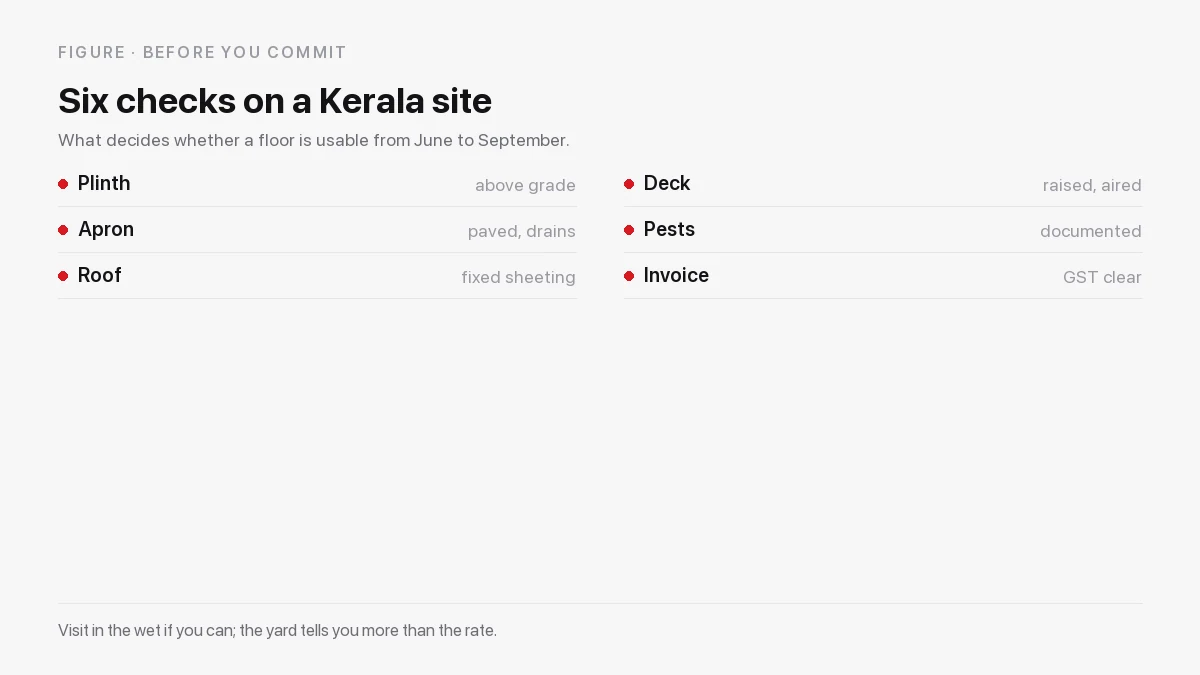
Plinth height above the ground around it. A paved apron rather than loose earth that turns to slurry under a trailer wheel. Roof sheeting that is mechanically fastened rather than lying on the purlins. A drain that discharges away from the building instead of past its door. And the site's own low point, which is usually closest to the loading face, because that is where the ground was cut to make the building level.
This is why the season you view in matters more in Kerala than almost anywhere. A unit inspected in a dry fortnight in January looks exactly like one that takes water in July. If a monsoon visit is impossible, ask the operator what happened to the yard between June and August, whether water ever reached the door, and how the site sits relative to the nearest canal, backwater or paddy field. A useful second question is what the neighbours' ground looked like, because water does not respect a boundary wall.
The humidity that stays after the rain stops
Kerala's air is moist through most of the year, not only during the monsoon, and that matters precisely for the goods this state is known for. Pepper, cardamom, ginger, turmeric, clove, nutmeg, tea, coffee, rubber and coir are all hygroscopic — they take on moisture and lose quality, and sometimes weight, doing it. Between showers the problem is not standing water but air, and the remedy is ventilation, height off the floor and clearance from the walls rather than a sealed container in a yard. A unit with cross-ventilation, ceiling fans and a raised deck handles a Kerala August. Sealed steel boxes and metal sheds in an open compound are the two worst places to put a spice lot in this state.
The Cochin node, and what a single centre has to carry
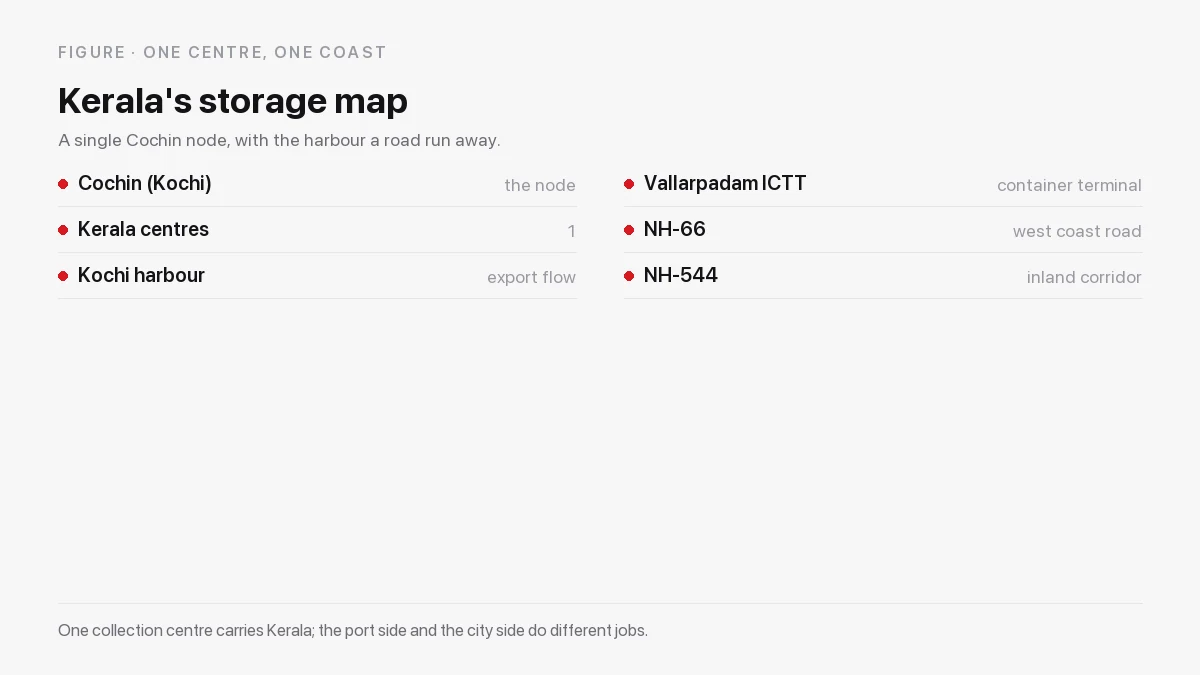
Kerala's organised storage sits where its trade sits, and in Kerala that means Kochi. The network's coverage here is deliberately simple — one collection centre, named at Cochin — and being straight about what one node can and cannot do is more useful to a reader than a longer list of place names. Everything this guide describes runs into or out of that node.
Cochin (Kochi), and the market it sits in
Kochi is the commercial capital of the Malabar coast and the busiest port city on it, and it earns that position twice over. Once as the distribution centre for a densely populated, high-consumption state whose towns sit close together with good roads between them. And once as the gateway its exports leave through. A unit here serves both jobs at the same time: consumer stock is received, held and released to shops and courier networks across the state, while export stock is graded, packed, consolidated and sent down to the harbour. The roads do the rest, with NH-66 running the length of the coast and NH-544 heading inland towards the Tamil Nadu border. Live coverage on this node sits on the Kerala location page.
The port side: Kochi harbour and Vallarpadam
The harbour is the reason this market exists at all. Kochi carries the container transshipment terminal on Vallarpadam, where much of the state's box traffic is handled, and it has the freight, clearing and inspection ecosystem that grows around a working port. For a storage decision the practical point is narrower: export stock is normally positioned a short road run from that gate rather than on the waterfront itself. Holding a container-load in the city belt and running it down when a vessel position firms up keeps documents, packing and the sales desk in one place, and keeps rent off port-side land.
That is also how a spice or marine exporter tends to work. Goods arrive from the production districts, are cleaned, graded and repacked into export bags or cartons, palletised, and then held dry until the shipping window opens. The grading and packing happen at the processor's own unit; what the warehouse does is keep finished, export-ready stock in the condition it was packed in. In a state with this much rain, that is the whole job.
What one node does well, and what it does not
A single Kochi-side centre is a real advantage for the trades this state actually runs: the port trades, the Kochi market, and any business within a reasonable run of the city. It is not a statewide network, and it would be dishonest to present it as one. If your entire market sits in the far south of Kerala, the line-haul from Kochi is a genuine cost and it belongs in the comparison from the first call rather than in month two. If your stock is export-bound, or destined for the state's own shops and households, or it is a family requirement in or near the city, then one well-run node is exactly the right answer. What is bookable at that node today is set out on the Kerala coverage page.
Who stores what in Kerala
Five groups of customer fill most of the organised square feet in this state, and their requirements barely overlap.
Spice, tea, coffee and coir exporters
This is Kerala's signature trade and the reason the harbour is busy. Pepper, cardamom, ginger, turmeric, clove, nutmeg and the tea, coffee and coir that travel with them are all moisture-sensitive, all sold on grade, and all packed in sacks, jute or cartons that let the outside air in. What they need from a floor is unglamorous and exacting: dry, ventilated, pest-controlled, raised off the deck and kept clear of walls that draw damp. A lot that takes on moisture in storage does not fail loudly. It loses grade, and grade is the price. The trade's own standards body sits in Kochi, which tells you where the industry's centre of gravity is.
Marine and food processing
Kerala's other major export line is marine, and the cold chain belongs to the processors. What an ordinary warehouse carries is the dry side that keeps those plants running: master cartons, inner packaging, labels, trays, gloves, cleaning chemicals and the general consumables of a food unit. That stock has one non-negotiable condition — it has to be held under a pest-management regime that produces records, because it is going into premises that face their own inspections. Food, spice and marine plants also carry approvals of their own, and those sit with the business rather than with the warehouse.
NRI households and the between-visits problem
Kerala's households are unusually internationally connected, and that creates a storage requirement most of India barely has. A family with members working abroad keeps a house here, and that house is frequently being built, extended or repaired while the people who own it are away. Somebody has to move out the furniture, appliances, mattresses, kitchen equipment and documents, and keep them safe for a year or two — sometimes longer — with the owner on another continent and no way to drive past and check. In between, the same household lands for a month or two each year and needs its own things back, on the day it arrives, without a negotiation.
What that requirement actually needs is modest and specific: a locked unit of its own rather than a position on a shared floor, a dry building with air moving through it, CCTV and controlled access, pricing per unit rather than per square foot, and somebody who answers a question from abroad without being chased. That is what self storage exists for, priced from ₹999 a month per unit and billed like everything else here — monthly, on a GST invoice, with no long lock-in and no notice period to argue about when the house is finally finished.
FMCG, retail and e-commerce into the state's towns
Kerala is a dense, high-consumption market with towns close together, and a distributor's problem is holding stock near enough to serve shops daily without paying city rents to park it. Fast-moving goods carry dates, so rotation is the real operational test: a floor that cannot show where the older batch sits will cost write-offs that a distributor usually blames on demand instead of on storage. Sellers running a marketplace account alongside their own storefront want the same catchment served from one racked floor, with goods received, barcoded and put away pick-ready, then picked, packed and handed to a courier on a daily schedule rather than in a weekly push.
Builders, contractors and small manufacturers
Kerala builds steadily, and much of that building is done by small firms with a compound, a pickup and nothing covered of their own. Cement, tiles, sanitaryware, hardware, paint and electrical fittings all hold better off the ground than in an open yard, and in a state where site work stops for a fortnight of heavy rain, being able to hold material dry and release it the day the site is ready is worth real money. It is a smaller requirement than an exporter's, priced by area like everything else here, and it turns up most often in the months between one monsoon and the next.
What warehouse space in Kerala costs
Three of Lozy's published starting rates cover what a Kerala requirement normally turns out to be, and each belongs to its own service page rather than to a state average that would mislead more than it informs.
- Warehouse and godown space for rent — from ₹12 per sq ft per month on the warehouse space for rent page. This is the basis for pricing a floor plate by area, and it is the lowest of the three.
- A managed business floor — from ₹14 per sq ft per month on the business warehousing page, for space with security, housekeeping and monthly reporting built in.
- Self storage — from ₹999 per month on the self storage page, the per-unit product a household or a small business books when it does not need an industrial floor plate at all.
Read those as floors rather than quotes. Each is a starting rate on its own basis, each is billed monthly and invoiced with GST, and none of them carries a long lock-in, so space can be taken for a peak and given back afterwards. The number that comes back on a real requirement will differ, and it should.
The five things that move a Kerala rate
- How the building handles water. Plinth, apron, roof fixing and drainage are the difference between a floor that holds stock through a wet season and one that does not, and a facility that has spent money on them knows it.
- Height, deck and air movement. A raised deck, cross-ventilation and working fans cost money to provide and are what protect the goods this state actually stores.
- Distance to the harbour and to the city. Waterfront land carries a premium, and the position that earns its rent is a short run from the terminal rather than on it.
- What the quote is actually measured on. Floor area per square foot, a racked position and a per-unit booking are three different purchases, so ask which one the number describes before comparing it with anything.
- The term you commit to. A monthly booking and a year-long arrangement price differently, and the longer one normally returns the lower month.
| Where the unit sits | What it suits | The route that carries it |
|---|---|---|
| Kochi city side and the ring around it | FMCG and retail distribution across the state, e-commerce fulfilment, household and business self storage | NH-66 into the city, then local distributor roads |
| The port side, near the harbour and Vallarpadam | Import and export staging, container stuffing and de-stuffing, spice, tea and marine export consolidation | The terminal road and the NH-66 approach |
| Ground on the NH-544 side, towards the Tamil Nadu border | Larger floor plates, processor and plant stock, goods moving between Kerala and the inland Tamil Nadu belt | NH-544 |
| Upland ground away from the backwaters and canals | Monsoon-sensitive goods: paper, packaging, bagged food ingredients, textiles, coir | Internal roads off NH-66 |
Use that table as a routing decision rather than a menu of options. The city side does the last mile and the household work, the port side does the export window, and the higher ground away from the water does the holding for anything that reacts to damp. Every unit behind the table is on the Kerala locations page. For how rent itself is structured, separately from the state, start with the guide to warehouse space for rent, which sets out what a per-square-foot rate does and does not cover.
Licences, GST and the paperwork in Kerala
Settle these before the first truck is loaded rather than after, because two of them behave differently in a state that exports and in a state that floods.
GST and the invoice
Rent on storage here carries GST, and a registered business can recover that tax when the document behind it is right: a tax invoice raised in your own entity's name, with storage and handling itemised separately so an accountant can post it without a query. Confirm what that document will look like before booking rather than at year end. A proper monthly invoice is what keeps rent a recoverable cost; a cash rent handed over with no paper behind it is an expense that never comes back. Registration and input credit are covered on the GST portal itself.
Building approvals, land, and the coastal question
Ask two blunt questions in the first conversation. Which authority cleared this building, and do the occupancy and fire papers exist as documents you can actually read? Kerala's industrial land is developed and allotted by the state through KSIDC, so a unit inside an approved estate inherits a land-use position that a shed on private ground has to establish on its own. There is also a local twist worth knowing before anything is signed: because this is a narrow coastal state with backwaters, wetlands and a high water table threaded through it, building close to water runs into coastal and wetland rules, and ground in a low-lying pocket is ground that floods. Both are reasons an approved estate with an engineered level is easier to price, easier to insure and easier to defend to a buyer.
What the floor will and will not accept
Ask what the unit refuses. Solvents and flammables, strong-smelling goods, anything needing fumigation separation, and food without the matching approvals are either handled in a dedicated bay or turned away, and it is better to learn which on the phone than at the gate. Spices, tea, coffee and food ingredients should be offered a raised deck, pest control on a documented schedule and a stated clearance from the walls, and an operator who has never been asked will have no system for it. If your goods are export-bound, the certification side — quality, phytosanitary or marine inspection — belongs to your own business rather than to the warehouse.
Receiving, records and the insurance conversation
Start with what happens when the truck arrives, because that is where most storage disputes begin. A photograph inventory taken at the gate and checked against your own count is what turns a shortage found three weeks later into a short email rather than an argument. Tell your insurer where the goods sit and how they are held, because a policy written for a locked godown of your own and one written for a shared managed floor are insuring different risks. For high-value or regulated stock, ask how records are kept as goods move — at batch or SKU level, not reconstructed at month end.
How to choose a Kerala warehouse — and the red flags
Run this list at the viewing. Every item on it is visible on site, which is why an hour in the yard tells you more here than a longer quotation does.
- Decide whether you are a port requirement or a city one. Export stock belongs within a short run of the harbour; stock serving shops, couriers and households inside the state belongs on the city side of the node.
- Look at the building in the wet, or ask about the wet. Plinth, apron, roof fixing and where the drain discharges. If a monsoon visit is impossible, ask what happened to the yard during the last one and whether water ever reached the loading face.
- Put the goods on the right floor. Spices, tea, coffee, food ingredients, paper and packaging need a raised deck and real air movement; cement, tiles and hardware need to be off the ground rather than under a sheet in the open.
- Time the run to the port gate. Drive it at the hour a truck would really leave, and ask when the terminal stops taking entries.
- Drive the approach road before you judge the building. A Kerala lane can be too narrow for a 40-ft trailer, and a yard the trailer cannot turn inside is worth nothing however good the shed looks from the road.
- Write down what the rate includes. Racking, trolleys, night security, housekeeping, pest control, ventilation and who pays the electricity for it.
- Ask for a sample of the reporting, and ask who answers when you are abroad. For a household requirement, the second question matters more than the rate.
What should stop you, roughly in the order these things surface: a rate that never says whether GST sits inside it; a floor at or below the level of the yard around it; a pest-control claim with no schedule and no records behind it; missing occupancy or fire clearance; a monthly figure that hides an annual minimum; a facility that only decides which bay is yours once the truck is already at the gate; and a unit offered in a low-lying pocket with no answer about the last monsoon.
A worked example: a Kochi house rebuilt while the owners are abroad
This requirement turns up in Kerala more often than anywhere else on the network. A family with two members working in the Gulf owns a house in the Kochi belt. The house is being rebuilt, the owners come back for three weeks a year, and the contents of four bedrooms, a kitchen and an office corner have to sit somewhere dry for eighteen months with nobody on the ground to supervise the move. What they had been doing was spreading the load between a relative's garage and a rented room — which is how furniture gets scratched, a folder of documents goes missing, and no one can say what is actually where.
The specification that came out of it was not about size. One locked unit of its own. A dry building with air moving through it rather than a sealed box. A photograph inventory taken at the door, so a list exists from day one and can be checked from abroad. CCTV, controlled access and a number that answers. And monthly billing that stops the month the house is handed over instead of running to the end of a lease that was signed before the plan changed.
Roughly 400 sq ft for the furniture and the cartons, with documents and smaller valuables in a separate unit of their own. Four hundred square feet at the published starting rate of ₹12 per sq ft per month comes to about ₹4,800 a month, or roughly ₹57,600 across a year at that rate — indicative only, since the unit, the access and the term all move the final figure — while a single self-storage unit of the kind the family used for its paperwork starts at ₹999 a month. The arithmetic is not the point. What they bought was a list, one address, and the ability to stop paying the month the keys changed hands. Requirements like that one begin with the space listed on the Kerala locations page.
Also in Delhi NCR
Kerala's export trades sell nationally, and the northern half of that trade is held rather than trucked daily. A spice, tea or coir business supplying north India keeps its Kochi-side floor for grading and shipment and takes a second position in NCR for the buyers it delivers to, and the same split suits a family posted between Kochi and the capital. Warehousing in New Delhi covers the capital's own market, and the locations hub maps the northern nodes against this one.
How Lozy helps in Kerala
Lozy runs 77+ warehouses and more than a million square feet of live space across its network, and Kerala appears in that network as one collection centre, named at Cochin. A booking brings a defined racked or open floor area of your own, 24/7 CCTV, on-site security and PIN-controlled access to gates, lifts and your storage bay, and the network is arranged so a business can step from a small floor to a larger one in the same city without changing operator. Free doorstep pickup is included on bookings of 30 days or more, which matters in a state where the realistic alternative is often a rented room behind a shop.
What the company offers across its services is set out on the services page, with business warehousing for the managed floor a distributor usually needs and self storage for the unit-sized household requirement. To see what is free before deciding, browse the warehouse listing, or contact us with the area, the goods and the dates you have in mind. If your goods move beyond the state, the guides either side are the place to start: warehousing in Tamil Nadu for the Coimbatore and Chennai belts, Karnataka and Chennai for the corridors north, and Telangana for the Deccan run. Two background reads help before a first call: the self storage guide on how the per-unit model works, and the guide to warehouse space for rent on how a monthly rate is actually built. Everything else is on the Lozy blog.

Need warehouse space in Kerala?
Tell us the city and the size you need — we reply with a rate and the options available now.
Get a quoteCall +91 93547 12345About the author
Lozy Editorial Desk. This guide was written by the Lozy Editorial Desk, the in-house team that covers warehousing, self storage, logistics and customs/EXIM topics for lozy.in. We write from Lozy's own facility and pricing information and from public, citable sources. We do not publish invented statistics, ratings or reviews.
Sources. The facility counts, rates and coverage quoted in this guide are Lozy's published figures rather than third-party estimates. Port context comes from the Cochin Port Authority; spice trade and quality context from the Spices Board; marine export context from the Marine Products Export Development Authority; state industrial land and investment context from KSIDC and IBEF's Kerala profile; industry context from the Warehousing Development and Regulatory Authority; and policy releases from the Press Information Bureau. GST registration and input credit are described from the GST portal, linked above. A reader comparing more than one state before calling will find the same plain style across the Lozy blog.
Last updated: 13 October 2026. Have a question the FAQ below does not answer? Call +91 93547 12345 or email care@lozy.in.
Need warehousing or storage in India?
Request a free, tailored quote in under 2 minutes — free pickup, no lock-in.