Warehousing in Madhya Pradesh: Indore, Pithampur and the Central Run
Short answer: warehousing in Madhya Pradesh runs through one city. Lozy’s network lists 2 collection centres in the state and both are at Indore, so the real question here is not which town but how much floor you take on one edge of Indore — and how much of India that single position can reach. The city sits on the old Agra–Bombay alignment inside the Delhi–Mumbai industrial corridor, with the Pithampur belt a short run south of it and an inland container depot inside that belt. That combination buys a pan-India seller transit time rather than cheap concrete. This guide covers the belt, the goods, the rates and the paperwork.
Key takeaways
- Madhya Pradesh carries 2 collection centres in Lozy’s network list, both listed at Indore — one pickup point has to serve everything from the soybean fields around the city to the factories at Pithampur.
- What gets stored follows the state’s fields and its factories: soybean, wheat and pulse stock, pharmaceutical and healthcare inventory, and auto components out of an industrial belt roughly 35 km from the city limits.
- Warehouse and godown space for rent starts at ₹12 per sq ft per month, commercial warehousing at ₹13 per sq ft per month, and inventory warehousing with a written stock register at ₹4,499 per month.
- What central India actually sells is distance: a single Indore floor can answer demand in the western ports, Delhi NCR and the Deccan without a second warehouse, which is the premise of the state’s own logistics policy.
Why warehousing in Madhya Pradesh means Indore
Most large Indian states hand a storage buyer a spread. There is a capital with its own shed belt, a port or a border town, two or three secondary cities, and each of them quotes a different rate for a different road. Madhya Pradesh does not work that way. The state’s wholesale trade, its processing units and its dispatch traffic all concentrated in and around Indore, and that is where both of this network’s collection centres sit. Anyone storing goods for Madhya Pradesh customers, or pushing stock into the state and back out again, is therefore dealing with one node to understand instead of five.
Two distances explain why it ended up that way. The first is inside the state: Indore is its largest consumer market and the funnel through which the farm produce of the surrounding plateau and the factory output to the north both move. The second is national: the city stands on the old Agra–Bombay road, the alignment now numbered NH-52 and six-lane for the run in from Dewas, which is the road that made Indore a trading town long before anybody called it a logistics one.
One city carries the state’s demand
The local economy is unusually mixed for a single city, and that mix decides what the warehouse floors around it are asked to hold. Indore processes soybean and edible oil, packs food, manufactures pharmaceuticals, runs a foundry cluster of several dozen units that grew up serving textile machinery and then commercial vehicles, and turns out ready-made garments — alongside a wholesale trade that supplies the districts. The effect on storage is that the same building gets asked to do different jobs through the year: a floor that takes palletised components in February may be expected to take sacks off the soybean harvest in the autumn, and the two do not need the same floor.
The units this network lists inside Madhya Pradesh are set out on the Madhya Pradesh location page, which is the page to read first if you want to see what a booking here actually looks like.
If your stock is not in Indore
Honest consequence of a one-node state: a business sitting in another district plans an inward movement to Indore rather than waiting for a local hub to appear. That is usually cheaper than it sounds, because goods are collected from the door instead of being brought to a depot by the seller — free doorstep pickup is included on bookings of 30 days or more — and one consolidated movement into the network costs less than three scattered ones. The wider coverage map, if your stock also moves outside the state, is on the locations hub, and what is free right now can be browsed on the warehouse listing.
What central India actually saves a pan-India seller
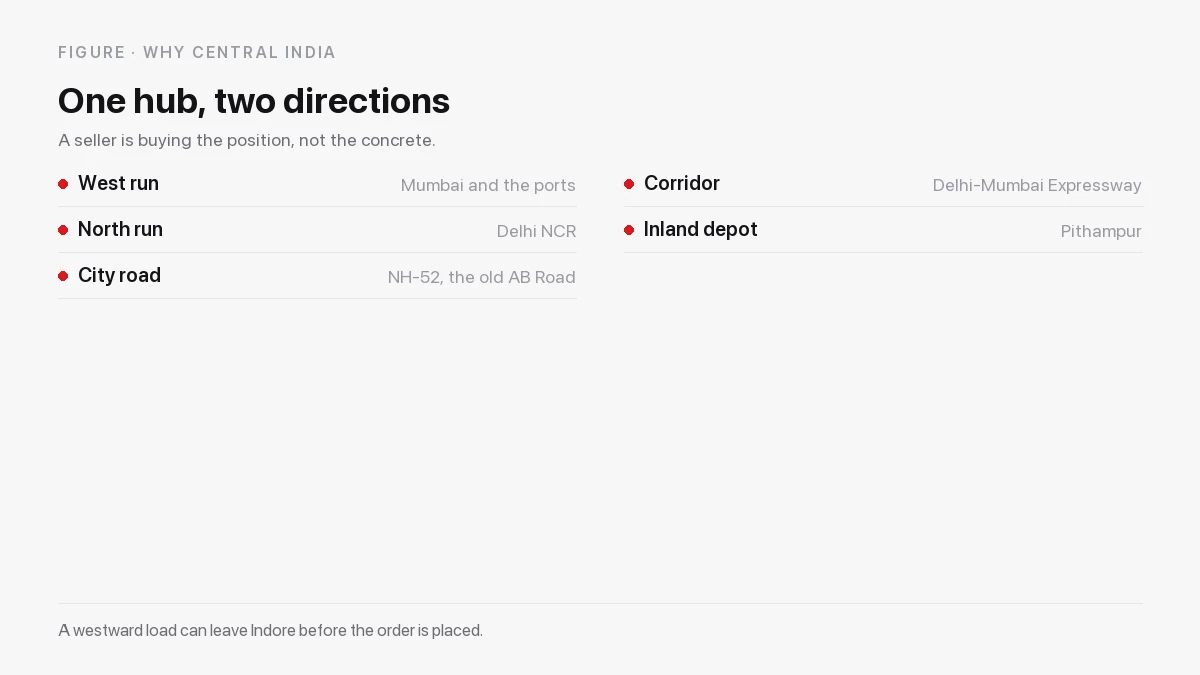
Madhya Pradesh is the state the country drives across between its two biggest freight pools, and that is the whole commercial argument for storing here. The Delhi–Mumbai Expressway crosses the state for roughly 245 km through its western districts, while the older axis — NH-52, the Agra–Bombay road — runs through Indore itself on its way from the north down to the coast. On top of the roads, the state carries an identified investment region on the Delhi–Mumbai Industrial Corridor around Pithampur, and the state’s own logistics policy, notified in 2025, is written around making Madhya Pradesh a central storage hub for the country rather than a place goods merely pass through.
For a seller, this is a transit argument, not a rent argument. One floor in Indore can be loaded for the west coast, for the capital and for the Deccan without a second stock position, and a consignment that would otherwise sit in a warehouse at one end of the country is already halfway to the buyer when the order arrives. None of that shows up on a rate card, and it is usually worth more than the rupees per square foot that do.
The run west: Mumbai and the Gujarat ports
Going west, NH-52 leaves Indore on the old Bombay alignment and keeps going once it crosses into Maharashtra. For a seller whose buyers sit in Mumbai, the industrial belt around it or the port towns, this is the reason to hold stock in central India rather than in the destination state: the load is already on the road when the order is confirmed, and a west-coast warehouse is not paying for the same inventory twice. Businesses comparing the two positions should read the guides to warehousing in Maharashtra and to warehousing in Gujarat before deciding, because the western belts price differently and serve different buyers.
The run north: Delhi NCR and the plains
Going north, the expressway does for Delhi what NH-52 does for Mumbai: it takes Indore out of the middle distance and puts it inside a single shift’s drive of the capital region. A seller holding stock for northern buyers can therefore serve them from a central floor and top up a northern arrangement only when the volume justifies it. The two directions do not compete — they are the same inventory pointed at different customers, which is exactly why a single well-placed floor here can carry a national catalogue.
When central India is the wrong answer
It is the wrong answer in three situations, and it is worth being straight about them. If your promise to customers is same-day delivery inside one metro, stock has to sit in that metro. If your goods arrive by sea and your cost model depends on moving them the shortest possible distance from the port, a coastal warehouse beats a central one. And if your product is perishable and committed to a plant, the plant’s location decides, not the map of India. What central India wins is the middle case: a catalogue with buyers in every direction and a warehouse that should not be duplicated in each of them.
The Pithampur belt and the demand it creates
The industrial belt at Pithampur sits around 35 km from the city and it is the second half of Madhya Pradesh’s storage story. It grew out of one of the country’s first greenfield special economic zones and it is now the state’s automotive centre — vehicle manufacturers, a tyre plant and something like sixty component and ancillary units — with a pharmaceutical cluster alongside it. Newer sectors are still arriving: the industrial sectors being developed there have drawn investment proposals running into thousands of crores, including a global consumer-healthcare company that has begun a plant reported at around ₹2,000 crore.
What that means for rented space
Plant clusters do not build storage for their suppliers. A component maker with a schedule to meet holds buffer stock somewhere near the gate; a contractor installing a line needs a floor to stage machines before the building is ready to receive them; an ancillary unit that wins a new order needs pallets in a rack for four months, not a shed on a five-year lease. That is the demand an industrial warehouse outside the plant wall exists to serve, and the heavier, palletised version of it is described on the industrial warehousing page.
Exporters, the inland container depot and bonded stock
Something else sits on this belt that most people outside the trade do not know about: an inland container depot. Containers can be stuffed and cleared inland here rather than at the port, which matters to a manufacturer whose export consignment starts at a factory gate near Indore and would otherwise have to travel to the coast before anyone looks at the paperwork. A private inland depot also operates on the Pithampur–Indore airport road. For stock that is imported and not yet duty-paid, the useful product is duty-deferred storage, described on the customs bonded warehouse page.
What businesses in Madhya Pradesh put in storage
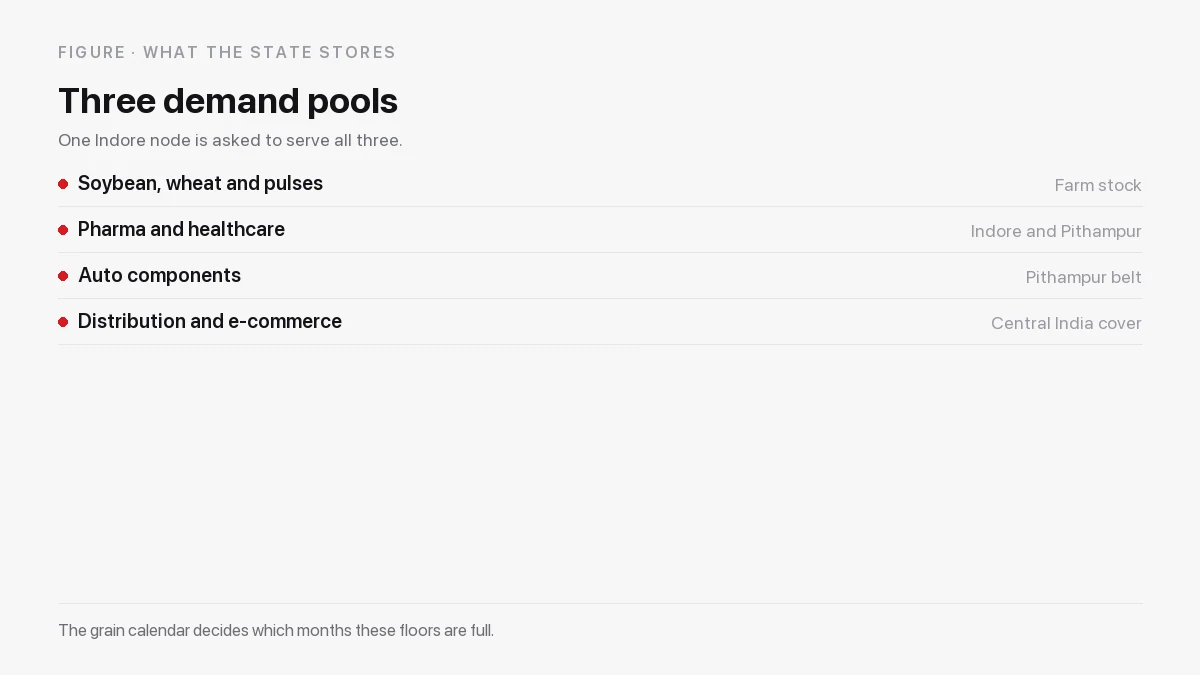
Four broad pools account for most of the occupied floor area around Indore, and they want different things from a building.
Soybean, wheat and pulse stock
Madhya Pradesh is the country’s largest producer of soybean and of pulses, and its second-largest wheat grower, and the fields around Indore are soybean land. That produce arrives in sacks, not on pallets, and it sets its own conditions: a floor that keeps the stack off the ground, a plinth that survives a wet September, a roof that does not drip, and a pest-control routine with a record attached. The calendar decides the space requirement too — the soybean crop moves in the weeks after the autumn harvest, wheat and gram arrive in the spring — so a floor that is full in November can be half empty in March. Traders financing stock should ask about a registered warehouse receipt rather than simply renting area, and the tracked-stock model is set out on the inventory warehousing page.
Pharmaceutical and healthcare inventory
Indore is one of the country’s larger pharmaceutical manufacturing centres and Pithampur runs a pharma cluster beside the auto one. The state counts hundreds of pharmaceutical companies, more than thirty makers of active ingredients and dozens of medical-device units, and medicines account for roughly a fifth of its exports. Stored stock here comes with conditions: a dry, protected room, records that trace a batch in and out, restricted access, and premises that match what the licence says. A facility serving this trade should be able to produce those records as a by-product of receiving goods, not as a favour afterwards.
Auto components and engineering stock
From the belt come components, spares, tooling, fabricated parts and the equipment a factory installs during expansion. These goods are heavy and they like racks, so the question to ask is about floor loading and clear height rather than square footage, and about whether a trailer can turn inside the yard rather than reverse off a highway shoulder. Project cargo has a short life of its own: a machine that will be bolted down in six weeks needs a covered floor and a way out, not a storage contract.
Distribution, FMCG and e-commerce
The last pool is the ordinary one. Distributors supplying Madhya Pradesh districts, brands holding safety stock for central India, and online sellers who want one node between the western and northern markets. For online sellers the work is reception, barcoding, shelving, picking and a courier handover at a fixed hour, and the rate basis for it sits on the e-commerce warehousing page.
What warehouse space in Madhya Pradesh costs
Three of Lozy’s published starting rates apply here, and they map onto three different ways of using a building.
- Warehouse space and godowns — published from ₹12 per sq ft per month on the warehouse space for rent page: a demarcated bay or a racked section, billed by the month, for stock that turns over on an ordinary cycle rather than in one seasonal burst.
- Commercial warehousing — starts at ₹13 per sq ft per month, quoted on the commercial warehousing page. Bigger, better-serviced floors with truck access and dispatch support are what a distribution operation grows into once a single bay stops being enough.
- Inventory warehousing — the figure on the inventory warehousing page is ₹4,499 per month. This is the tracked-stock product, where a register, cycle counts and a readable stock position replace a floor somebody has to walk.
Each of those three numbers is a starting rate, and each is billed monthly on a GST invoice. Treat them as the floor of the market rather than as a quotation for one particular bay: the final figure follows the building, the area, the length of the term and what the goods need. The units these rates apply to in the state are listed on the Madhya Pradesh location page.
The four local inputs behind an Indore rate
- Whether the floor has to take sacks or pallets. Grain stacked in bags wants ground-bearing capacity and a plinth; racked components want clear height. Two very different floors, two different numbers, frequently the same published start rate.
- Whether the goods are food or drug grade. A room that a licence, a pest-control record and a customer audit can point at costs more to run than an open bay, and the paperwork is part of the price.
- How far out from the city the unit sits. The industrial ring towards Pithampur, the roads in from Dewas and the units closer to the wholesale markets are not interchangeable for a distribution round, and the rent knows it before the broker explains it.
- The term and the exit. A monthly booking and a long arrangement are different products. The longer one normally carries the lower monthly figure, and the monthly one normally carries the freedom, which is worth real money to a seller with a moving catalogue.
| What you are weighing | Shared managed floor | Shed you rent yourself | Inventory storage with a register |
|---|---|---|---|
| What you pay for | Published start rate per sq ft per month | Rent, deposit, fit-out and upkeep, quoted locally | Published start rate per month |
| Fit-out | Racking or demarcated floor already in place | Yours to build: racks, lighting, pest proofing | Racks and handling provided |
| Security and housekeeping | On site, with camera cover and pin access | You appoint it and you pay for it | On site, under the same cover |
| Stock position | A dispatch list you keep yourself | Your own registers | A written register with cycle counts |
| Minimum commitment | Monthly, on a GST invoice | Usually a lease or a long notice period | Monthly |
| Best suited to | Bulk and palletised business stock | A large, stable, single-owner operation | A catalogue that needs an auditable count |
Licences, GST and the paperwork for a Madhya Pradesh warehouse
Most of these questions are cheaper to settle before the first truck arrives, and in a state that moves regulated goods as well as grain, three of them tend to decide things.
GST, the invoice and the e-way bill
Rent for storage in this state attracts GST, and input credit reaches a registered business only when the invoice is raised properly: in the entity’s own name, as a tax invoice, with the lines an accountant expects to see. Goods moving out of the state travel under an e-way bill, and a warehouse that understands the document rather than treating it as a formality saves its customers a detention at a check post. Registration and input-credit rules are set out on the GST portal, and it is worth agreeing the invoice lines an accountant will need before the first bill arrives.
Drugs, food and medical devices
A wholesale drug licence names the premises, so medicines and devices may only be held in a room the licence actually covers — a shed a licence does not mention is a shed they cannot legally sit in. Food and food-grade storage carries its own conditions, and cosmetic and hazardous goods bring a further set. Ask a prospective facility which approvals its building holds instead of assuming that size implies any of them, and check the national position on the Central Drugs Standard Control Organisation site where devices and drugs are concerned.
Grain and a registered warehouse receipt
For farm stock there is a document that matters more than the rent: a negotiable warehouse receipt, which a lender will accept as security against stored produce only if the warehouse that issued it is registered with the Warehousing Development and Regulatory Authority. If you are financing a soybean or pulse position, ask that question before you ask about the rate, because a cheap floor that cannot issue the receipt is the more expensive option. Pest control, fumigation records and weighment discipline are the practical companions of that paperwork.
What the state itself adds
Madhya Pradesh notified a dedicated logistics policy in 2025 with incentives aimed squarely at warehouses and freight infrastructure — support for multi-modal logistics parks, inland container depots and private freight terminals, stamp-duty relief on land for such projects, and a provision for converting agricultural-produce warehouses into industrial ones. The state has also been recognised in the central government’s logistics rankings for the infrastructure it has built. That policy context is worth knowing if you are a business planning premises rather than renting a bay, and the state’s investment portal publishes the detail. Central-road and corridor context comes from the National Highways Authority of India, and the state’s industrial profile from IBEF.
How to choose a warehouse in Madhya Pradesh — and the red flags
The same seven checks we would want a customer to run against us, in the order they usually matter here.
- Decide whether the floor is for bags or for racks. Grain, pulses and grain-processing stock go in sacks on a floor; components, pharma cartons and FMCG cases go on racks. Choosing the wrong one is the mistake that costs a move.
- Fix the road before the rate. If your outbound is westward and northward, position matters more than finish; time the actual run from the gate at the hour you really dispatch.
- Look at what the monsoon does. Ask where water went in the last heavy August: the plinth, the roof sheets, the drain outside the gate. In a state where grain is stored in sacks this is not a detail.
- Ask for the pest-control and fumigation records. A schedule you can see, with dates on it, tells you more than any assurance about cleanliness.
- Check load capacity and clear height. Filled grain stacks and racked pallets load a floor differently, and a shed that looks generous can be useless once the height is measured.
- For export stock, ask who handles the container. If it is cleared inland, the arrangement between the warehouse, the depot and your freight forwarder should be written down before you book.
- Get inclusions and exits in writing. Racking, handling, security, housekeeping, the notice period, and who pays for electricity if a room is air-cooled.
Red flags, roughly in the order they appear: a quote that will not say whether GST is included; a grain floor with no fumigation record and no weighbridge within reach; a facility that cannot produce an occupancy or fire clearance when asked; a monthly rate that quietly carries a long minimum term; a pharma-grade offer from a building that appears on no licence; and a yard where a trailer would have to be reversed in from a live highway.
A worked example: one Indore floor instead of two cities
A seller of small appliances was running two small godowns — one in Indore for local and central India demand, one on the western side of the country for the Maharashtra and Gujarat trade. Nothing was wrong with either building. The problem was that the catalogue had to be split between them, so the same SKU sat in two places, slow movers aged in both, and every stock query involved two phone calls to two different people.
The pattern that came out of the review was simple arithmetic. Roughly half the orders went west, about a third went north towards Delhi NCR and the plains, and the rest stayed inside Madhya Pradesh. With those proportions, a west-coast warehouse was buying delivery hours on half the catalogue and paying a full city’s rent for the privilege. The seller consolidated into a single floor on the Indore side and kept the catalogue tracked so that both sales channels read the same stock position.
Three thousand square feet at the published starting figure of ₹12 per sq ft per month comes to roughly ₹36,000 for the month — indicative only, because the final number follows the unit, the term and the goods. The tracked-stock product that carries the register starts at ₹4,499 per month on its own published basis. What the seller actually bought was one stock position instead of two, a westward load that leaves Indore before the order is placed, and no argument about which godown holds the last unit. A requirement shaped like that one begins with a look at what is free on the Madhya Pradesh location page.
How Lozy helps in Madhya Pradesh
The Lozy network runs 77+ warehouses with 1M+ sq ft of live space behind it, and two collection centres in this state, both listed at Indore. A booking brings a defined floor or racked area of your own, camera coverage across the site, security on the premises and an access pin that is yours rather than the gatekeeper’s. Invoices go out monthly on GST with no long lock-in attached, and a booking of 30 days or more carries doorstep pickup at no charge, so vacating a rented godown or the corner of a factory does not stall the business for a week.
The full range of what the company runs, from a single bay to a managed floor, is set out on the services page. A business that wants the managed version of its own space should start with business warehousing, and one storing heavier palletised or bulk industrial stock should look at industrial warehousing. How shared and commercial floors are run in general, and how the numbers behind a per-square-foot rate are built, are both covered in the guide to warehouse space for rent and in the commercial warehousing guide.
Seeing a floor usually settles more than reading about one, so the warehouse listing shows what the network has free today, and the team at contact us will match a size, a goods type and a timeline against it. The Madhya Pradesh location page covers the state’s own coverage, the locations hub covers the rest of the country, and the Lozy blog carries the guides on storage, stock control and customs.
Also in Delhi NCR
A seller shipping out of Indore into the north usually adds one floor in NCR rather than pushing every order up the expressway — the northern stock then serves same-day buyers while Indore serves everyone else. The guides to warehousing in New Delhi and to warehousing in Uttar Pradesh cover the two addresses most central India sellers pick, and the sibling guides cover Rajasthan on the corridor between them.

Need warehouse space in Madhya Pradesh?
Tell us the city and the size you need — we reply with a rate and the options available now.
Get a quoteCall +91 93547 12345About the author
Lozy Editorial Desk. This guide was written by the Lozy Editorial Desk, the in-house team that covers warehousing, self storage, logistics and customs/EXIM topics for lozy.in. We write from Lozy’s own facility and pricing information and from public, citable sources. We do not publish invented statistics, ratings or reviews.
Sources. Facility counts and rates are Lozy’s own published figures. Corridor and highway context comes from the National Highways Authority of India and corridor releases from the Press Information Bureau; industry context from the Warehousing Development and Regulatory Authority and IBEF’s Madhya Pradesh profile; state incentives from the Madhya Pradesh logistics policy notified in 2025, published on the state’s investment portal; warehouse-receipt rules from the WDRA; and GST procedure from the GST portal. The rest of the location guides on the Lozy blog are written to the same standard: published rates, named places, no invented numbers.
Last updated: 13 October 2026. Have a question the FAQ below does not answer? Call +91 93547 12345 or email care@lozy.in.
Need warehousing or storage in India?
Request a free, tailored quote in under 2 minutes — free pickup, no lock-in.