Warehousing in New Delhi: Demand, Compliance and Storage (2026 Guide)
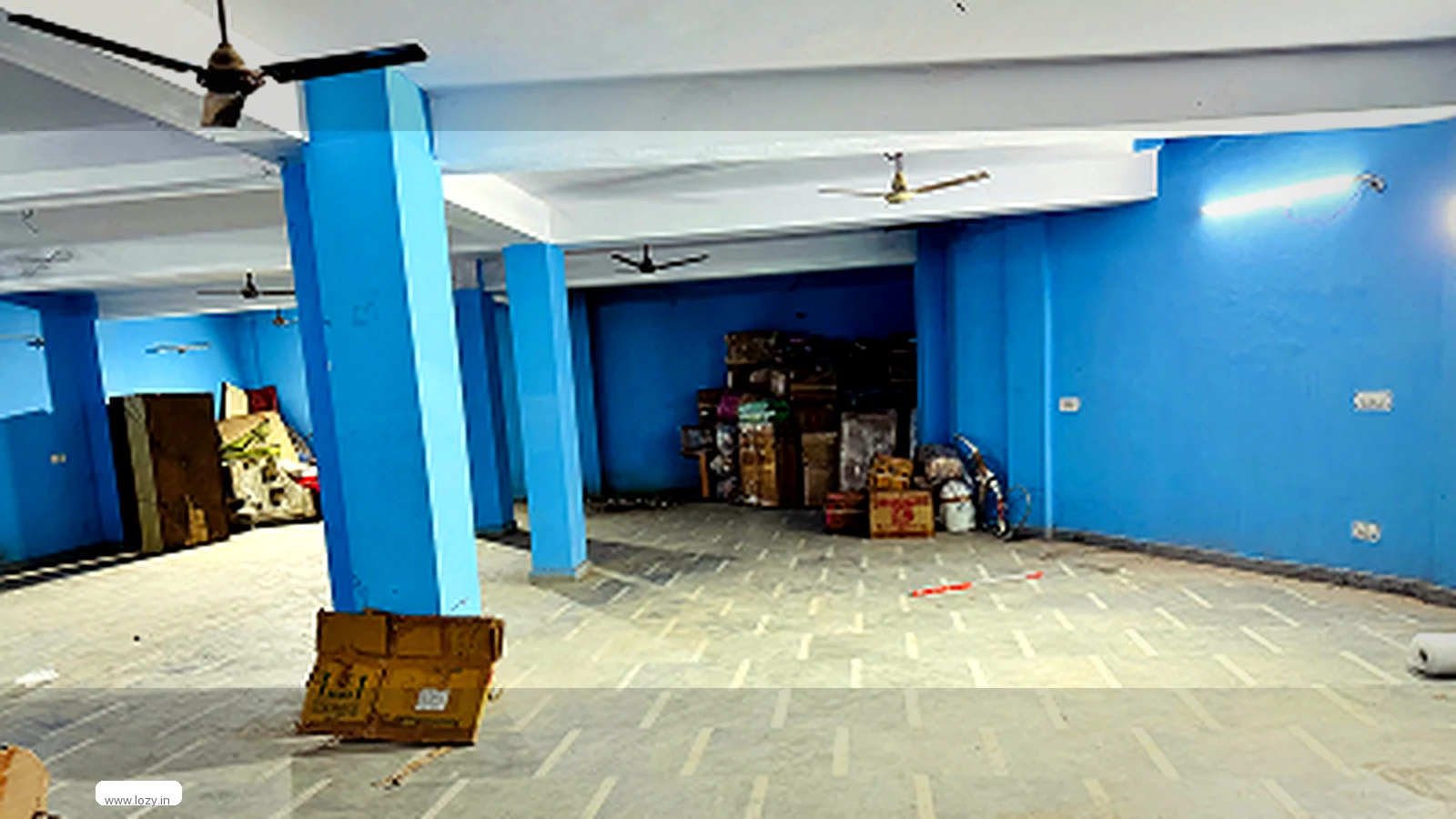
New Delhi is where the supply chain ends, not where it starts: almost everything sold in the city was made somewhere else and trucked in. That single fact shapes warehousing in New Delhi more than any rate table does. The city needs small, well-placed units minutes from its customers — and it needs them to be legal, because land use, building approval and vehicle hours decide what may be stored inside the boundary. Warehouse space from Lozy starts at ₹12 per sq ft per month.
Key takeaways
- Delhi's storage demand comes from consumption, not production: five Lozy collection centres operate inside the city — including Alipur in the north, Bamnoli in the south-west and Dhulsiras near Dwarka — so pickup and delivery begin close to the buyer.
- Warehouse and godown space starts at ₹12 per sq ft per month, self storage in Dwarka at ₹999 a month and household storage at ₹1,499 a month — billed monthly, GST-invoiced, with no long lock-in.
- Storing goods inside Delhi is a land-use question before it is a rent question: the Master Plan and the MCD's Unified Building Bye-laws govern it, and those bye-laws classify warehouses, cold storages and freight depots as storage buildings.
- Large floorplates are scarce inside the boundary, so the working split is customer-facing stock in Delhi and patient stock on the NCR belt — 77+ Lozy warehouses and more than a million square feet of live space cover both.
Warehousing in New Delhi: where the demand actually comes from
Delhi buys. Its manufacturing base is modest, its density is the highest of any Indian metropolis — 11,320 people per square kilometre at the 2011 Census, against a national average of 382 (source: Census of India) — and its households sit in flats that were never designed to hold much. The storage consequence is a city made of many small, busy units rather than a few large sheds.
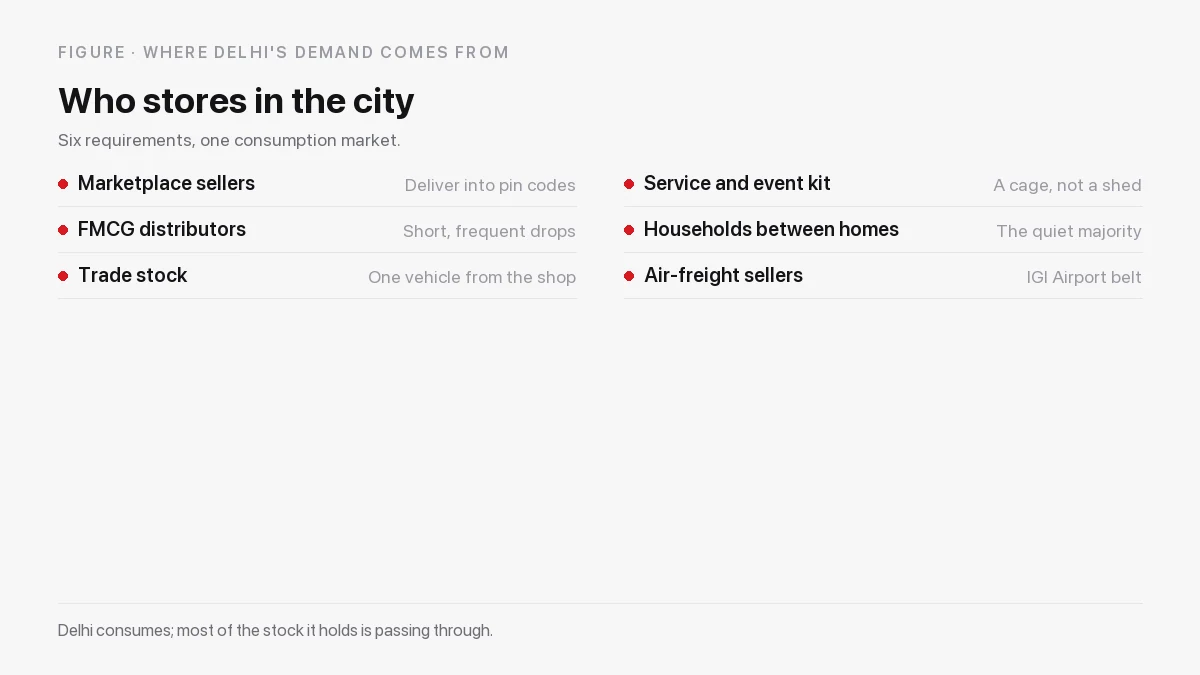
Five kinds of Delhi requirement turn up again and again at Lozy's facilities in the city:
- Retail and marketplace sellers keeping stock close to the pin codes they deliver into — which is e-commerce warehousing with a delivery route attached.
- FMCG, packaged food and pharma distributors who need short, frequent drops into the city and a unit on the north-west side for the trade stock that feeds them.
- Wholesale and trade businesses that want goods one vehicle away from the shops they supply, not one highway away.
- Service, project and event businesses storing equipment, signage, spares and exhibition material — a cage and a loading bay rather than a warehouse.
- Households and families between homes, who make up the quiet majority of Delhi's storage bookings.
What Delhi does not have is much appetite for patient, long-duration bulk space. Stock that sits for a quarter — an imported container, a seasonal build-up, a year of spares — is cheaper to hold outside the boundary, and it enters the city only for its last leg. That is the structural reason a Delhi business ends up with two addresses: a customer-facing unit inside the city and a floorplate on the belt. If you want the pocket-by-pocket picture of where the city's godowns cluster, our guide to warehouse space in Delhi maps those belts; this post stays on the demand and the compliance side.
The compliance reality of storing goods inside the city
Warehousing in New Delhi has a step that the belt does not: land use. Elsewhere a warehouse decision begins with rent; here it begins with zoning, because the city has spent decades regularising and sealing storage while demand kept rising. Three questions decide whether an address works.
1. Is storage a permitted use on this plot?
Land use in Delhi is set by the Master Plan and administered by the Delhi Development Authority, while the buildings themselves fall under the Municipal Corporation of Delhi's bye-laws. Those bye-laws treat warehouses, cold storages, freight depots and transit sheds as storage buildings — a defined category with its own risk classification and its own approval route (source: MCD, compendium of Unified Building Bye-laws). A shed standing on the ground is not automatically a shed you may fill.
So ask for the approval rather than the assurance. If the owner cannot show that the plot's use permits storage and that the building is sanctioned for it, you are being asked to carry his risk. Cheap rent inside a non-conforming pocket is a warning, not a bargain: Delhi does seal unauthorised structures, and a sealed unit means clearing your stock at your own cost, at an hour you did not choose. An organised, approved facility takes that question off your list — which is part of what the rate is buying.
2. Will the paperwork survive a GST review?
Storage rent is a taxable supply. If the invoice does not carry GST in your entity's name, there is no input credit to claim and an apparently cheap godown turns out to be the more expensive one. The rules sit on the GST portal, and ten minutes with your accountant settles your own position.
Two GST details bite Delhi businesses in particular. First, most goods stored in Delhi arrived from another state — a plant in Haryana, a unit in Uttar Pradesh, a port shipment — and a consignment above the prescribed value threshold needs an e-way bill generated before the goods move (source: GST Council and the e-way bill portal). Second, a fixed place of business in another state generally brings its own GST registration with it, so a factory in one state and a Delhi unit in another is a registration question to settle before the first truck rather than after a consignment is held at a check post. Imported goods add one more layer, because duty-deferred storage is a different licence and is explained on the customs bonded warehouse page.
3. Can a truck reach the unit at the hour you need it?
Delhi restricts goods vehicles inside the city during peak hours, and the schedule — entry, plying and idle parking — is published by the Delhi Transport Department. If your dispatches leave in the evening, that timetable matters a great deal more than drive time on a quiet Sunday.
Then there is the physical last kilometre. Delhi's older commercial lanes take a large trailer badly, basement storage has a height limit no rate card mentions, and an upper floor without a goods lift turns a two-person job into a six-person one. Walk the route with the biggest vehicle you will ever send, and check the gate width, the turning circle and the lift capacity before you sign. A facility that answers those three questions without hesitating is a facility worth renting.
Where Lozy's New Delhi space is
Delhi's storage clusters where trucks can move and where land is cheap enough to keep goods on, which in practice means the edges of the city. Lozy's network follows the same two corridors, with five collection centres inside New Delhi — among them Alipur in the north, Bamnoli and Dhulsiras in the south-west — so that pickup and delivery start inside the city rather than on a highway outside it.
The Dwarka and airport belt
The strongest cluster sits in the south-west: warehouses in Dwarka for business and 3PL work, self storage for homes and businesses in Dwarka Sector 26, self storage units in Dwarka Sector 27, further space in Dwarka Sector 19, and units on the Yashobhumi Sector 26 side. The Dhulsiras collection centre serves the same side of Delhi, close to the IGI Airport belt. That is why this pocket suits sellers who ship by air, distribution operations that need stock inside the city rather than staged outside it, and south-west households who would rather drive fifteen minutes than cross Delhi with a van.
What is bookable in that pocket, and everywhere else Lozy runs, is listed on the New Delhi location page and in the live warehouse listing.
Ghevra Metro and the north-west
On the other side of the city, the Ghevra Metro and Ghevra Metro 2 warehouses stand on the Rohtak Road stretch that serves north-west Delhi's trade, the Mundka and Bawana belts behind it, and a trade that has been drifting out of the older godown pockets for years. For a trader on that side, a unit near Ghevra Metro is often closer to both the stock and the customer than anything on the NCR belt — worth checking before you assume that anything sizeable has to leave the city. Warehouse and self storage space in New Delhi of that kind is bookable month by month, which matters when the requirement is a season rather than a decade.
New Delhi or the NCR belt: how the split actually works
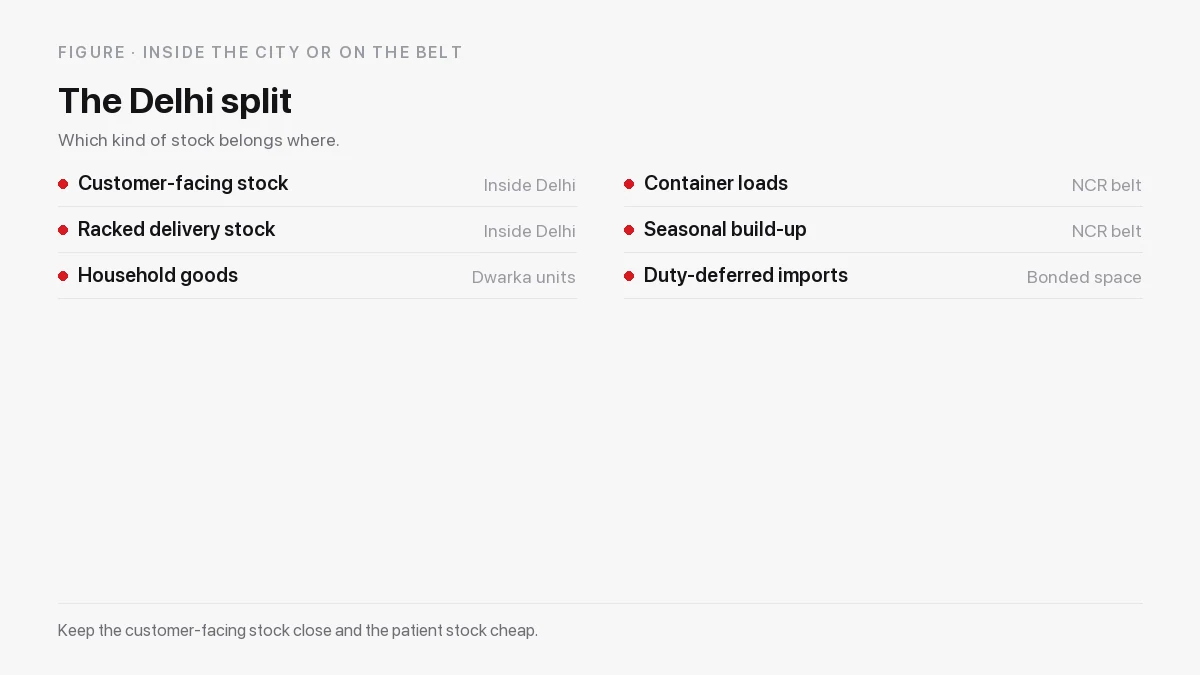
Businesses rarely choose one or the other. They choose a mix and shift it as the customer moves. This table is the version we see most often — a starting point, not a rule.
| What you are weighing | Inside New Delhi | On the NCR belt |
|---|---|---|
| Space usually available | Small to mid units, racked floors | Large floorplates and sheds |
| Distance to the customer | Minutes across the city | An hour or more, plus a window |
| Land use and approval | Master Plan and MCD bye-laws apply | State industrial areas, own rules |
| Best suited to | Delivery, 3PL, self storage | Bulk, seasonal, imported stock |
| How the rate is quoted | Per sq ft, or per unit | Per sq ft on a bigger area |
Read it as one line: keep the customer-facing stock close and the patient stock cheap. A seller whose catalogue moves weekly wants the unit near the buyer; a business holding a container until next quarter wants the lowest covered square foot it can find, which is almost never inside the boundary. The belt that absorbs most of Delhi's overflow is covered on our Haryana location page and in the Haryana warehousing guide; the eastern half of the same question is in the Uttar Pradesh guide.
What warehouse space in New Delhi costs
Lozy publishes starting rates rather than an average, because an average quoted without its basis misleads more than it informs. Delhi has no single market rate either: an approved unit in Dwarka and a shed on the Rohtak Road side do not trade at the same rent, and neither is comparable with a floorplate outside the city. On today's published figures, warehouse and godown space starts at ₹12 per sq ft per month, a lockable self storage unit at ₹999 a month, and household storage at ₹1,499 a month — all billed monthly with GST invoicing and no long lock-in.
Those three figures are three products on three different bases, and mixing them up is the quickest route to a bad comparison. Per square foot applies to a warehouse floor or a racked bay. A lockable unit is priced per unit per month, because you are buying the room rather than the area. A household plan is priced for the job, including collection and return. Line two quotes up on different bases and the cheaper number is usually the more expensive product; the New Delhi facilities page lists which of them is bookable in each Delhi pocket.
What actually moves the cost of warehousing in New Delhi: the size of the unit, how close it sits to the customers you deliver to, the term you commit to, and whether the goods need climate control, extra handling or packing material. What does not move it is the label — a godown, a warehouse bay and a storage unit are three different products. For a requirement measured in weeks, short-term storage is the option that looks expensive per month and usually costs less than a lease you cannot use.
Self storage for New Delhi households
Delhi's flats are small, expensive and rarely built with storage, which is why the households using Lozy's Dwarka floors are not storing because they own too much. They are storing because the flat they moved into has no loft, no garage and no balcony worth the name — and because a Delhi family's furniture is worth more than the cost of keeping it for a year.
The Dwarka self storage floors
A lockable self storage unit starts at ₹999 a month and is priced per unit rather than per square foot, so a small requirement stays a small bill. A family-scale move is covered by household storage from ₹1,499 a month, which adds the handling: free doorstep pickup across New Delhi through the collection centres at Alipur, Bamnoli and Dhulsiras, trolleys free at the facility, and delivery back when the new home is ready. Both run on PIN access with 24/7 CCTV, monthly GST-invoiced billing and no lock-in.
The two Delhi facilities built for this are the self storage floors at Dwarka Sector 26 and the self storage units at Dwarka Sector 27, both inside the city's own network. A Dwarka household can drive its own cartons over and walk in with a checklist, or book the pickup and skip the trip entirely — a real difference when the item is a three-seater sofa and the building has no lift.
What a Delhi household actually puts in storage
- Furniture between homes — beds, wardrobes and dining sets, including the pieces a family is not ready to sell.
- Appliances and coolers out of season, next to the air conditioners a Delhi home owns but needs for half the year.
- Renovation overflow: two rooms' contents out while the work runs, and back the week it finishes.
- Transfer and posting kits, for families whose next address is decided in another city.
- Records a household cannot lose and does not want in the house, which document storage handles on its own.
- Stock belonging to a home-run seller — often the reason a bedroom stops being a bedroom.
The test is simple. If the goods are your home's contents, take a unit with walk-in access and no handling charge. If they are pallets and cartons that turn over, take a warehouse bay. The difference is who loads the truck, not the price per square foot.
Worked example: one trader, one household
A trader. A Delhi business needs 1,000 sq ft for fast-moving stock and another 500 sq ft for a seasonal build-up it will clear in ten weeks. At Lozy's published starting rate the base works out to about ₹12,000 a month and the seasonal block to about ₹6,000, so the flexible arrangement costs roughly ₹18,000 a month while the surge lasts and ₹12,000 afterwards. The alternative is a 3,000 sq ft shed on a multi-year lease that covers a peak needing half of it — and keeps charging through February.
The Delhi unit stays where the deliveries are, because that is where the riders already ride. The seasonal block either sits alongside it or moves to the belt if it is a container that will not be touched for weeks. Nothing in the arrangement needs a new building; it needs the trader to know which part of the stock is permanent and which part is not.
A household. A family leaves a Dwarka flat while a new one is being done up, keeping two bedrooms' worth of furniture, appliances and about twenty cartons. A self storage unit takes it from ₹999 a month with walk-in access; the household plan handles it from ₹1,499 with pickup and return. Weighed against paying market rent for a room in Delhi for three months, or against a facility two districts away that costs a day of driving in each direction, the Delhi answer is usually the cheapest one.
How to choose, and the red flags
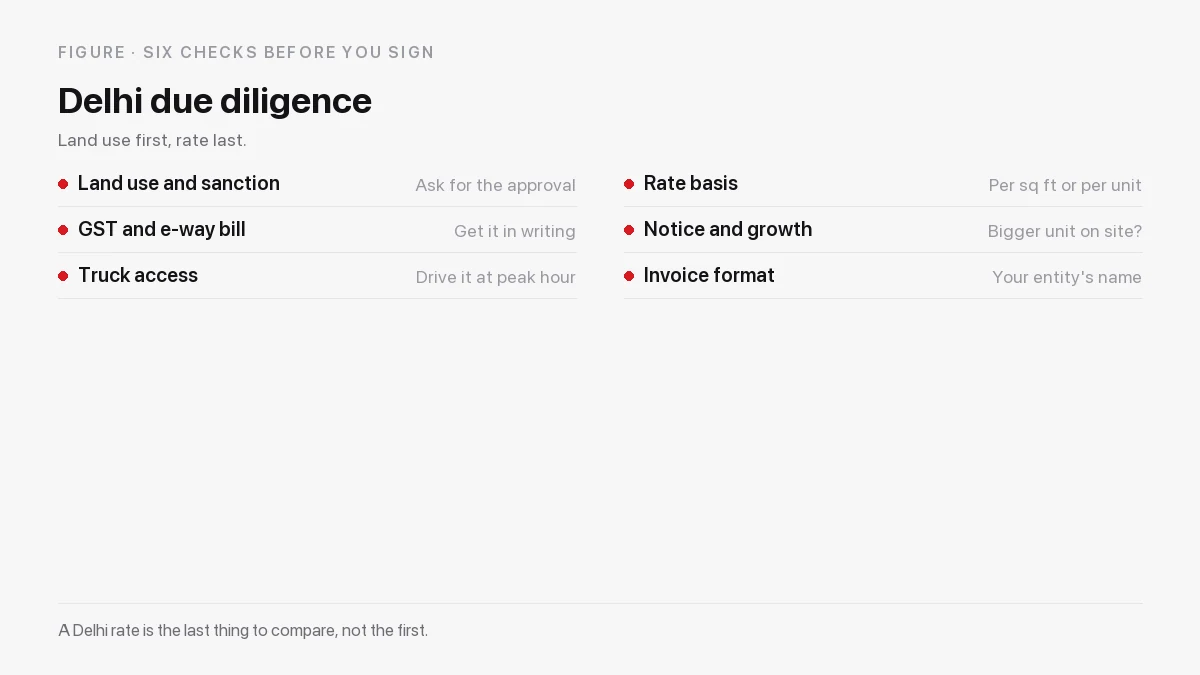
Before you commit to warehousing in New Delhi, work through these six checks. The mistakes that cost Delhi businesses money are the same six every time, and every one of them is avoidable with the questions asked before signature rather than after.
- Settle the land use first. Confirm that storage is a permitted use, that the building is sanctioned for it, and get the approval in writing rather than the reassurance.
- Time the drive, not the distance. Run the delivery route at the hour you will actually use it, with Delhi's peak-hour goods-vehicle restrictions in front of you.
- Fix the basis of the quote. Per square foot, per pallet or per unit — and whether GST is charged on a tax invoice in your entity's name.
- Check how a truck reaches the door. Gate width, turning circle, height, lift capacity. Bring the largest vehicle you will ever send.
- Get the inclusions in writing. Racking, trolleys, handling, security, housekeeping and pest control change the real cost more than the headline rate.
- Ask about growth and notice. Whether a bigger unit exists on the same site, and how much notice you must give to leave — a seasonal requirement should never carry a multi-year clause.
Red flags, in Delhi specifically: a rate well below the pocket it sits in with no explanation; an owner who changes the subject when you ask about land use or sanctioned plans; cash rent with no tax invoice; a unit that needs a smaller vehicle than your normal dispatch to reach it; and vague answers about who is liable when goods are damaged, with no insurance cover to point at.
If you would rather not run those checks alone, the services page sets out what Lozy operates across India, the Lozy blog covers the topic in the same plain style as this guide, and telling us the city and the size gets you a rate and the options that are actually free now.
Also in Delhi NCR
Delhi's stock does not stop at the boundary, and most businesses working inside the city hold space on both sides of it. Containers arriving from the manufacturing belt land on the Haryana and Uttar Pradesh corridors as often as they do inside Delhi, which is why the Gurgaon, Faridabad, Noida and Ghaziabad guides read as one NCR decision, and the New Delhi page is where the city's own side of that split is written down.

Need warehouse space in New Delhi?
Tell us the city and the size you need — we reply with a rate and the options available now.
Get a quoteCall +91 93547 12345About the author
Lozy Editorial Desk. This guide was written by the Lozy Editorial Desk, the in-house team that covers warehousing, self storage, logistics and customs/EXIM topics for lozy.in. We write from Lozy's own facility and pricing information and from public, citable sources. We do not publish invented statistics, ratings or reviews.
Sources. Pricing, facility names and the collection-centre list are Lozy's own. Delhi's land use is described from the Delhi Development Authority's Master Plan material and its building classification from the Municipal Corporation of Delhi's Unified Building Bye-laws; goods-vehicle hours from the Delhi Transport Department; GST registration, invoices and the e-way bill from the GST portal and the GST Council's e-way bill explainer; and the population density figure from the Census of India.
Last updated: 13 October 2026. Have a question the FAQ below does not answer? Call +91 93547 12345 or email care@lozy.in.
Need warehousing or storage in India?
Request a free, tailored quote in under 2 minutes — free pickup, no lock-in.