Warehousing in Noida: Space, Cost and Booking (2026 Guide)
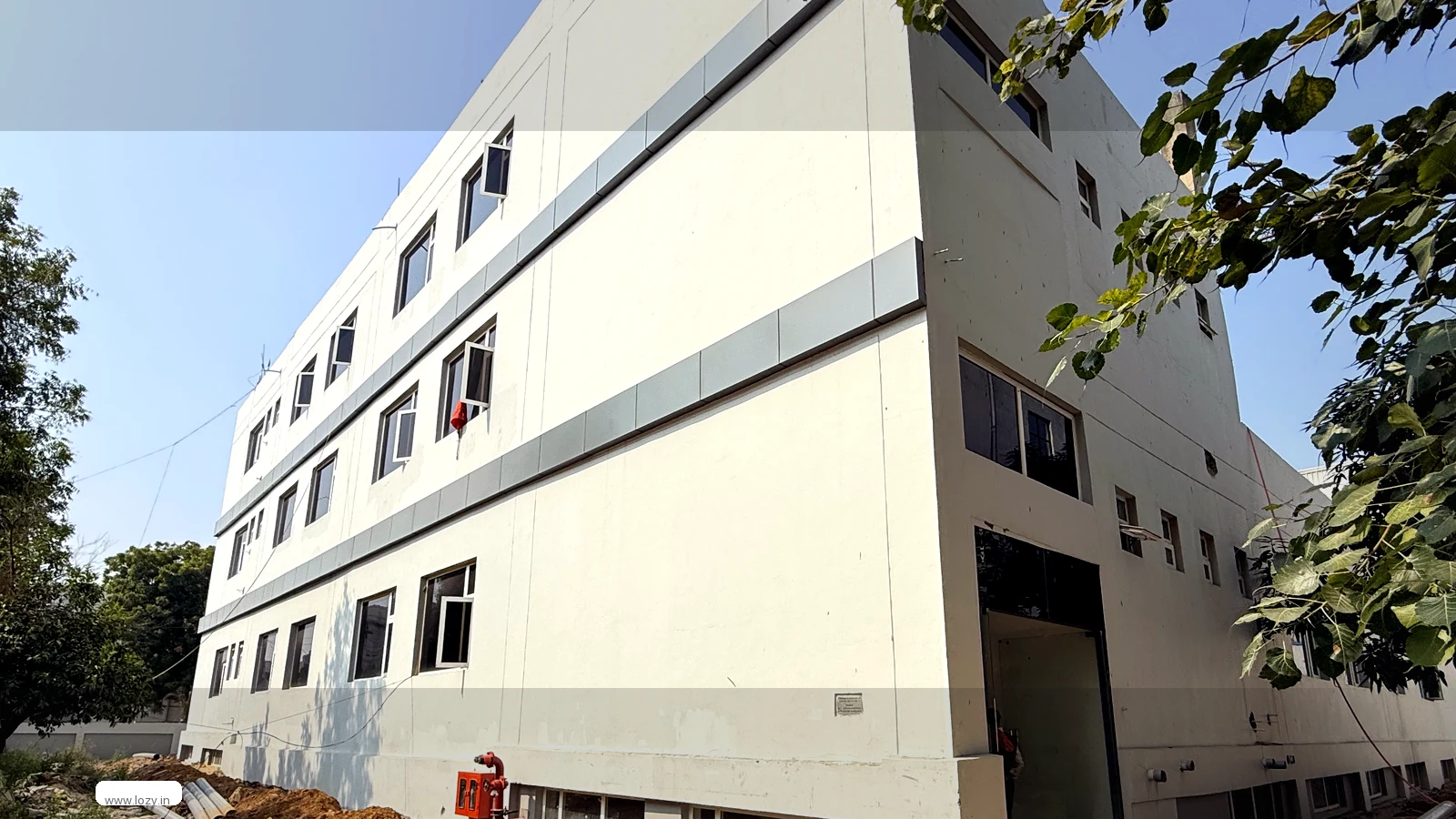
Short answer: Warehousing in Noida is the storage end of Delhi NCR's electronics and fast-moving-consumer-goods trade — distribution space for brands, importers and online sellers who deliver into the city's sector grid, the IT-enabled offices around it and the retail catchments on both sides of the expressway. Land here costs enough that much of the usable space sits on an upper floor or in a rebuilt unit rather than a purpose-built shed, which is the first thing to check before you sign. Space in the Lozy network starts at ₹12 per sq ft per month.
Key takeaways
- Noida is one of the eight collection centres in Lozy's Uttar Pradesh pickup network, alongside Ghaziabad, Lucknow and Ballia, so a booking begins with a doorstep collection inside the city rather than a run to another district.
- Godown and warehouse space is quoted from ₹12 per sq ft per month, and an e-commerce fulfilment plan starts at ₹4,999 per month — both billed monthly on a GST invoice with no long lock-in.
- A large share of the space that comes up in this city is a first-floor or split-level unit instead of a dock-height shed, so floor loading, lift access and the last hundred metres to the gate decide whether a unit is usable at all.
- Lozy's network holds 77+ warehouses and over a million square feet of live space; the published Uttar Pradesh facility — a 30,000 sq ft commercial and 3PL warehouse on the Greater Noida industrial stretch — is the state address a Noida pickup feeds.
Noida is the part of Gautam Buddh Nagar that behaves like a city rather than an industrial estate. The numbered sector grid gives a trading business an address inside Delhi NCR without a Delhi rent, and the electronics trade, IT-enabled offices and consumer-goods distribution that grew up around that grid created the storage demand this guide is about. What follows is written for this city specifically: what gets stored here, which corridor the goods move on, what the space costs, and how to avoid signing for a unit that no loaded vehicle can actually reach.
Why the electronics and FMCG trade keeps its stock in Noida
Two very different businesses have made this city their North India stockroom, and neither of them is the heavy-engineering tenant you meet in the belts further north.
The first is the electronics trade — components, spares, accessories, small appliances and the packaging that arrives with them — much of it import-led and moving through Delhi NCR's wholesale network into retail counters across the region. The second is fast-moving consumer goods: distributors holding soaps, packaged food, beverages and household lines for a catchment that runs from the sector grid into Ghaziabad's residential belts and back over the Yamuna into east and south Delhi.
Their requirements overlap almost completely, which is what makes the local market distinctive. Both hold stock that turns over quickly in small quantities rather than sitting for a season, and both are judged on whether an order received this morning can be picked, packed and dispatched before the courier cut-off. Neither wants a warehouse to be a storage shed. They want pick faces, racked positions, a bench to pack on, a returns corner and a dock a van can reach without blocking a lane.
Who the tenants are
Stand inside a well-run unit here on a Tuesday morning and the stock tells you what the city does for a living: cartons of mobile accessories and cables, boxes of LED fittings, printed circuit boards and spares in labelled bins, appliance cartons waiting on dealer allocations, shrink-wrapped FMCG cases stacked for a distributor round, and branded packaging material bought in bulk because it was cheaper that way.
The tenants behind that stock are brands running their own North India inventory, importers holding cleared cargo while it is allocated to orders, distributors breaking bulk for the sector-grid shops, and online sellers who need somewhere within a day of Ghaziabad, Delhi and the city's own residential sectors. Add the IT-enabled firms that keep fit-out material, signage, demo units and event stock between office moves, and you have a tenant mix where one facility can serve very different sizes of business.
The sector grid, and why the eastern edge matters
Noida was laid out before its traffic arrived, so the city has wide internal roads, planned industrial pockets and gates that were built for vehicles rather than adapted to them — a real advantage over the older godown lanes of inner Delhi. What it also has is Gautam Buddh Nagar's land economics: the further you go from Delhi, the easier it is to find ground-floor space with a dock and an apron, and the further your stock sits from the buyers inside the city.
That trade-off is the whole location decision here. A business delivering daily into the sector grid pays for proximity; a business dispatching palletised loads across North India pays less per square foot by moving east along the expressway. Lozy's Uttar Pradesh network page sets out how the state coverage is arranged around that stretch, and the pickup that starts in this city runs into it rather than around it.
The expressway corridor and what it changes for a Noida tenant
Two expressways do most of the work in this market, and they do different jobs.
The Noida–Greater Noida Expressway as the city's spine
The Noida–Greater Noida Expressway ties this city to its planned neighbour and carries the middle of the market: distribution units, 3PL blocks and fulfilment operations that serve both the sector grid and the eastern industrial belts. Goods move on it all day, which means a driver leaving a unit beside it can be inside the city or out towards the Yamuna Expressway without crossing the sectors twice. For a tenant whose customers are spread across Noida, Ghaziabad and the Delhi border, an address near this corridor usually beats a cheaper one in a corner of the city.
The Yamuna Expressway as the long-haul route
Where the city spine handles the last mile, the Yamuna Expressway handles distance: it starts at the southern end of this belt and runs out of the district towards Agra and the routes beyond. A distribution business whose orders leave North India — or that feeds a national 3PL network — plans its truck timing around that corridor, because the difference between loading at six in the morning and at ten is measured in hours on the road, not in minutes at the gate.
Neither corridor is a claim about a Lozy facility on it; they are simply the two roads that decide what a Noida address is worth to your buyers. Read them alongside the godown versus warehouse comparison if you are still deciding what kind of space the requirement actually is.
Monsoon, drainage and the low side of the district
One local constraint deserves a place in the plan. This belt sits on the Yamuna's side of the NCR, and parts of it hold water after a heavy spell. A ground-floor unit with a level loading apron can be unusable for days when the yard drains towards the building rather than away from it. When you visit, ask what the compound looked like after the last monsoon week, look at the plinth height against the road, and check whether the apron slopes away from the door. An upper-floor unit rarely has this problem, which is one honest argument in its favour.
Upper-floor and split-level units: the shape of space in this city
Because land here is priced as city land, a good deal of the storage a Noida business can actually rent is not a shed at all. It is a first-floor hall, a mezzanine inside a larger building, or a unit whose loading happens from a shared ramp — priced per square foot like any other space, but with a different set of rules attached.
That is not automatically worse. For light, high-value stock it can be better: upper floors are usually cleaner, drier and less exposed to the dust and heat that come with a yard, and they are often available in small sizes that a ground-floor shed is not. An electronics accessories seller with 2,000 cartons does not need a 40-foot trailer at the door, and paying for dock-height building would be money spent on vehicles it never sends.
What to check before you take an upper floor
- Floor loading. How much weight per square metre the slab carries, and whether racking legs and a stacker are allowed on it. Get it in writing.
- Lift and stair access. The internal dimensions of the lift, its capacity in kilograms, and what happens when it breaks down on a dispatch day.
- The shared ramp or dock. Who else uses it, at what hours, and who has priority when two tenants are loading at once.
- How the van gets in. Turning circle for a 20-foot vehicle, the height of the gate, and whether there is anywhere to stand a pallet while it is checked in.
- Fire access and the escape route. An upper floor with one staircase and stored cartons is a question worth asking plainly, and worth getting an answer about.
If your goods are heavy, dense or arrive by the pallet, treat the extra square footage as a trap rather than a bargain. The next section sets out the three shapes of space this market offers, so the comparison is on paper rather than in your head.
Three ways to take space in Noida
Almost every enquiry from this city lands on one of three arrangements. They are priced on different bases, so comparing the headline numbers without reading the middle column is the fastest way to a wrong decision.
| Arrangement | What the rate covers | Best fit in Noida | Typical basis |
|---|---|---|---|
| Managed racked or floor block | Your demarcated area inside a shared facility, security and handling included | FMCG distribution, e-commerce sellers, small electronics stock | Per sq ft per month |
| Ground-floor unit with a dock | Whole unit, trailer access, room for a pallet truck and an apron | Importers, appliance dealers, palletised dispatch | Per sq ft per month |
| Upper-floor or split-level hall | Light-goods storage on a slab, usually with a shared lift or ramp | Records, packaging, apparel, office and IT fit-out material | Per sq ft per month |
The pattern worth remembering is that the managed block is the only one of the three you can resize without moving, and it is the shape most of the space in the Uttar Pradesh network is offered in. Everything else fixes a footprint for the length of the agreement, which is exactly the risk when a festive quarter doubles your stock and the quarter after halves it.
What warehousing in Noida costs
Three published starting rates cover nearly every enquiry that comes out of this city, and each one belongs to a different product, not to a different address.
- Godown and warehouse space — priced from ₹12 per sq ft per month, per the warehouse space for rent page: a racked or demarcated floor area for stock on a normal turnover cycle.
- Business or on-demand space — quoted from ₹14 per sq ft per month on business warehousing. The premium buys a rolling or short term in place of a longer commitment, which suits stock that is only passing through the city.
- E-commerce fulfilment plans — from ₹4,999 per month on e-commerce warehousing, priced as a plan rather than by the square foot because the work includes pick, pack and returns handling.
Every one of those is a starting figure, not a quote. What you are actually offered depends on the size, the position (a ground-floor unit with a dock and an upper-floor hall are not the same product), the term, and any add-ons you take — climate control, extra handling, packing material or insurance cover. Billing is monthly with no setup charge, storage and handling are invoiced with GST so a registered business can claim the input credit, and there is no long lock-in on a monthly plan.
What moves the number here specifically
- Ground floor versus upper floor. The single biggest local swing. Dock-height ground space with an apron costs more than a slab hall of the same size, because it can take the vehicle the other one cannot.
- Area taken. From a few racked positions to a whole unit. Measure what the goods occupy, add aisle and packing space, and resist the unit two sizes up.
- Term. Length changes the product: a rolling booking that stops when the stock moves, set against a fixed longer term that normally prices lower per month.
- Position inside the city. A unit that keeps a delivery round inside the sector grid is priced differently from one on the expressway edge, because the land under them is not the same land.
If you want the wider picture before comparing quotes, the warehouse for rent guide sets out how these rates are built, and comparing a godown with a warehouse explains why two quotes for the same square footage can differ so sharply.
How to choose a Noida warehouse — and the red flags
Work through this list in order, and hold us to every line of it just as firmly as any other operator quoting you space in this city.
- Send the vehicle you actually use. Drive a loaded van or truck to the gate before you sign. Upper floors and shared ramps are where good-looking units fail.
- Check the slab if it is not ground floor. Floor loading, lift dimensions and stacking rules, in writing, not described to you at the door.
- Ask about water after the last heavy rain. Plinth height, apron slope and whether the yard drains away from the loading bay.
- Confirm what the rate includes. Racking, trolleys, handling, security, housekeeping and pest control — the list should be on paper before the first invoice.
- Settle the rent basis and the exit. Whether you pay per square foot, per pallet or per unit, and what notice you owe when you leave.
- Read the invoice format first. A GST tax invoice in your own entity's name is what makes the rent claimable; the rules are published on the GST portal.
- Ask which goods are not allowed. Every managed facility restricts flammables, liquids, perishables and unattended batteries. Knowing the list early saves a rejected consignment later.
Red flags worth taking seriously
- A ground-floor unit offered without anyone showing you the turning circle for a loaded vehicle.
- Racking described as included, then appearing as a separate line on the first invoice.
- An upper-floor price quoted per square foot with no mention of lift capacity or slab loading.
- A facility with one staircase, stored cartons and no clear answer on fire access or insurance cover.
- A long lock-in pushed on a first booking when a monthly arrangement would settle your requirement first.
Worked example: an electronics accessories seller with a festive peak
Consider a seller of mobile and appliance accessories that holds North India stock and runs on a festive peak. The steady requirement is around 3,000 sq ft — racked positions for the fast lines, floor space for cartons, and a bench to pack at. In the festive quarter the stock roughly doubles.
Two ways to cover that. Take a 4,500 sq ft unit for the whole year, or take 3,000 sq ft and add 1,500 sq ft for the two months the peak lasts. At the published starting rate of ₹12 per sq ft per month, the year-round unit runs to ₹54,000 a month against ₹36,000 for the smaller one. The difference is ₹18,000 a month, or ₹2,16,000 over a year, spent on floor that is empty for ten months.
The flexible route pays for the extra 1,500 sq ft for two months instead: 1,500 × ₹12 × 2, which comes to ₹36,000 for the peak, leaving ₹1,80,000 of that ₹2,16,000 unspent — roughly the cost of the racking and handling for a year. That is the ordinary arithmetic of monthly space in this city: the requirement here moves with the festive calendar, so the rent should move with it too. Bigger palletised requirements follow the same logic through industrial and bulk warehousing, and a seller who wants the pick-and-pack side handled by the operator starts from the e-commerce plan priced above.
Also in Delhi NCR
Noida and the belts around it split the region's work rather than compete for it. A business shipping east and south out of Delhi usually pairs a unit here with one on the Greater Noida expressway belt for bulk floorplates, or with Ghaziabad when the buyers sit on the north-east side of the border. Deliveries into the city itself are covered by the New Delhi guide, while Gurgaon and Faridabad cover the western half of the region.

Where the space is, and how Lozy helps
Lozy provides managed warehouse space through its Uttar Pradesh network, backed by 77+ warehouses and more than a million square feet of live space. The published state facility is a 30,000 sq ft commercial and 3PL warehouse on the Greater Noida industrial stretch — rack, pallet and bulk-floor storage with dispatch support — and the pickup that starts in this city feeds it, so stock collected in Noida does not have to be driven across the region by you.
Doorstep collection costs nothing once your booking runs a month or longer, your goods are recorded at check-in against a photo inventory, and the plan brings a demarcated racked or floor area with round-the-clock CCTV, on-site security and PIN-controlled entry. The full state picture is on the Uttar Pradesh location page, the city-side options are on Lozy's New Delhi page, and every other state is listed on the locations index.
To see what is available now, browse the warehouse listing. Smaller lockable units for records and home goods sit under self storage, short peaks are handled by short-term storage, and stock arriving in a container can be held duty-deferred in a customs bonded warehouse. Offices moving across the city keep fit-out material in the same managed space, trading stock that needs a running record is handled as inventory, and larger floorplates are covered in the industrial warehousing guide. The state-level view sits in warehousing in Uttar Pradesh, and for anything else talk to us.
Need warehouse space in Noida?
Tell us the city and the size you need — we reply with a rate and the options available now.
Get a quoteCall +91 93547 12345About the author
Lozy Editorial Desk. Warehousing, self storage, logistics and customs/EXIM topics for lozy.in are covered by the in-house Lozy Editorial Desk, which wrote this guide. The facts here come from Lozy's own facility records and published rates, together with public sources that can be checked; nothing in it is a statistic, rating or review invented for effect.
Sources. The rates, the facility details and the count of collection centres are Lozy's own and appear on the Uttar Pradesh locations page. Industrial land, corridor planning and single-window approvals in the state are taken from Invest UP and UPSIDA, city infrastructure and industrial planning from the Noida Authority, highway and expressway context from NHAI, state economic context from IBEF, and GST registration and input credit from the GST portal.
Last updated: 13 October 2026. If the FAQ below misses your question, call +91 93547 12345 or write to care@lozy.in.
Need warehousing or storage in India?
Request a free, tailored quote in under 2 minutes — free pickup, no lock-in.