Warehousing in Odisha: The Port Belt, the Coastal Air and the Cost
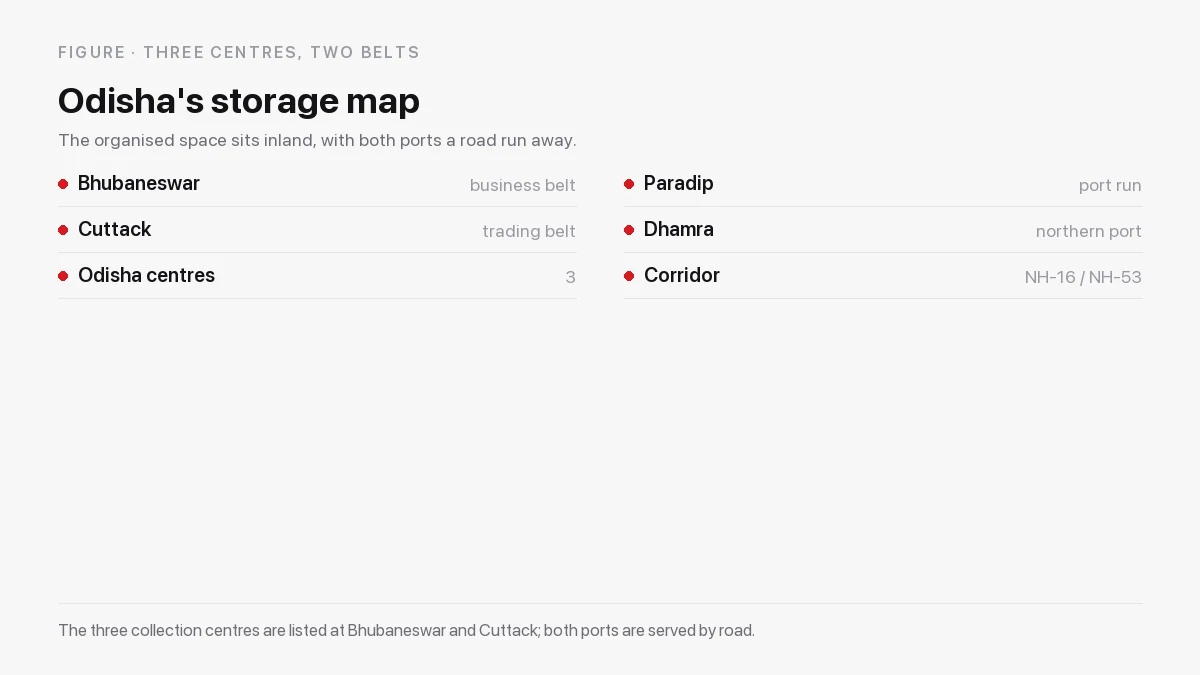
Short answer: warehousing in Odisha is decided by two things most Indian storage markets can ignore — the Bay of Bengal and the two ports on its edge. Demand concentrates in a narrow inland corridor between Cuttack and Bhubaneswar, and the goods moving through it are headed either to Paradip or Dhamra for shipment or into the coastal districts for distribution. Three collection centres carry Odisha in this network, listed at Bhubaneswar and Cuttack. This guide covers the belts, what the state stores, the humidity and cyclone questions a coastal shed must answer, and what space costs.
Key takeaways
- Odisha carries 3 collection centres in Lozy's network list, named at Bhubaneswar and Cuttack, and both sit on the NH-16 corridor that carries the capital region's road freight.
- Paradip and Dhamra are the two ports the state's export tonnage leaves from, and stock held for them is normally positioned inland at Cuttack or Bhubaneswar rather than on the waterfront.
- Space for rent is published from ₹12 per sq ft per month, a managed business floor from ₹14 per sq ft per month and self storage from ₹999 per month, each billed monthly on a GST invoice.
- The two local risks that quietly cost money are coastal humidity on paper, packaging and bagged goods, and the cyclone season that sits either side of the southwest monsoon.
Why warehousing in Odisha is a coastal calculation first
Most Indian storage markets answer to a highway. Odisha answers to the sea, and not in a decorative sense. The state sits on the Bay of Bengal's cyclone track, it carries a relative humidity that stays high for most of the year, and it runs two working deep-draft ports in Paradip and Dhamra that pull a large share of the state's export tonnage. Any one of those would be a footnote elsewhere; together they decide where a shed is worth building and what can safely be stacked inside it.
The practical result is that a coastal plan and an inland plan are not interchangeable here, however similar the two sheds look. A stack of steel plates or a pallet of mine spares will shrug off a wet September in a building with a high plinth and a sound roof. Corrugated cartons, paper stock, bagged fertiliser and cement will not — those goods lose value the moment the floor takes on damp, well before anything looks ruined.
How the yard behaves in the rain comes before the rate
Odisha's southwest monsoon runs roughly from June into September, and the Bay adds a second, sharper window around the pre-monsoon and post-monsoon cyclone period. For a buyer of storage that is not a weather conversation but a specification list: plinth height above the surrounding grade; a paved apron rather than loose earth that turns to slurry under a trailer; roof sheeting that is mechanically fastened, not simply laid over purlins; and a drain that carries water away from the building rather than past its door. Ask all four while standing in the yard — none of them survive a phone call.
The coast is an advantage as well as a risk
The same water that creates the risk creates the business. Odisha's mineral and metals economy moves an enormous tonnage out by sea, and Paradip and Dhamra are where that flow concentrates. Storage positioned inland at Cuttack or Bhubaneswar sits roughly midway between the plants and the terminals, which is usually the more useful place to stand: near enough to a port gate for a same-day drayage run, far enough from the waterfront to avoid the salt-laden air and the highest land rents in the state. The units available today are set out on the Odisha coverage page.
The two inland belts: Bhubaneswar and Cuttack
Odisha's organised storage market is geographically narrow. Bhubaneswar, Cuttack and the ground between them hold most of it, and the 3 collection centres this network lists in the state are named at those two cities. The reason is not administrative convenience: the capital region is where the state's consumer demand, its trading houses and its road and rail connections to both ports already sit, so a warehouse placed here serves the city market and the port flow without choosing between them.
Bhubaneswar, the capital belt
Bhubaneswar is a planned city with a services economy on top of it, and its storage requirement follows the shape of that economy. FMCG and retail distribution needs local stock close to the retail network; e-commerce sellers want a fulfilment floor within a courier's run of the city and the airport side; households and small businesses moving between addresses want a secure unit rather than a lease. None of those needs a container yard, and all of them need a floor that is dry, secure and reachable without a long negotiation. A unit on the Bhubaneswar side of the corridor is bought for delivery speed inside the city, and that is what it should be measured on.
Cuttack, the trading floor of the state
Wholesale trade, metals and building material, packaging and paper, and the spares that keep industrial plants running tend to be held here, because the trading houses that handle them are here and the Mahanadi-side road network gives a clean run west into the interior and east towards the port. A trader consolidating stock from several plants usually ends up on this side, and the reason is road geometry more than rent.The stretch between the two, and why it works
The land between Cuttack and Bhubaneswar behaves like a logistics belt, because a unit there is a short run from either city and a straight run to the coast. Larger floor plates, plant-to-warehouse movement and consolidation for shipment all fit this middle ground, and a business that cannot decide which city it belongs in often finds that the honest answer is somewhere between them. Whatever the answer, confirm it against the live inventory on the Odisha locations page rather than against a map.
The port belt: Paradip, Dhamra and the export flow
Two ports define Odisha's external freight, and they sit on opposite sides of the state's coast, which is why the storage decision rarely has one right answer.
Paradip: the Cuttack run on NH-53
Paradip, south-east of Cuttack at the mouth of the Mahanadi delta, is the state's principal cargo port and the one most Odisha shippers mean when they say "the port". The run out to it from Cuttack is a single highway movement, which is why stock earmarked for shipment is held in and around Cuttack rather than at the terminal: stock, documents and the sales office stay in one town, a truck goes down when a vessel position firms up, and nobody pays port-side rent for the weeks in between. Ask a prospective warehouse two blunt questions — how long the gate run really takes on a working day, and whether it has handled container stuffing or de-stuffing before.
Dhamra: the northern water
Dhamra, further north up the coast, gives the state a second outlet and takes pressure off a single terminal. For a business whose plants or suppliers sit on the northern side of Odisha, positioning stock inland in the Cuttack–Bhubaneswar corridor keeps both ports within a road movement rather than forcing an early commitment to one. That flexibility has a price — a unit roughly between the two is not on the doorstep of either — and it is the right trade for a shipper whose port choice changes with the cargo and the season. The industrial warehousing service covers the larger, dock-access floor plates these flows usually need.
Who stores what in Odisha
Five customer types occupy most of the organised square feet in the state, and no two of them want the same building.
Steel, metals and mining-adjacent stock
Odisha's mining and metals economy is the largest single driver of its industrial storage. What arrives at a warehouse is rarely the ore itself: it is the finished and semi-finished end of that chain — sections, plates, coils, ferroalloy bags, aluminium ingots and billets — along with the enormous consumable tail the industry runs on. Drill bits, conveyor belting, crusher and mill liners, electrodes, refractory bricks, lubricants, PPE and the tyre sizes only a mine haul truck uses. It is dense, high-value, low-perishability stock that tolerates an ambient floor and asks instead for load-bearing capacity, wide aisles and a yard a trailer can enter without a shunt. Mine and plant procurement rarely buys one item at a time, so the requirement is usually a mixed palletised floor rather than a neat single-SKU block — and this is the demand that settles around Cuttack.
Packaging, paper and other humidity-sensitive goods
The coastal air is the local technical constraint, and it lands hardest on exactly the goods a growing state consumes in bulk. Corrugated cartons, paper and board stock, printed packaging, bagged fertiliser, cement and certain food ingredients all pull moisture out of humid air, and the damage shows up as softening, caking, blocked sheets and lost print quality rather than as an obvious leak. A carton that has taken on damp loses its stacking strength long before it feels wet, which is why a pallet stacked three high in June can be a collapsed pallet in August. Storing these goods on a raised deck, in a ventilated building, with a defined distance from any wall or floor that draws damp, is the whole of the remedy — and it is a specification worth stating to the operator in writing rather than assuming.
FMCG and retail distribution into the districts
Odisha's retail trade runs out of the capital region into the districts, and a distributor's problem is a route problem as much as a space problem. Stock has to be held close enough to the city to service modern trade and general trade daily, and far enough out to load a district van without fighting city traffic. Fast-moving goods also carry dates, so rotation matters: a facility that cannot show where the older batch sits will cost a distributor write-offs it never attributes to storage.
E-commerce sellers serving the coast and the interior
A seller whose buyers are spread across coastal Odisha, the interior districts and the neighbouring states needs one node rather than several. Fulfilment here means stock is received, barcoded and racked pick-ready, then each order is picked, packed and handed to a courier on a schedule instead of a scramble. Sellers who run a marketplace account alongside their own storefront want a single floor feeding both channels, with a stock view they can check on any working day rather than a reconciliation at month end.
Households, businesses and self storage
Bhubaneswar's services economy generates a steady stream of furniture, appliances, documents, shop fixtures and office equipment that needs a home between two addresses. None of it requires an industrial floor; all of it requires a dry, secure, individually accessible unit bookable for months rather than years. That is what the per-unit product on the self storage page exists to serve, and in a humid state the difference between a ventilated unit and a sealed one shows up in paper, fabric and leather.
What warehouse space in Odisha costs
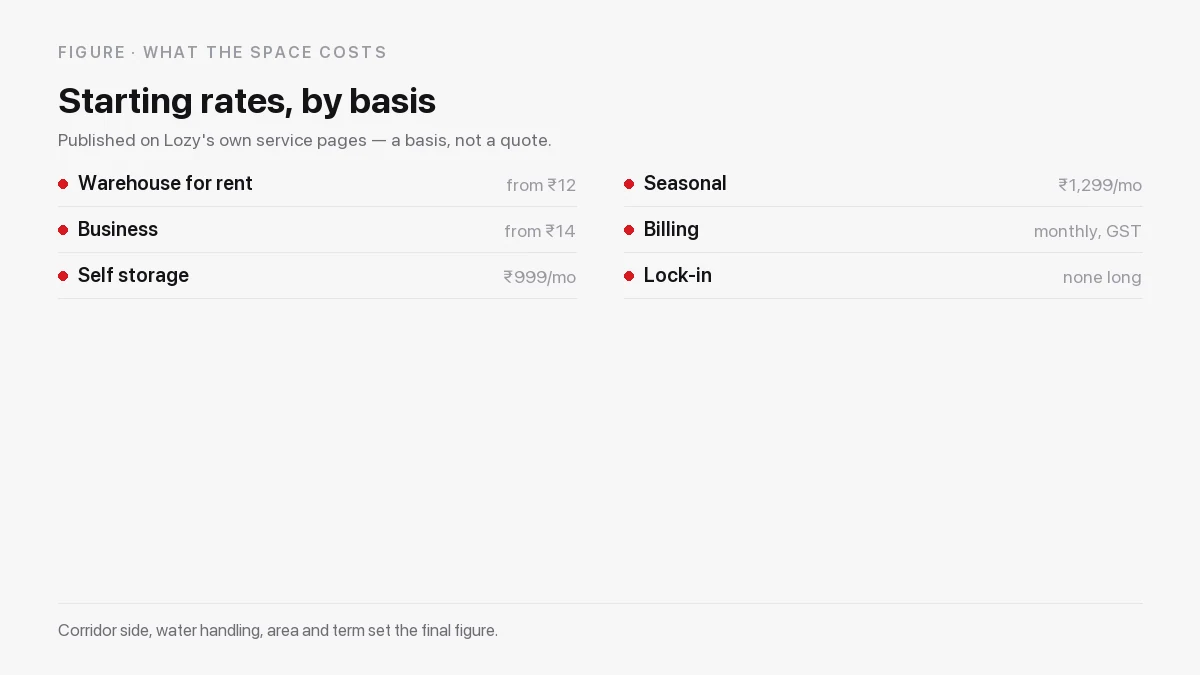
Four of Lozy's published starting rates cover what an Odisha requirement normally turns out to be. Rent for godown and warehouse space is published from ₹12 per sq ft per month, and a managed business floor — security, housekeeping and reporting built in — from ₹14 per sq ft per month. Self storage, the per-unit product a household or small business books, begins at ₹999 a month, and seasonal storage for a defined peak at ₹1,299 a month. Each is billed monthly on a GST invoice with no long lock-in attached.
The four inputs behind an Odisha rate
- Which side of the corridor. Bhubaneswar-side space is priced partly on city access; the Cuttack side and the ground between the two are priced on road and port access. They are not the same product.
- What the building does about water. Plinth height, apron, roof fixing and drainage are the difference between a shed that holds stock through a wet season and one that does not, and a facility that has invested in them knows it.
- The area and the basis it is quoted on. Compare one bay against one bay, and a quoted floor area against a racked position, rather than a headline rate against a headline rate.
- How long you commit for. A monthly booking and a year-long arrangement are priced differently, and the longer one normally returns the lower monthly figure.
| Where the unit sits | What it suits | The route that carries it |
|---|---|---|
| Bhubaneswar and the ring around it | FMCG and retail distribution, e-commerce fulfilment, household and business self storage | NH-16 and the city's own consumer market |
| Cuttack and its trading edge | Metals and steel stock, mine spares and consumables, packaging and paper, wholesale trade | NH-53 towards Paradip, NH-16 west into the interior |
| The Cuttack–Bhubaneswar stretch between them | Larger floor plates, plant-to-warehouse movement, consolidation before shipment | Both highways, with a short run to either city |
| Port-side positions near Paradip | Container staging and export consolidation, where a terminal-adjacent yard is genuinely required | The terminal road and the NH-53 run back to Cuttack |
Use the table as a routing decision rather than a menu of options. Cuttack-side space does the holding, Bhubaneswar does the last mile, and a port-adjacent yard only earns its premium if your goods genuinely need to sit near a terminal. Every unit behind that table is on the Odisha locations page. For how rent itself is structured, separately from the state, start with the guide to warehouse space for rent.
Licences, GST and the paperwork in Odisha
Settle these before the first truck is loaded rather than after, because two of them behave differently in a state that ships through a port.
GST, the invoice and input credit
Rent on storage in Odisha carries GST, and a business registered for it can recover that tax when the paperwork is right: the invoice raised in your own entity's name, as a tax invoice rather than a receipt or a cash memo, itemising storage and handling separately so the accountant can post it without a query. Confirm what that document will look like before booking, not at year-end. A proper monthly invoice is what keeps rent a recoverable cost; a cash rent with no paper behind it is always an expense. The rules on registration and credit sit on the GST portal.
Premises approvals, fire and the goods list
Two questions belong in the first conversation. Which authority approved the building, and can the occupancy and fire clearances be shown rather than described? Organised industrial land in Odisha is normally developed and allotted by the state, so a unit inside an approved estate inherits a land-use position that a standalone shed on private ground must establish on its own; the state's industrial picture is published by Invest Odisha. Then ask what the unit will not accept. Solvents and flammables, food without the matching licence, strong-smelling goods and anything needing pest-controlled separation are either handled in a dedicated bay or refused, and it is better to learn which on the phone than at the gate. Bagged fertiliser and cement should be offered a raised deck with a stated clearance from the walls, and an operator who has never been asked will have no system for it.
Insurance, inventory and the way in
Ask what happens on the way in. A photograph inventory, checked against your own count at the door, is what converts a shortage discovered three weeks later into a short email rather than an argument. Tell your insurer where the goods sit and how they are held: a policy written for a locked godown of your own and a shared managed floor are different risks. For high-value or regulated stock, the tracked model — records kept as goods move, at batch or SKU level — is described on the inventory warehousing page.
How to choose an Odisha warehouse — and the red flags
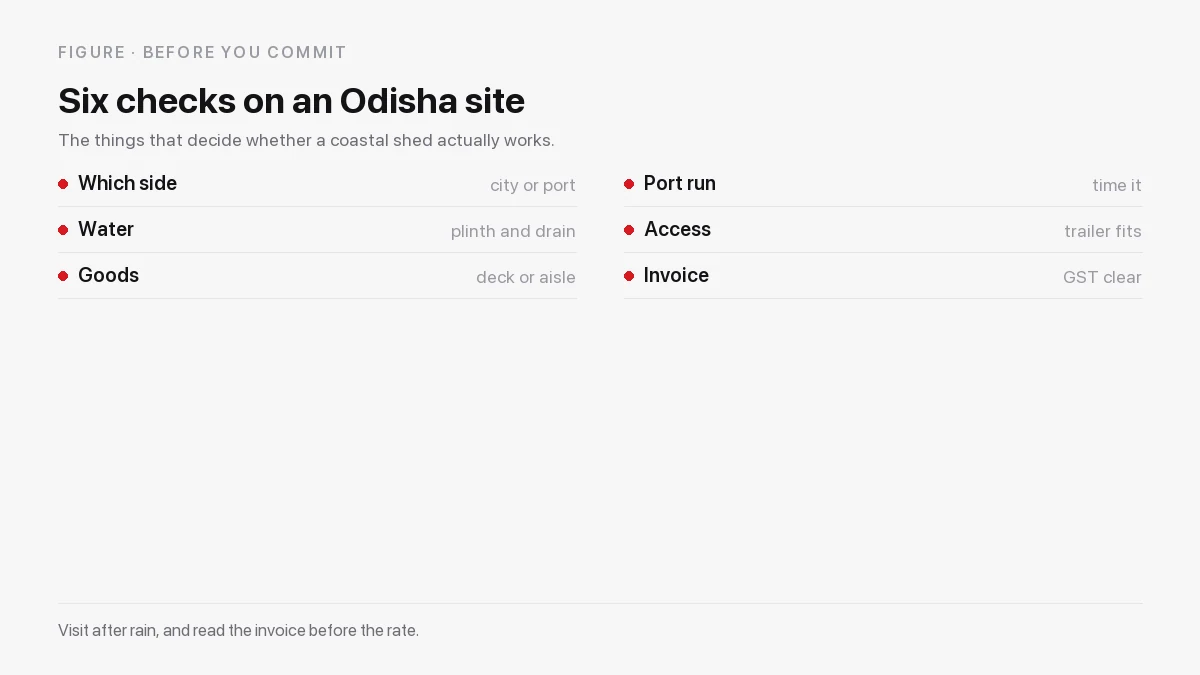
Run this list at the viewing. All seven items are visible on site, which is why an hour in the yard is worth more here than a longer quotation.
- Get your own end of the route right first. Stock that serves shops and households around Bhubaneswar belongs on the city side; wholesale lots, plant and mine consumables, and anything staging for shipment belong nearer Cuttack.
- Look at how the building handles water. Plinth, apron, roof fixing, and where the drain discharges. Walk the yard and see where the water went during the last heavy spell.
- Match the goods to the floor. Paper, packaging, cement and bagged fertiliser need a raised deck and air movement; steel, coils and spares need load capacity and aisle width.
- Time the run to a port gate. If part of your volume ships through Paradip or Dhamra, drive it at the hour your truck would really leave, and ask when the terminal stops taking entries.
- Check the gate, not the address. A shed on a good road with a gate a loaded truck cannot swing through will cost more than the rent it saved, and the coastal belt has both kinds side by side.
- Write down what the rate includes. Racking and pallet trucks, night security cover, housekeeping, pest control, and who carries the electricity bill for ventilation and lighting.
- Ask to see a real report, not a template. What you get after goods are received, and how a stock question is answered mid-month, tells you more than any promise about service.
What should stop you, roughly in the order these things surface: a rate that never says whether GST sits inside it; a coastal floor at or below the level of the yard around it; a humidity claim with no ventilation and no readings behind it; missing occupancy or fire clearance; a monthly figure that hides an annual minimum; a facility that only decides which bay is yours when the truck is already at the gate; and a port-adjacent offer from a yard that has never loaded or stripped a container.
A worked example: a mine-spares trader out of three small yards
A Cuttack-based supplier of mine and plant spares held stock in three rented godowns within a few kilometres of each other. Each was cheap on its own. Together they were expensive in ways the rent did not show: one order could be split across two buildings, a man spent his mornings driving between them to confirm stock, and when monsoon water came into the lowest of the three the loss was in the consumables nobody had counted — belts, hoses and cartons that took on damp and were written off months later.
What that season produced was a specification rather than a wish: roughly 3,000 sq ft under one roof, on a raised deck, a racked section for the fast-moving spares, an aisle wide enough for a forklift, and a receiving process that leaves a usable stock position behind it without anyone filling in a register afterwards.
Three thousand square feet at the published starting rate of ₹12 per sq ft per month comes to about ₹36,000 a month before any add-ons — indicative only, since the unit, the access and the term all move the final figure. What the trader gained was less easy to price: one address on his invoices, a count he could trust, and stock that came through a monsoon. Requirements like that one begin with the space listed on the Odisha locations page.
How Lozy helps in Odisha
Lozy runs 77+ warehouses and more than a million square feet of live space, and Odisha carries three collection centres in the network, named at Bhubaneswar and Cuttack. A booking brings a defined racked or open floor area of your own, 24/7 CCTV, on-site security and PIN-controlled access to gates, lifts and your storage bay, and the network is arranged so a business can scale from a small floor to a bigger one in the same city with the same operator.
The arrangement is monthly on a GST invoice, with no long lock-in and free doorstep pickup included on bookings of 30 days or more — so relocating out of a rented godown or a corner of a factory does not have to interrupt trade. What the company offers across its services is set out on the services page, with business warehousing for the managed floor a distributor usually needs and self storage for a unit-sized household or small-business requirement. To see availability before deciding, browse the warehouse listing and look at what is free in the state today, or contact us with the area, the goods and the dates you have in mind. If your stock moves beyond Odisha, the locations hub shows the rest of the network.
Also in Delhi NCR
An Odisha shipper opening a northern position normally keeps its Cuttack or Bhubaneswar floor in place and takes a second one in NCR, instead of trucking northern demand out of the east. Warehousing in New Delhi covers the capital's own market, Telangana sits on the southern corridor, and Jharkhand, Bihar and West Bengal cover the road east and north of here. For how a shared floor is actually run, see the guide to commercial warehousing; for the per-unit model a household or small business wants, self storage is the closer read.

Need warehouse space in Odisha?
Tell us the city and the size you need — we reply with a rate and the options available now.
Get a quoteCall +91 93547 12345About the author
Lozy Editorial Desk. This guide was written by the Lozy Editorial Desk, the in-house team that covers warehousing, self storage, logistics and customs/EXIM topics for lozy.in. We write from Lozy's own facility and pricing information and from public, citable sources. We do not publish invented statistics, ratings or reviews.
Sources. The facility counts, rates and coverage quoted in this guide are Lozy's published figures rather than third-party estimates. Port context comes from Paradip Port Authority and Dhamra Port; highway corridor context from the National Highways Authority of India; state economic context from IBEF's Odisha profile; industrial land and investment context from Invest Odisha; industry context from the Warehousing Development and Regulatory Authority; and policy releases from the Press Information Bureau. GST registration and input credit are described from the GST portal, linked above. A reader comparing more than one state before calling will find the same plain style across the Lozy blog, which covers warehousing, self storage and customs without the marketing gloss.
Last updated: 13 October 2026. Have a question the FAQ below does not answer? Call +91 93547 12345 or email care@lozy.in.
Need warehousing or storage in India?
Request a free, tailored quote in under 2 minutes — free pickup, no lock-in.