Warehousing in Bihar: Patna, the East-West Run and the Flood Season
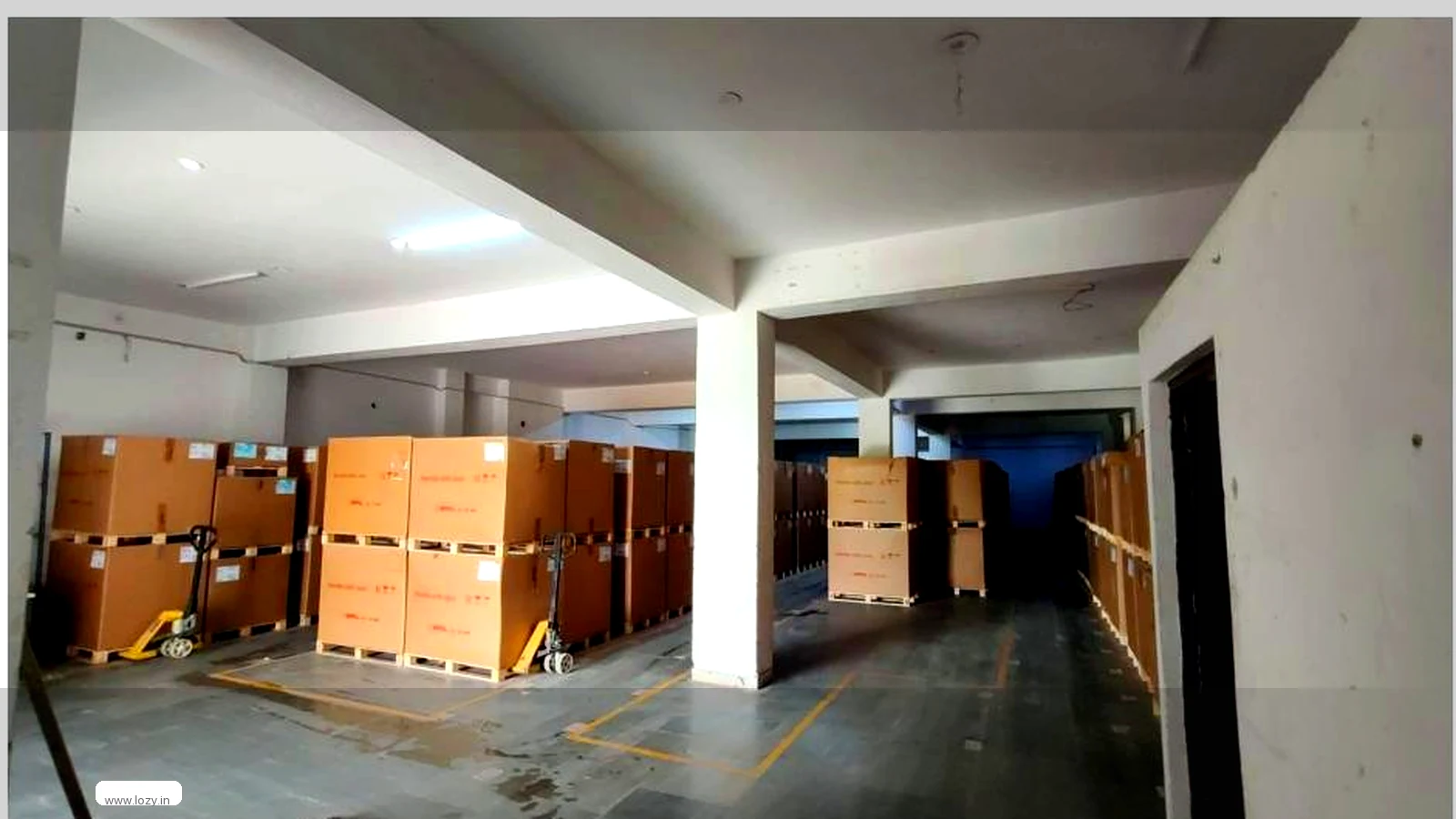
Short answer: warehousing in Bihar is a distribution decision taken in Patna. The state has no port and no mineral belt to organise its storage market around, so demand collects in one city — the capital — and radiates outwards along the roads that cross the state from east to west. Three collection centres carry Bihar in this network, all listed at Patna. This guide covers what those centres serve, the NH-19 and NH-31 corridor the state's freight actually runs on, the agricultural and wholesale stock Bihar holds in volume, the flood-season questions a ground-level godown has to answer, and what space costs.
Key takeaways
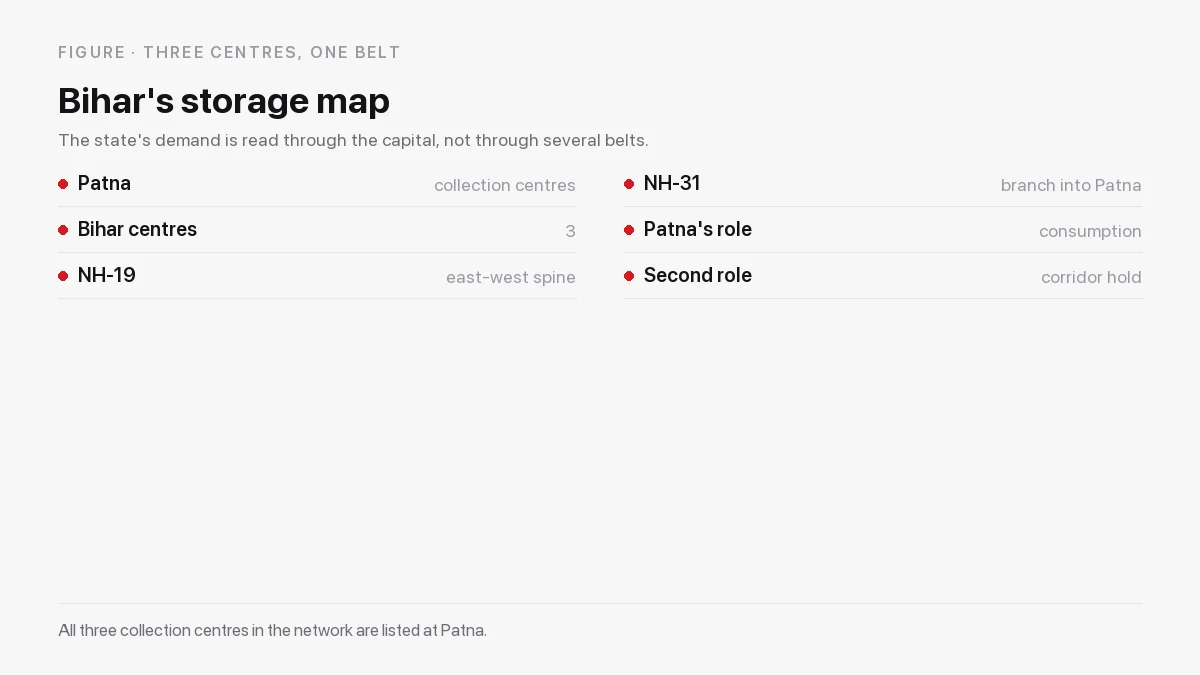
- Bihar carries 3 collection centres in Lozy's network list, named at Patna, so the state's storage demand is read through one city rather than across several belts.
- Patna works as a consumption and distribution centre before it works as a logistics address: stock is held here to serve the capital's own market and to break bulk for the districts around it.
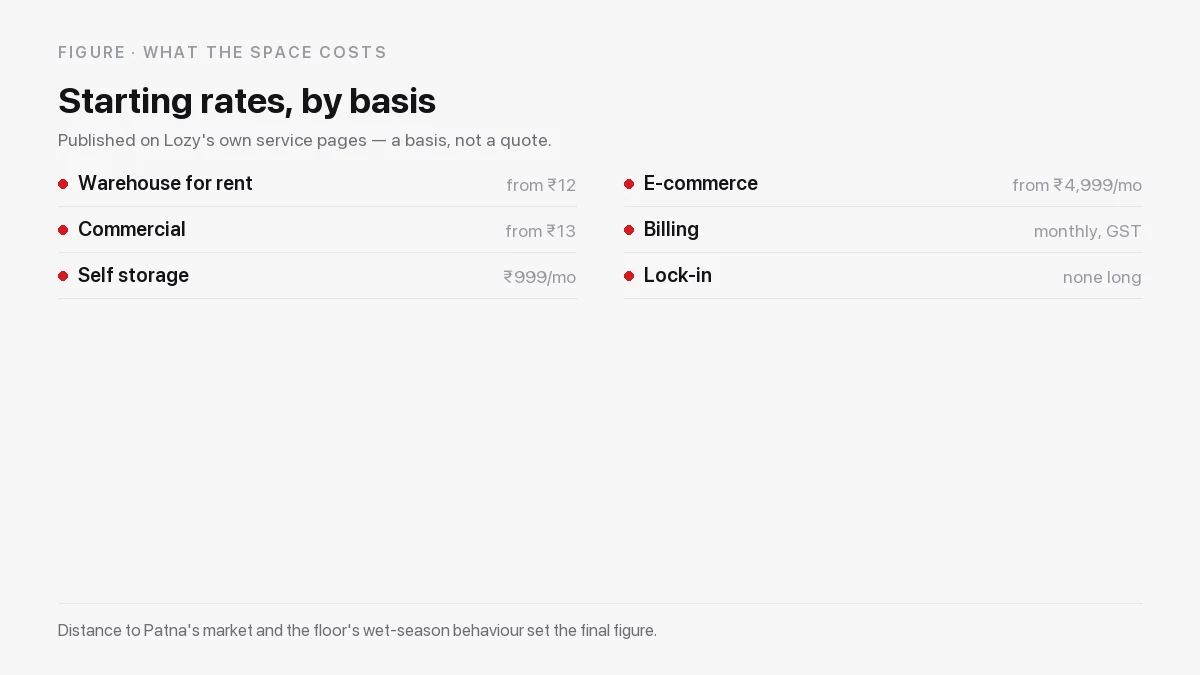
- Warehouse space for rent is published from ₹12 per sq ft per month, commercial warehousing from ₹13 per sq ft per month and self storage from ₹999 a month, each billed monthly on a GST invoice.
- The local risk that quietly costs money is the monsoon flood season — a godown whose floor sits at or below the level of its own yard is the wrong building, whatever the rate attached to it.
Why warehousing in Bihar is decided by a city, not a coast
Most states in this series have a landmark that explains their storage map. Odisha has two ports on the Bay of Bengal, West Bengal has the Hooghly and the docks at the head of it, Jharkhand has the mineral belt. Bihar has none of those. It is a landlocked, densely populated, agricultural state whose freight moves by road and rail, and whose organised storage has clustered in the one place where consumers, traders, government offices and road connections all sit together — Patna, the capital.
That changes what a buyer should ask. In a port state the question is how close the shed is to a terminal; in Bihar it is how well the unit is placed to serve the capital's market and to send stock outwards to the rest of the state. Get that call right and the rate follows.
Patna is a consumption market before it is a warehouse address
Patna is where Bihar's spending happens. Government, education, healthcare, the state's larger trading houses, the branded retail chains and the professional middle class that buys from them are concentrated in and around the capital, and every one of them pulls stock towards the city on a weekly or daily cycle. A distributor serving Patna is not building a regional hub; he is keeping a shopfront supplied, and the warehouse is simply the place the stock waits between the wholesaler's invoice and the retailer's order.
The useful units in Bihar are therefore modest floors rather than giant sheds. A few thousand square feet near the city, with a clean last mile and a dispatch window someone actually honours, does more for a Patna distributor than five times the area forty kilometres out. The real cost is rarely the rent; it is the city traffic a badly placed unit adds to every delivery run.
The corridor: NH-19 across the state and the NH-31 branch into Patna
Two highways carry most of the freight conversation in Bihar. NH-19 runs the long east-west spine across the state, from the Uttar Pradesh side through Patna and on towards Jharkhand and West Bengal, which makes it the road Bihar's interstate trucks live on. NH-31 branches off towards the northern riverine districts. Together they do the job a port does elsewhere: they decide which way your stock can leave, and how fast.
For a warehouse buyer, the practical read is that a unit sitting within reach of either highway can serve two markets — the capital and the wider state — without moving stock twice. A unit buried inside the city can serve the capital beautifully and almost nothing else. The National Highways Authority of India publishes the corridor information behind those roads if you want the routing detail, and the units available in the state are set out on the Bihar locations page.
The Patna belt and what it holds
Because the network lists Bihar through three collection centres, all named at Patna, the honest description of the state's storage map is a single belt rather than several. That is not a weakness. It means almost every requirement in Bihar can be served from one place, and it means a business that grows does not have to relocate to a second city to find more space.
What sits where on the belt
The city-facing side of the belt suits anything that ends its journey as a shop, a clinic, an office or a household: branded FMCG, packaged food, appliances, electronics, building fittings and the general trade goods a wholesaler turns over quickly. The outer side, where a trailer can get in without crossing the city, suits stock that is only passing through — a container load broken down into wholesale lots, a seasonal consignment held for a procurement window, or inventory waiting for a distributor's next order cycle.
The two sides are priced differently for a reason. City-side space is bought for the delivery run; outer-belt space is bought for the truck — and a business that treats the cheapest rate on the belt as a saving usually finds the difference was the access it needed.
Bihar as the bridge between the eastern and northern markets
There is a second role Patna plays that has nothing to do with serving Bihar's own consumers. Sitting between the Uttar Pradesh and Delhi NCR markets to the west and the West Bengal and Odisha markets to the east, the state is a natural intermediate hold on a long road movement. A seller who runs stock in NCR and in Kolkata can put a portion in Patna and cut the distance on either leg, which is usually cheaper than sending every order the whole way.
That is a different requirement from the capital's own distribution floor — larger bays, trailer turning space, a gate that opens early — and it is the one case where a Bihar unit is bought for the corridor rather than for the city. Floor plates of that kind are covered by industrial warehousing.
What Bihar's businesses actually store
Three pools account for most of the occupied square feet in the state, and they disagree about almost everything except one thing: none of them wants a warehouse floor that gets wet.
Agricultural produce, inputs and the procurement calendar
Bihar's economy is agricultural, and so is a serious share of its storage demand. That shows up as two separate flows. The first is produce: grain, pulses, oilseeds and tubers moving off the fields in bulk after harvest, moving again into the trade, and sitting somewhere dry in between. The second is inputs: seed, fertiliser and crop-protection material bought by the district trade and held until the planting window opens, which means a peak of movement into a warehouse before the season and a peak of movement out of it during it.
Neither flow behaves like a modern retail supply chain. Volumes arrive in bulk bags and loose loads rather than neat pallets, they sit for weeks rather than days, and the goods are heavy for the space they take, which puts load-bearing capacity and floor-level access ahead of racking and speed. Bagged fertiliser and bagged grain are also the two commodities that punish a damp floor hardest — they cake, they lose weight, and the loss is only discovered when a bag is opened. For the public side of the same system, see the Central Warehousing Corporation and the Food Corporation of India, and for where the state's processing capacity is heading, the Ministry of Food Processing Industries.
Wholesale trade, FMCG and the retail network
The second pool is trading stock. Patna's wholesalers and distributors hold branded FMCG, packaged food, beverages, personal care, hardware and general merchandise, and they turn it over against a buyer network that runs from the capital outwards through the rest of the state. Their requirement is unglamorous and specific: a clean, secure, vermin-free floor with enough aisle width to move a pallet, a loading point that works in the morning, and a stock position they can actually read when a retailer calls to ask what is left.
The trap for this group is dates. Packaged food has a shelf life, so the older batch has to move first, and a warehouse that cannot show where that batch sits turns storage into a write-off column nobody looked at. A visible first-in-first-out discipline beats an extra thousand square feet.
Online sellers, and the households that only need a unit
The third pool is newer and growing quietly. Sellers whose customers are spread across Bihar and the neighbouring states want a floor where stock is received, barcoded and racked pick-ready, and where orders are picked, packed and handed to a courier on a schedule rather than improvised at the gate. The published basis for that service starts at ₹4,999 per month on a starting catalogue and is described on the e-commerce warehousing page.
Alongside that sits a smaller, steadier demand. Households and small offices moving between addresses in Patna need furniture, appliances, files and shop fittings held safely for a few months, and none of it needs an industrial floor — only a lockable, monitored unit, which is what the per-unit product on the self storage page is. Check ventilation if documents, fabric or leather are going in.
The flood season, and why a plinth is the whole argument
Bihar's defining local constraint is water, and not the human-comfort kind. The state's rivers come down from the Himalayan foothills and across the plain, and in a heavy monsoon year they spread well beyond their banks. Large parts of the state are flood-prone in most years, standing water can persist for days, and the monsoon window from roughly June into September is the period a storage plan has to be built around rather than hoped through.
What water does to stock that a rate sheet never mentions
Flood damage rarely arrives as a wave through the door. It arrives as ground water rising to meet the plinth, as a drain that reverses under load, as an apron that holds two inches of water for a week and wicks into the bottom of a stack. By the time a carton of grain feels wet it has already lost its stacking strength, and by the time a bag of fertiliser looks affected the product inside has caked into a lump that cannot be sold.
The goods that fail earliest are the ones Bihar stores in volume: bagged grain and pulses, bagged fertiliser, packaged food, paper and board, and anything in a corrugated carton. Steel, machinery, cement and hardware tolerate far more. That split decides how much protection a unit genuinely needs — and a buyer who has not worked out which side his goods sit on will either overpay for it or lose a season's stock to protection he never bought.
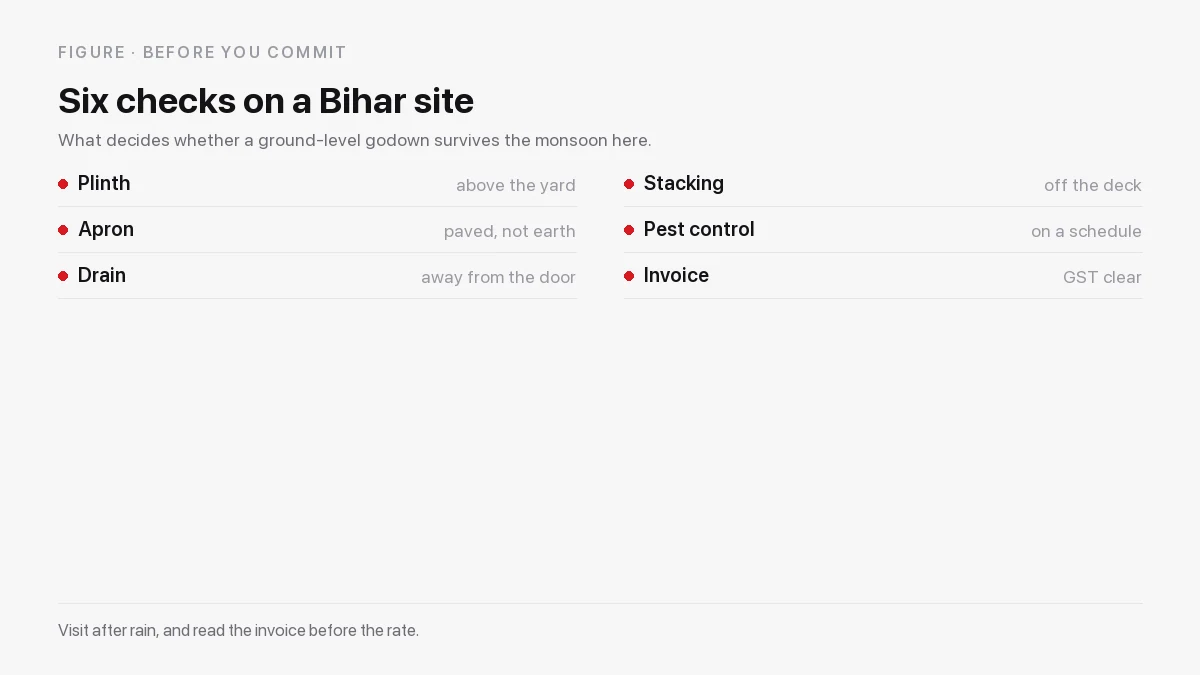
The five things to check before the rains, not after them
None of these is visible from a quotation. All of them are visible from the yard in half an hour.
- Plinth height. How far the finished floor sits above the surrounding ground, and above the level the yard reaches in a bad week. Ask for the figure, not an assurance.
- The apron and the approach. A paved apron sheds water; loose earth turns to slurry and then into mud tracked into the building on every tyre.
- Drainage direction. Where the site's water goes when it cannot drain away, and whether that is towards the building or away from it.
- Where goods sit. On pallets or dunnage off the floor, with a stated clearance from the walls, rather than straight on the deck.
- Roof and ventilation. Fixed sheeting, a roof inspected before the season rather than repaired during it, and enough air movement that a humid week does not condense on the stock.
Two more belong in that conversation: what the operator's own plan is if the site floods, and whether your stock is insured against flood specifically rather than under a general list of perils.
What warehouse space in Bihar costs
Three published starting rates cover what most Bihar requirements turn out to be. Plain warehouse and godown space for rent starts at ₹12 per sq ft per month. Commercial warehousing — the managed, racked version with security and housekeeping included — starts at ₹13 per sq ft per month. Self storage, the per-unit product a household or small business books, begins at ₹999 a month. All three are billed monthly on a GST invoice with no long lock-in attached.
Read each figure as a basis for comparison rather than a price. What a Bihar unit finally costs depends on four things, and only one of them is negotiable in the ordinary sense.
The four inputs behind a Bihar rate
- How close to Patna's market it is. City-side space is priced on the delivery run it saves; outer-belt space on the truck access it offers. They are not the same product at the same rate.
- What the floor does in a wet season. Plinth, apron, drainage and a raised stacking system are real construction, and a building that has them knows their value.
- What the quoted area really covers. One bay read against another bay, a racked position against an open floor. A headline rate compared with a headline rate tells you nothing.
- How long you commit for. A monthly booking and a year's arrangement are priced differently, and the longer term normally returns the lower monthly figure.
| The stock | What the floor has to do | Where it fits on the belt |
|---|---|---|
| Bagged grain, pulses, oilseeds and tubers | Raised stacking off the deck, load-bearing capacity, floor-level access for bulk loads, pest control on a schedule | Outer belt, where a bulk truck can be brought in and worked |
| Seed, fertiliser and crop inputs | A dry floor with a stated wall clearance, heavy-load access, and space held through a seasonal peak | Outer belt or a city-edge unit with a good apron |
| Branded FMCG and packaged food | Clean, vermin-free, date-rotated racking and an early dispatch window | City-facing side, for daily delivery into the capital |
| E-commerce inventory | Barcoded, pick-ready racking and a packing bench feeding a courier schedule | Anywhere a courier reaches on time, twice a day |
| Household and office goods | A lockable, monitored, ventilated unit booked by the month | Wherever the unit is free and access is easy |
Behind every row of that table is a unit listed on the Bihar locations page. How the monthly figure is actually arrived at, rather than where the unit sits, is the subject of the guide to warehouse space for rent.
GST, approvals and the paperwork for a Bihar godown
Two of these are ordinary for any state; the third is specific to a market where so much of the stock is bagged and edible.
GST, the tax invoice and input credit
Rent on storage in Bihar attracts GST, and a registered business recovers that tax when the paperwork is right: an invoice raised in your own entity's name, as a tax invoice rather than a receipt or a cash memo, with the storage and handling lines shown the way an accountant needs to post them. That single document decides whether rent is a recoverable input or a dead cost. Confirm what the invoice will look like before you book rather than at the end of the financial year; the rules on registration and credit are on the GST portal.
Premises approvals, fire clearance and the goods list
Ask which authority approved the building, and whether the occupancy papers and the fire clearance can be produced rather than described. A godown operating without a current fire clearance can be closed while your stock is inside it, and that risk sits with whoever owns the goods, not with the landlord. Beyond the building itself, ask what the unit will not accept. Solvents and flammables, strong-smelling goods, anything requiring pest-segregated bays and food without the matching licence are either handled in a dedicated space or refused outright, and it is better to learn which on the phone than at the gate with a loaded truck.
For agricultural stock the questions sharpen. Bagged grain, pulses and fertiliser should be offered a raised deck, a stated wall clearance and a pest-control schedule that is recorded rather than promised — a godown that has never been asked about fumigation or rodent control will not have a system for either. If your business handles food, ask what licence the premises holds and keep a copy.
Insurance, inventory and the count on the way in
Tell your insurer where the goods sit and how they are held, because a policy written for a locked godown of your own and a shared managed floor are different risks — and in Bihar, flood cover deserves to be named explicitly rather than assumed under a general clause. Then settle how stock is counted on arrival: a photo inventory checked against your own paperwork at the door is what turns a shortage found three weeks later into a short email instead of an argument. Where the stock is high-value or regulated and has to be traceable lot by lot, the tracked model is set out on the inventory warehousing page.
How to choose a Bihar warehouse — and the red flags
Run this list at the viewing. Every item on it is visible on site, which is why an hour in the yard beats a longer quotation.
- Decide whether you are buying the city or the corridor. Stock that ends up in Patna's shops and clinics belongs on the city-facing side; stock breaking bulk, staging for the road or waiting on a procurement window belongs where a trailer can work.
- Look at the level, not the finish. Compare the finished floor height with the ground outside it, and with the mark the yard reached last monsoon. If nobody can answer, that is the answer.
- Walk the drainage. Find where the site's water leaves and confirm it is not past your door. Check the apron for the low spot where water stands.
- Match the goods to the floor. Bagged grain and fertiliser want raised stacking, load capacity and floor-level access; FMCG wants clean racking, date rotation and an early dispatch window.
- Judge the approach road, not the postcode. A yard a 40-ft trailer can enter and turn inside is worth more than a smarter building behind a lane a trailer cannot use at all.
- Write down what the rate includes. Racking and pallet trucks, night security, housekeeping, pest control, and who pays for the power the lighting and ventilation consume.
- Ask for a sample of the reporting. What arrives after a receipt, and how a stock question gets answered halfway through a month. Then send one and time the reply.
What should stop you, roughly in the order these surface: a rate that will not say whether GST is inside it; a floor level with the yard around it; a dry godown claimed with goods stacked on the bare deck and no pest schedule; a missing fire clearance; a monthly figure hiding an annual minimum; a bay allocated only once your truck is at the gate; and, in a state this dependent on the monsoon, an operator with no answer for what happens if the site floods.
A worked example: a Patna agri-input distributor out of three godowns
A Patna distributor of seed and crop inputs ran his stock through three small rented godowns — one behind his shop, two on the edge of the city — because each was cheap on its own and none was quite big enough for the season peak. Fertiliser and seed sat in whichever building had room that week, the count was assembled by phone, and a bag moved twice before it was sold had a habit of arriving at the wrong end of the season.
The bad year was a wet one. The lowest of the three buildings took on water at the base of two stacks, and because nobody had thought to record where those bags had come from, the loss had to be absorbed rather than traced. What came out of that season was a written requirement instead of a preference: roughly 2,500 sq ft in one place, on a deck that sat clear of the yard, with a racked section for the packed seed, floor-level capacity for the fertiliser, a pest-control schedule on the wall, and a receiving process that left a stock position behind it without anyone filling in a register after the fact.
At the published starting rate of ₹12 per sq ft per month, 2,500 sq ft comes to about ₹30,000 a month before any add-ons — indicative only, since the unit, the access and the term all move the final number. What the distributor bought for it was harder to price: one address on his invoices, a count he could trust during the busiest eight weeks of his year, and a monsoon that no longer decided his margin. Requirements of that shape start with the space listed on the Bihar locations page.
How Lozy helps in Bihar
Lozy runs 77+ warehouses and more than a million square feet of live space, and Bihar carries three collection centres in the network, all listed at Patna. A booking gives you a defined floor or racked area of your own, 24/7 CCTV cover, on-site security and PIN-controlled access — and because the floors sit in one coordinated network, a business can move from a small unit to a larger one in the same city without changing operators.
The arrangement is monthly on a GST invoice with no long lock-in, so a distributor can take space ahead of a procurement season and release it afterwards instead of carrying a leased godown through the quiet months. Free doorstep pickup is included on bookings of 30 days or more, which means shifting out of a rented godown or a corner of a shop does not have to interrupt trade. What the company offers across its services is set out on the services page, with business warehousing for the managed floor a distributor usually wants and self storage where the requirement is a single unit.
To see what is actually free before deciding, the Bihar locations page lists the state's own units and the warehouse listing shows what is available today; to move faster, contact us with the area, the goods and the dates you have in mind. If stock also moves through other states, the locations hub covers the rest of the network.
Also in Delhi NCR
A Bihar seller who begins shipping to the north-west normally keeps the Patna floor and adds one in NCR rather than hauling every order up NH-19. That is the cheaper shape of the same business: bulk movement once, then local delivery. Warehousing in New Delhi covers the capital's own market, and Uttar Pradesh sits on the road between the two — with Jharkhand, West Bengal and Odisha covering the eastern run. For how a shared floor is run day to day, see the guide to commercial warehousing; for the per-unit model, self storage is the closer read.

Need warehouse space in Bihar?
Tell us the city and the size you need — we reply with a rate and the options available now.
Get a quoteCall +91 93547 12345About the author
Lozy Editorial Desk. This guide was written by the Lozy Editorial Desk, the in-house team that covers warehousing, self storage, logistics and customs/EXIM topics for lozy.in. We write from Lozy's own facility and pricing information and from public, citable sources. We do not publish invented statistics, ratings or reviews.
Sources. The facility counts, rates and coverage quoted in this guide are Lozy's published figures rather than third-party estimates. Highway and corridor context comes from the National Highways Authority of India; state economic context from IBEF's Bihar profile; public storage and procurement context from the Central Warehousing Corporation and the Food Corporation of India; and food-processing policy context from the Ministry of Food Processing Industries. GST registration and input credit are described from the GST portal linked above, and industry context from the Warehousing Development and Regulatory Authority, with policy releases on the Press Information Bureau site. A reader comparing more than one state before calling will find the same plain style across the Lozy blog, which covers warehousing, self storage and customs without the marketing gloss.
Last updated: 13 October 2026. Have a question the FAQ below does not answer? Call +91 93547 12345 or email care@lozy.in.
Need warehousing or storage in India?
Request a free, tailored quote in under 2 minutes — free pickup, no lock-in.