
Warehousing in Bengaluru: A City Guide to Fulfilment Space and Cost

Short answer: warehousing in Bengaluru is a fulfilment decision before it is a storage decision. This is the city India's online sellers and consumer-tech brands ship from, so the space that earns its rent is the space inside a fast delivery radius — on the outer belts at Hoskote, Nelamangala and along Hosur Road rather than in the core. Lozy runs 77+ warehouses and more than a million square feet of live space nationwide, with four collection centres in Bengaluru. This guide covers who stores what here, the belts goods move along, what the space costs and how to pick a unit that does not put your delivery promise at risk.
Key takeaways
- Bengaluru's storage demand is led by e-commerce and D2C fulfilment rather than one factory cluster, and it spreads across three belts: Hoskote in the east, Nelamangala to the north-west and Hosur Road in the south.
- Lozy's Bengaluru network carries 4 collection centres, and the wider network behind it runs 77+ warehouses and more than a million square feet of live space.
- Two published starting rates apply most often here — ready floor space from ₹12 per sq ft per month and e-commerce fulfilment from ₹4,999 per month, both billed monthly on a GST invoice.
- Core-city rents and multi-floor buildings push storage outward, so the real choice is usually between a small unit inside the city and a larger single-level floor on an outer belt.
Why storage in Bengaluru behaves differently
Most Indian warehouse markets are shaped by one industry. Bengaluru's is shaped by its customers. The city holds the country's densest cluster of software firms, startups and consumer-internet companies, and a growing share of them sell something physical as well — a device, a subscription box, a spare unit that ships with a service contract, a chip that goes out as a finished array. The stock that results is small in volume and unforgiving in timing, which is the opposite of what a bulk godown is built for.
That single difference explains almost every storage question in this city. A business here rarely needs a thousand pallets of raw material; it needs two hundred cartons in the right place at the right hour, restocked often, and photographed on the way out. The state picture around the city, including the smaller Karnataka towns, is set out on the Karnataka location page, and the city's own coverage sits on the Bengaluru location page.
A fulfilment-first market, not a factory market
Bengaluru companies think in service levels: same-day inside the city, next-day across South India, dispatch cut-offs that decide whether an order leaves today. Every one of those promises is really a distance question. Rent spent closer in buys delivery time; rent spent further out buys floor area. Because most Bengaluru sellers are working to a cut-off rather than a contract delivery window, they tend to buy proximity first and scale the unit later — a pattern you do not see in a manufacturing city.
Why urban rents keep pushing storage outward
Inside the ORR and the core, rent is set by offices and apartments, not by warehouses, and a storage operator cannot outbid either. Where land is left, it is often in a multi-floor building rather than a single-level shed, so goods travel by lift instead of by dock. Multi-floor units work well for cartons and small parcels and badly for pallets and trailers. The moment a business starts moving volume rather than parcels, the arithmetic sends it to an outer belt — and that shift, not the city's growth, is what has built the belts described below.
The belts where warehouse space in Bengaluru actually sits
Bengaluru has no single warehouse district. It has three loading directions, and each one suits a different kind of stock. The Bengaluru location page shows what the network carries here; the belts themselves follow the outer highways.
Hoskote and the eastern side
The eastern edge of the city, out past the airport road towards Hoskote, has become the natural home for larger floor plates: land is more available, approach roads take a trailer, and the eastern side of the city can be reached without crossing Bengaluru's worst junctions. For a seller whose volume justifies a racked bay rather than a back room, this is usually the first belt quoted, and it is also the belt that serves buyers in the eastern suburbs and towards the Tamil Nadu border.
Nelamangala and the north-west exit
Nelamangala sits on the city's north-west exit, where the highway towards Pune branches away, and it behaves like a staging belt rather than a fulfilment one. Goods that are passing through Bengaluru rather than ending in it — inbound from Maharashtra, outbound to the northern districts and the coast — can be held here without ever entering the city, which is what makes it useful for a distributor running a two-warehouse pattern. If your freight is mostly transit, this side prices better than anything inside the core.
Hosur Road and the southern corridor
The southern corridor along Hosur Road is the oldest of the three and the most mixed: electronics assembly, auto components and industrial suppliers share the road with e-commerce and 3PL floors. That mix is its advantage — a business that needs to be close to both a component supplier and a parcel network can often find both within a few kilometres. It is also the belt that directly serves the industrial towns south of the city, so a Bengaluru stock position here doubles as a South India gateway. Browse the warehouse listing to see what is free on each belt right now.
Who stores what in Bengaluru
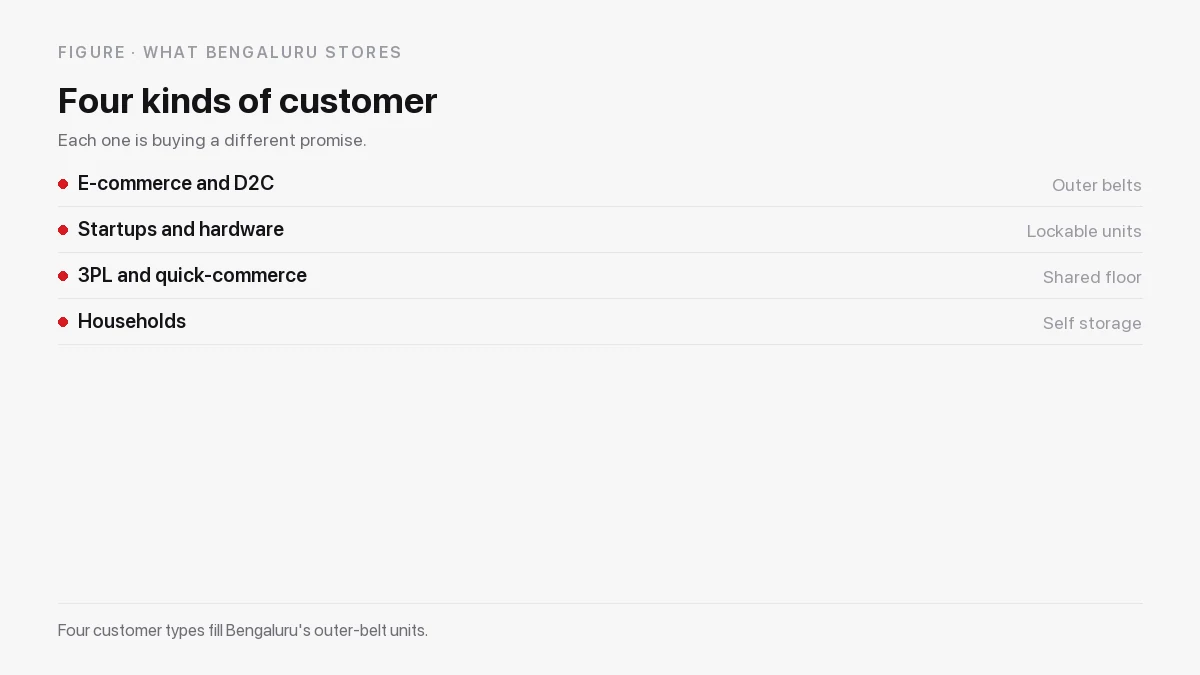
Four kinds of customer fill the racks and floor plates here, and each one wants something different from a building.
E-commerce sellers and D2C brands
This is the largest single group and the reason Bengaluru's storage market looks the way it does. A D2C brand in this city is typically holding a few hundred SKUs, shipping to marketplaces and its own site, and judging a warehouse by how fast a picker can get an order out the door. Racking, a packing bench, reliable inbound receiving and a dispatch cut-off that is actually met matter far more than the office. That requirement is priced on the e-commerce warehousing side of the service, and the shape of it is set out in the e-commerce warehousing guide.
Startups, hardware teams and IT asset stock
Bengaluru's second customer is the unusual one: companies whose stock is expensive per unit and small per shipment. Laptops and monitors waiting on a join date, returned devices awaiting refurbishment, demo kit that tours client offices, spare parts for field service — all of it needs a lockable, monitored, documented space rather than a big empty shed. These teams buy reporting and access control, and they almost always want monthly terms, because a company that is still finding its volume cannot sign a three-year lease on space it may outgrow or abandon.
3PL and quick-commerce operators
Third-party logistics operators and quick-commerce networks take the same floors and run pick, pack and dispatch from them, and they bring a different discipline again: dock scheduling, inbound appointment windows, and a tolerance for shared floor that a brand shipping its own orders does not have. Their presence is what has made the outer belts viable at scale, because a fulfilled floor is far easier to fill than a single company's seasonal swing. For a shared, managed floor rather than a leased building the relevant service is commercial warehousing.
Households and people moving for work
The domestic side of Bengaluru's demand is unusually large because so much of the city's population is mobile: new joiners arriving, transfers leaving, families between a rented flat and a purchased home, and landlords clearing a property between tenants. Furniture, appliances and cartons go into self storage from ₹999 per month, dust-free and CCTV-monitored, billed month to month rather than on a fixed lease. The self storage guide covers what fits in each unit size.
What warehouse space in Bengaluru costs
Three of Lozy's published starting rates cover most of what an enquiry from this city turns into. Warehouse space for rent starts at ₹12 per sq ft per month on a commercial basis; e-commerce warehousing starts at ₹4,999 per month for fulfilment-ready storage around a starting catalogue; and self storage starts at ₹999 per month per unit. All three bill monthly on a GST invoice rather than on a yearly contract. The rate basis itself is published on the warehouse space for rent page, and what the network runs here is listed on the Bengaluru location page.
Those are starting rates, not quotes, and in Bengaluru they move for city-specific reasons. A multi-floor unit inside the core carries a different cost base from a single-level floor at Hoskote. A seller that needs racking, a packing bench and daily handling is buying a different product from one that drops pallets and collects them in a month. And a term that covers a festive peak prices differently from one that runs a year. None of that is visible from the headline figure, which is why the requirement check matters more here than the rate.
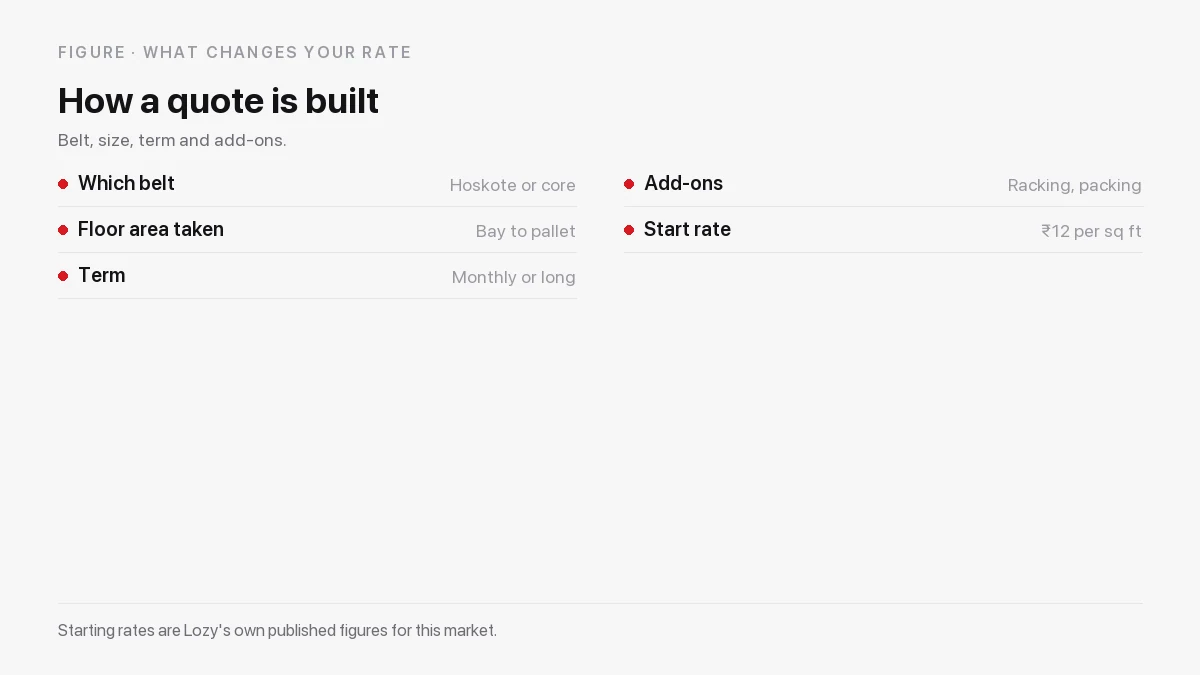
How a Bengaluru rate is actually built
- Which belt. An inner multi-floor unit and an outer single-level floor are not the same product, and the rent says so before anyone explains it.
- How much floor you take. Area is the largest single input — four pallet positions and a full bay cannot be priced off the same line.
- How long you commit. Taking a unit by the month and taking it for a year are two different products, and the longer one prices lower per month.
- What you add. Racking, a packing bench, climate control, extra handling, packing material and insurance cover all move the number.
| What you are deciding | Monthly storage plan | Commercial lease in Bengaluru |
|---|---|---|
| Commitment | Month by month | Multi-year, usually with escalation |
| Money up front | No fit-out and no setup charge | Deposit plus fit-out and fitment |
| When your volumes move | Shrink or grow the footprint | Pay for space you may not fill |
| Facility upkeep | Security, housekeeping and pest control included | Yours to arrange and pay for |
| Suits which Bengaluru business | A seller still finding its dispatch volume | A brand with proven, flat, long-run demand |
The Bengaluru version of that choice usually turns on the festive quarter. A seller heading into October needs more floor than it will in March, and a commercial lease cannot follow that swing. A company with proven, flat volume can and often should lease, and can still keep flexible space for the peak — which is what business warehousing is for.
Compliance and paperwork for a Bengaluru warehouse
Karnataka's rules are the ones that apply, and all of them are cheaper to settle before the first truck than after it.
GST, the invoice and input credit
Storage rent in Karnataka attracts GST, and a registered business can claim input credit when the invoice is raised correctly: in your entity's name, as a tax invoice, with the storage and handling lines shown the way your accountant needs them. Karnataka registrations and the credit rules that follow are documented on the GST portal. Rent handed over in cash to a landlord with no invoice looks cheaper each month, then costs more across the year, because nothing on it comes back.
Which authority approved the building
Karnataka's industrial land and the estates built on it sit with the Karnataka Industrial Areas Development Board, and the state's investment and single-window clearances run through Invest Karnataka. Put the plain question to any operator: which authority approved this building, and can I see the occupancy and fire clearances? An operator who fumbles that question is telling you plenty about how the rest of the tenancy will run.
What the unit will and will not take
Settle the permitted-goods list in writing before the agreement is signed, because it is the one clause every dispute here turns on. Flammable and hazardous material, food without the right licence, lithium batteries shipped as loose stock and anything strongly odorous are handled differently — sometimes in a separate bay, sometimes not at all. Photograph the consignment as it arrives and tick it against your own count — that is what keeps a later disagreement short and factual rather than long and arguable.
How to choose a warehouse in Bengaluru — and the red flags
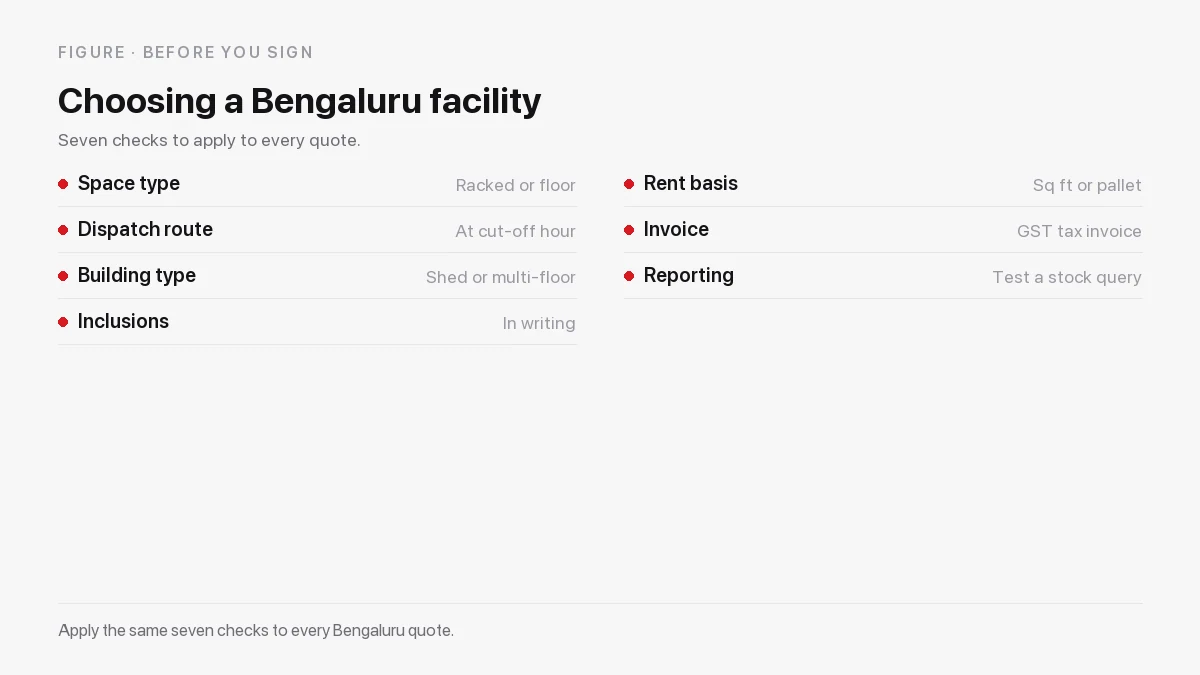
The checklist below is the same one we would want a customer to run against us. It takes an hour and saves months.
- Begin with the product profile. Racked, floor-level, climate-controlled, shared, or a lockable unit of your own — the goods decide, not the rate.
- Test the dispatch run, not the map. Time the trip from the unit to your main customer area at the hour you actually dispatch — not at noon on a Sunday.
- Check the building type. A single-level floor with a dock and a truck yard beats a multi-floor unit with one goods lift when your volume is pallets.
- Get the inclusions in writing. Racking, trolleys, pallet trucks, security cover, housekeeping and pest control.
- Pin down the billing basis and the exit terms. Whether the rate is per sq ft, per pallet or per unit, and how much notice you owe before leaving.
- Look at the invoice. Small businesses are not exempt from GST on storage rent, however informal the arrangement feels.
- Test the reporting. Ask what report lands after check-in, and how long a stock query takes to answer on a normal working day.
Red flags, in the order they usually appear: a quote that will not say whether GST is included; a facility whose only access is a goods lift during fixed hours; an operator who cannot produce an occupancy or fire clearance; a "monthly" rate that turns out to carry a yearly minimum; and a warehouse that cannot tell you which unit your stock will sit in until you arrive with the truck.
A worked example: a D2C brand's festive buffer
A Bengaluru D2C brand selling small consumer electronics was running fulfilment out of a back room attached to its own office. As volumes grew through the year the room stopped working: pallets blocked the packing bench, inbound cartons were stacked in a corridor, and the team was sending orders out late on the days that mattered most.
The requirement that came out of it was around 1,500 sq ft of racked space with a packing area, within a dispatch run that still met the same cut-off, and on a term that could end after the festive quarter. The workable answer was a racked bay on one of the outer belts rather than a larger room in the city: cartons on racking instead of the floor, pallet positions documented at check-in, and a monthly plan the brand could step down after the peak instead of a lease it would still be paying for in March.
On the published starting rate of ₹12 per sq ft per month, 1,500 sq ft works out to roughly ₹18,000 a month. Treat that as indicative only — the final figure follows the unit and the term — but it makes the point: what the brand actually bought was a dispatch cut-off it could keep.
How Lozy helps in Bengaluru
Lozy runs 77+ warehouses and more than a million square feet of live space, and Bengaluru's 4 collection centres are part of that network. A booking gives you your own racked or floor area, 24/7 CCTV cover, on-site security and PIN-controlled access to the gates, the lifts and your storage area.
Billing is monthly on a GST invoice, there is no long lock-in, and free doorstep pickup is included on bookings of 30 days or more, so moving stock out of an office back room does not have to pause the business. When your requirement moves, you step up or down inside the same building rather than starting the search again. Everything the company runs is set out on the services page, and the Bengaluru location page covers the city in more detail.
If you would rather see the space first, browse the warehouse listing for what is free right now, or talk to the team with the size and the timeline you have in mind. The locations hub covers the rest of the network if your goods move beyond Karnataka.
Where Bengaluru sits in the wider network
A Bengaluru seller rarely ships only to Bengaluru. Most split their stock between a city unit and a position closer to their customers, and the pattern usually pairs this city with one other South India node: the guide to warehousing in Chennai covers the eastern coast, Hyderabad the Deccan belt in between, and Pune the route north-west towards Mumbai. For a brand that also sells into the capital, New Delhi is the northern counterpart to this city, and the Karnataka guide covers the state around Bengaluru rather than the city itself — the units in the city are listed on the Bengaluru location page. Every post is indexed on the Lozy blog.

Need warehouse space in Bengaluru?
Tell us the city and the size you need — we reply with a rate and the options available now.
Get a quoteCall +91 93547 12345About the author
Lozy Editorial Desk. This guide was written by the Lozy Editorial Desk, the in-house team that covers warehousing, self storage, logistics and customs/EXIM topics for lozy.in. We write from Lozy's own facility and pricing information and from public, citable sources. We do not publish invented statistics, ratings or reviews.
Sources. Facility details, published rates and network coverage come from Lozy's own records. Highway and corridor context comes from the National Highways Authority of India; industry context from the Warehousing Development and Regulatory Authority and IBEF's Karnataka profile; policy releases from the Press Information Bureau. GST registration and input credit are described from the GST portal, and the Karnataka industrial context from KIADB and Invest Karnataka, both linked above. More background is indexed on the Lozy blog, which covers warehousing, self storage and customs in this same plain style.
Last updated: 13 October 2026. Have a question the FAQ below does not answer? Call +91 93547 12345 or email care@lozy.in.
Need warehousing or storage in India?
Request a free, tailored quote in under 2 minutes — free pickup, no lock-in.






