
Warehousing in Hyderabad: Pharma-Grade Space, Belts and Cost

Short answer: warehousing in Hyderabad is shaped by the state's life-sciences economy. Much of the space this market actually wants is not a plain godown — it is a monitored floor with a temperature log and a paper trail, because the goods moving through Telangana's pharma belt have to sit inside a written range and be able to prove they did. The belts that carry that demand are Medchal–Shamirpet in the north and Sangareddy on the western side of the Outer Ring Road. Lozy runs 77+ warehouses and more than a million square feet of live space, and Hyderabad carries three collection centres in the network. This guide covers what the city stores, the belts goods travel, what space costs and how to choose a unit that will not fail an audit.
Key takeaways
- Hyderabad's storage demand is led by pharma, life sciences and the packagers, cold-chain handlers and 3PLs that serve them — most of it clustered around Medchal–Shamirpet on the northern edge and Sangareddy to the west.
- Telangana carries 3 collection centres in Lozy's network list, all listed at Hyderabad, and they feed both the city's own distribution demand and its fulfilment flows.
- Warehouse and godown space for rent starts at ₹12 per sq ft per month and business warehousing at ₹14 per sq ft per month, billed monthly on a GST invoice. E-commerce fulfilment starts at ₹4,999 per month.
- Temperature is the local dividing line: a monitored, documented floor costs more than a dry shed, and for a regulated product it is not optional.
Why warehousing in Hyderabad is built around temperature first
Ask what makes this city different from every other Indian storage market and the honest answer is chemical, not commercial. Hyderabad is one of the country's largest pharmaceutical and life-sciences clusters, and a product that has to be held between two temperatures cannot live in a tin shed on a highway shoulder, however cheap the shed is. That single requirement decides the shape of the buildings, the paperwork and the rent in a way it does not in a textile or auto-parts city.
The consequence for anyone shopping for space here is simple: the first question is not how big, but how controlled. A dry floor is a perfectly good answer for packaging material, cartons, hardware and household goods. It is the wrong answer for a batch of tablets waiting on a dispatch order. Getting that distinction right at the start saves the cost of moving everything eighteen months later. The three centres this network lists in Hyderabad are set out on the Hyderabad location page, and the state-level picture, including the centres outside the city, sits on the Telangana location page.
The northern belt: Medchal and Shamirpet
The Medchal–Shamirpet corridor north of the city is the address the life-sciences industry gravitates to, and the reason is proximity: this is where the manufacturing, the analytical labs and the packaging units sit, so a storage floor placed here shortens the link between the plant that makes the goods and the building that holds them. For a company whose inbound flow is a factory gate, a unit on this belt removes a cross-city movement from every single batch.
It also changes what a unit has to offer. On this belt a plain palletised floor and a temperature-controlled bay are two different products, frequently under the same operator, and the buyer who assumes they are interchangeable is the buyer who ends up rejected at the first customer audit.
What temperature-controlled actually means in practice
Controlled storage is not air conditioning with a nice reception area. It means the room holds inside a stated band, the instruments that measure it are calibrated on a schedule, and the readings are recorded continuously rather than written down when somebody remembers. Product that arrives and leaves is booked in and out against a batch, so a consignment can be traced back to the hours it spent on the floor.
Ask to see the monitoring setup before you commit, not after. A facility that can show you the previous month's temperature chart, taken with a calibrated data logger, is a different proposition from one that answers the question with a thermometer on the wall. Cold-chain goods and room-temperature pharma do not need the same room, and a good operator will tell you which one your product needs rather than selling you the more expensive of the two.
Why this matters even if you sell nothing pharmaceutical
There is a knock-on effect worth understanding. Because pharma sets the ceiling on what landlords can charge and what they must build, the general-purpose space in and around Hyderabad is decently engineered: better flooring, better security, a defined loading area. A furniture seller, an appliance brand or an FMCG distributor renting a dry floor here inherits part of that standard. The trick is to take a plain floor knowingly, at a plain price, instead of paying a pharma premium for a room you do not need.
Who stores what in Hyderabad
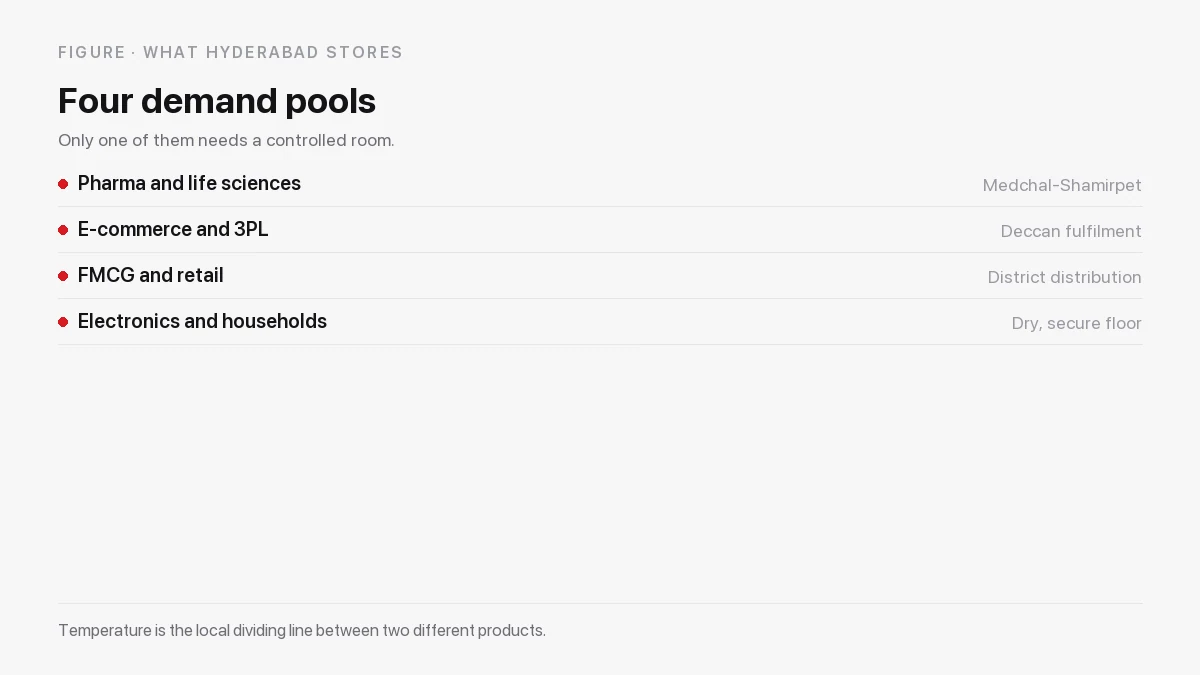
Four kinds of customer account for most of the occupied square feet in the city, and they do not want the same building.
Pharma, life sciences and medical devices
Formulations, active ingredients, packing material, diagnostic kits and devices — a category that comes with conditions attached. Temperature is one; documentation is the other. These customers want batch-wise records, restricted access, and a room they can describe accurately to an auditor without hoping nobody asks. The Wholesale drug licence under which such goods are distributed is issued by the state drug control administration, and the premises have to match what the licence says. Operators who serve this sector build the documentation into check-in rather than reconstructing it later, and the details of what tracked storage includes are set out on the inventory warehousing page.
E-commerce sellers serving the Deccan
Hyderabad is a convenient single node for a seller whose buyers are spread across Telangana, Andhra Pradesh and the northern Karnataka belt. Fulfilment here means the stock is received, barcoded and shelved pick-ready, then every order is picked, packed and handed to a courier at a quiet hour instead of during a peak rush. The rate basis for that service, from ₹4,999 per month on a starting catalogue, is published on the e-commerce warehousing page, and the floors available to a seller in this city are listed on the Hyderabad location page. Sellers running both Amazon and their own storefront generally want one floor behind both channels.
FMCG and retail distribution
The city has a large, dense retail market within it and a distributor network that pushes stock outward into the districts. That trade wants wide bays, easy pallet access and a location where a delivery van can get in and out without a long wait at a gate. Fast-moving consumer goods also come with expiry dates, which is a storage consideration in its own right: stock has to be rotated, and a facility that cannot show you where the older batch sits is a facility that will quietly cost you write-offs.
Electronics, equipment and household goods
Hyderabad's services economy supports a steady stream of machinery, IT equipment, exhibition material and household furniture that needs a home between one address and the next. None of it needs a controlled room, and all of it needs a floor that is dry, secure and accessible without a lease. This is the part of local demand that plain warehousing and per-unit self storage exist to serve.
The belts and roads goods move along
Hyderabad's storage map is drawn by the Outer Ring Road and by three radial highways. Which one your unit sits on decides your delivery times far more than the building's finish does, and the units themselves are listed on the Hyderabad location page.
North: Medchal and Shamirpet off NH-44
The northern axis towards Medchal and Shamirpet carries the life-sciences traffic and the traffic heading out of the state towards Nagpur and central India. Units on this side suit a business whose inbound supply is a manufacturing plant or a lab and whose outbound is a distributor network rather than a retail counter. The approach roads are wide enough for trailers, which matters more here than the last few kilometres of distance.
West: Sangareddy and the NH-65 side
The western belt along the Mumbai highway through Sangareddy is the industrial half of the same story — formulations, bulk chemical handling and heavier manufacturing, with the Outer Ring Road giving a clean run around the city instead of through it. A unit here makes sense when your goods are moving between plants and warehouses rather than to consumers: the ring road means a truck leaving at dawn reaches the far side without crossing the city centre.
South and east: the airport side and the Warangal road
Not every consignment is road freight. Hyderabad's airport side and the eastern corridor out towards Warangal carry the flows that go by air or serve the eastern districts, and a fulfilment floor wants to be reasonably close to whichever of those the courier network uses. Ask a prospective facility how its pickups actually work — whether riders arrive on a fixed schedule or whenever they are called — because that single detail decides whether an order placed at four in the afternoon leaves the same day.
The Outer Ring Road as the real connector
The ORR is what allows a business to hold stock on one side of Hyderabad and serve customers on all four. That is also why so much modern warehousing development has moved outward along it: land is workable, a trailer can turn, and a load can be routed around the city instead of through it. If you are choosing between two units at similar rents, the one with the shorter on-ramp is usually the better buy, and the National Highways Authority of India publishes the network context on its own site.
What warehouse space in Hyderabad costs
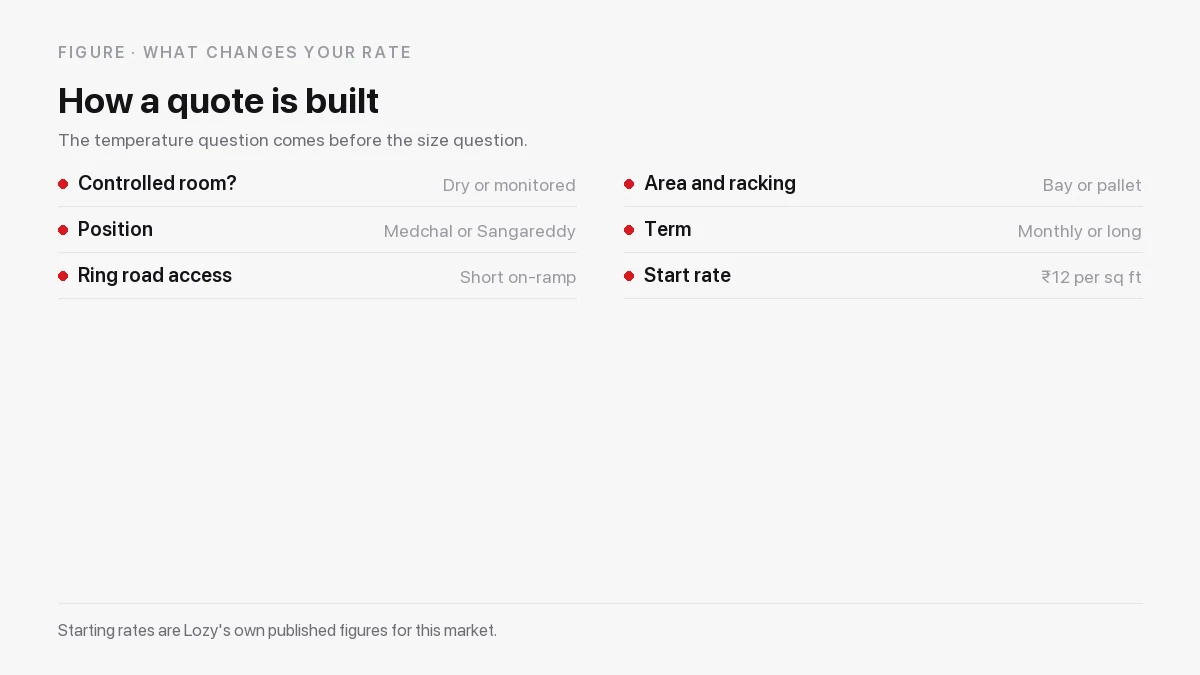
Three of Lozy's published starting rates apply to this market, and they map neatly onto the three things people actually come looking for. Warehouse and godown space for rent starts at ₹12 per sq ft per month. Business warehousing, the managed version with the security and housekeeping included, starts at ₹14 per sq ft per month. E-commerce fulfilment, where the seller's stock is picked, packed and dispatched, starts at ₹4,999 per month for a starting catalogue. All of it is billed monthly on a GST invoice, with no long lock-in.
Say the obvious thing about these figures: they are starting rates, not quotes. What you actually pay follows the unit, the floor area, how long you commit and what the goods require. A controlled room costs more to run than a dry floor, and an operator who quotes the same number for both is either guessing or planning to explain later. The mechanics of the rent itself, apart from the city, are covered in the guide to warehouse space for rent.
The four inputs behind a Hyderabad rate
- Whether the room is controlled. This is the largest single difference in the city. A dry floor and a monitored, logged room are two products at two prices.
- Where on the ring. A unit on a belt with a fast ORR on-ramp and a unit deep inside the city are not comparable, and the rent reflects the access before anybody explains it.
- Floor area and racking. A whole bay priced against four pallet positions is not a like-for-like comparison; ask what is included rather than what is covered.
- The commitment. A monthly booking and a year-long arrangement are different products, and the longer one usually carries the lower monthly number.
| What you are deciding | Dry warehouse floor | Temperature-controlled space |
|---|---|---|
| Internal conditions | Ambient, ventilated | Held inside a stated band |
| Monitoring | None needed | Calibrated loggers, readings kept |
| Records kept | Stock and dispatch list | Batch-wise in and out, traceable |
| Who inspects it | Your own team | Your customer's audit, and the drug authority |
| Cost basis | Per sq ft per month | Per sq ft per month, quoted per room |
| Suits | Cartons, hardware, FMCG, furniture | Formulations, kits, cold-chain goods |
Compliance and paperwork for a Hyderabad warehouse
Most of these questions are cheaper to settle before the first truck arrives than after it, and in a pharma city two of them are decisive.
The licences that actually apply
Storage and distribution of drugs and medical devices is licensed and inspected, and the licence names the premises: a wholesale drug licence covers the room the goods sit in, so a warehouse the licence does not mention is a warehouse the goods cannot legally be held in. Devices and diagnostics add their own conditions. If your goods are food, cosmetic or hazardous, a different set of rules again applies, and the honest answer is that you should ask the facility which approvals its building carries before you sign rather than assume that a big shed carries any of them. National regulator context is published by the Central Drugs Standard Control Organisation.
GST, the invoice and input credit
Storage rent in Telangana attracts GST, and a registered business can claim input credit when the invoice is raised properly: in the entity's own name, as a tax invoice, with the storage and handling lines shown the way the accountant needs them. A monthly GST invoice is not paperwork for its own sake — it is the difference between rent being a recoverable cost and rent being a permanent expense. The registration and credit rules are published on the GST portal.
Who approved the building
Telangana's industrial estates and the infrastructure around them sit with the Telangana Industrial Infrastructure Corporation, and the state's investment clearances run through Invest Telangana. In a pharma city this question carries more weight than it does elsewhere, because an inspector will expect the building's approvals to line up with the licence the goods are held under. Ask which authority approved the premises, and whether the occupancy and fire clearances can be produced on the spot. A vague answer there is usually a preview of how the rest of the arrangement will run.
What the unit will and will not take
Ask about the goods list before you sign. Solvents and flammable material, food without the matching licence, strong odours and anything requiring pest-controlled segregation are handled differently — sometimes in a separate bay, sometimes not at all. Pharmaceutical waste and returned or expired stock are their own category with their own rules, and a facility that has never been asked the question probably has no answer prepared. On the way in, a photo inventory and a check-in list against your own count is what turns a later discrepancy into a short conversation.
How to choose a Hyderabad warehouse — and the red flags
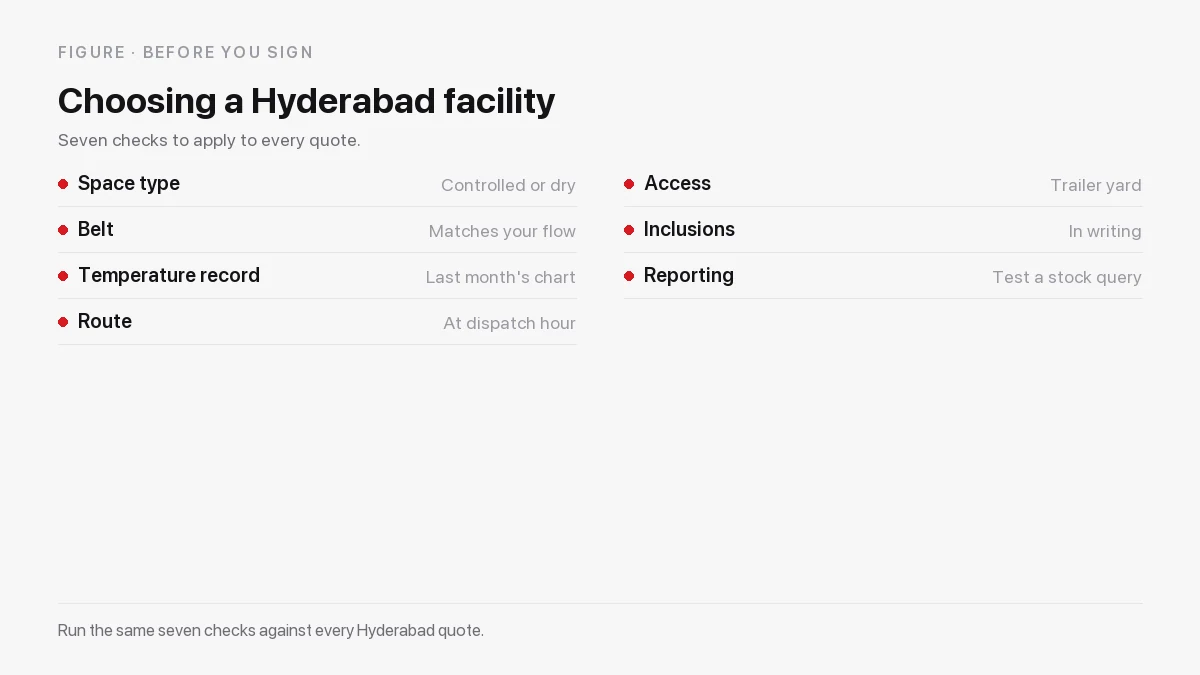
The check below is the same one we would want a customer to run against us. It takes an hour and saves months.
- Decide whether you need controlled space at all. If your product has a storage condition on the label, you do; if it does not, do not pay for one.
- Match the belt to the flow. Inbound from a plant on the north side argues for Medchal–Shamirpet; plant-to-plant movement argues for the Sangareddy side and the ring road.
- Ask for the previous month's temperature record. Not a promise about the future — the actual chart, from a calibrated logger.
- Walk the route at dispatch hour. Time the run from the gate to your main customer area when you would really be sending the truck, not at noon on a Sunday.
- Check the access, not just the address. A yard a trailer can reverse into beats a shed down a lane with a height barrier, whatever the racking looks like.
- Get inclusions in writing. Racking, pallet trucks, security, housekeeping, pest control, and who pays for the electricity the controlled room consumes.
- Test the reporting. Ask what you will be sent after check-in and what a stock query looks like on an ordinary Tuesday.
Red flags, roughly in the order they show up: a quote that will not say whether GST is included; a claim of temperature control with no logger and no record; an operator who cannot produce an occupancy or fire clearance; a "monthly" rate that turns out to carry a yearly minimum; a facility that cannot tell you which room your pallets will sit in until you arrive with the truck; and a drug-storage offer from a building that does not appear on any licence.
A worked example: a distributor holding stock in three godowns
A Hyderabad distributor of diagnostic kits was holding stock across three small rented godowns in different parts of the city. Each one was cheap on its own. Together they were costing more than the rent suggested: a single consignment could be split across two rooms, staff drove between them to check stock, and when a customer audit arrived the batch records took two days to assemble from handwritten registers.
The requirement that came out of the audit was about 2,500 sq ft in one place, with a controlled section for the kits that needed it and a dry section for cartons and packaging, plus a check-in process that produced batch-wise records as a by-product of receiving rather than as a separate job.
On the published starting rate of ₹12 per sq ft per month, 2,500 sq ft works out to roughly ₹30,000 a month for the dry section — treat that as indicative only, because the controlled room is quoted on its own size and the final figure follows the unit and the term. What the distributor actually bought was a shorter audit, one address on the paperwork and a stock position that could be answered without a phone call. Requirements like that one start with the units listed on the Hyderabad location page.
How Lozy helps in Hyderabad
Lozy runs 77+ warehouses and more than a million square feet of live space, and Telangana carries three collection centres in the network, listed at Hyderabad. Every unit comes with a dedicated racked or floor area, 24/7 CCTV, on-site security and unique PIN access to gates, lifts and your own storage area, and the network is built so that a business can move from a small floor to a larger one without changing city or operator.
Billing is monthly on a GST invoice with no long lock-in, and free doorstep pickup is included on bookings of 30 days or more, so moving out of a rented godown or a factory corner does not have to pause the business. Everything the company runs is set out on the services page; businesses that need the managed version of a floor should start with business warehousing, and those with a heavier, palletised requirement with industrial warehousing.
If you would rather see the space first, browse the warehouse listing for what is free right now, or talk to the team with the size, the goods and the timeline you have in mind. The Hyderabad location page shows the city's own coverage, and the locations hub covers the rest of the network if your goods move beyond the Deccan.
Also in Delhi NCR
A Hyderabad seller expanding north usually keeps one floor here and adds one in NCR rather than shipping from Telangana. The guides to warehousing in New Delhi and warehousing in Gurgaon cover the two addresses most northern buyers pick, and the Noida and Faridabad guides cover the eastern and southern sides. Stock that arrives by air or by road from the south is generally cheaper to hold once in the north than to move per order.
Where the rest of the country is the question, the sibling guides cover warehousing in Telangana beyond the city, Bengaluru and Chennai on the southern corridors, and Pune on the western route through Sangareddy and onward to Mumbai. A guide to commercial warehousing sets out how shared floors are run, and inventory warehousing explains the tracked-stock model that regulated goods usually need.

Need warehouse space in Hyderabad?
Tell us the city and the size you need — we reply with a rate and the options available now.
Get a quoteCall +91 93547 12345About the author
Lozy Editorial Desk. This guide was written by the Lozy Editorial Desk, the in-house team that covers warehousing, self storage, logistics and customs/EXIM topics for lozy.in. We write from Lozy's own facility and pricing information and from public, citable sources. We do not publish invented statistics, ratings or reviews.
Sources. The facility counts, rates and coverage quoted in this guide are Lozy's published figures rather than third-party estimates. Highway and ring-road context comes from the National Highways Authority of India; industry context from the Warehousing Development and Regulatory Authority and IBEF's Telangana profile; policy releases from the Press Information Bureau. GST registration and input credit are described from the GST portal, and the Telangana industrial context from TGIC and Invest Telangana, both linked above. A reader comparing more than one city before calling will find the same plain style across the Lozy blog, which covers warehousing, self storage and customs without the marketing gloss.
Last updated: 13 October 2026. Have a question the FAQ below does not answer? Call +91 93547 12345 or email care@lozy.in.
Need warehousing or storage in India?
Request a free, tailored quote in under 2 minutes — free pickup, no lock-in.






