
Warehousing in Telangana: District Demand, Agro Belts and the City Node
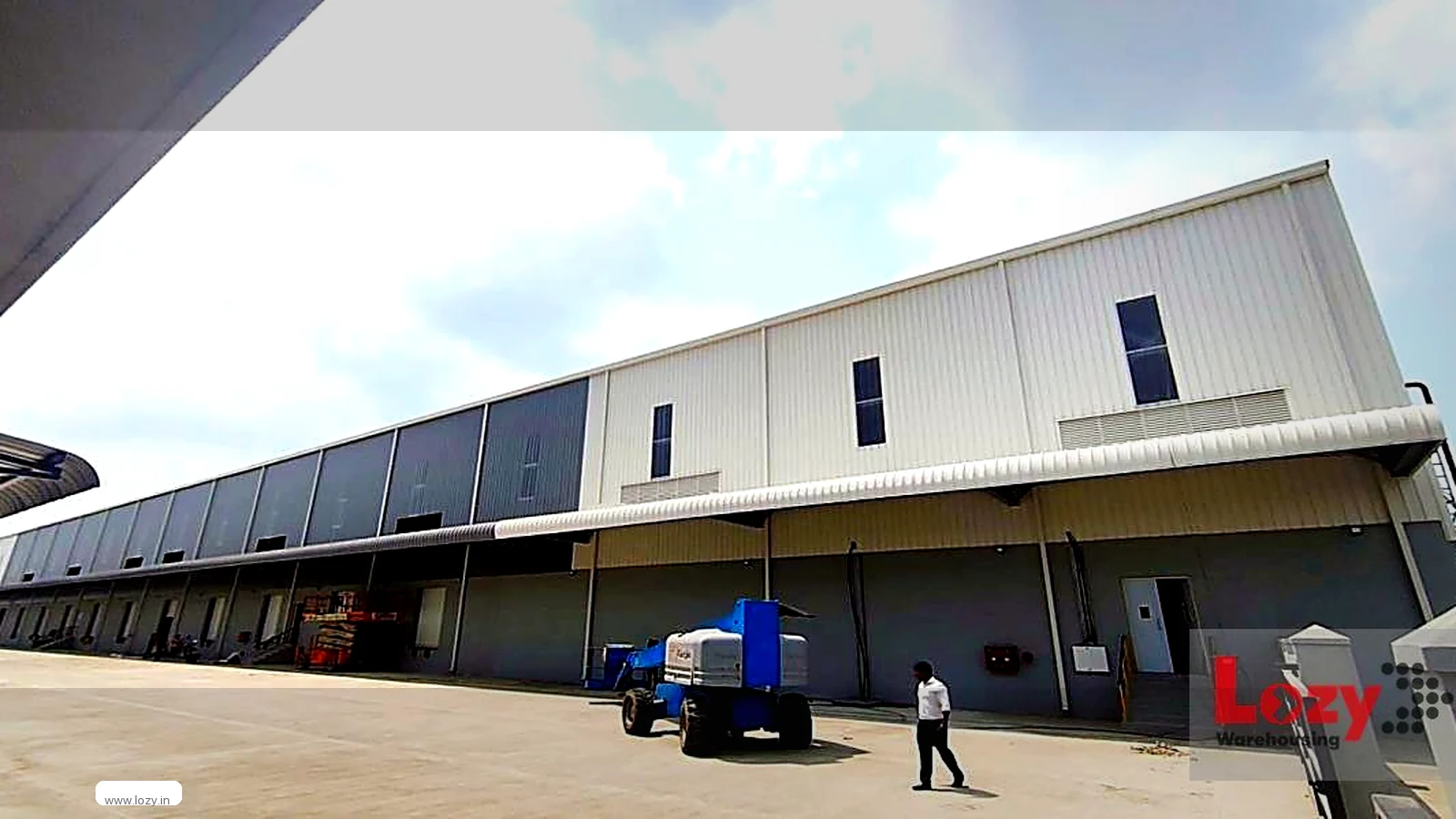
Short answer: warehousing in Telangana is one state carrying two storage requirements at once. Around Hyderabad sits a regulated market — life sciences, packaging, consumer brands and online sellers — where temperature, paperwork and delivery speed decide everything. Outside it sit the districts that grow the state's paddy, cotton and turmeric, where storage is judged on volume, dryness, pest control and whether a loaded truck can leave for a market yard on time. Lozy runs 77+ warehouses and more than a million square feet of live space nationally, and its three Telangana collection centres are all listed at Hyderabad. This guide is about covering the state from that node, and knowing when a district godown is the honest second answer.
Key takeaways
- Lozy's Telangana network is 3 collection centres, all listed at Hyderabad, and the district markets that drive statewide demand — Warangal, Nizamabad and Karimnagar — are served from that node rather than from facilities of their own.
- Telangana is among India's largest paddy producers and one of its leading cotton states, so a large share of the storage requirement here is bagged, seasonal and price-sensitive, not racked and pallet-ready.
- Warehouse and godown space for rent starts at ₹12 per sq ft per month, commercial warehousing at ₹13 per sq ft per month, and short-term storage at ₹699 per week, each billed monthly on a GST invoice.
- A statewide distributor and a Hyderabad-only seller are asking different questions of the same three centres: one needs the right side of the city for district runs, the other needs proximity to the delivery radius.
Why warehousing in Telangana is not a Hyderabad question
The Outer Ring Road is not the state's boundary, and for a storage decision it is the wrong line to draw. A brand selling only into Hyderabad is buying speed inside a delivery radius. A distributor whose dealers sit in Warangal, Nizamabad and Karimnagar is buying reach instead, and reach behaves differently: the same floor on the same terms becomes a better or a worse unit depending on which road leaves the gate first.
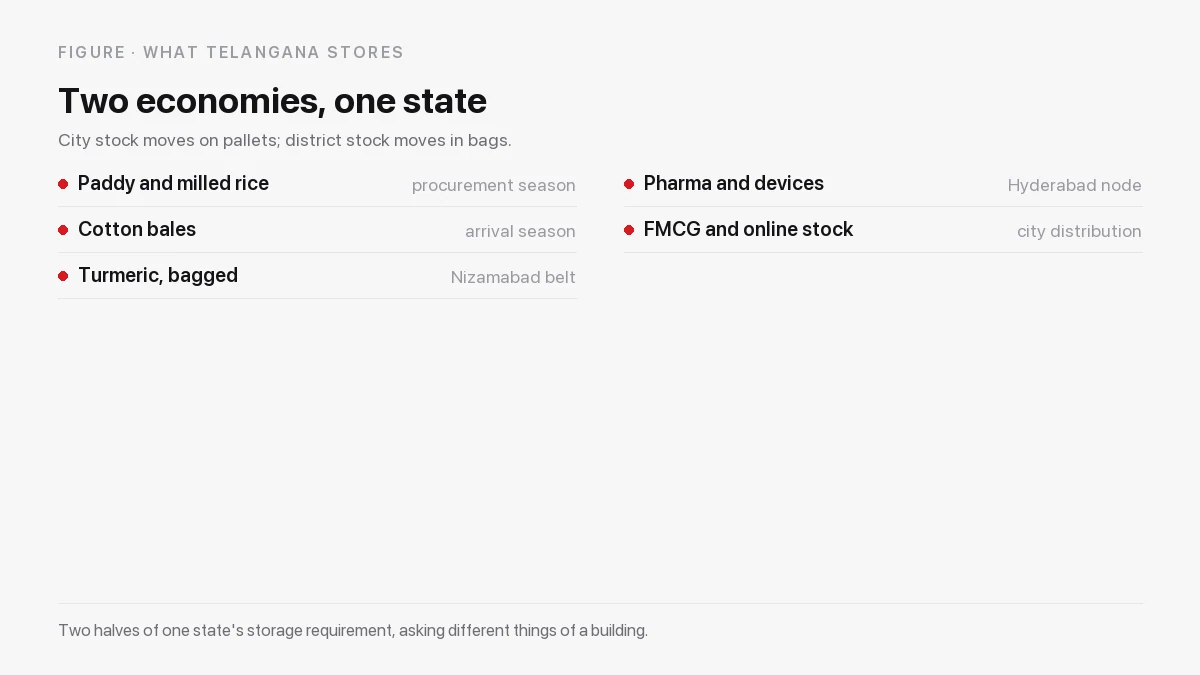
The districts also generate demand in a pattern the city does not. A paddy procurement season, a cotton arrival season and a turmeric harvest each push volume through a district in a few weeks, and the goods arrive bagged, weighed and moved in truckloads rather than picked off a shelf. None of that flow needs a monitored room. A good deal of it needs a floor that stays dry through the monsoon, a pest programme that keeps running when the supervisor is away, and a fire plan that a cotton lot will not turn into a headline.
The city's side: regulated, fast and documented
Around Hyderabad the requirement is regulated demand: formulations and devices that have to sit inside a stated range, packaging and packing material, consumer brands serving a dense retail market, and online sellers whose orders leave on a courier's schedule. Temperature and documentation dominate that market, which is why the storage belts it uses are the city's. The Hyderabad location page and the Hyderabad warehousing guide cover it properly; here it matters for one reason — it is why all three Telangana collection centres sit in the city and nowhere else.
The districts' side: seasonal, bulky and bagged
Telangana is one of the country's largest paddy producers and among its biggest cotton states, and turmeric gives the north of the state a market of national standing. Goods like those arrive by lorry, sit in bags on a floor, get graded and weighed, and move on within weeks. The buyer is usually a miller, a ginner, a commission agent or another trader rather than a consumer, so volume per square foot, floor loading, dust, moisture and fire safety matter more than how many pallet positions a bay holds.
What a business loses by confusing the two
Hold agro volume in a city unit and you pay for an address your goods cannot use: bagged stock stacks lower and moves out in truckloads. Hold a regulated product in a plain district godown and the licence, the monitoring and the courier pickups simply are not there. For most statewide businesses the working answer is a primary node at Hyderabad, plus a small local godown beside a demand centre once the volume there justifies a second rent.
The three district markets that reshape a Telangana storage plan
A state guide that lists twenty districts is not a plan. Three markets here carry enough volume to change how a distributor arranges its space: Warangal in the east, Karimnagar to the north-east and Nizamabad to the north. Each asks for something slightly different from the building that serves it.
Warangal: cotton, paddy and a market yard the whole country quotes
Warangal is a cotton and paddy district, and its arrival season draws buyers from outside the state to the market yard at Enumamula, one of the largest agricultural yards in Asia. Storage demand around that trade is bagged and bulky, and cotton adds a condition of its own: a bale lot is a fire risk, so separation between stacks and a working water supply become the reason a facility is chosen. For most businesses the honest use of Warangal is a small godown serving a specific set of local dealers, held alongside the city node rather than instead of it.
Nizamabad: turmeric, bags and the road north
Nizamabad is where Telangana's turmeric trade concentrates, and the National Turmeric Board is headquartered in the district — which says as much about the crop's weight here as any production figure would. Turmeric is stored in bags, in bulk, and it is unforgiving about damp: a floor that holds moisture dulls a bright lot and takes the premium off it. The town also sits on the line running north towards Adilabad and onward to Nagpur, so FMCG and farm-input stock leaving the state often starts that journey from this side of Telangana.
Karimnagar: paddy, mills and cotton yards
Karimnagar's demand is agricultural and industrial at once. Paddy and cotton come in from the surrounding districts, and the mills along the belt buy, process and dispatch, so the space taken here is floor space rather than shelving. Bagged paddy is dense and heavy, which puts floor loading and a hard-standing approach ahead of finish on the list of things to check. The season compounds it: seed, fertiliser and crop-protection stock has to be in a godown before the sowing weeks begin, not ordered once dealers start asking.
One thing should be said plainly. None of those three is a Lozy collection centre — the network's Telangana centres are all listed at Hyderabad, as the Telangana location page shows. Those three matter because they are where a distributor's stock has to reach, and a plan that pretends otherwise sends every lorry out of a city the buyer does not live in.
Who stores what across Telangana
Six kinds of customer account for most of the state's occupied storage, and two of them look identical on a spreadsheet while needing opposite things from a building.
Statewide FMCG and farm-input distributors
This is the customer the state post is really written for. Its stock splits in two: palletised FMCG that comes out of the city and moves to dealers on a schedule, and bagged inputs — seed, fertiliser, crop protection — whose year is set by the sowing calendar. Both halves sit better in one place with one stock list, and the position that works is a city unit with a fast exit towards the districts. Fertiliser and pesticide stock carries its own handling licences, so declare it before the first lorry. Where a district godown is not justified, the middle path between a monthly plan and a full lease is set out in the commercial warehousing guide.
Rice millers, commission agents and traders
Milled rice and paddy account for a large share of the state's stored tonnage, and this trade stores close to the mill or the yard rather than near the consumer. Its arithmetic is per quintal rather than per pallet, so high ceilings and clear aisles are worth more here than racking is. Stock rotates with the procurement season, and a trader holding a lot against a price move needs a few months of space without a year's commitment attached to it.
Cotton ginners and traders
Cotton arrives in bales, sits in volume, and earns little per square foot compared with a pallet of electronics. That combination makes it the most price-sensitive storage in the state and the most fire-conscious: loose lint, dust and a dry summer are the classic ingredients of a yard fire, so separation, water and an electrical installation that survives a load test all belong on the checklist before signing.
Pharma, life sciences and medical devices
The regulated half of Telangana's storage sits with the city's life-sciences cluster and the packagers, 3PLs and cold-chain handlers around it. This customer needs a room that holds inside a stated band with calibrated monitoring, batch-wise records and restricted access, and the licence under which the goods move names the premises — so the building has to match what the licence says. How tracked stock is received and reported is set out on the inventory and stock storage page.
E-commerce and D2C brands selling across the state
A seller whose buyers are spread across Telangana's towns, plus a share of Andhra Pradesh and northern Karnataka, is best served by one fulfilment floor in the city rather than a unit in each district. Orders are received, barcoded and shelved pick-ready, then picked, packed and handed over on a courier's schedule, and the rate basis for that service is published on the e-commerce warehousing page. The test of the floor is not its finish but when the last pickup of the day actually leaves.
Households, offices and people on the move
The quietest requirement is domestic. Transfers into and out of Hyderabad, families between two homes and shops changing premises all produce furniture, appliances and cartons that need somewhere to sit for a few weeks. That is a per-unit booking rather than a leased godown, priced and sized by the unit, and it is the city-side product rather than a district one: the self storage page sets out how the sizes work.
The roads a Telangana load actually travels
The state's storage map follows three routes, and the one a facility touches decides its useful reach far more than the building's finish does. The state's own coverage is set out on the Telangana location page.
North on NH-44, towards Nizamabad and beyond
The north–south trunk runs out of Hyderabad through Nizamabad towards Adilabad and on to Nagpur, which makes it the state's busiest storage corridor. Turmeric and paddy move south on it; consumer and farm-input stock moves north on the same stretch. For a unit inside the city, the practical question is how quickly it can reach this road: a facility on the northern side joins the trunk without crossing the city, and one on the southern side pays for that crossing on every district run.
East on the Warangal road
The eastern axis carries the state's cotton and paddy traffic out towards Warangal and the districts behind it, and it fills up fastest when the arrival season opens. A distributor serving east Telangana wants to be on this side of the city for the same reason a miller wants to be near a yard: the goods are heavy, the margins are thin, and every extra hour on the road is a cost the buyer eventually sees in the rate. It is also the first leg for anything heading further east or towards the coast beyond the state.
North-east to Karimnagar
The north-east route links the city with Karimnagar and its surrounding paddy and cotton belt, and it lets a load staged in the city reach the northern trunk without coming back through it. For the distributor whose dealers are split between Karimnagar and Nizamabad, this is the route that decides whether one city unit can serve both before the sowing peak or whether a second godown has to be rented for a few weeks.
The Outer Ring Road as the state's loading dock
The ring road is what lets a business hold stock in Hyderabad and still dispatch in three directions without entering the city's traffic. That is why modern storage development has moved outward along it, and why a short on-ramp is worth checking when two units quote the same rent. Ask which junction a unit uses and how many minutes it costs at the hour your lorries actually leave, not at a quiet lunchtime.
What warehouse space in Telangana costs
Three of Lozy's published starting rates apply to a warehousing requirement in Telangana, and each belongs to a different product rather than to a part of the state.
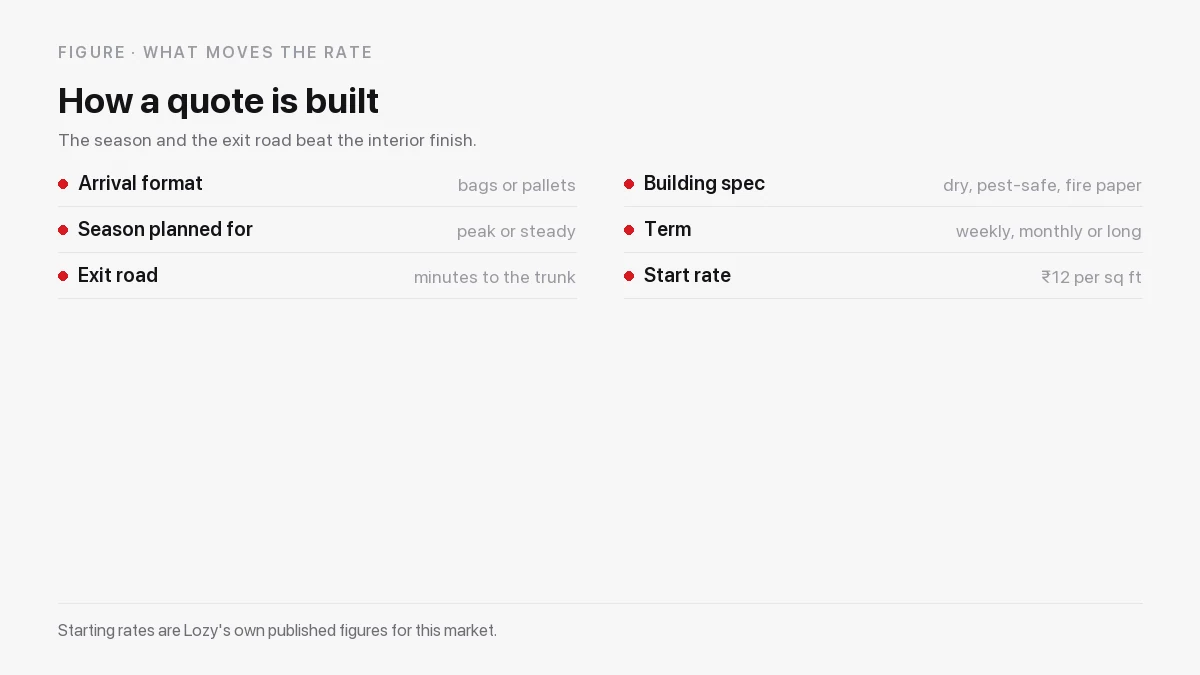
- Warehouse and godown space for rent — from ₹12 per sq ft per month, the basis used when a floorplate is priced by area, and the starting point most enquiries from millers, traders and distributors begin from. It is set out on the warehouse and godown space for rent page.
- Commercial warehousing — from ₹13 per sq ft per month, for managed commercial space taken month by month with security, handling and billing included, which is the shape most distribution requirements end up in. The basis is on the commercial warehousing page.
- Short-term storage — from ₹699 per week, for floor taken in weeks rather than years. In this state that is the right product for a procurement or arrival season, when volume comes and goes inside a window and a yearly commitment would outlast the crop.
Each of those is a starting rate rather than a quote, billed monthly on a GST invoice with no long lock-in. What turns a starting figure into an actual number is specific to this market, and it is worth knowing before the first call — the rate basis itself, apart from the state, is set out in the warehouse space for rent guide.
What moves a Telangana rate
- How the goods arrive. Bagged paddy, turmeric and cotton take floor area per tonne rather than pallet positions, so the height a building allows decides how much of the rent is usable — a tall shed prices better per quintal than a low one at the same square-foot rate.
- The season you are planning for. District volume lands in weeks, not quarters. A monthly or weekly basis lets a business take floor before the sowing or arrival peak and step back down after it, which an annual lease cannot do.
- Which way the gate faces. Two units at one rate are not the same product if one joins the trunk road in minutes and the other crosses the city to reach it. On district freight volumes, that difference is the largest hidden line in the budget.
- The building's spec. Dust control, a pest programme, separation and water for cotton, a yard that stays firm under a loaded lorry in the monsoon, and floor loading for bagged stock — each cheap to test at the visit and expensive to retrofit.
How to choose a node in Telangana — and the red flags
Work backwards from the buyer rather than forwards from the rate. The table sets out what each arrangement buys, and the checks below catch the expensive mistakes while they are still on paper.
| Your arrangement | What it reaches best | What it costs you |
|---|---|---|
| A city unit on the northern side | Nizamabad, Karimnagar and the NH-44 trunk | A longer run to the state's southern districts |
| A city unit on the eastern side | The Warangal road and the cotton and paddy districts | Slower access to the western industrial side |
| A second godown at a demand centre | Same-week service to dealers in that district | A second rent and a second stock list to reconcile |
| One city unit for everything | The metro, plus any district inside a day's run | District dealers waiting on a dispatch from the city |
| Short-term floor for one season | Procurement and arrival peaks | Nothing — if it is booked before the season, not during it |
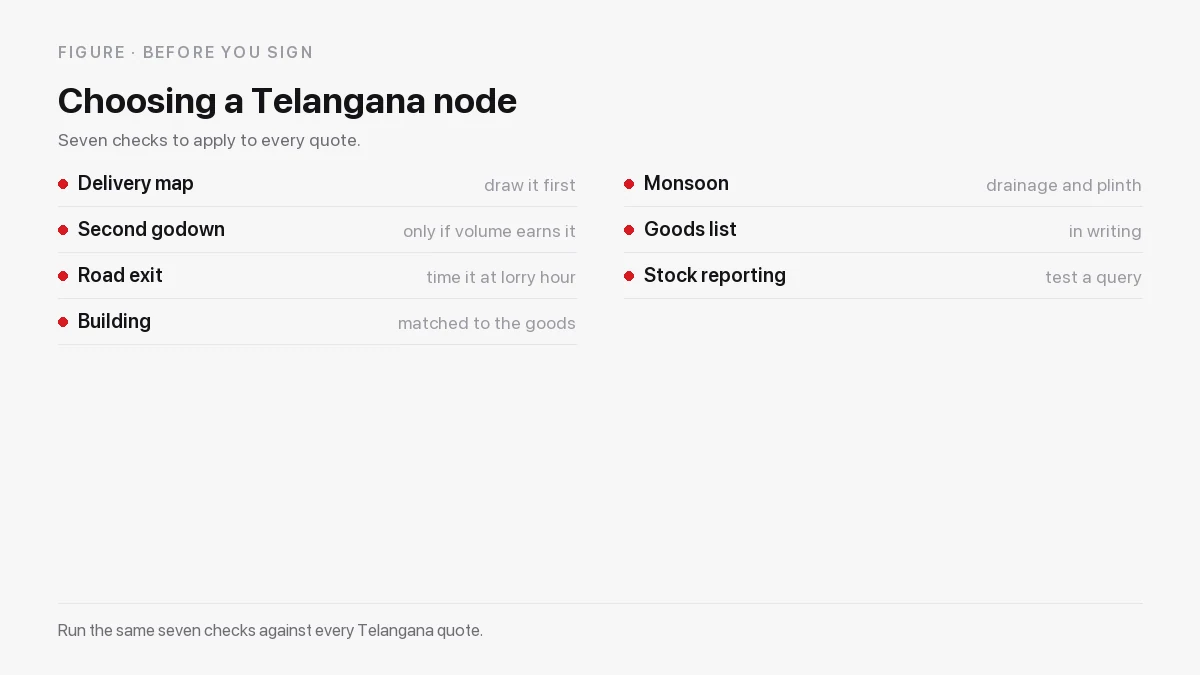
- Draw the delivery map first. Mark every district town you actually invoice, then see which single position sits closest to the middle of that spread. A statewide distributor and a Hyderabad-only seller reach different answers.
- Decide whether the district volume justifies a second unit. A local godown pays for itself when it removes a long leg from regular deliveries. Bought for one shipment a year, it is just a second rent.
- Check the exit, not the address. Time the run from the gate to the trunk road at the hour your lorries leave.
- Match the building to the goods. Bagged agro stock wants dry floor, height, floor loading and pest control; a regulated product wants monitoring and records. Do not pay for the wrong one.
- Ask what happens in the monsoon. Plinth height, drainage that falls away from the shed and a yard that stays firm under a loaded lorry decide whether stock survives June to September.
- Get the goods list and the invoice terms in writing. What the unit will and will not accept, the GST treatment, and how much notice you must give before leaving.
- Test the reporting. Ask what you are sent after check-in and what a stock query looks like on an ordinary Tuesday, before the first lorry arrives.
Red flags, roughly in the order they surface: a rate that does not say whether GST is included; a godown with no fire paper where cotton or oilseed will be stacked; a landlord who cannot show which authority approved the building; a monthly rate with an unmentioned annual minimum buried in it; a facility that cannot say which bay your bags will sit in until the lorry is at the gate; and a promise of seasonal space that was never booked.
A worked example: covering the state from one city node
A distributor of farm inputs and household FMCG was serving dealers in Warangal, Nizamabad and Karimnagar, plus its own city customers, out of three small rented godowns in different parts of Hyderabad. Each rent was modest on its own. Together they were expensive in a way the rent roll did not show: one consignment could be split across two rooms, a stock count took a day and a half, and the lorry that had to be in Karimnagar by morning sometimes had to be loaded somewhere else first.
The requirement that came out of that review was a single floor of about 4,000 sq ft on the city's eastern side, with a dry section wide enough for bagged inputs, a hard-standing yard for a loaded lorry, and a check-in process that produced the stock list as a by-product of receiving. Nothing in it needed temperature control; everything in it needed a dry floor and a gate that opened onto the right road.
At the published starting rate of ₹12 per sq ft per month, 4,000 sq ft works out to roughly ₹48,000 a month — indicative only, since the final figure follows the unit, the access and the term. The seasonal top-up was handled with short-term floor at ₹699 per week ahead of the sowing weeks rather than by signing a year on a bigger godown. What the distributor actually bought was one address on the paperwork, a stock list that matched its own records, and lorries that reached the districts without starting the day with a cross-city trip. Requirements of that shape start with the units on the Telangana location page.
How Lozy helps in Telangana
Lozy runs 77+ warehouses and more than a million square feet of live space nationally, and Telangana's part of that network is three collection centres, all listed at Hyderabad, so a statewide requirement is received, documented and dispatched from a single city node. Every booking comes with a dedicated racked or floor area, 24/7 CCTV, on-site security and unique PIN access to the gates, the lifts and your own storage area, and the space can grow for a sowing or festive peak and step back down afterwards inside the same facility.
Billing is monthly on a GST invoice with no long lock-in, and free doorstep pickup is included on bookings of 30 days or more, so a move out of a district godown or a factory corner does not pause the business. Bulk, palletised and bagged requirements are handled through industrial and bulk warehousing, and a managed floor with security, handling and billing included is the commercial warehousing route. Everything the company provides is set out on the services page.
If you would rather see the space first, browse the warehouse listing for what is free now, or talk to the team with the districts you deliver to, the goods and the timeline. The Telangana location page shows the state's coverage, the Hyderabad location page the city's own units, and the locations hub the rest of the network when goods move beyond the state.
Also in Delhi NCR
Telangana stock does not stop at the state line, and a distributor whose FMCG also sells in the north ends up holding space at both ends of the country rather than trucking cartons north per order. A Hyderabad node and a position in NCR are complements for anyone supplying the capital's market; the New Delhi warehousing guide covers the northern addresses, and the rest of the network is mapped from the locations hub.
Where Telangana sits in the wider network
A warehousing requirement in Telangana usually pairs with a neighbour, and most flows out of the state run along four routes. To the east, the Chennai guide covers the run to the coast beyond the Deccan. To the south-west, the Karnataka guide takes in the plateau and the Bengaluru node that shares this state's southern traffic. To the north-west, the Maharashtra guide picks up the road towards Nagpur, Aurangabad and Mumbai. Everything published is indexed on the Lozy blog.

Need warehouse space in Telangana?
Tell us the districts you deliver to and the size you need — we reply with a rate and the options available now.
Get a quoteCall +91 93547 12345About the author
Lozy Editorial Desk. This guide was written by the Lozy Editorial Desk, the in-house team that covers warehousing, self storage, logistics and customs/EXIM topics for lozy.in. We write from Lozy's own facility and pricing information and from public, citable sources. We do not publish invented statistics, ratings or reviews.
Sources. The collection-centre counts, published rates and coverage quoted here are Lozy's own figures rather than third-party estimates. Crop and marketing context comes from IBEF's Telangana profile and from policy releases on the Press Information Bureau; warehouse receipt and agricultural pledge rules from the Warehousing Development and Regulatory Authority; highway context from the National Highways Authority of India; and the state's industrial land and clearance framework from the Telangana Industrial Infrastructure Corporation and Invest Telangana. GST registration, e-way bills and input credit are described from the GST portal.
Last updated: 13 October 2026. Have a question the FAQ below does not answer? Call +91 93547 12345 or email care@lozy.in.
Need warehousing or storage in India?
Request a free, tailored quote in under 2 minutes — free pickup, no lock-in.






