Warehousing in Tamil Nadu: The Port Belt, the Inland Belts and What Space Costs (2026 Guide)

Short answer: warehousing in Tamil Nadu runs on two belts that rarely share a truck. The port-side belt north of Chennai — Puzhal, Red Hills and Sholavaram along NH-16 — carries the Grade A floors and the container traffic, while Coimbatore and Madurai carry the inland storage that serves the state's own makers and buyers. Lozy's Tamil Nadu space is at Red Hills in North Chennai, in 40,000 and 60,000 sq ft blocks, reached through seven collection centres across the state. This guide sets out what each belt stores, the corridors goods move along, what the space costs and how to pick a node without paying for the wrong one.
Key takeaways
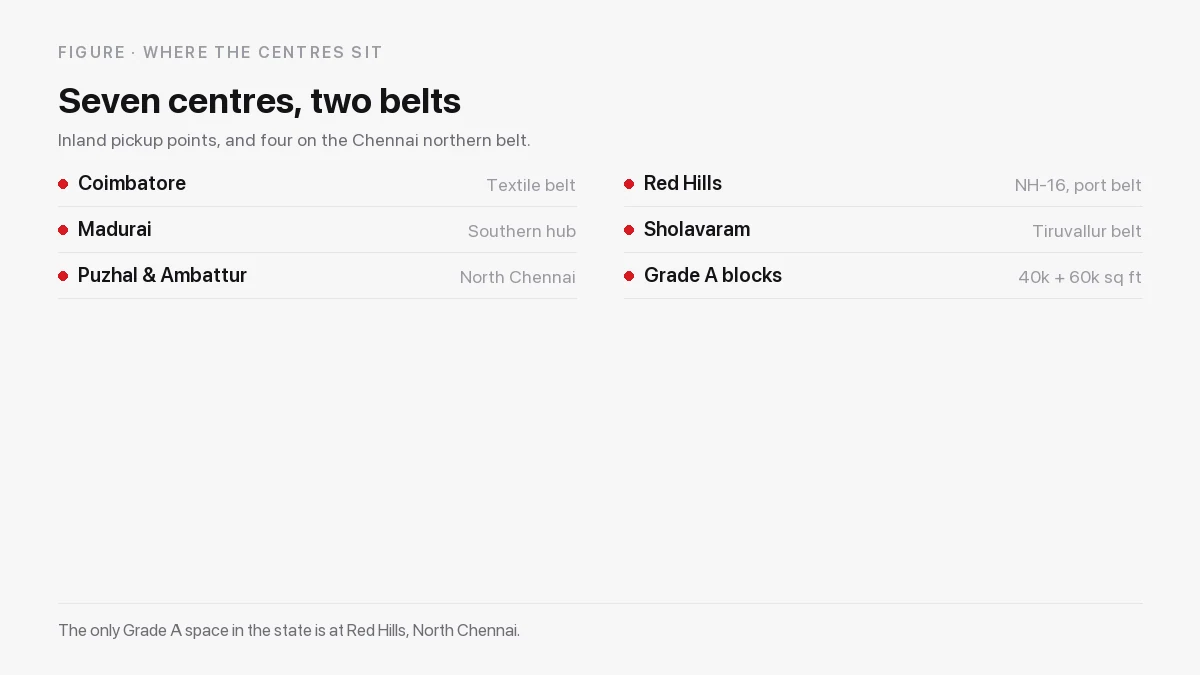
- Seven Lozy collection centres cover Tamil Nadu — Coimbatore and Madurai inland, and Puzhal, Ambattur, Red Hills and Sholavaram across the Chennai belt.
- The state's Grade A space sits at Red Hills in North Chennai, in two blocks of 40,000 and 60,000 sq ft, on the NH-16 (GNT Road) corridor, 22 km from Ennore Port and 25 km from Chennai Port.
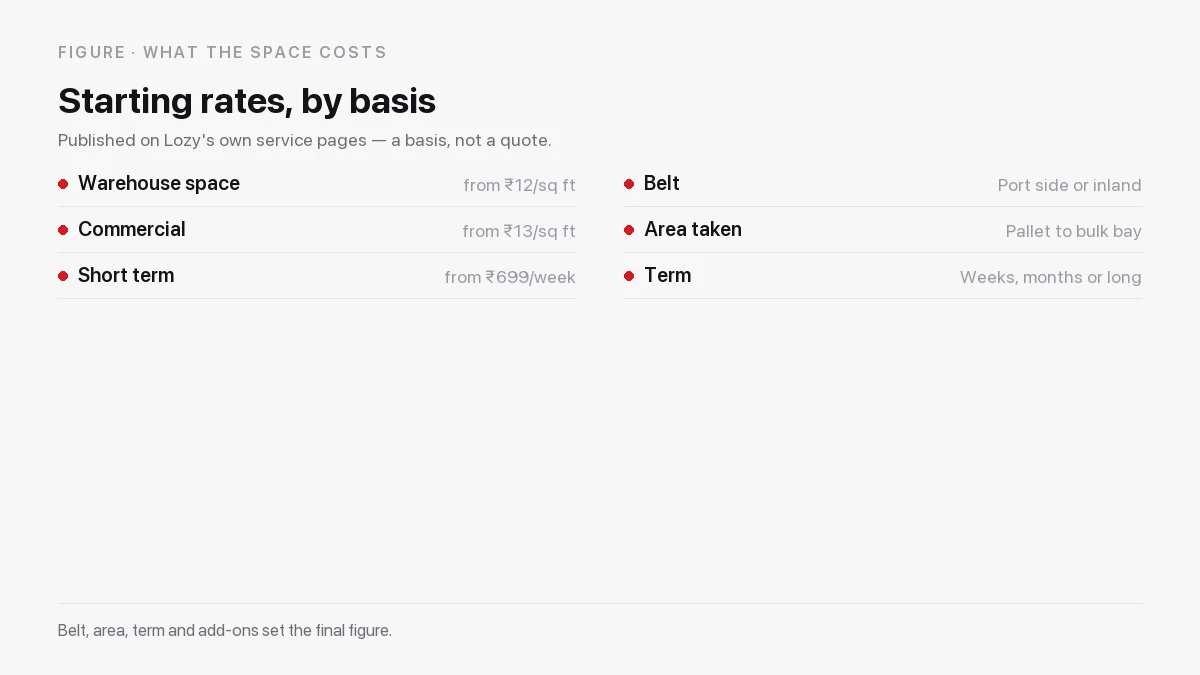
- Warehouse space for rent starts at ₹12 per sq ft per month, commercial warehousing at ₹13 per sq ft per month, and a short-term booking at ₹699 per week.
- Behind those units are 77+ warehouses and more than a million square feet of live space, billed monthly on a GST invoice with no long lock-in.
Tamil Nadu is not one warehouse market with one rent level. It is a coastal industrial state of long overland distances, and its storage splits along a line that is easy to see on a map and expensive to ignore: the port and industrial belt wrapped around Chennai on the north and west, and the inland manufacturing towns where a large share of the goods on those pallets is actually made. A distributor choosing between them is choosing between a shed that can take a 40-ft container straight off a terminal apron and a godown that stands beside the mill or the industrial estate its suppliers work in. Both are legitimate answers. They simply do different jobs, and confusing them is the most expensive storage mistake a Tamil Nadu business makes.
Lozy's presence in the state is laid along that same line. There is one Grade A facility — Red Hills in North Chennai, in 40,000 and 60,000 sq ft blocks — and there are seven collection centres: Coimbatore and Madurai inland, and Puzhal, Ambattur, Red Hills and Sholavaram across the Chennai belt. The Tamil Nadu location page carries the live coverage; what follows is what each half of the state is genuinely good at, and where the money goes in each.
Why warehousing in Tamil Nadu is two belts, not one
The Chennai port belt: NH-16 from Puzhal to Sholavaram
Red Hills sits on the NH-16 (GNT Road) run north out of the city, and Lozy's unit there is addressed to Budur Village in the Sholavaram panchayat union of Tiruvallur district. The published distances tell the story better than any description: Ennore Port 22 km, Chennai Port 25 km, Chennai International Airport 34 km, with Kattupalli reachable along the same NH-16 corridor. A container that lands on the north side of the city can therefore be de-stuffed, sorted and re-dispatched without ever crossing central Chennai, which is the one thing a Chennai-based importer most wants to avoid.
Puzhal and Ambattur sit inside the same belt, closer to the city and to the western industrial estate, and they do a different job from Red Hills: they shorten the last leg into north and west Chennai rather than the leg to the port. Together with Sholavaram they give a business four pickup and intake points on a single stretch of road, which matters more than it sounds when your suppliers are spread across the city. The Chennai location page shows the city-side inventory in full.
The western textile belt: Coimbatore and Tiruppur
Go west and the storage problem changes completely. Coimbatore and Tiruppur are the state's textile and light-engineering address, and the stock that moves through them is not container cargo arriving from a port; it is yarn, fabric, knitwear, packaging and the pumps, motors and foundry castings that Coimbatore's engineering trade is known for. A knitwear unit in Tiruppur building for an export season needs cartons held in dry, dust-free space for weeks at a time, and it needs them within a truck run of the stitching floor — not 500 km away on the coast, however cheap that coast might look on paper.
Humidity is the technical constraint here, and it is the reason a textile buyer asks different questions from an auto buyer. Coimbatore is inland and relatively dry, but the monsoon season still decides whether an unsealed shed is usable, and yarn and finished garments both suffer when a floor takes on damp. Lozy's Coimbatore collection centre takes pickups from this belt and routes them into managed, dust-free space, which is the practical answer for a trader holding stock between two export cycles.
The southern belt: Madurai, and the SIDCO and SIPCOT estates
Madurai does the job for southern Tamil Nadu that no Chennai facility can do: it puts stock in the districts where it will be sold. The state's industrial geography is built on estates — the SIDCO industrial estates that carry small and mid-sized manufacturers, and the SIPCOT industrial parks built for larger process and engineering plants — and the pattern inside those estates is always the same. A cluster of units inside one walled area, each with a shop floor that is already too full, and each needing buffer space a few minutes away rather than in another district.
That is the shape of inland demand in Tamil Nadu, and it is why the state cannot be served from one location. A Madurai-side footprint shortens delivery into the southern districts and keeps a manufacturer's finished goods near the customer, while a Chennai-side unit does the opposite and keeps them near the port. A business with both ends of that traffic runs two positions; a business that only ever sells inside the state rarely needs the coast at all.
Why an inland godown can beat a port-adjacent shed
The instinct for anyone importing is to get as close to the terminal as possible. That instinct is right for a container that is re-exported and wrong for stock that is picked, packed and delivered across a state. Port-side space is shaped for containers: high clear height, dock levellers, a concrete apron that takes a trailer, and a rent that reflects all three. An inland godown is shaped for orders: racked pick faces, a smaller door, a smaller unit, and a rent that reflects the distance from the water.
Run the arithmetic on a real requirement and the trade-off resolves quickly. If most of your volume leaves as full pallets on a drayage run, proximity to Ennore or Chennai Port wins outright, and the Red Hills belt is where you belong. If most of your volume leaves as individual orders to shops, dealers or customers in Coimbatore, Madurai and the districts between them, the port is nowhere near your buyer, and a Chennai unit adds a 450 km line to every consignment. Tamil Nadu has enough internal demand that both answers are common, sometimes inside the same company.
The Tamil Nadu network, node by node
Seven collection centres sound like a lot until they are mapped against the state's shape, at which point the gaps are as informative as the coverage. Four of them sit on one stretch of the Chennai belt; two sit in the inland manufacturing belts; and that distribution is a fair description of where Tamil Nadu's stock actually is. What each node is good at is set out below, and the state coverage page shows what is bookable at each.
| Node | What it suits | Corridor |
|---|---|---|
| Red Hills and Sholavaram | Port-side 3PL, import and export staging, container handling | NH-16 (GNT Road) |
| Puzhal | North Chennai distribution and city-side overflow | GNT Road, north Chennai |
| Ambattur | Engineering and component stock beside the industrial estate | West Chennai industrial belt |
| Coimbatore | Textile, pump and foundry stock; western Tamil Nadu distribution | NH-544 towards Salem |
| Madurai | Southern districts distribution and estate-side buffer stock | NH-44 southern leg |
Read the table as a routing decision rather than a menu. If your inbound flow is containerised and your outbound flow is statewide, the Chennai belt does the receiving and an inland centre does the delivering. If your goods never see a port, the inland centres do both. The warehouse listing is worth checking before any of this, because availability changes the recommendation more often than preference does.
Who stores what in Tamil Nadu
Five kinds of customer fill Tamil Nadu's storage, and each of them measures a facility by a different standard. The rest of this section is what they actually keep, and what they should be asking for.
Textile and apparel businesses
This is the state's largest storage category by volume. Coimbatore and Tiruppur run on yarn, greige fabric, knitwear and packaging, and the storage requirement swings hard with the export calendar: a unit holds cartons for a few flat weeks, then needs twice the floor before a shipping window. Dust-free floors and pest control matter more here than temperature, and the ability to add and drop area month by month is worth more than a marginally lower rate on a locked lease. It is the clearest case in the state for a managed monthly arrangement rather than a long lease.
Engineering, pumps and component suppliers
Coimbatore's pump and foundry trade and Ambattur's industrial estate both run on components: castings, machined parts, motors, spares and the packaging they travel in. These businesses store heavy goods that belong on the floor rather than on racking, and they care about two things above all — whether a truck can reach the bay, and whether the floor can carry the load. Racked space is for the fast-moving spares; the rest wants a bulk floor and a forklift.
E-commerce sellers and 3PL operators
Chennai's fulfilment demand concentrates on the northern belt, where a seller can reach north and central Chennai in one run and the port corridor in another. The requirement is pick faces, not pallets: racked positions, a live stock view, and the ability to hand pick, pack and dispatch to a third party. Sellers who outgrow a back room usually start with a defined block in a shared floor and only take a sealed area once volumes justify it.
Importers and exporters
Anyone clearing cargo through Ennore or Chennai Port is really buying a position between the terminal and the buyer. Space at Red Hills lets a consignment be de-stuffed, checked, relabelled and re-dispatched without a second cross-city movement, and it keeps duty-paid stock under one roof instead of split across a yard and an office. For an exporter, the same unit does the reverse: consolidation and container stuffing before the run to the port.
Households across the state
The other half of Tamil Nadu's demand is domestic and it is spread far wider than the industrial belts. Families on transfer between Chennai, Coimbatore and Madurai, households between two homes and landlords holding furniture between tenants all need a lockable unit rather than a pallet position. That is self storage: dust-free, CCTV-monitored and billed for as long as it is needed.
What warehouse space in Tamil Nadu costs
Lozy publishes starting rates on its own service pages rather than a single state average, because an average without its basis misleads more than it informs. Three of those rates apply to this market, each attached to the service it belongs to and each quoted exactly as published:
- Warehouse and godown space for rent — from ₹12 per sq ft per month on the warehouse space for rent page. This is the basis you use when you are pricing a floor plate by area, and it is the lowest of the three starting rates.
- Commercial warehousing — from ₹13 per sq ft per month on the commercial warehousing page, for managed floor space with security, handling and monthly billing included.
- Short-term booking — from ₹699 per week on the short-term option, which is the right basis for a seasonal overflow or a sample consignment that has to be held for a few weeks rather than a year.
Read those as floors rather than quotes — each is a starting rate on its own basis. Every charge is billed monthly and invoiced with GST, and none of them carries a long lock-in, so space can be added for a peak and given back afterwards. The figure that comes back on a real requirement will differ, and it should: these numbers exist to anchor a conversation, not to replace one.
What moves the number in Tamil Nadu
- Which belt. A Chennai port-belt unit and an inland unit in Coimbatore are not the same product, and the landed cost of land under each is the reason. Cheaper space that adds a 450 km line to every dispatch is not cheaper.
- The area taken. A few rak positions and a full bulk bay price differently, and the area you occupy is the largest single input to any rate.
- The term. A short booking and a year-long arrangement are different products, and the longer commitment is normally the cheaper month. The short booking is what you take when you cannot yet say how long the requirement lasts.
- What you add. Racking, extra handling, packing material, insurance cover and any climate control all move the figure, so describe the goods rather than asking for a generic warehouse.
- Access. A unit with a trailer-friendly apron and dock access is a different building from a shed reached down a lane, and the rent reflects the difference before anyone explains it.
Paperwork, humidity and the site visit
Three things decide whether a Tamil Nadu facility is usable, and none of them is the rate on the first email. They are worth settling before a truck arrives rather than after it.
GST and the invoice
Storage rent attracts GST, and a registered business can claim input credit when the invoice is raised correctly: in your own entity's name, as a tax invoice, with the storage and handling lines shown the way your accountant needs them. That is the question to put in writing — what the document will look like and who it comes from — because the rules are published on the GST portal and your accountant can confirm how they apply in minutes. A cash rent handed over with no document is cheaper in the month and dearer across the year, since none of it comes back.
Who the building is approved by
Tamil Nadu's industrial land and the estates on it are developed and allotted by state bodies — SIPCOT for the larger industrial parks and the SIDCO estates for smaller units — and a warehouse inside an approved estate inherits the land-use position a warehouse outside it has to earn. Ask the plain version of the question at any viewing: which authority approved this building, and can I see the occupancy and fire clearances? A slow answer to either carries more information than any rate discussed later in the visit. For tenants who export, the registration that genuinely matters is the import-export code issued through the Directorate General of Foreign Trade, and that is held by your own business rather than by the warehouse.
The northeast monsoon and coastal humidity
Tamil Nadu's rain does not arrive when the rest of India's does. The coastal belt takes the northeast monsoon between October and December, and Chennai's reputation for a wet, disruptive autumn is earned rather than invented. So the checks here are physical: plinth height above the surrounding grade, a paved or hard-standing apron rather than loose ground, and a drain invert that runs away from the shed instead of towards it. Ask how the yard behaved last October, and if you can, walk it after rain. Inland, the constraint is subtler and more constant — humidity rather than standing water — which is why a textile or food enquiry should ask what the floor does in a wet month, not just what it looks like in a dry one.
How to choose a node in Tamil Nadu
Work backwards from your buyer to the building, not forwards from a cheap rate. The sequence below is the one that catches the expensive mistakes early.
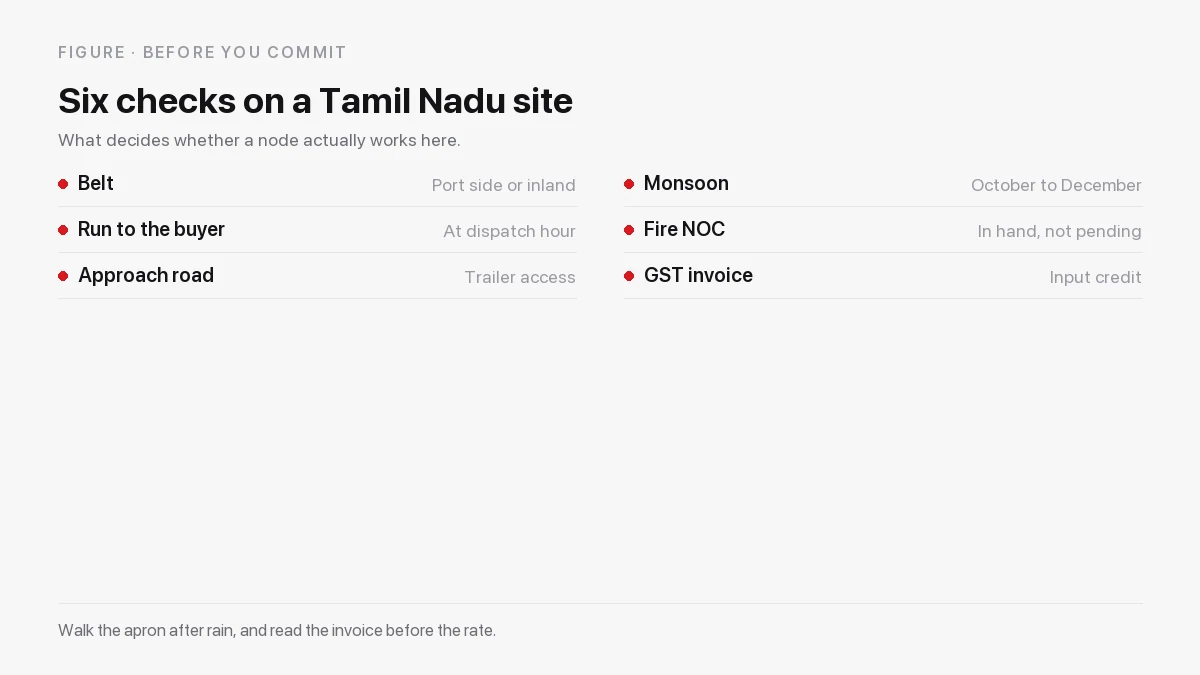
- Decide which belt before which building. Containerised inbound flow and statewide outbound flow point at the Chennai belt; goods that never see a port point inland. This decision changes the transport bill more than any negotiation on rent.
- Measure the run to your customer, not to your office. Check the same trip at the hour your trucks actually leave. A Chennai belt unit that loses forty minutes at a city junction every morning is not the cheaper option it looked like.
- Check the approach road before the racking. A trailer needs width, clearance and a turning circle. An estate road in Ambattur and a lane behind a Coimbatore mill are not interchangeable, and no interior photograph will show you the difference.
- Match the space to the goods. Racked pick faces for e-commerce lines, bulk floor for castings and bales, dust-free and pest-controlled space for textiles and food.
- Ask what happens in October. Drainage, plinth and roof condition decide whether a coastal unit is usable through the northeast monsoon, and the answer is worth more than a small difference in rent.
- Get the inclusions and the invoice in writing. Racking, trolleys, handling, security and pest control on one side; GST treatment, the invoicing entity, the notice period and the minimum term on the other.
Red flags in a Tamil Nadu deal
- A rate quoted with no basis. Per square foot, per pallet and per unit are three different prices for the same goods, and a quote that will not say which one it uses cannot be compared with anything.
- No land-use or occupancy answer. If the owner cannot say which authority approved the building, the compliance risk ends up with the tenant.
- Fire clearance "in progress". A NOC in hand and a NOC applied for are different buildings, and fire is routinely the longest item in any fit-out.
- An apron that holds water — or has none. Loose ground and a bad drain invert make a loading face unusable for days after October rain.
- An area described only in vague terms. Ask for the square feet, the pallet positions and the clear height, because "plenty of space" is not a specification.
- A monthly rate carrying a yearly minimum. A short booking from ₹699 per week is a real product, and the terms that come with it should be stated rather than discovered.
A worked example: a Coimbatore trader's pre-season stock
Take a representative case rather than a named customer. A Coimbatore textile trader supplies knitwear and fabric to dealers across western and southern Tamil Nadu and has been keeping its stock in a rented room behind its own shop. Two seasons of growth later, the room cannot hold the pre-season build, cartons are stacked in the corridor, and staff spend the first hour of every dispatch moving stock out of the way to reach what is behind it.
The requirement that came out of it was roughly 4,500 sq ft of dust-free, pest-controlled floor within a short drive of the shop, with space to add a racked section for the fast-moving lines and a working aisle wide enough for a trolley. Coimbatore — not the Chennai coast — was the right answer, because every consignment this business sends goes to a dealer inside the state or to the airport for a sample shipment, and not one of them sees a container terminal.
Four thousand five hundred square feet at the published starting rate of ₹12 per sq ft per month lands near ₹54,000 a month before any add-ons, which is indicative rather than final because the block, the access and the term all move it. The point the arithmetic makes is that the trader did not buy floor space; it bought a stockroom it could walk through, a count that matches its own records and a floor that still holds stock after the northeast monsoon has passed.
Also in Delhi NCR
Tamil Nadu goods do not stop at the state line, and a Tamil Nadu business that also supplies the north ends up holding space at both ends of the country. A Chennai-side unit on NH-16 and a position in NCR are complements rather than alternatives for anyone shipping cartons into the capital's market; the Delhi location page shows the northern inventory, and the locations hub maps the rest of the network node by node.
How Lozy helps in Tamil Nadu
Lozy runs 77+ warehouses and more than a million square feet of live space across the network, and in Tamil Nadu that means one Grade A facility at Red Hills in North Chennai — 40,000 and 60,000 sq ft blocks on the city's northern industrial belt, minutes from the port corridor — backed by seven collection centres at Coimbatore, Madurai, Puzhal, Ambattur, Red Hills and Sholavaram. Every unit comes with a dedicated racked or bulk-floor area, 24/7 CCTV, on-site security and PIN access to your own storage area, with free doorstep pickup and delivery back across the state.
Billing is monthly on a GST invoice with no long lock-in, and the space can grow for an export or festive peak and step back down afterwards inside the same facility. For a manufacturing-scale requirement, industrial and bulk warehousing covers large floor plates with dock access, which is what most Coimbatore and Ambattur enquiries turn into. For stock that moves month to month, the business warehousing route is the one to compare. Everything the company provides is set out on the services page, and the Tamil Nadu coverage page lists the units themselves.
If your goods move beyond the state, the neighbouring guides are the place to start: warehousing in Chennai for the city in more detail, Karnataka, Kerala, Hyderabad and Bengaluru for the corridors either side of Tamil Nadu. Two background reads help before a first call: the business warehousing guide on how a monthly managed arrangement differs from a lease, and the warehouse for rent guide on what a rate per square foot does and does not include.
To see what is free right now, browse the warehouse listing, or talk to the team with the city, the size and the date you have in mind. Coverage beyond this state is on the Tamil Nadu location page and the wider Lozy blog covers everything else in the same plain style as this post.

Need warehouse space in Tamil Nadu?
Tell us where the goods are and the size you need — we reply with a rate and what is free now.
Get a quoteCall +91 93547 12345Sources. Rates, centre counts, facility names and distances are Lozy's own published information. Highway corridor context comes from the National Highways Authority of India; port-side context from Chennai Port Authority; state economic context from IBEF's Tamil Nadu profile; policy releases from the Press Information Bureau; and industry context from the Warehousing Development and Regulatory Authority. The GST, SIPCOT and DGFT references are linked where they are used above.
Last updated: 13 October 2026. A question the FAQ below does not cover? Call +91 93547 12345 or write to care@lozy.in.
Need warehousing or storage in India?
Request a free, tailored quote in under 2 minutes — free pickup, no lock-in.