Warehousing in Chennai: The Port Corridor, the North Belt and What Space Costs
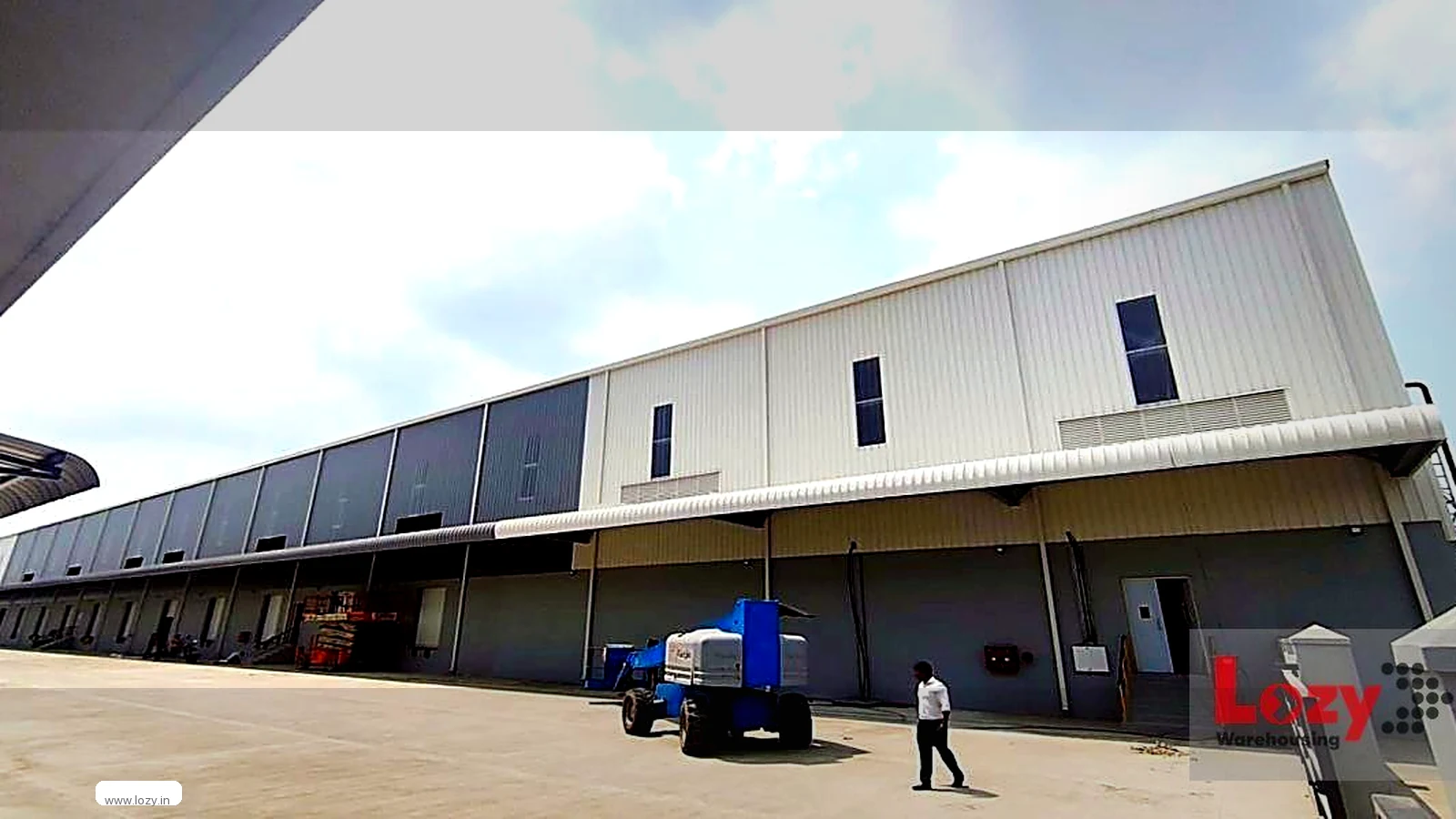
Short answer: warehousing in Chennai begins at the port and only afterwards becomes a property decision. The floors that matter sit on the northern belt — Red Hills, Puzhal and Sholavaram — inside the short run between the city's own docks and the Kamarajar (Ennore) terminal, because that is where the containers and the trailers go. Lozy's national network runs to 77+ warehouses and over a million square feet of live space, seven collection centres of it in Tamil Nadu; this guide covers what Chennai stores, the belts goods travel, how the sea air changes the storage decision, and what space costs.
Key takeaways
- Chennai's storage is anchored by the port corridor — the city docks and the Kamarajar (Ennore) terminal — which is why the sheds cluster on the northern belt at Red Hills, Puzhal and Sholavaram rather than near the southern suburbs.
- The network lists 7 collection centres for Tamil Nadu, and five of them carry names: Red Hills, Puzhal & Ambattur, Sholavaram, Coimbatore and Madurai.
- The city's own space is the Grade A floor at Red Hills, in blocks of 40,000 and 60,000 sq ft, built for 3PL operators, e-commerce sellers and manufacturers.
- Published rates here start at ₹12 per sq ft per month for floor space, ₹14 on a managed business plan, and ₹4,999 a month for e-commerce fulfilment — each monthly on a GST invoice.
Why warehousing in Chennai runs on the port before the pin code
Almost every storage question in this city is answered by one thing: where the containers go. Chennai has two working gateways within its own reach — the docks in the north of the city and the Kamarajar terminal out at Ennore — and a box released at either of them wants to be parked close by, not hauled across the metropolis. That single fact pulls the storage market north and keeps it there. The buildings this network operates in the city are listed on the Chennai location page, and the wider state picture, including the centres outside the city, is on the Tamil Nadu page.
The second force is manufacturing. Chennai is the base for a large share of India's car, two-wheeler and commercial-vehicle output and a growing slice of its electronics assembly, and both industries consume storage instead of selling it: components and packaging arriving in batches, finished goods parked between dispatch cycles, kits held for a service network. Neither flow cares about a smart address. Both want a wide gate, a floor a pallet truck can work, and a run to the plant that never crosses the city centre.
The port corridor sets the northern belt
Nothing in Chennai competes with the docks as a storage magnet. Cargo cleared at the city port or at Kamarajar (Ennore) does not want a second long movement before it is de-stuffed; it wants a shed within the hour. That is what the northern belt gives you: Red Hills, Puzhal and Sholavaram sit inside the run between the two gateways, on the industrial spine the city built northwards, and the Grade A space this network runs is there rather than anywhere else. Ask a broker in the south where the containers are and the answer will send you north every time.
North Chennai and south Chennai are two different markets
The city splits cleanly, and the split settles almost every requirement that comes up. North Chennai is industrial and port-led — Red Hills, Puzhal and Sholavaram hold the godowns, the container yards and the light engineering, with the workforce living alongside them. South Chennai, along the information-technology corridor and the residential belt around it, is a consumption market instead. Businesses do not put a warehouse floor there; households put furniture there.
One rule follows from that faster than any other. Stock arriving from a vessel or leaving for a plant belongs on the northern belt, and the drive through the city to a southern address is a cost you pay every working day. A domestic requirement works the other way: a southern pickup with a northern storage floor suits it perfectly, because those goods move in once and out once, never every morning.
What the sea air does to stored stock
This is the local constraint that catches out anyone relocating from an inland market. The city sits on the coast, the air carries salt and moisture, and two monsoons a year push humidity into the eighties and nineties for weeks at a stretch. Paper, board, cartons, leather, machine tools, electronics and anything with a steel component all respond badly to that when they sit in a shed with a stained roof and no air movement.
Nothing stored in Chennai needs refrigeration — almost nothing in the market ever does. What it needs is ventilation, a dry floor, a raised pallet base and a roof that genuinely keeps the rain out. Those are worth more here than in Nagpur or Jaipur, where a cheap godown with rusted sheeting is a far smaller risk. Inspect the roof from inside on a bright day, and ask where the water came in during the last northeast monsoon.
Who fills Chennai's warehouse floors
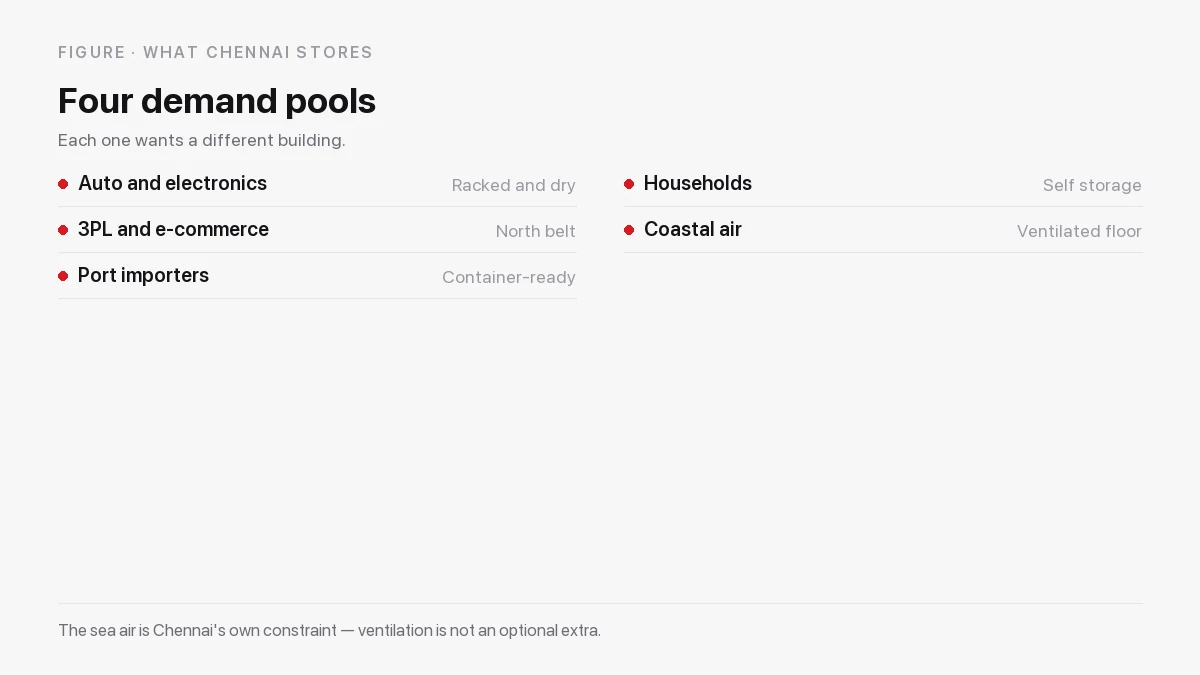
Four kinds of customer occupy most of the square feet this market holds, and they are not looking for the same building.
Auto, engineering and electronics manufacturers
The city's industrial base is vehicles, components and electronics, and that shows up in storage as demand for racked, dry, accessible space rather than anything glamorous. A supplier holds packaging material, inbound components and finished parts that must not sit on a damp floor. An electronics assembler holds cartons of boards, housings and accessories that are sensitive to moisture and to handling alike. Both want the same three things: racking that goes up rather than out, a bay a truck can use without a shunting tractor, and a check-in record that matches the line's own count. Where the loads turn over by the pallet, that requirement belongs on the industrial warehousing side of the service.
3PL operators and e-commerce sellers
Chennai fulfils all of Tamil Nadu and a large part of the southern peninsula, so a seller holding stock here serves a big, dense market from a single node. The city's courier network is still moving late into the evening, which is what makes a north-belt floor workable for dispatch as well as storage — goods do not have to cross the city twice to leave it. Third-party logistics operators work the same floors, running pick, pack and dispatch themselves, and the rate basis for that work sits on the e-commerce warehousing page.
Importers and exporters working the docks
Anyone de-stuffing a box that has just left the Chennai docks or the Kamarajar (Ennore) terminal is looking for a holding position between the quay and the buyer. Space on the northern belt lets a container be emptied, sorted and re-dispatched without a second cross-city movement, and it keeps duty-paid stock under one roof instead of split across two hired godowns. Hold the same goods before duty has been paid and a different arrangement applies, which the customs bonded warehouse page sets out.
Households between two addresses
The other half of the demand here is domestic, and it is steady all year rather than seasonal, because the city gains and loses people continuously. Tenancies turn over, families renovate, children move away for work and parents move back, and furniture a household cannot carry to the next address needs somewhere dry for three or six months. That is the job self storage does — a private, dust-free unit from ₹999 a month, CCTV-monitored, with pickup from the door and delivery back when the new home is ready. None of it involves a warehouse lease, a minimum floor area or a pallet count, and the floors held for a business requirement are on the Chennai location page.
The Chennai belts goods actually travel
Chennai's storage map is drawn by the northern run and by the outer ring that lets a truck avoid the middle of the city. Which of those your unit sits on shapes your delivery times far more than the building's finish does. The units themselves are on the Chennai location page.
Red Hills — the city's own Grade A floor
Red Hills is where this network keeps its Chennai space, and the reason is the belt rather than the postcode. The facility is two Grade A godown blocks of 40,000 and 60,000 square feet on the northern industrial belt, truck-accessible and a short run from the port corridor. That scale suits the customer Chennai actually produces: a 3PL operator, an e-commerce seller or a manufacturer that needs pallets in and out by the truckload rather than a room for a few cartons. Ask about Red Hills first if your goods arrive or leave by trailer.
Puzhal and Sholavaram on the northern run
Puzhal and Sholavaram sit on the same northbound spine as Red Hills, one after the other, and they carry the collection side of the network rather than the storage floor. A household in Puzhal or Sholavaram, an Ambattur trader or a small workshop does not drive goods across the city to the warehouse; the booking is routed to the nearest centre, collected from the door, then moved to the unit. For anyone on the northern side that is the whole point — the warehouse comes to you instead of you coming to it.
Ambattur and the western industrial estate
Ambattur is the city's established western industrial estate, a belt of engineering units, workshops and small manufacturers that has been turning out components for decades. Its requirement is different in shape from the port-side one: smaller floor plates, more frequent movements, and a customer who often needs somewhere to put finished stock out of a workshop that has run out of room. The Puzhal and Ambattur collection point serves exactly that trade, which is why the network names the two together on its own list.
The outer ring is the way around the city
What makes the northern belt usable rather than merely northern is the ring road, which links the northern corridors to the western and southern highways without putting a truck through the centre of Chennai. A load leaving Red Hills for the west, or arriving from the south for a northern godown, can be routed around the city instead of through it, and on a working day that difference is measured in hours rather than minutes. It is the one piece of infrastructure most worth asking about when two units are priced alike.
What space in Chennai costs
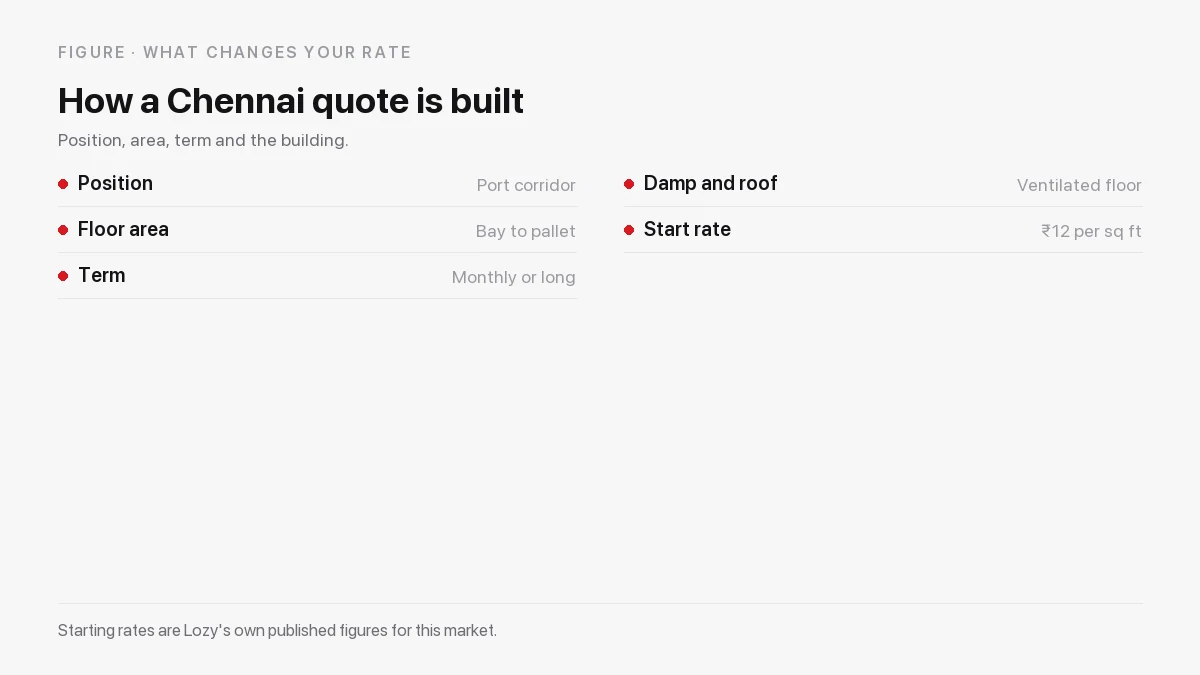
This market is priced off three published starting rates. Floor and godown space for rent begins at ₹12 per sq ft per month, the basis to use when you are pricing an area. A managed business plan begins at ₹14 per sq ft per month, with security and housekeeping inside it. E-commerce fulfilment, where stock is received, held and dispatched on a seller's behalf, begins at ₹4,999 per month. Each of the three is billed month to month, GST included, with no lock-in of any length.
These are starting rates rather than quotes, and the distinction matters more here than in an inland market. What you pay follows the unit, the area, the term and the goods — and in Chennai one further input, which is how much the building has to do about the coastal air. A ventilated, well-roofed floor and a leaky shed are not the same product, and the rent should not pretend otherwise. How rent is built in general, apart from the city, is set out in the warehouse space for rent guide.
What actually moves a Chennai rate
- Where on the belt. A unit with a fast run to the port corridor and a shed buried behind a residential street are different products, and the rent reflects the access long before anybody explains it.
- How much floor. Floor area usually decides the number before anything else does, and a whole bay is not the same quotation as four pallet positions.
- How long you commit. A four-week booking and a twelve-month agreement are priced against different risks, and the twelve-month number is normally the lower of the two.
- What the building has to do. Ventilation, damp treatment, racking, extra handling and packing material all move the figure, and on this coast the first two are not optional extras.
| What you are deciding | Managed Chennai warehouse | Your own leased godown |
|---|---|---|
| Commitment | Month by month | Multi-year, usually with escalation |
| Money up front | No fit-out and no setup charge | Deposit, repairs and fit-out |
| Monsoon and damp | Roof, drainage and ventilation maintained | Yours to patch after every November |
| Security and upkeep | 24/7 CCTV, security, housekeeping and pest control included | Yours to arrange and pay for |
| When your volumes move | Shrink or grow the footprint | Pay for space you may not fill |
| Makes sense when | Your requirement is still settling | Your requirement is proven and long |
The Chennai version of that choice usually turns on the import calendar. A trader working a container cycle needs floor when the box lands and far less once the stock has sold through, and a lease cannot follow that shape. A manufacturer with a steady, proven load can and often should lease a site of its own, while keeping flexible overflow space beside it, which is what business warehousing is for.
GST, licences and the paper trail for a Chennai unit
Settling these before the first truck costs far less than settling them afterwards, and one of them is peculiar to the coast.
GST, the invoice and input credit
Rent for storage in Tamil Nadu carries GST, and input credit is available to a registered business when the invoice is raised correctly: in the entity's own name, as a tax invoice, with the storage and handling lines shown the way the accountant needs them. A GST invoice is not paperwork for its own sake — it is what turns rent from a permanent expense into a recoverable one. The rules are published on the GST portal, and the state's own industrial and investment information sits with the Tamil Nadu Industrial Development Corporation.
Who approved the building
Put one question to any operator: by which authority were these premises approved, and can the occupancy and fire clearances be shown on the spot? A facility on a port belt may also sit inside an area with its own planning and environmental conditions. A quick, straight answer to that says a great deal about how the rest of the arrangement will run; a vague one says a great deal more.
The goods list, and the damp clause
Settle what the unit will and will not take before you sign. Flammables and hazardous goods, food lacking the matching licence, and anything with a strong odour each come with conditions of their own — sometimes in a separate bay, sometimes nowhere in the building. Then ask the coastal question: how is the floor treated, how does the roof drain, and is anything stacked directly against an outside wall? An operator on this coast who has run through monsoons will have an answer ready, and that answer beats the brochure.
Choosing a Chennai unit — and the red flags
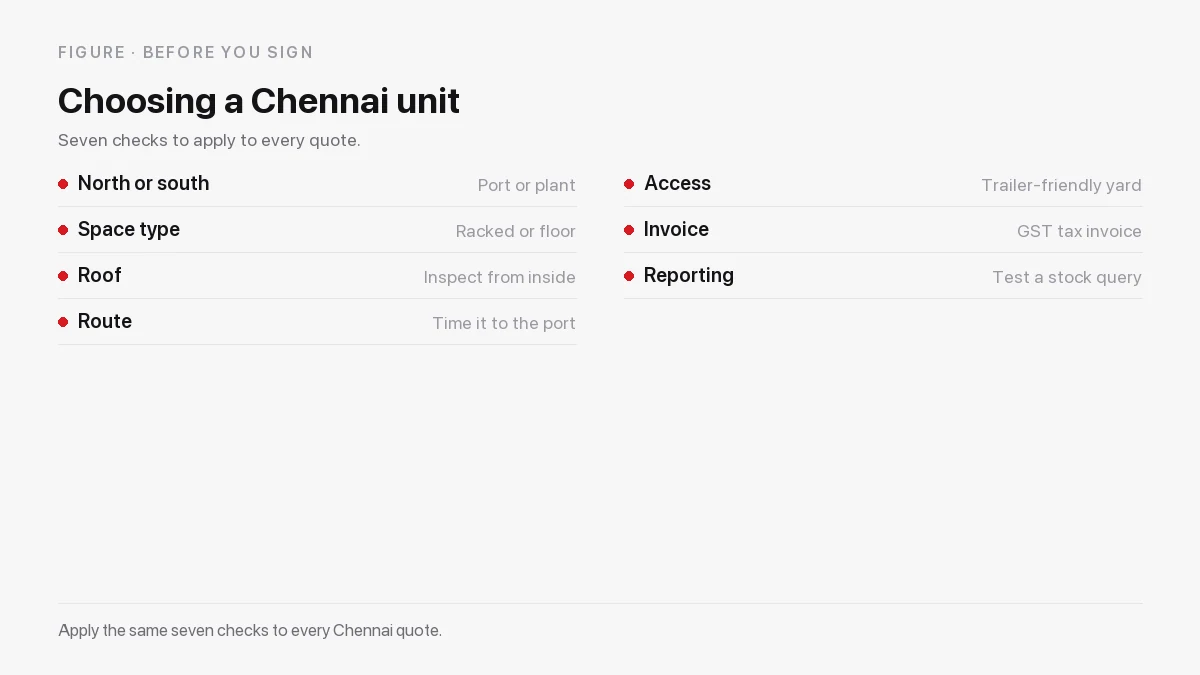
Run the list below against us as readily as against anyone else. An hour of it saves months.
- Decide north or south before you see anything. If your goods touch a port or a plant, you are on the northern belt. Only a domestic requirement belongs further south, and even then only the pickup needs to be there.
- Match the space to the goods. Choose a racked bay, an open floor position or a bulk stack; dry air or moving air; a shared floor or a unit only you can open.
- Inspect the roof from inside. On a bright day, look for staining, sagging sheets and daylight, and ask where the water came in during the last northeast monsoon.
- Time the run to the port. Drive it at the hour you would really send the truck, not at noon on a Sunday.
- Check the approach and the gate. Room to swing a trailer matters more than any finish inside, and a lane with a height barrier cancels it out.
- Get the inclusions in writing. Racking, pallet trucks, ventilation, guard cover, cleaning and pest control, listed item by item.
- Confirm the rate basis and the notice period. How the rate is actually built — by area, by pallet or by whole unit — and the notice period attached to ending it.
The warning signs, roughly in the order they turn up: a quote that will not say whether GST is inside it; a shed with a patched roof and no answer about the next monsoon; an operator who cannot produce an occupancy or fire clearance; a "monthly" rate carrying a yearly minimum; and a facility that cannot name the bay your pallets will occupy until you arrive with the truck.
A worked example: a components supplier moving stock out of Ambattur
One component supplier on the Ambattur side had been keeping finished stock and packing material in the last quarter of its own unit. It is not a storage business and had no wish to become one: the stock blocked the dispatch bay, the packing material stood against a wall that drew damp every monsoon, and each audit cost a day of counting.
The requirement that came out of that was about 2,600 sq ft of racked space, dry and ventilated, a short run from the workshop and no more than twenty minutes from the northern corridor for the truck that collected twice a week. A racked bay on the northern belt answered it: cartons and components up on racking instead of against the wall, pallet positions logged at check-in, and finished stock off the shop floor and out of the line's way.
Run 2,600 sq ft through the published ₹12 starting rate and the figure lands near ₹31,200 a month. Read that as indicative only — the real figure follows the unit and the term — but the arithmetic makes the point: what the supplier bought back was its dispatch bay and a stock position answerable in an afternoon rather than a day.
How Lozy works in Chennai
The company's network reaches 77+ warehouses and more than a million square feet of live space in total, with seven Tamil Nadu collection centres inside it. The city's own space is the Grade A floor at Red Hills — 40,000 and 60,000 sq ft blocks on the northern industrial belt, truck-accessible and a short run from the port corridor, built for 3PL operators, e-commerce sellers and manufacturers. A booking hands you a racked or floor area of your own, sitting behind 24/7 CCTV, on-site guards and PIN-controlled gates, lifts and storage doors.
Billing runs monthly on a GST invoice, there is no long lock-in, and a free doorstep pickup applies once a booking reaches 30 days, so leaving a workshop, a hired godown or a flat does not stall anything. If the requirement shifts, the size changes within the same facility instead of the lease being torn up. The whole of what the company does is on the services page; a business wanting the managed version of a floor should start with business warehousing, while a household move is a self storage booking.
See the units themselves on the warehouse listing, or tell the team what you are storing, how much room it needs and when it has to move. The Chennai location page carries the city's own coverage, and the locations hub maps every other city the network serves.
Also in Delhi NCR
A Chennai seller who begins shipping north tends to keep one floor here and add another in NCR, rather than moving stock up the coast order by order. The New Delhi and Gurgaon guides take the two addresses northern buyers choose most often. A container that lands here and then sells into Delhi NCR is cheaper held once in the north, close to the buyer, than trucked up from the coast every week.
Where the rest of the country is the question, the sibling guides cover warehousing in Tamil Nadu beyond the city, Bengaluru and Hyderabad on the southern corridors, and Kolkata on the eastern run around the peninsula. How shared floors are operated is set out in the commercial warehousing guide.

Need warehouse space in Chennai?
Tell us the city and the size you need — we reply with a rate and the options available now.
Get a quoteCall +91 93547 12345About the author
Lozy Editorial Desk. This guide was written by the Lozy Editorial Desk, the in-house team that covers warehousing, self storage, logistics and customs/EXIM topics for lozy.in. We write from Lozy's own facility and pricing information and from public, citable sources. We do not publish invented statistics, ratings or reviews.
Sources. Everything said here about facilities, rates and collection centres comes from Lozy's own published figures, not from third-party estimates. Corridor and ring-road context is taken from the National Highways Authority of India; industry context from the Warehousing Development and Regulatory Authority and IBEF's Tamil Nadu profile. Input credit and registration are described from the GST portal, with the state industrial picture from the Tamil Nadu Industrial Development Corporation; both are linked above. Someone shopping several cities before making a call will recognise the same plain, unhyped house style on the Lozy blog, which covers warehousing, self storage and customs in the same register.
Last updated: 13 October 2026. Have a question the FAQ below does not answer? Call +91 93547 12345 or email care@lozy.in.
Need warehousing or storage in India?
Request a free, tailored quote in under 2 minutes — free pickup, no lock-in.