Warehousing in Gurgaon: A City Guide to Space, Corridors and Cost
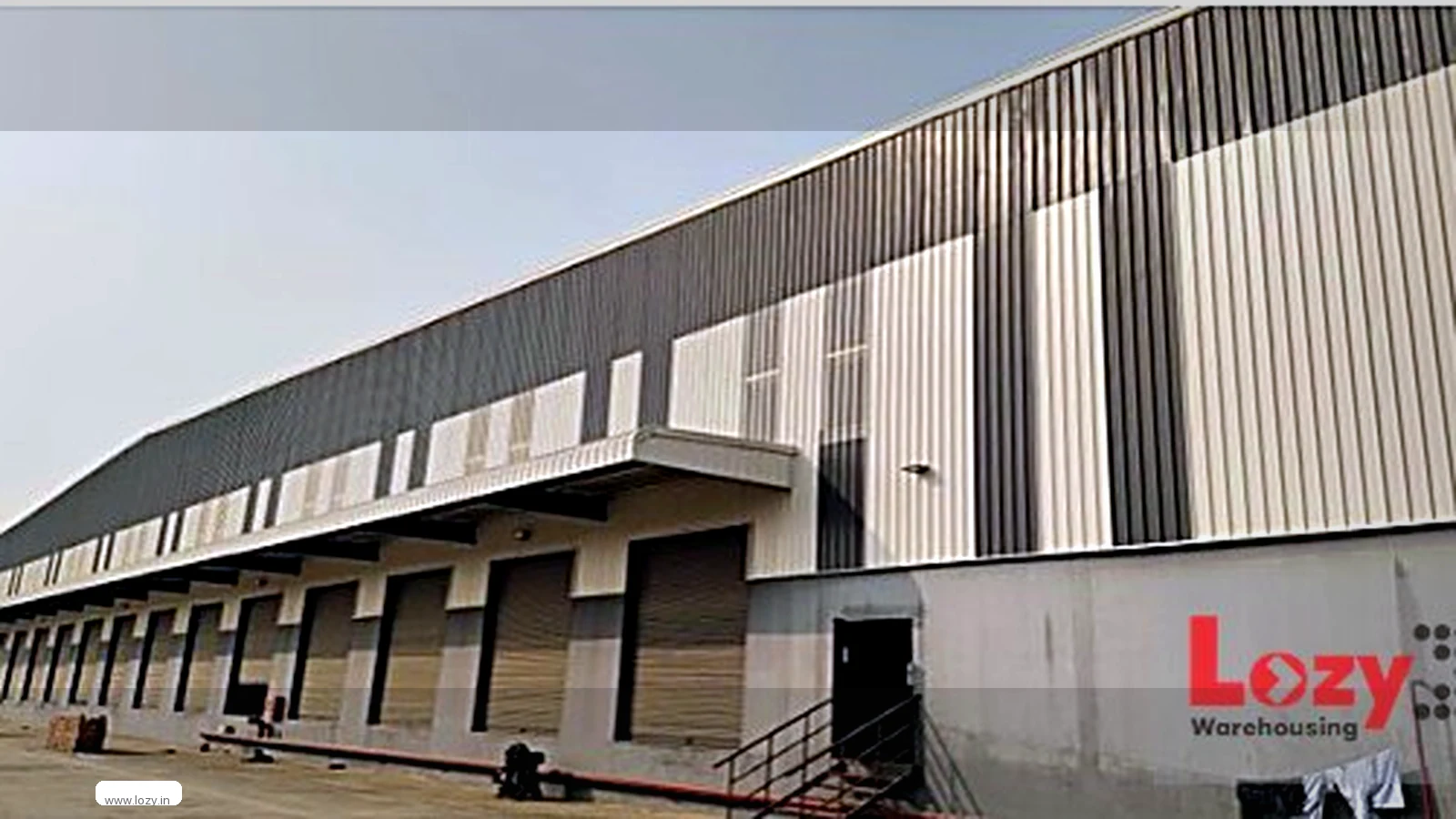
Short answer: warehousing in Gurgaon is not inside Gurgaon. The floor plates sit on the Gurugram–Manesar industrial belt — the Manesar sectors, Jamalpur, the Kherki Daula toll belt on NH-48 and the ICD-side yards at Garhi Harsaru — all within a short run of Delhi's southern border. Lozy runs 77+ warehouses and more than one million square feet of live space, and Haryana is the densest part of that network. This guide covers who stores what here, the corridors goods move along, what the space costs and how to pick a unit without paying for the wrong one.
Key takeaways
- Gurgaon's storage runs on two axes, not on Sectors: NH-48 through Kherki Daula, Manesar and Dharuhera, and the Dwarka Expressway side out towards the ICD at Garhi Harsaru.
- Haryana carries 8 collection centres in Lozy's network — Garhi Harsaru, Jamalpur, Dharuhera, Faridabad and Sonipat among them — feeding the Gurugram units.
- Warehouse space for rent starts at ₹12 per sq ft per month and commercial warehousing at ₹13 per sq ft per month, billed monthly on a GST invoice.
- Self storage starts at ₹999 per month, which is the option for a Gurgaon household between two homes rather than a pallet of stock.
Why warehousing in Gurgaon is not like the rest of NCR
Gurugram puts two kinds of demand on the same twenty-kilometre strip. On one side are the offices, flats and Sector addresses that made the city a residential and commercial address; on the other are the industrial floor plates that serve them — and those floor plates are not inside the city at all. They sit in the Manesar sectors and along the toll belt at Kherki Daula, because that is where there is land, a wide approach road and a yard a container trailer can turn in.
That one fact decides almost every storage question in the city. A unit that looks close on a map can be the wrong side of the toll plaza for a morning dispatch, and a unit eight kilometres further down NH-48 can load faster. Read the corridor, not the distance. The state-level picture, including the belts outside Gurugram, is on the Haryana location page.
The Manesar sectors carry the bulk
Manesar Sector 8, Manesar M Zone in Sector 9 and the shedded block in Sector 8 are the named Lozy units on this belt, and they are the ones to ask about first if you are holding pallets rather than boxes. These are large floor plates with dock access and truck-friendly yards — the shape NCR freight is built around — and they sit close enough to the Kherki Daula toll that a Delhi-bound load is on the highway within minutes of the gate closing.
What the ICD at Garhi Harsaru changes
Garhi Harsaru has an inland container depot, and that changes the arithmetic for anyone importing. Cargo arriving in a container by rail can be de-stuffed and held nearby instead of being hauled across the city and back again. Lozy's Garhi Hasru Dwarka Expressway unit sits on that side of the district, which makes it the one to consider if your inbound flow is import-heavy and your customers are on the Dwarka side of Delhi.
Jamalpur and the northern reach
Lozy Jamalpur Distribution Center anchors the distribution side of the Haryana cluster, and the same network reaches Sonipat on NH-44, Ambala further north and Dharuhera down the Delhi–Jaipur highway. If your Gurgaon stock is a staging point for a wider North India run, those are the centres your goods either pass through or land in — and the warehouse listing shows what is available at each.
Who stores what in Gurgaon
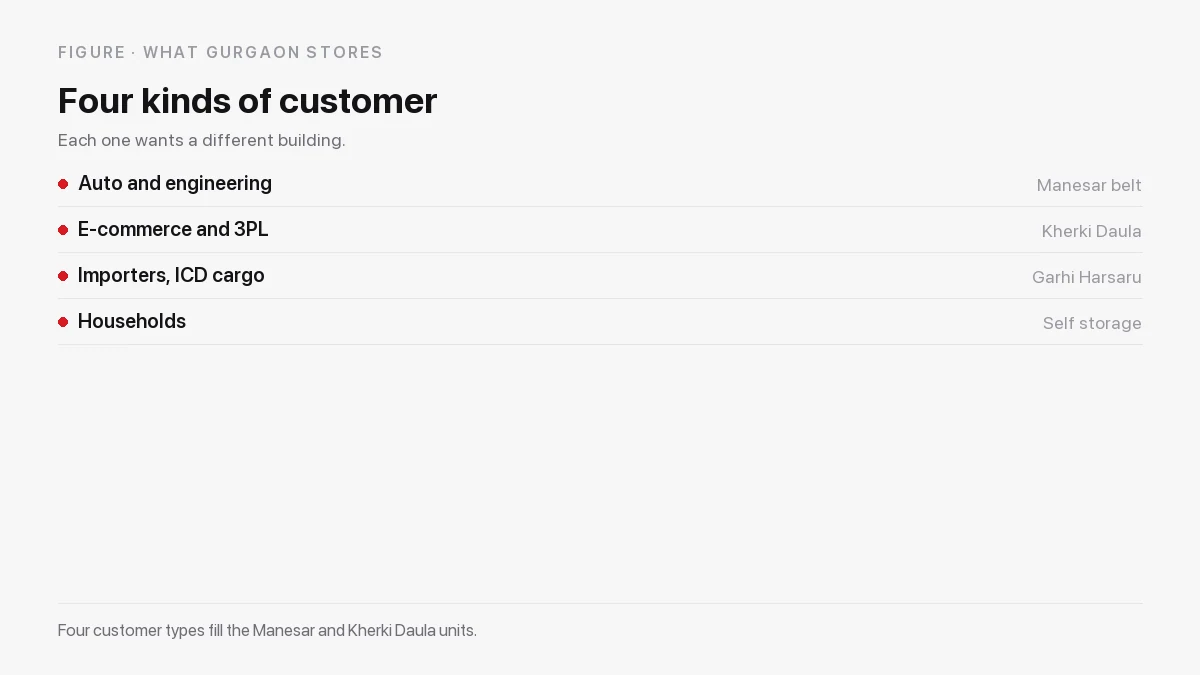
Gurgaon is not one industry with one storage need. Four kinds of customer fill the units on the Manesar and Kherki Daula belts, and each of them wants something different from a facility.
Auto, engineering and component suppliers
The Manesar belt is automotive and engineering country, and its suppliers run the classic pattern: packaging material and spares arriving in batches, finished components waiting for a dispatch cycle, and a buffer that swings with the customer's build schedule. They take floor space for the bulky items and racked space for the fast-moving lines, and they care far more about dock access and truck turnaround than about how the office looks. Pricing for that style of requirement sits on the industrial and bulk warehousing side of the service.
E-commerce sellers and 3PL operators
Gurugram sellers are working to same-day and next-day promises across south Delhi, the Dwarka belt and the city's own Sector addresses. That makes a unit on NH-48 at Kherki Daula or in Manesar the practical answer: close enough for a rider or a small truck to reach the customer, far enough out that the rent is not a Sector 29 rent. Third-party logistics operators take the same floors and run pick, pack and dispatch from them, which is what commercial warehousing is for.
Importers and exporters clearing through the ICD
Anyone clearing containerised cargo through Garhi Harsaru is really looking for a holding position between the depot and the buyer. Space near the ICD and the Dwarka Expressway lets you de-stuff, sort and re-dispatch without a second cross-city movement, and it keeps duty-paid stock under one roof instead of split across two godowns. If the goods are held before duty is paid, that is a different arrangement again.
Households moving across Gurgaon
The other half of the demand here is domestic, and it is larger in Gurgaon than in most NCR cities because so many people arrive, leave or change Sector within a year. Furniture, appliances and cartons go into self storage from ₹999 per month, dust-free and CCTV-monitored, with the unit billed month to month instead of on a fixed lease. Families between two homes, professionals on an assignment and landlords holding furniture between tenants all use the same product.
The corridors goods move along
Gurgaon's storage map is drawn by routes rather than by Sectors. Four of them matter, and which one your unit sits on decides your delivery times far more than the facility's finishing does.
NH-48: Kherki Daula, Manesar, Dharuhera
The Delhi–Jaipur highway is the spine of the belt. The Kherki Daula toll plaza is the gateway between the city and the industrial land beyond it, and Lozy runs units on both the Kherki Daula Toll 1 and Toll 2 positions, then again at Manesar and at Dharuhera further down the same road. Note the published rate basis for this product on the warehouse space for rent page. If most of your outbound freight leaves southwards or towards Delhi, this is the corridor to be on.
Dwarka Expressway and the Pataudi Road side
The northern edge of the district runs along the Dwarka Expressway, which is what makes the Garhi Harsaru ICD genuinely usable for a Gurgaon-based importer — the container and the warehouse end up on the same side of the city, and a load does not cross central Delhi twice. Units on this axis suit businesses whose buyers are in west and south-west Delhi rather than in the city's own commercial Sectors.
NH-44 north towards Sonipat
Northbound freight uses NH-44, and the network's Sonipat centre on that road is the natural staging point for a load heading into Punjab or Haryana's northern belt. Gurgaon distributors running a two-warehouse pattern generally keep the Manesar or Kherki Daula unit for the NCR and use Sonipat for the north, which is cheaper than running everything out of one yard.
The ICD rail link at Garhi Harsaru
Containerised cargo that arrives by rail lands at Garhi Harsaru, and the value of holding space nearby is that the container does not travel twice. Ask how the ICD side of a facility is served: a yard that can take a container trailer is a different proposition from a shed that only handles loose cartons, and the difference shows up on the day you actually need it.
What warehouse space in Gurgaon costs
Two of Lozy's published starting rates apply to this market because it is an industrial city first. Warehouse and godown space for rent starts at ₹12 per sq ft per month on a commercial basis, and commercial warehousing starts at ₹13 per sq ft per month. For domestic storage rather than business stock, self storage starts at ₹999 per month per unit. Every one of those is billed monthly on a GST invoice, with no long lock-in.
Those are starting rates, not quotes. They anchor the conversation and they should not decide it: the unit, the floor you take and the term you commit to move the number, and none of that is visible until someone looks at your requirement. The city's rent picture in full — rate bands and what drives them — is already covered in the guide to Gurgaon warehouse rent rates, so this post stays on the choosing side of the question.
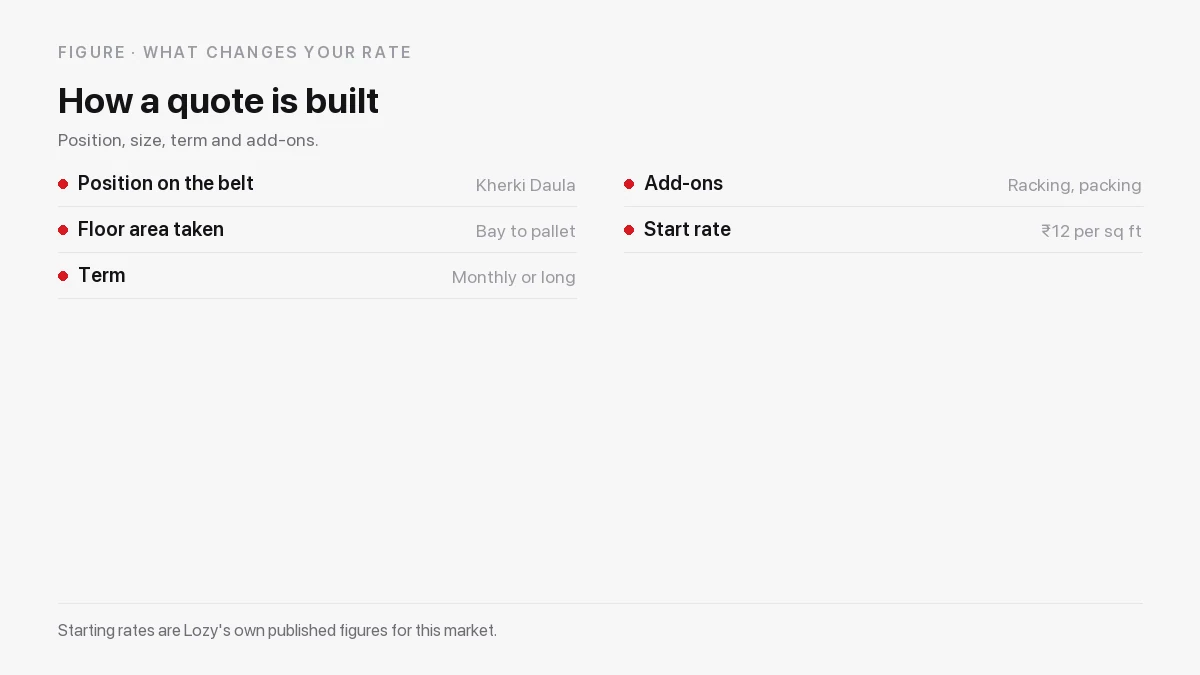
How a Gurgaon rate is actually built
- Where on the belt. A Kherki Daula roadside unit and a shed five kilometres off it are not the same product, and the rent says so before anyone explains it.
- How much floor you take. The area is the biggest single input — a full bay and four pallet positions cannot be priced off the same line.
- How long you commit. A monthly booking and a year-long arrangement are different products, and the longer one is usually cheaper per month.
- What you add. Racking, climate control, extra handling, packing material and insurance cover all move the number.
| What you are deciding | Monthly storage plan | Commercial lease in Gurgaon |
|---|---|---|
| Commitment | Month by month | Multi-year, usually with escalation |
| Money up front | No fit-out and no setup charge | Deposit plus fit-out and fitment |
| When your volumes move | Shrink or grow the footprint | Pay for space you may not fill |
| Facility upkeep | Security, housekeeping and pest control included | Yours to arrange and pay for |
| Makes sense when | Your requirement is still settling | Your requirement is proven and long |
The Gurgaon version of that choice usually comes down to the festive peak. A seller heading into October needs more floor than it will in February, and a commercial lease cannot follow that. A manufacturer with a proven, flat requirement can and often should lease — and can still keep flexible space for the swing, which is what business warehousing is for. The business warehousing guide sets that middle path out in detail.
Compliance and paperwork for a Gurgaon warehouse
Most of the paperwork questions here are the same ones that apply across Haryana, and all of them are cheaper to settle before the first truck than after it.
GST, the invoice and input credit
Storage rent in Haryana attracts GST, and a registered business can claim input credit when the invoice is raised correctly: in your entity's name, as a tax invoice, with the storage and handling lines shown the way your accountant needs them. The registration and credit rules themselves are published on the GST portal. A cash rent paid to a landlord with no invoice looks cheaper every month and costs more over a year, because none of it comes back.
Who the building is approved by
Haryana's industrial estates and the infrastructure that serves them sit with the Haryana State Industrial and Infrastructure Development Corporation, and the state's single-window clearances run through Invest Haryana. Put the plain version of the question to any operator: which authority approved this building, and can I see the occupancy and fire clearances? An operator who cannot answer that quickly is telling you something about the rest of the arrangement.
What the unit will and will not take
Ask about the goods list before you sign, not after. Flammable and hazardous material, food without the right licence, and anything strongly odorous are handled differently — sometimes with a separate bay, sometimes not at all. On the way in, a photo inventory and a check-in list against your own count is what makes a later dispute a short conversation instead of a long one.
How to choose a warehouse in Gurgaon — and the red flags
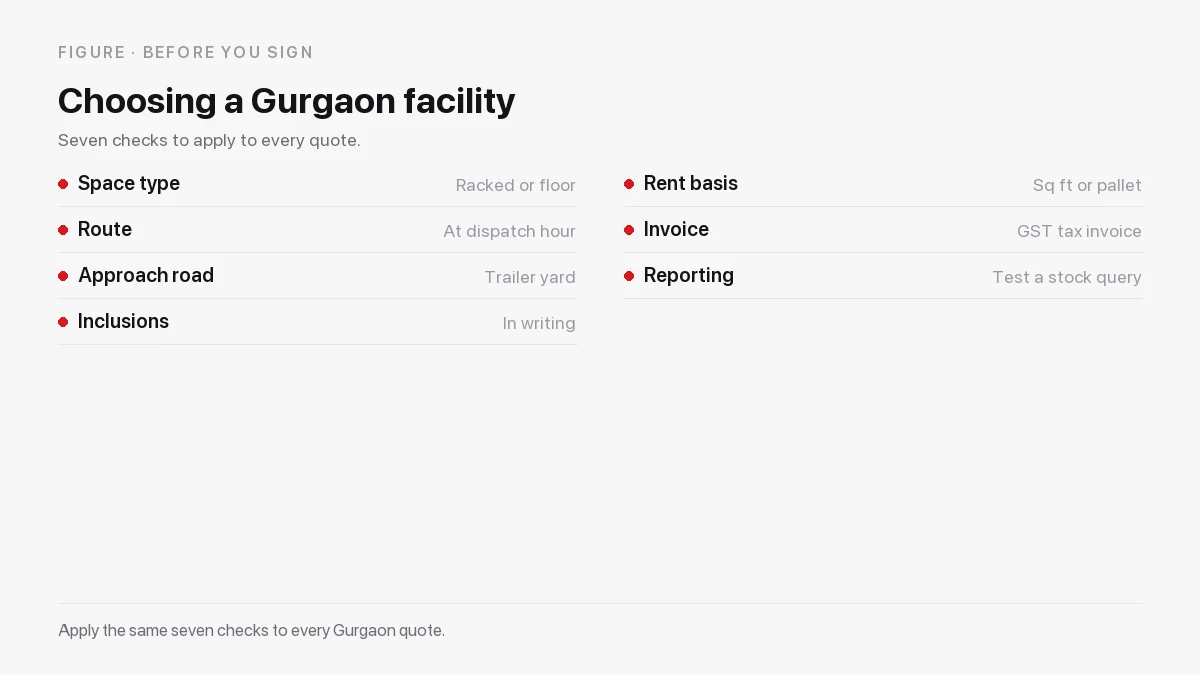
The checklist below is the same one we would want a customer to run against us. It takes an hour and saves months.
- Match the space to the goods. Racked or floor, dry or climate-controlled, shared floor or a lockable unit of your own.
- Drive the route, not the map. Time the run from the unit to your main customer area at the hour you actually dispatch, not at noon on a Sunday.
- Check the approach road. A toll-belt unit with a trailer-friendly yard beats a shed down a lane with a height barrier, whatever the racking inside looks like.
- Get the inclusions in writing. Racking, trolleys, pallet trucks, security, housekeeping and pest control.
- Confirm the rent basis and the notice period. Per square foot, per pallet or per unit — and how much notice you must give to leave.
- Look at the invoice. GST treatment does not change because a business is small.
- Test the reporting. Ask what you will be sent after check-in, and what a stock query looks like on an ordinary Tuesday.
Red flags, in the order they usually appear: a quote that will not say whether GST is included; a yard you cannot picture a container trailer reversing into; an operator who cannot produce an occupancy or fire clearance; a "monthly" rate that turns out to carry a yearly minimum; and a facility that cannot tell you which unit your pallets will sit in until you arrive with the truck.
A worked example: a Manesar supplier's buffer stock
A component supplier to the Manesar belt was holding roughly 1,200 cartons of spares and packaging in a corner of its own factory. The stock was blocking the loading bay and slowing every dispatch, and there was no room to build the next season's buffer.
The requirement that came out of it was about 2,000 sq ft of racked space with room for a working aisle, roughly twenty-five minutes from the plant, reachable on the same day the line called for a part. The workable answer was a racked bay in one of the Manesar Sector 8 units: cartons on racking rather than on the floor, pallet positions documented at check-in, and the spare buffer eight kilometres away instead of eight hundred metres inside the plant.
On the published starting rate of ₹12 per sq ft per month, 2,000 sq ft works out to roughly ₹24,000 a month. Treat that as indicative only — the final figure follows the unit and the term — but it makes the point: what the supplier actually bought was the loading bay it could not get back any other way.
How Lozy helps in Gurgaon
Lozy runs 77+ warehouses and more than a million square feet of live space, and the Haryana cluster — Manesar, Kherki Daula, Garhi Harsaru, Jamalpur, Dharuhera, Sonipat, Ambala and Faridabad — is the densest part of it. Every unit comes with a dedicated racked or floor area, 24/7 CCTV, on-site security and unique PIN access to gates, lifts and your own storage area.
Billing is monthly on a GST invoice, there is no long lock-in, and free doorstep pickup is included on bookings of 30 days or more, so a move out of a factory corner or a Sector flat does not have to pause the business. When the requirement changes, you change size inside the same facility. Everything the company runs is set out on the services page, and the Haryana location page shows the full coverage of this belt.
If you would rather see the space first, browse the warehouse listing for what is free right now, or talk to the team with the size and the timeline you have in mind. The locations hub covers the rest of the network if your goods move beyond NCR.
Also in Delhi NCR
Gurgaon is one node in an NCR network, not a standalone market. A distributor running the Delhi–Jaipur highway very often pairs a Manesar or Kherki Daula unit with space on the other side of the city: the guides to warehousing in Faridabad and warehousing in Noida cover the eastern side, Ghaziabad and Greater Noida the UP belt, and New Delhi the space inside the city. Delhi is the other half of most Gurgaon dispatch patterns, and the Haryana guide sets out the state around it; the Haryana location page lists the units themselves.

Need warehouse space in Gurgaon?
Tell us the city and the size you need — we reply with a rate and the options available now.
Get a quoteCall +91 93547 12345About the author
Lozy Editorial Desk. This guide was written by the Lozy Editorial Desk, the in-house team that covers warehousing, self storage, logistics and customs/EXIM topics for lozy.in. We write from Lozy's own facility and pricing information and from public, citable sources. We do not publish invented statistics, ratings or reviews.
Sources. Facility names, prices and coverage are Lozy's own. Highway and corridor context comes from the National Highways Authority of India; industry context from the Warehousing Development and Regulatory Authority and IBEF's Haryana profile; policy releases from the Press Information Bureau. GST registration and input credit are described from the GST portal, and the Haryana industrial context from HSIIDC and Invest Haryana, both linked above. If you want to read more before you call, the Lozy blog covers warehousing, self storage and customs in the same plain style as this post.
Last updated: 13 October 2026. Have a question the FAQ below does not answer? Call +91 93547 12345 or email care@lozy.in.
Need warehousing or storage in India?
Request a free, tailored quote in under 2 minutes — free pickup, no lock-in.