Warehousing in Gujarat: Chemical Belts, Ports and Cost
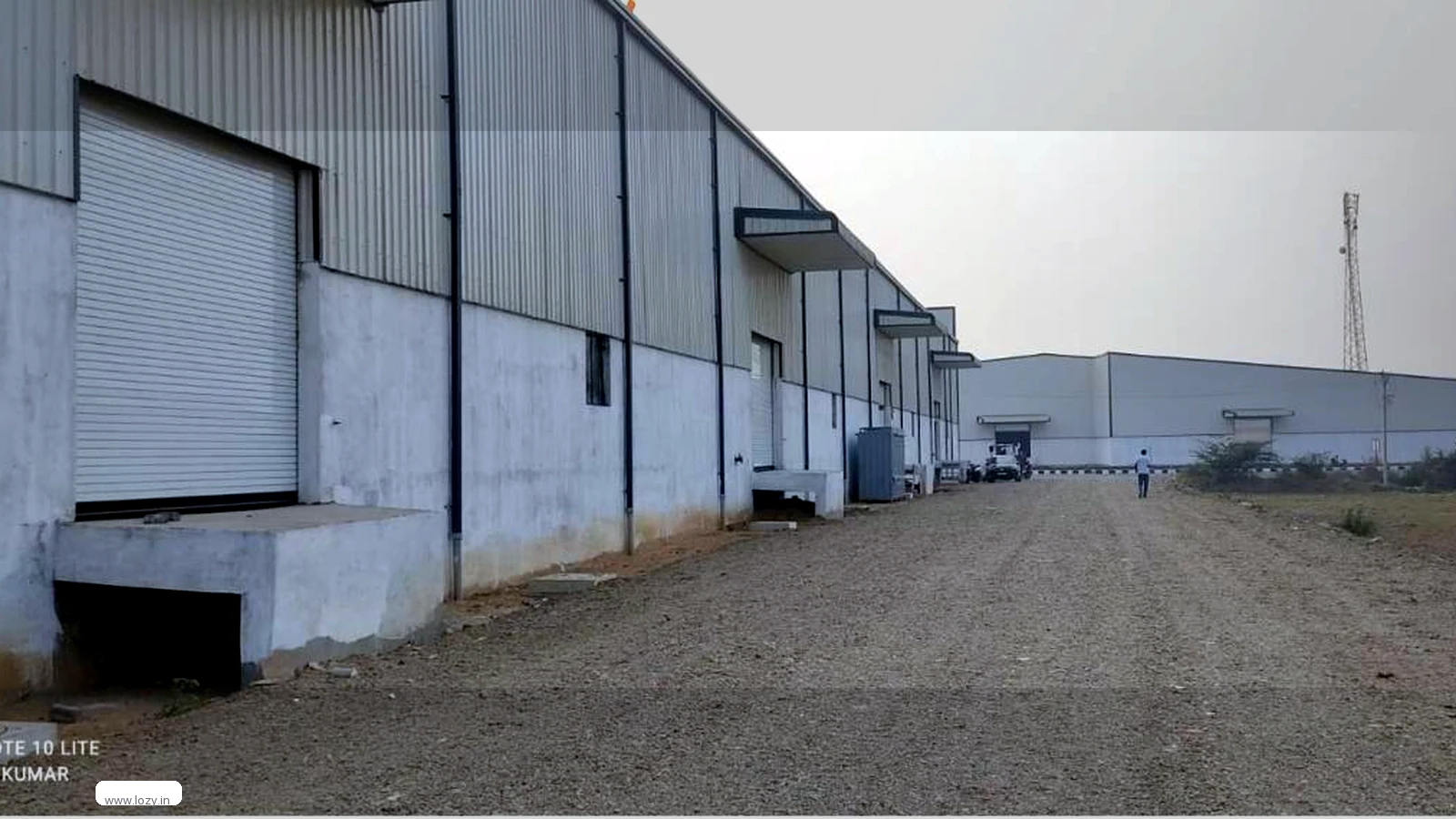
Short answer: warehousing in Gujarat is shaped by two things no other Indian state combines in quite the same way — the country's largest chemical and pharmaceutical manufacturing belt, and the longest coastline of any state, which puts two big cargo gateways within a day's run of the industrial interior. The GIDC estates at Ankleshwar and Vapi and the manufacturing cluster around Ahmedabad and Sanand decide what a floor has to be built to handle; the docks at Mundra and Kandla decide how quickly imported and exported cargo turns. Lozy runs 77+ warehouses and more than a million square feet of live space, and Gujarat carries four collection centres in the network, listed at Ahmedabad, Ankleshwar and Vapi. The guide covers what the state stores, what space costs and how to choose.
Key takeaways
- Gujarat's storage demand is led by chemicals and pharmaceuticals, and the two estates carrying most of it are Ankleshwar and Vapi — both Gujarat Industrial Development Corporation estates on the state's southern chemical corridor.
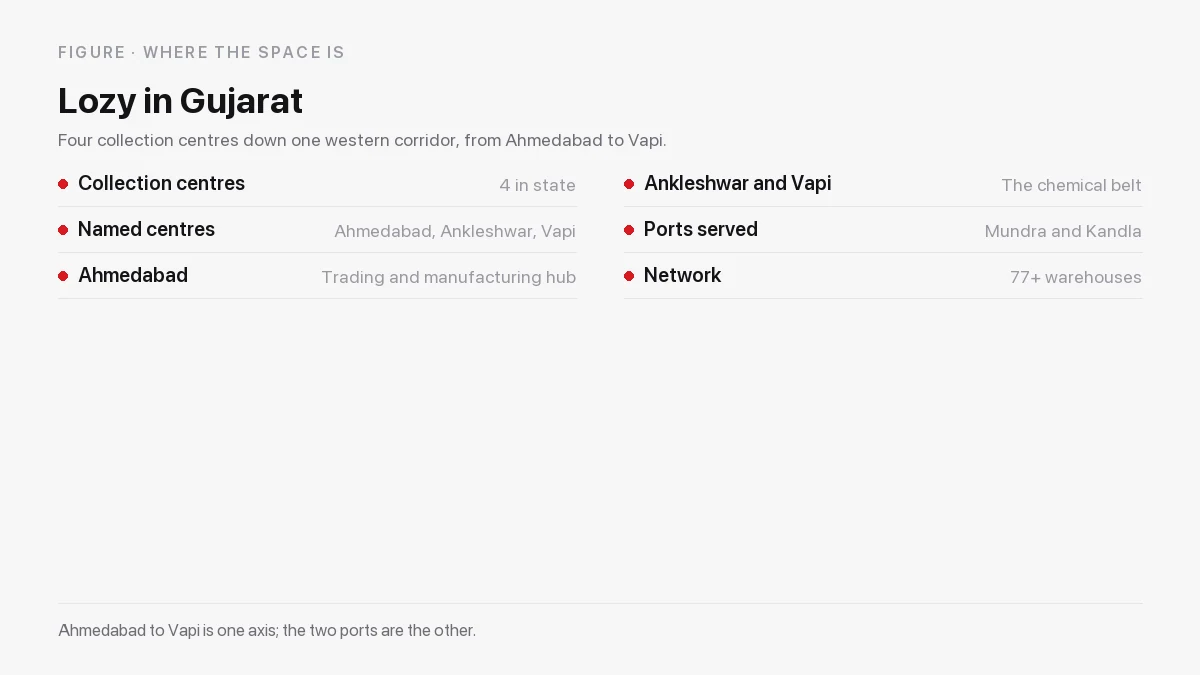
- The state carries 4 collection centres in Lozy's network, listed at Ahmedabad, Ankleshwar and Vapi; Ahmedabad is the northern trading and manufacturing hub, the other two are the southern chemical belt.
- Warehouse space for rent starts at ₹12 per sq ft per month, business and on-demand warehousing at ₹14 per sq ft per month and inventory warehousing from ₹4,499 per month — starting rates, each billed monthly on a GST invoice.
- A chemical or pharma tenant buys more than floor area here: a pollution control consent that covers the goods, a written list of what may not sit beside them, and damp protection built for a wet June are what separate one facility from the next.
Why warehousing in Gujarat is a chemicals-and-coast question
Most Indian cities are one kind of storage market; Gujarat is three at once. Its western coast carries the country's largest petrochemical and chemical base, Ahmedabad holds an old trading and textile economy, and around Sanand sits one of India's newer automotive clusters. Each wants a different building, and a buyer treating Gujarat as one rate will hold the wrong one.
The first question here is not how many square feet but what is inside the drums: a floor that suits cartons of cotton is not fine for a solvent. The three places named in this network's Gujarat list — Ahmedabad, Ankleshwar and Vapi — sit across those economies, and the state's coverage is on the Gujarat location page.
The Ankleshwar and Vapi estates
Ankleshwar and Vapi are the estates India's chemical industry actually built on. Both are Gujarat Industrial Development Corporation (GIDC) estates on the corridor between Ahmedabad and Mumbai, and both have spent decades accumulating what a chemical trader most needs — specialist storage, tanker handling and technical labour no ordinary logistics park assembles quickly.
For a storage decision that means permission as much as space. A unit taking drummed solvents must hold consent saying it may, keep incompatible materials genuinely apart, and show a fire officer the arrangement is deliberate. Ankleshwar is among the country's oldest chemical clusters; Vapi is the belt's southern anchor. The estates are administered by the Gujarat Industrial Development Corporation.
Ahmedabad, Sanand and the northern cluster
Ahmedabad is the state's commercial capital and densest consumer market, and its storage is the most mixed in Gujarat: pharmaceutical packers, textile distributors, food and FMCG trade, engineering spares and online sellers serving the west. Few of those goods need a regulated room; they need a floor that is dry, secure and close enough to town that a van is not losing an hour.
Sanand, a short run south-west, is the newer half of the story: the automotive cluster that drew car and component manufacturing into the Ahmedabad district, and with it a demand for spares, jigs, moulds and packaging. That stock is heavy, dry and unforgiving of rust, which is why northern buyers weigh flooring and loading access above temperature.
The coast: Kandla, Mundra and what port access buys you
Gujarat has the longest coastline of any Indian state, and two of the country's busiest cargo gateways sit on it: the state-run port at Kandla, operated under the Deendayal Port Authority in Kutch, and the private deep-water port at Mundra just west. IBEF treats the coastline and the petrochemical base as the twin engines of the state's industrial economy.
Port access decides which direction goods travel first. A trader importing through Mundra or Kandla and distributing into north or central India wants stock held on the port side of the state, where the container run is short, rather than parked near the customer where every unit pays for the same drayage twice. That is why so much national distribution is planned from Gujarat rather than merely through it.
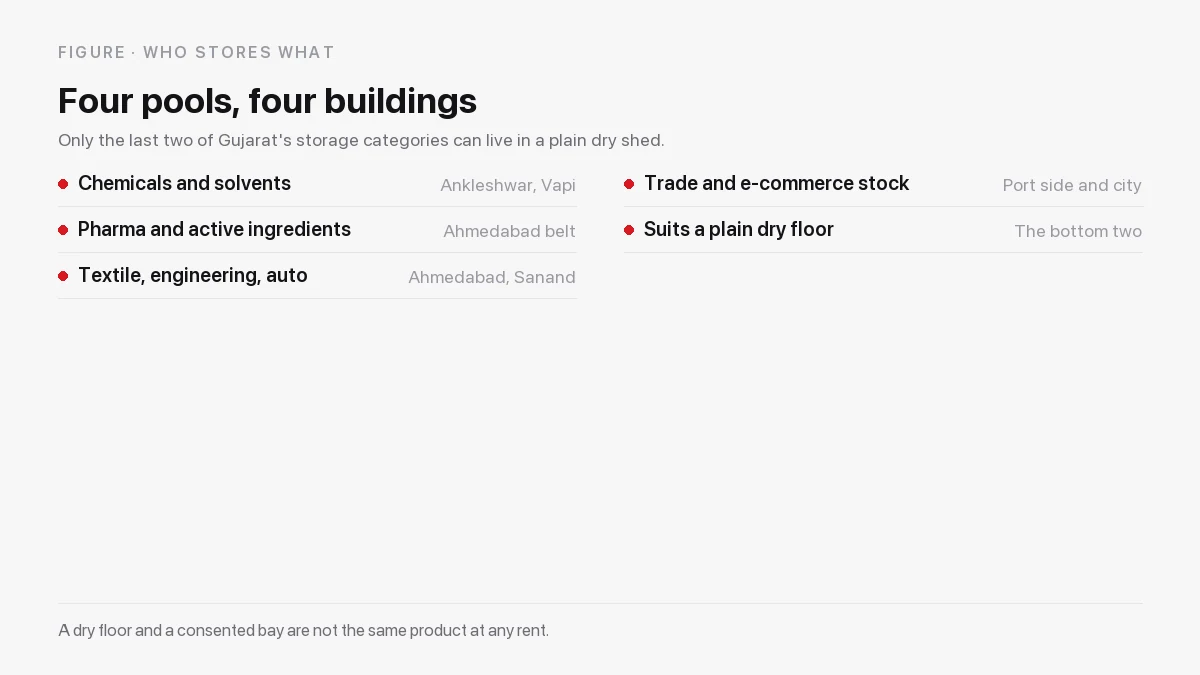
Who stores what in Gujarat
Four groups fill the state's floors, and none wants the same building.
Bulk chemicals, solvents and intermediates
The largest category by value and the most demanding by specification. Drummed and bagged chemicals, solvents, dyes and intermediates, agrochemicals and speciality chemicals move through the Ankleshwar and Vapi estates in huge quantities, and carry storage conditions with them: a written goods list, real segregation between materials that must not react, and a floor a spill can be contained on.
Pharmaceuticals and active ingredients
Gujarat is one of the country's pharmaceutical heartlands, and the belt around Ahmedabad adds formulations, packing material and finished medicines to the bulk chemistry of the south. Some of it needs a temperature band, most needs batch-wise records, and all needs premises that match the licence the goods are held under. The tracked model suited to this stock is on the inventory warehousing page.
Textile, engineering and the Sanand automotive trade
Ahmedabad's textile heritage has not gone anywhere: cotton, yarn, fabric and made-ups still take up a great deal of space around the city, beside a dense apparel and home-textile trade. Next to it sits the engineering demand of the Sanand cluster — spares, tools, moulds and packaging that want a dry floor, racking and a bay a trailer can reach.
Import-export trade and e-commerce fulfilment
The fourth group is the trading economy the ports and the chemical belt jointly created: importers holding duty-paid resale stock, distributors feeding western and central India, and online sellers who treat Gujarat as one fulfilment node for the west. The rate basis for that work, from ₹4,499 per month on a starting catalogue, is on the e-commerce warehousing page.
The corridor the goods travel: down the west, then out to the ports
Gujarat's storage map is a line rather than a cluster, running the length of the state's industrial west. Which end you sit on decides more about delivery times than the building's finish.
The run south: Ahmedabad, Ankleshwar, Vapi
The main artery leaves Ahmedabad and runs south past Ankleshwar, on to Vapi and into Maharashtra and Mumbai. Three of the four centres this network lists in Gujarat sit on that axis, which is why a business storing here thinks less about a city than about a position on the road: north of the chemical belt, inside it, or at its southern edge.
The western run to Kandla and Mundra
The second route turns west out of Ahmedabad towards Kutch and the two ports. It matters to anyone whose inventory arrives or leaves by sea, and explains why the north of the state carries so much import-linked storage: a container move from Mundra or Kandla to a floor near Ahmedabad is one leg, paid once per container rather than once per order.
Access, not the address, is what you are buying
An estate address is not a yard. On the GIDC belts a unit can sit behind a lane a trailer cannot reverse into, or in a compound with one gate and no turning circle. Drive the route your own vehicle would take at the hour it would really take it, and ask where a full trailer turns around.
Monsoon and humidity: the part of the spec that is not optional
South Gujarat takes more rain from June to September than the arid west of Kutch takes in a year, which turns waterproofing from a formality into a job. For anyone storing powder, board, paper or steel, the wet season is the biggest risk on the calendar — and on the chemical belt a specification risk, not a cosmetic one.
How damp gets to the goods
Water arrives four ways: through the roof, up off the yard, sideways through the walls, and carried in the air as humidity. Cartons, paper labels, bagged powders and anything with a steel component react in a predictable order, and none of it shows early. A bagged product that has taken on moisture may fail a specification; a drum with a rusted seam is a containment question.
What to ask for before the season starts
Five things, each owed a straight answer. A floor or plinth above the surrounding yard, so stormwater runs away from the building instead of into it. A roof and drainage line that take a heavy spell without ponding. Pallets or racking keeping goods a level above the slab. Ventilation through the stack instead of a shut-up room. And a damp record taken at check-in and repeated after the season.
What warehouse space in Gujarat costs
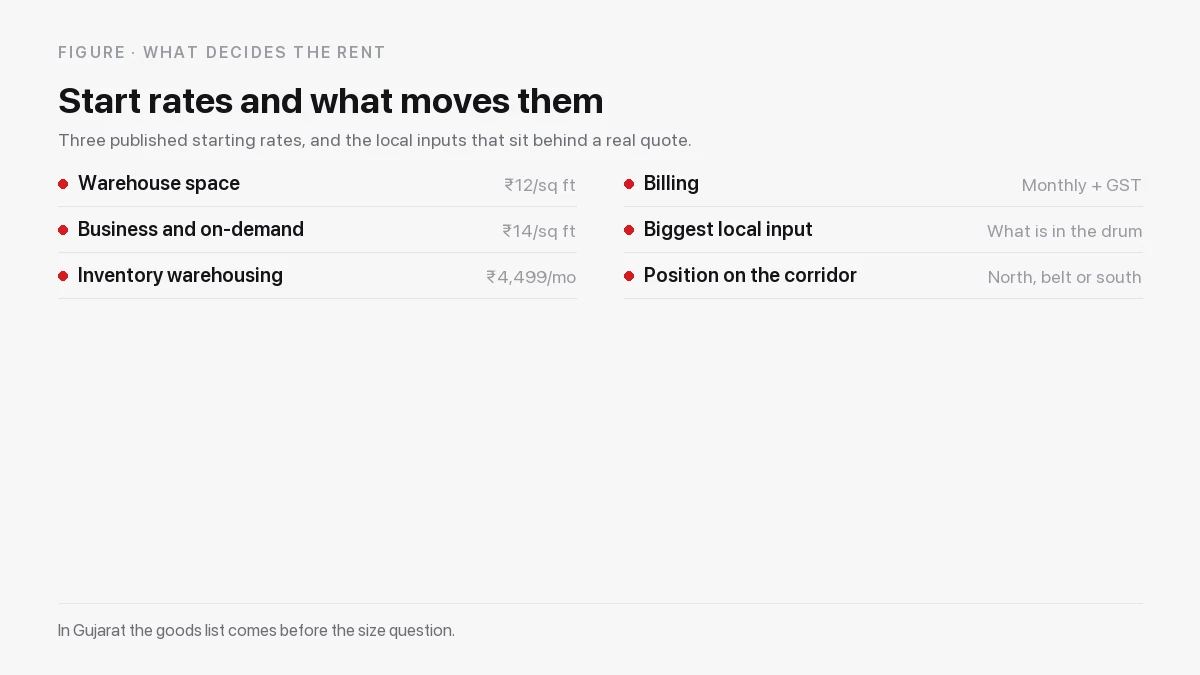
Three of Lozy's published starting rates cover this market. Warehouse and godown space for rent starts at ₹12 per sq ft per month for a bare floor or racked area. Business and on-demand warehousing, the managed version with handling and security built in, starts at ₹14 per sq ft per month. Inventory warehousing, where stock is tracked rather than simply kept, starts at ₹4,499 per month. Each is a starting rate billed monthly on a GST invoice, not a quote.
Worth saying plainly: these are the bottom of the range. What you pay follows the unit, the area, the term and above all what the goods require. Gujarat spreads wider than most states between its cheapest and dearest answer for the same requirement, because the stock here runs from cotton bales to drummed solvent, and a bay cleared for the second is a different product. How a rent basis is chosen is set out in the guide to warehouse space for rent.
The four inputs behind a Gujarat rate
- What is inside the drum. A plain dry floor and a bay cleared for regulated or flammable stock are two products with two prices, and the gap is construction and consent rather than decoration.
- Where the unit sits on the corridor. A floor near the ports serves an import flow, one on the southern belt serves an estate or a plant, and the rent follows the access.
- Area, racking and segregation. A dedicated bay, a racked block and four pallet positions are not the same purchase, so ask what is included.
- The term you commit to. A monthly booking and a year-long arrangement carry different monthly rates, and the longer one is normally the lower one.
| What you are weighing | Monthly storage in Gujarat | A leased godown on a GIDC estate |
|---|---|---|
| Commitment | Month to month | Multi-year lease, usually with annual escalation |
| Money up front | Nothing beyond the first month's bill | Deposit, racking and fit-out of your own |
| Chemical consents | The operator's building consents are already in place | You apply, and you hold the conditions |
| When volumes move | Add or release footprint inside the same facility | Keep paying for floor you have stopped filling |
| Monsoon handling | Structure, drainage and damp checks sit with the operator | Roof, drainage and pest control are your problem |
| Suits you when | Your flow still moves with a season or a shipment | Your volume is flat and proven for years |
The Gujarat version of that choice usually turns on the chemical calendar and the festive quarter: a trader whose stock lands in uneven consignments wants floor it can hand back after a season, while a distributor with a steady load can lease, keeping a flexible slice for the peaks. That middle arrangement is what business warehousing is built for, and the business warehousing guide explains how it runs.
Compliance and paperwork for a Gujarat storage booking
Most of these questions are cheaper settled before the first truck arrives than after it, and on this belt two of them decide the deal outright.
Pollution control consent and the goods list
The first question here is not about tax, it is about consent. Gujarat's industrial belt operates under the pollution regime administered by the Gujarat Pollution Control Board, and categories of chemical storage carry a consent of their own. Flammable goods are additionally governed by petroleum and explosives rules, which prescribe how much may be held, in what room, and at what separation. A facility cleared for general cargo and one cleared for solvents are not interchangeable.
GST, the invoice and the e-way bill
Storage rent is a taxable supply, and a registered business recovers part of it as input credit when the document is a proper tax invoice in your own entity's name, with the storage and handling lines shown the way your accountant expects. The rules are on the GST portal. Rent paid without an invoice looks cheaper on the first of every month and costs more across the year, because none of the tax comes back.
Who approved the building
The estate land itself is GIDC's to allocate, and a category of goods carrying a pollution consent needs that consent held by the operator of the premises, not the tenant passing through. Ask which authority approved this premises, and whether the occupancy certificate and fire clearance can be produced on the spot. State industrial clearances run through the Industries Commissionerate, Government of Gujarat.
What the unit will and will not take
Ask about the accepted goods list before signing, not on the morning the vehicle is loaded. Flammable and hazardous material, food without the matching licence, strong odours and anything needing pest-controlled segregation are treated differently, sometimes in a dedicated bay and sometimes not at all. A chemical tenant should confirm in writing that reactive goods will not be stored against their own.
How to choose a Gujarat warehouse — and the red flags
The test below is the one we would want a customer to run against us, applied to whatever the Gujarat location page is offering this week. It takes an hour and saves a season in the wrong building.
- Start from the goods, not the rate. Decide whether your stock is plain, regulated or flammable before you look at a floor plan; that answer eliminates most of the market.
- Match the position on the corridor to your flow. Port-side stock for an import flow, the southern belt for a plant, the northern cluster for city distribution.
- Ask for the consents, then read them. Which categories the building is cleared for, and whether that list actually covers what you intend to send in.
- Walk the approach at dispatch hour. Time the run from the gate to your main customer or plant when you would really send the vehicle, not at noon on a Sunday.
- Judge the yard after rain if you can. A trailer has to turn and the floor has to sit above the water; a compound holding an inch of monsoon is a problem no racking fixes.
- Write the inclusions down. Racking, pallet trucks, segregation bays, security, housekeeping, pest control, and who pays for any power a controlled room draws.
- Test the reporting early. Ask what you are sent after check-in and how a stock query is answered on an ordinary Tuesday.
Red flags, roughly in the order they appear. A quote that will not say whether GST sits inside it. A chemical storage offer from a building whose consents nobody can put on a table. A rate well under the going number for its position. A compound you cannot picture a trailer reversing into. A monthly figure carrying an annual minimum. And an operator who cannot name your bay until the vehicle is at the gate.
A worked example: a speciality chemicals trader consolidating three godowns
A speciality chemicals distributor working the Ankleshwar–Vapi belt held stock across three rented godowns in one estate. Each shed was cheap alone; together they cost more than the rent suggested. One order could split across two buildings, drum stock was checked by hand, and last year's fire inspection raised an awkward question about which shed a flammable intermediate sat in.
What came out of that inspection was a requirement for about 3,000 sq ft in one place, split into a dry section for bagged and packed goods and a separated, ventilated section for the drummed material carrying a consent condition, with check-in that produced a location for every drum as a by-product of receiving rather than a separate job.
On the published starting rate of ₹12 per sq ft per month, 3,000 sq ft works out to roughly ₹36,000 a month for the dry floor — indicative only, because the ventilated section is quoted on its own size. What the distributor bought was a single address on the consents, a stock position answerable without walking the yard, and one fewer building for the fire officer. Requirements like that start with the units on the Gujarat location page.
How Lozy helps in Gujarat
Lozy runs 77+ warehouses and more than a million square feet of live space, and Gujarat carries four collection centres in the network, listed at Ahmedabad, Ankleshwar and Vapi. Each booking holds a defined racked or floor area, with 24/7 CCTV, guards on site and unique PIN access to the gates, lifts and your own storage area, and the network lets a business move to a larger floor without changing city.
Billing is monthly on a GST invoice with no long lock-in, and free doorstep pickup is included on bookings of 30 days or more. Everything the company runs is on the services page; a business wanting the managed version of a floor should start with business warehousing, and a heavier, palletised requirement with industrial warehousing.
Rather see the floor before deciding? The warehouse listing shows the space free at this moment, and a short note to the team naming your size, goods and timing brings back a priced answer. The Gujarat location page shows the state's own coverage, and the locations hub covers the rest of the network if your goods move beyond the state.
Also in Delhi NCR
A Gujarat chemical or materials business selling into north India usually holds stock at both ends rather than shipping per order, and the northern half of that decision is already written down. The guide to warehousing in New Delhi covers the capital as a consumption market and its storage rules; the Gurgaon guide covers the industrial belt where most northern distribution actually sits; and the Haryana guide sets out the state around both.
Where the rest of the country matters, the sibling guides cover warehousing in Maharashtra and Mumbai at the southern end of this state's own highway, Rajasthan on the northern route out of Ahmedabad, and Madhya Pradesh on the eastern one.

Need warehouse space in Gujarat?
Tell us the city and the size you need — we reply with a rate and the options available now.
Get a quoteCall +91 93547 12345About the author
Lozy Editorial Desk. This guide was written by the Lozy Editorial Desk, the in-house team that covers warehousing, self storage, logistics and customs/EXIM topics for lozy.in. We write from Lozy's own facility and pricing information and from public, citable sources. We do not publish invented statistics, ratings or reviews.
Sources. The facility counts, rates and coverage quoted here are Lozy's published figures, not third-party estimates. Industrial estate context comes from the Gujarat Industrial Development Corporation; pollution consent from the Gujarat Pollution Control Board; investment context from IBEF's Gujarat profile; port context from the Deendayal Port Authority; industry context from the Warehousing Development and Regulatory Authority; and policy releases from the Press Information Bureau. GST rules are described from the GST portal. A reader comparing more than one state will find the same plain style across the Lozy blog.
Last updated: 13 October 2026. Have a question the FAQ below does not answer? Call +91 93547 12345 or email care@lozy.in.
Need warehousing or storage in India?
Request a free, tailored quote in under 2 minutes — free pickup, no lock-in.