
Warehousing in Mumbai: A City Guide to the Port, Bhiwandi and Cost
Short answer: warehousing in Mumbai is shaped by two things the city cannot change — it is a peninsula, and it is a port. Very little trade storage stands on the island itself; the sheds that serve it cluster at Bhiwandi, on the Mumbai–Nashik highway side of Thane district, where import cargo is de-stuffed and consolidated before it reaches the docks at Nhava Sheva and where city-bound stock is broken down before delivery. Lozy's Mumbai unit is in that belt, one of ten collection centres the network lists in Maharashtra, and warehouse space for rent starts at ₹12 per sq ft per month.
Key takeaways
- Mumbai's storage map is drawn by the port rather than by the city: the shed belt at Bhiwandi exists because the container terminals at JNPT and Nhava Sheva are a short run away, and that run is the first cost a trading house can control.
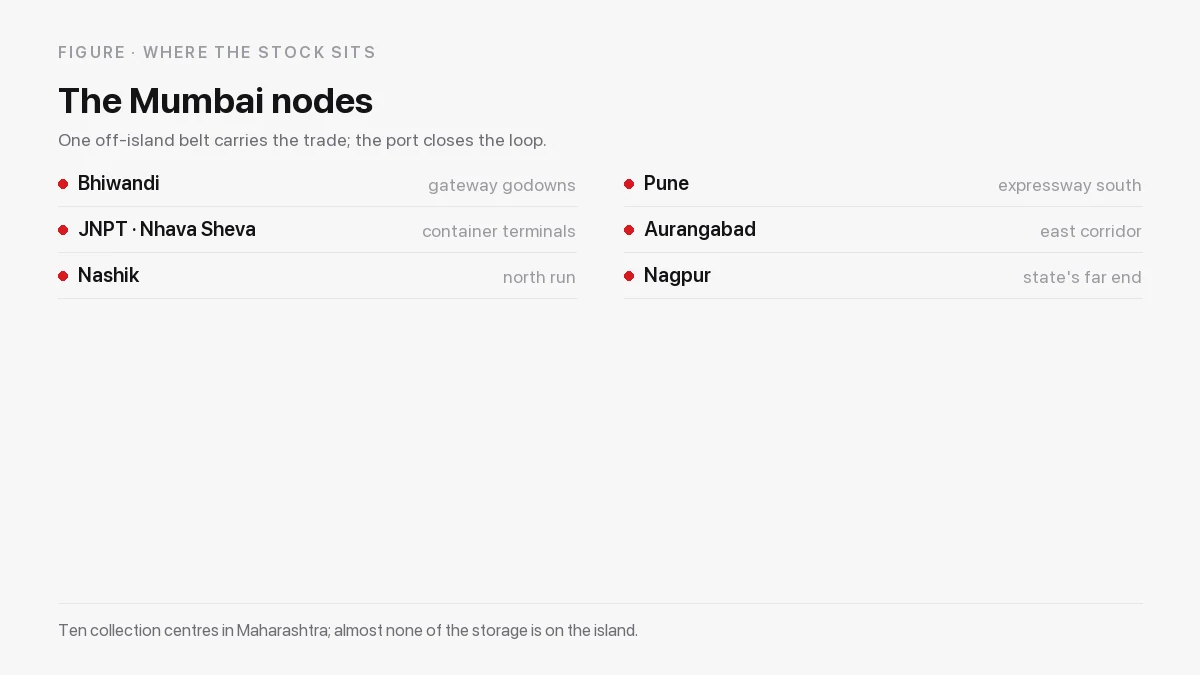
- Maharashtra carries 10 collection centres in Lozy's network, and Bhiwandi, Pune, Nashik, Aurangabad and Nagpur are the places named in that list.
- Warehouse space for rent starts at ₹12 per sq ft per month and business or on-demand space at ₹14 per sq ft per month, while a private self storage unit starts at ₹999 per month — all billed monthly on a GST invoice.
- A peninsula makes land scarce and dear, so this belt prices above the interior of the state, and the southwest monsoon turns damp protection into part of the specification rather than an afterthought.
Why warehousing in Mumbai is a port question before it is a rent question
Storage in this city is a consequence of trade, not of production. Mumbai is a consumption market of several million households and the gateway for a large share of India's containerised imports, and both facts point at the same building type: space that can hold goods cheaply while they wait for a vessel, a customs decision or a buyer. That is why the storage carrying the city's name rarely stands inside it.
The island is where the customers, the brokers and the consignees are. The floor plates are behind it, in the sheds of Bhiwandi and along the corridor north of Thane, and the network serving this market runs from the Mumbai location page through the state's ten-centre coverage on the Maharashtra page. Once the "where" question is answered as off-island, everything left is about the port, the road and the weather.
The island keeps the light end; the belt keeps the tonnage
Anyone who has hunted for space inside the city has met the same wall: there is almost no industrial land left, and what remains is priced against the residential towers around it. The old port estate at Indira Docks moves cargo rather than storing it, and the godown pockets that survived redevelopment now compete with builders instead of with other warehouse operators. A small unit in one of them is not really a warehouse decision any more.
So Mumbai keeps the light end of storage — an office archive, a small unit for a trader whose goods turn over every week, a lockable space for a household between flats — and the palletised tonnage goes out to the belt, where a floor plate costs a fraction of an island address and a trailer can reach the door. That one split explains the shape of almost every storage arrangement in this market, and it is the split the Mumbai locations page is built around.
What JNPT and the CFS network change about the plan
The port is not a single gate but a system, and the warehousing decision follows it. Nhava Sheva, across the harbour in Raigad district, carries the container traffic: the Jawaharlal Nehru Port Authority is India's largest container port and crossed eight million TEUs of throughput in the 2025–26 fiscal year (source: JNPA), with capacity the Union Minister for Ports, Shipping and Waterways has put above ten million TEUs (source: Press Information Bureau). Around the terminals sit the container freight stations, the off-dock yards where a container is de-stuffed, examined and cleared, and those clusters are where an importer's storage plan usually starts.
Practically, that means your goods will sit in more than one place. A container lands, moves to a CFS, clears, and then the cargo needs somewhere to live until it is sold or dispatched. If that somewhere is also on the Bhiwandi side, the cargo makes one leg instead of two, and the saving shows up in drayage and in how fast a buyer's order can be picked. Ask any operator which CFS serves their shed and how long that run takes on a working morning.
Why the same square foot costs more here than in the interior
The belt prices above the interior of Maharashtra, and the reasons are structural rather than seasonal. Land on a narrow peninsula is scarce and still valued against commercial development; industrial parcels on the belt face constant pressure from residential growth; labour and power cost more than they do in the state's smaller cities; and every square foot here carries a proximity premium, because it sits close to a working port and to a market of millions of buyers who need stock within a day.
None of that makes the belt the wrong place to be. It means the comparison should be made honestly: a floor plate in Nagpur or Aurangabad will always quote a lower rate per square foot, and it will also add most of a day to the run when the goods are needed in Andheri tomorrow. The useful question is not which belt is cheapest but which one keeps your stock closest to what decides your revenue — a vessel, a buyer or a dispatch promise.
Who stores what in Mumbai
Four kinds of business fill the sheds on this side of the harbour, and warehousing in Mumbai is the sum of those four decisions rather than one market rate. Each of them is measuring the space against a different problem.
Importers and trading houses clearing through a CFS
This is the largest group and the one the belt was built for. An importer holding duty-paid resale stock wants floor area, a trailer-friendly yard, and a facility that can take a delivery from a container freight station without losing a day at the gate. The stock is bulky, it turns with a shipping calendar rather than with a season, and it often needs sorting and relabelling before it goes out. Say whether the goods are duty-paid before they arrive, because duty-deferred storage is a different licence and a different arrangement, not a discount on the same one.
E-commerce and D2C sellers working to island delivery promises
On the other side of the same floor sit sellers who sell into Mumbai's pin codes and are judged on how fast an order arrives. A brand does not need an island address to serve the island; it needs a compact picking operation, a courier who collects on time, and a returns corner that stays out of the picking aisle. That is the shape of the inventory and stock storage service, where tracked stock and a monthly footprint matter more than the size of the yard.
FMCG, pharma and trade distributors
Distribution adds a third pattern: packaged food, FMCG, pharma and retail stock moving into the city's trade in small, frequent drops. These customers are why the belt runs on so many small vehicles — a distributor reloading a tempo's worth of stock twice a week needs the shed to load quickly, not to be enormous. Racking density, a swept floor and a defined dispatch bay matter more to them than the acreage.
Households and small businesses between addresses
The last group is domestic and easy to underestimate. Mumbai households move between rented flats and family homes, renovate, and hold furniture in the gap, in a city where a spare bedroom is an expensive way to store a sofa. A lockable self storage unit from ₹999 a month answers it, and it sits in the same facility the trade uses rather than in a separate shed on the island.
The three routes that decide where a Mumbai shed sits
Each route out of the city leads somewhere different, and the one your goods travel most often is the one worth being close to.
The Mumbai–Nashik highway and the Bhiwandi belt
The first route runs north-east out of the city. Bhiwandi's godown belt lies on the Mumbai–Nashik highway side of Thane district, near enough to the island for a morning delivery and far enough out to hold a floor plate nobody could rent in town. Lozy's Mumbai unit sits inside that cluster — the Bhiwandi warehouse — and for a trading house it keeps an import flow and a city customer inside one short loop. The state-level picture, including the belts outside this corridor, is on the Maharashtra warehousing guide.
The container road towards Nhava Sheva
The second route leads to the terminals. Any plan built on import or export has to answer how long a container takes from the yard to the port and back, because that leg is billed either way, and the volume at the far end is large, because the terminals behind this shed belong to India's largest container gateway by capacity. A shed a few kilometres nearer that road regularly beats a cheaper one further inland once drayage is counted properly. Around the terminals, and at the inland yards behind them, the National Association of Container Freight Stations represents the CFS operators whose facilities your cargo will pass through.
The expressway south, and the run east to the Deccan
The third route runs south-east on the Mumbai–Pune Expressway and from there into the Deccan. Pune is the production side of the same state network, so a Mumbai trader holding resale stock and a Pune supplier feeding it can work inside one arrangement instead of two contracts, which is the ground the Pune warehousing guide covers. Nashik, Aurangabad and Nagpur are the other centres named in the Maharashtra list, and they are how a Mumbai business reaches the state's northern belt and Vidarbha without opening a warehouse in either market.
The monsoon is a warehouse specification, not a season
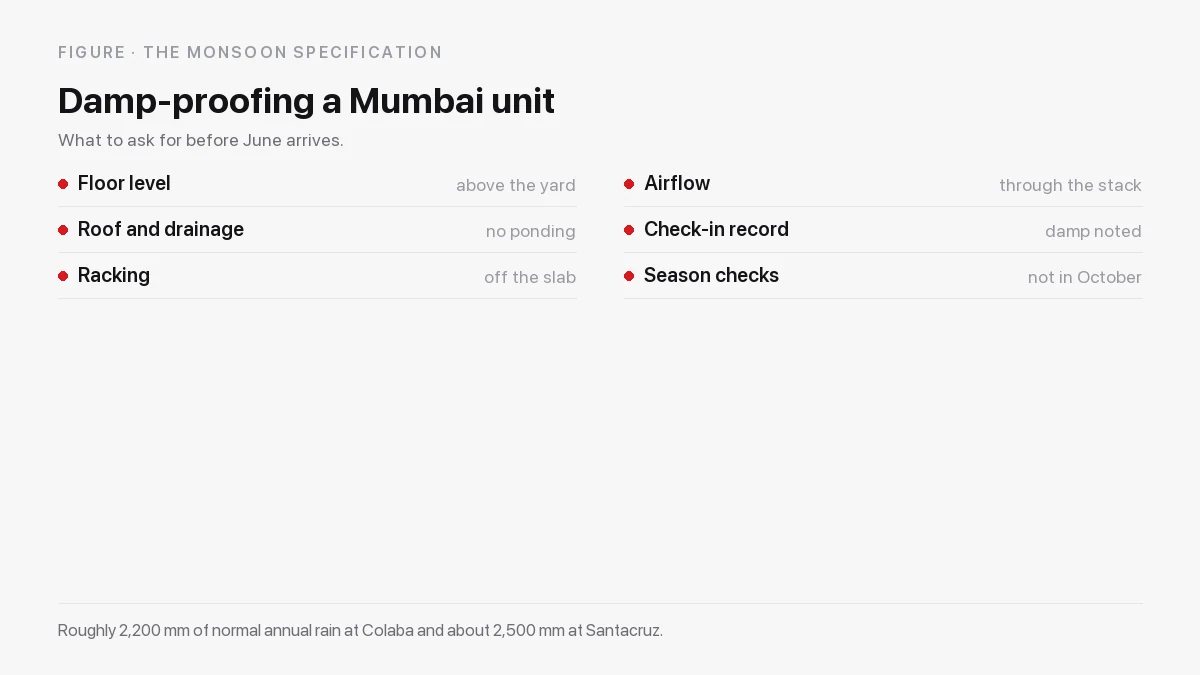
Every storage plan on this coast has to survive June to September. The southwest monsoon brings the bulk of the year's rain in four months, with the city's own records running to roughly 2,200 mm of normal annual rainfall at Colaba and about 2,500 mm at Santacruz (source: India Meteorological Department, Mumbai). For a warehouse that is not a weather curiosity; it is the difference between cartons that leave as they arrived and cartons that leave with a sagging base.
How damp gets into a godown
Water arrives in four ways: through the roof, up from the yard, sideways through the walls, and suspended in the air itself. A shed that leaks shows it in a predictable order — a stain on a carton corner, rust blooming on a steel rack, a smell near a shutter, and a pallet that has taken root on the slab. Humidity does the quiet damage, working on paper and corrugated board, textiles, leather, packaged food, powders and anything with a steel or iron component. None of it announces itself until a customer opens a box.
Damp protection to ask for before the season
Six things, and each should get a straight answer. A plinth or floor level above the surrounding yard, so stormwater runs away from the building rather than into it. A roof and drainage line that can take a heavy spell without ponding. Racking or pallet stands that keep goods a level above the slab instead of directly on it. Airflow through the stack rather than a sealed room. A damp check recorded at check-in against your own list, and repeated after the season. And inspections through the monsoon rather than a conversation in October when the damage is already inside the carton.
A trader who wants the last point in writing should say so at enquiry. Stretch wrap and corner boards on export cartons cost a fraction of a re-pack, and a unit that has already been through two monsoons is easier to judge than one that opened in April. The same logic applies to the vehicle: goods moving in July travel best covered, and counted in at the unit rather than at the origin.
Timing a move around the season
Move in during the last dry weeks before the rain and you get a chance to inspect the building, the racking and the drainage while it is still possible to see the floor. If the requirement lands in July instead, expect the ordinary monsoon handling that this belt does every year — sheeting on the day, a covered vehicle until it is at the door, and a count taken where the goods actually stop. A storage arrangement signed in the monsoon is neither unusual nor a problem; it just has one more line to check.
What warehouse space in Mumbai costs
Two of Lozy's published starting rates apply to business stock in this market, and a third applies to households. Warehouse space for rent starts at ₹12 per sq ft per month, business and on-demand warehousing start at ₹14 per sq ft per month, and a private self storage unit starts at ₹999 per month per unit. All three are billed monthly on a GST invoice with no long lock-in, and all three are starting points rather than quotes for your requirement.
Read them as three products rather than three prices for one thing. A floor or racked area is bought by the square foot, so the area you take becomes the bill. Business and on-demand space is bought with handling and reporting attached, which is why its basis sits above bare floor. A lockable unit is bought by the room, so a small requirement stays a small invoice. Lining these up against each other is how buyers talk themselves into a bad comparison; the warehouse space for rent page sets out the plain floor-space basis, the Mumbai location page shows which of them is bookable on the belt, and the warehouse for rent guide explains how a rent basis gets chosen at all.
How a rate is built on this belt
- Which side of Bhiwandi. A shed with a clean run to the port road and one at the end of a lane that floods are not the same product, and the rent says so before anyone explains it.
- How much floor you take. Area is the biggest single input — a single racked bay and four pallet positions cannot be priced off one line.
- How long you commit. A booking that runs a fortnight and one that runs a year carry different rates per month.
- What the goods need. Racking, damp protection, container handling, packing material and insurance cover all move the figure before GST is added.
| What you are weighing | Monthly storage in Mumbai | A leased godown on the belt |
|---|---|---|
| Commitment | Month to month | Multi-year, usually with an annual escalation |
| Money up front | Nothing beyond the first month's bill | Deposit, racking and fit-out of your own |
| When your volumes move | Add or release footprint inside the same facility | Keep paying for floor you have stopped filling |
| Monsoon handling | Maintenance and damp checks sit with the operator | Roof, drainage and pest control are yours |
| Suits you when | Your flow still moves with the shipping season | Your volume is flat and proven for years |
The Mumbai version of that choice usually comes down to shipping schedules and the festive quarter. An importer whose stock lands in uneven consignments needs floor it can hand back after a season, and a signed lease cannot follow that pattern. A distributor with a steady, proven load can lease and should — while still keeping a flexible slice for the peak, which is what business warehousing is designed for. The business warehousing guide sets out how that middle arrangement runs when a company wants a fixed core and a flexible slice under one operator.
Compliance and paperwork for a Mumbai storage booking
The questions that come up here are the ones that apply across Maharashtra, plus two that only appear when a port is involved.
GST, the invoice and input credit
Storage rent is a taxable supply, and a registered business gets part of it back as input credit provided the document is a proper tax invoice raised in your own entity's name, with the storage and handling lines broken out the way your accountant expects to see them. The rules themselves are published on the GST portal. Rent paid in cash with no invoice looks cheaper on the first of every month and costs more across the year, because none of the tax comes back. If the goods arrive from another state, remember that a consignment above the prescribed value threshold needs an e-way bill generated before it moves.
Who approved the building, and who controls the goods
Industrial land and the estates built on it sit with the Maharashtra Industrial Development Corporation, and categories of goods that carry pollution consent need that consent held by the operator. Put the direct question: which authority approved this building, and can I see the occupancy certificate and the fire clearance? Then ask the second one that only matters near a port — is this an ordinary storage facility or a customs-licensed bonded one? Duty-deferred cargo may only sit in a licensed space, so confirm which of the two you are being offered before the container leaves the terminal.
What the unit will and will not take
Ask about the accepted goods list before signing, not on the day the vehicle is loaded. Flammable and hazardous material, food without the right licence, tobacco and anything strongly odorous are handled differently — sometimes in a dedicated bay, sometimes not at all. On the way in, a photo inventory counted against your own list is what turns a later discrepancy into a short conversation instead of a long one, and if your cargo is moisture-sensitive the damp expectation belongs in that same record.
How to choose a Mumbai warehouse — and the red flags
Here is the test we would want a customer to run against us, applied to whatever the Mumbai locations page is offering this week. It takes an hour and saves a season in the wrong shed.
- Decide what the goods need from the building. Racked or open floor, dry or ventilated, a shared trade floor or a lockable unit only you open.
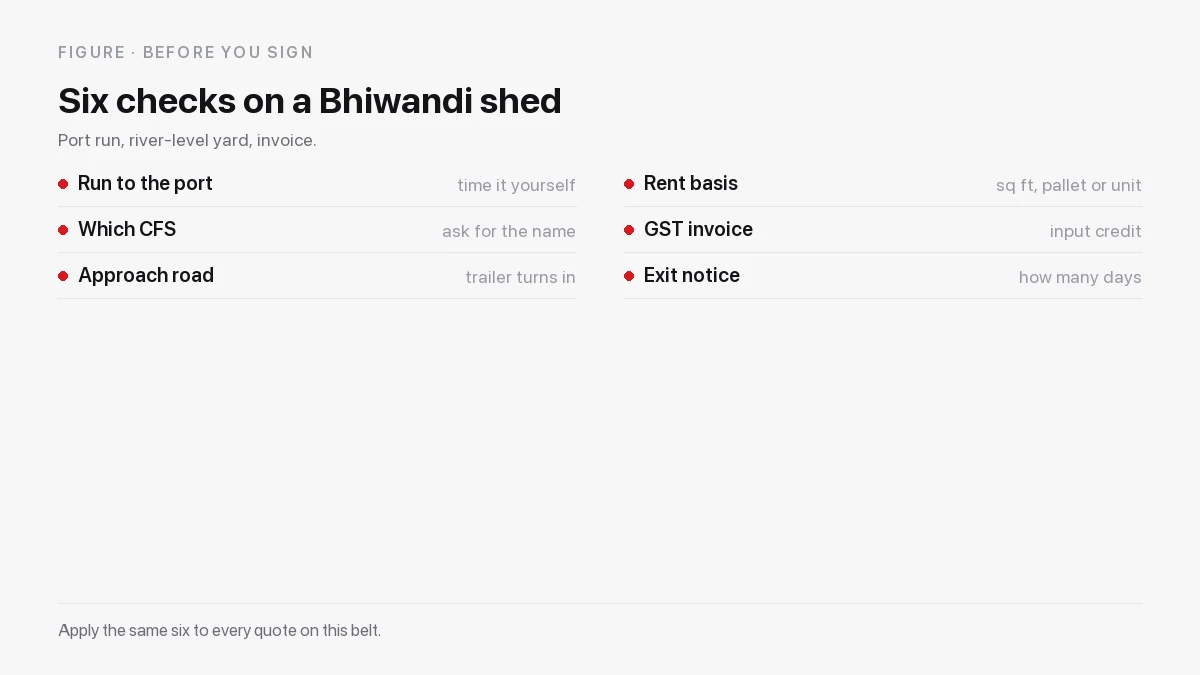
- Time the run to the port, not to the city centre. Measure the trip from the shed to the terminal or the CFS at the hour your vehicles actually leave.
- Judge the yard after rain if you can, and the approach road always. A trailer has to turn and a container needs a level pad; a lane with a height barrier fails whatever the racking inside looks like.
- Write the inclusions down. Racking, pallet trucks, damp checks, pest control, security and housekeeping, listed rather than promised.
- Fix the rent basis and the exit. Priced per square foot, per pallet or per unit, and how much notice you must give before leaving.
- Look at the invoice before the rate. GST treatment does not change because the business is small.
- Test the reporting and the monsoon plan. Ask what you will be sent after check-in, and what happens to your stock in the third week of July.
The warning signs on this belt arrive in a recognisable order. A rate quoted without saying whether the tax is inside it. A shed priced well under the going rate for its position, with no reason offered. A yard you cannot imagine a container trailer reversing into. Building paperwork that nobody can put on the table. A monthly figure that turns out to carry an annual minimum in the small print. And a facility that will not name the bay your goods will sit in until your vehicle is waiting at the gate.
A worked example: an importer's CFS-to-warehouse flow
A trading house importing homeware and small appliances was clearing containers through a container freight station and then paying for city storage by the pallet. The arrangement had two faults: the goods were handled twice before reaching a buyer, and the city space could not take a delivery from a container without shutting its own dispatch for half a day.
The requirement that emerged was roughly 2,500 sq ft of racked area with a trailer-friendly yard and a dock that could take a de-stuffed load without a queue, within a short run of the port road. The workable answer was a racked bay at the Bhiwandi facility: cartons on racking instead of on the floor, pallet positions counted at check-in against the importer's own list, and one leg removed from every container.
Two thousand five hundred square feet against the published starting rate lands at about ₹30,000 for the month. Treat that as indicative only — the final figure follows the unit, the term and the handling you add — but it makes the point: what the importer bought back was a day per consignment and a handling charge on every pallet.
How Lozy helps in Mumbai
Lozy runs 77+ warehouses and more than a million square feet of live space, and the Mumbai booking sits at the Bhiwandi unit inside a ten-centre Maharashtra network that also names Pune, Nashik, Aurangabad and Nagpur. Each booking holds a defined racked or floor area, with 24/7 CCTV coverage, guards on site and PIN entry to the gate, the lifts and the storage area itself.
Billing is monthly on a GST invoice with no long lock-in, free doorstep pickup is included on bookings of 30 days or more, and the space can be scaled up or down inside the same facility as your flow changes. Because the state network runs on one arrangement, a booking made here can collect at Nashik, Aurangabad or Nagpur without a second contract. Everything the company operates is set out on the services page, and the ten-centre coverage is described on the Maharashtra location page.
To look before you decide, the warehouse listing shows what is free on the belt today, and the team will price a requirement once it knows the size and the date you need it. The locations hub covers the rest of the network if your goods move beyond this state.
Also in Delhi NCR
A Mumbai importer selling into the north usually ends up holding stock at both ends of the run, and the northern half of that decision is already written down. The guide to warehousing in New Delhi covers the capital as a consumption market and the paperwork of storing inside it; the Gurgaon guide covers the industrial belt where most northern distribution sits; and the Haryana guide sets out the state around both. Read together they are one answer: port-side stock here, customer-side stock there.

Need warehouse space in Mumbai?
Tell us the city and the size you need — we reply with a rate and the options available now.
Get a quoteCall +91 93547 12345About the author
Lozy Editorial Desk. This guide was written by the Lozy Editorial Desk, the in-house team that covers warehousing, self storage, logistics and customs/EXIM topics for lozy.in. We write from Lozy's own facility and pricing information and from public, citable sources. We do not publish invented statistics, ratings or reviews.
Sources. Pricing, the facility name and the collection-centre list are Lozy's own. Port throughput and capacity context comes from the Jawaharlal Nehru Port Authority and the Press Information Bureau; the description of dry-port clearing comes from the National Association of Container Freight Stations; rainfall normals and the monsoon season come from the India Meteorological Department's Mumbai records; industrial-land context from the Maharashtra Industrial Development Corporation; state economic context from IBEF's Maharashtra profile; and GST registration and input credit from the GST portal, linked above. If you want to read more before you call, the guides to warehousing in Maharashtra and warehousing in Pune cover the state and its production belt, and the Lozy blog covers the rest in the same plain style as this post, including Warehousing Development and Regulatory Authority industry material on how organised warehousing is run.
Last updated: 13 October 2026. Have a question the FAQ below does not answer? Call +91 93547 12345 or email care@lozy.in.
Need warehousing or storage in India?
Request a free, tailored quote in under 2 minutes — free pickup, no lock-in.






