
Warehousing in Pune: A City Guide to Manufacturing Stock and Space
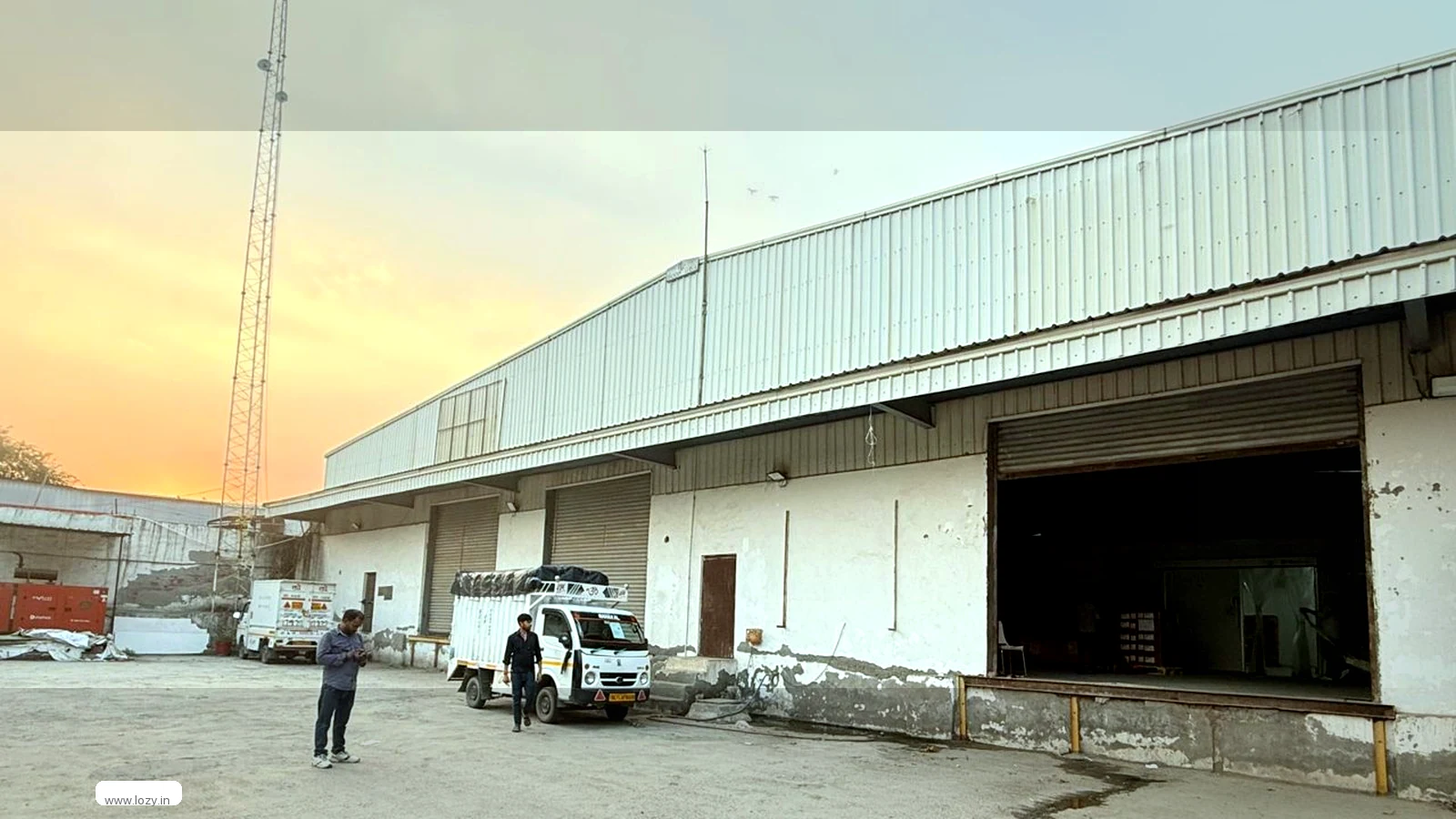
Short answer: warehousing in Pune serves two very different sets of customers, and the city's own unit is built around the larger one. The Pune godown carries 40,000 sq ft of rack, pallet and bulk-floor space sized for manufacturers, component suppliers and dispatch-ready inventory — the stock an engineering economy generates — while sellers, offices and households inside the city book smaller monitored units on the same monthly terms. Pune also anchors the southern end of a ten-centre Maharashtra network that names Mumbai, Bhiwandi, Nashik, Aurangabad and Nagpur, so stock moves between the state's logistics hubs on one arrangement.
Key takeaways
- Pune is the production-side node of the network: raw material, component inventory and dispatch stock, held in a unit of roughly 40,000 sq ft of godown and warehouse space.
- Maharashtra carries 10 collection centres, and Pune, Mumbai, Bhiwandi, Nashik, Aurangabad and Nagpur are the places named in that list — a Pune booking can pick up from any of them.
- Warehouse and godown space for rent starts at ₹12 per sq ft per month, and business or on-demand warehousing starts at ₹14 per sq ft per month, both billed monthly on a GST invoice with no lock-in.
- An e-commerce fulfilment plan starts at ₹4,999 per month, which is the option when you want pick, pack and dispatch rather than bare floor behind a shutter.
Why warehousing in Pune is two markets sharing one city
Pune's storage demand does not come from one industry and it does not sit in one place. Half of it is industrial: the manufacturing belt that rings the city generates raw material arriving in batches, components held between processes and finished goods waiting for a dispatch cycle. The other half is urban, and it is made of the sellers, professional firms and families who need a monitored, invoice-backed unit close to where they already work and live. Lozy's Pune unit is aimed squarely at the first group, and the monthly terms are what make the second group possible at all, because a small requirement is bookable without a warehouse minimum.
That split is the reason the same page offers godown space by the thousand square feet and a private unit for one household's furniture. The unit, the terms and the addresses behind both are on the Pune location page, and the wider state picture sits on the Maharashtra location page.
What the production side of Pune actually needs
The requirement that walks in from a component or engineering supplier is remarkably consistent. Inbound raw material has to be received against a count, staged somewhere it will not block the shop floor, and released in the sequence production asks for it. Outbound, the finished batch needs to be assembled, labelled and loaded without a scramble. What that buyer wants from a building is unglamorous: racking dense enough to justify the rent, a floor that takes a pallet truck, truck access that does not require reversing blind, and a check-in record that matches their own stock sheet. The bulk and industrial warehousing service is the shape that fits.
What the city side of Pune needs instead
A seller running a catalogue from a flat does not need a godown; it needs shelving, a packing bench and somewhere to park returns, which is a fraction of what an industrial unit implies. A professional firm needs its archive boxes and unused furniture out of a commercial building where every square foot is billed at office rates. A household between two addresses needs a lockable unit and a month-to-month bill. All three are the same product at different sizes, which is why a Pune booking can be a single pallet position or a full bay and neither customer is subsidising the other. Small units of exactly this kind are on the Pune business warehousing side.
Why a Pune unit is not a Mumbai unit
Maharashtra's two big storage markets pull in opposite directions. Mumbai's demand is trader- and import-led, and the state's godown cluster at Bhiwandi grew up around consolidation for that flow. Pune's demand is production-led: stock here turns with a build schedule, not with a vessel, and the goods held are parts and packaging rather than containers of resale stock. If your inventory answers to a factory, a Pune unit keeps you near the line that generates it; if it answers to a port, Bhiwandi is the better address. Both sit inside the same ten-centre state network, so the decision is about which end of the run your goods live at, not about which operator you sign with.
Who stores what in Pune
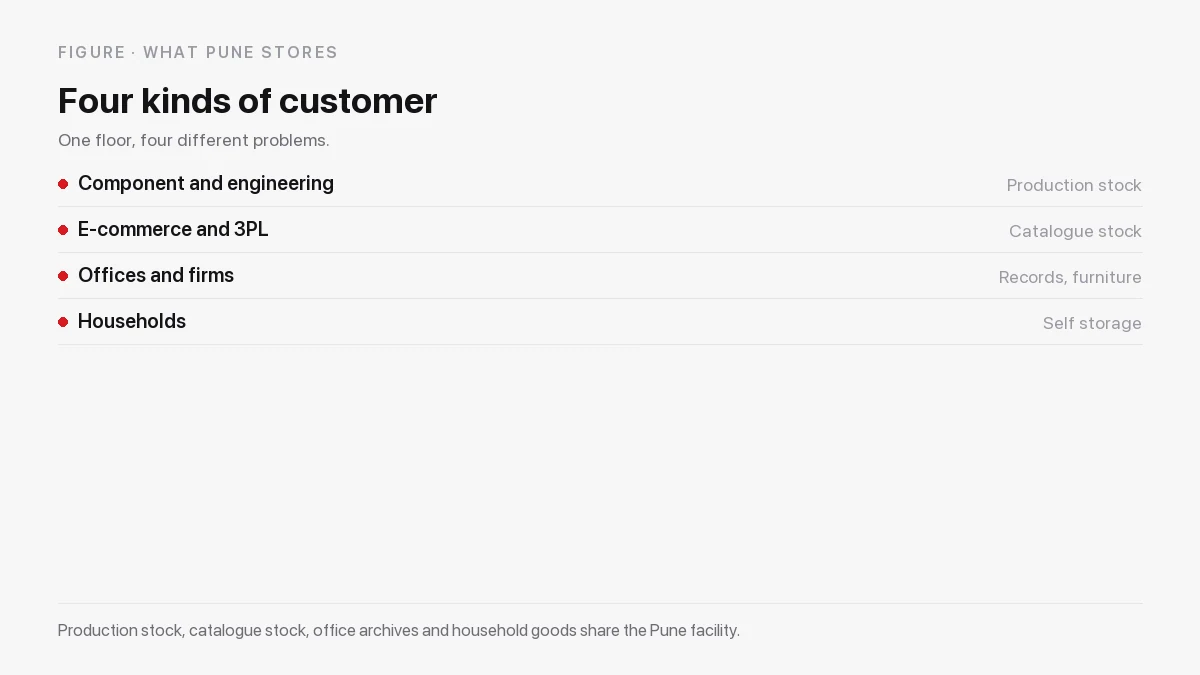
Four customer types fill the floor here, and each of them is measuring the space against a different problem.
Component and engineering suppliers
This is the largest group. Packaging material, spares and staged components arrive in lots, sit while the production calendar catches up with them, and leave again as a dispatch batch. Their storage swings with a customer's build schedule rather than with a season, which is precisely why a monthly footprint beats a lease: a supplier can take the extra rack positions the month a large order lands and hand them back when it ships. Racking density matters more to these customers than the finish on the office wall, and a documented check-in is what keeps a stock query from turning into an argument.
E-commerce sellers and 3PL operators
Fulfilment is the second group, and it arrives as a catalogue rather than as pallets. Pick, pack and dispatch for a seller with a few hundred SKUs is a compact operation: shelving, a bench, packing material, a returns corner and a courier who collects on time. The reason sellers here care about the billing model is volume variance — an order surge in one month and a quiet one in the next, with rent that follows the space used rather than a lease that ignores it. That is what the e-commerce warehousing plan is for, and 3PL operators run the same floor for their own client list.
Offices, clinics and professional firms
Pune's service economy generates a storage requirement that is easy to overlook: old files, archived records, spare furniture, event material and the overflow that a growing office has nowhere to keep. A paid room in a commercial building is the expensive way to solve it; a monitored unit with a GST invoice in the firm's name is the cheaper one, and it keeps the archive retrievable instead of stacked behind a reception desk. Firms usually start with one unit, discover how much floor they were wasting, and keep it.
Households between two addresses
The remainder is domestic. People arrive in Pune for a posting, leave again, or move across the city within a year, and their furniture, appliances, wardrobes and seasonal goods need to sit somewhere dust-free and monitored in between. These customers want a lockable unit they can walk into, trolleys that are free to use, PIN access and a bill that runs month to month. Self storage is that product, and it sits in the same Pune facility rather than in a separate building — the Pune page shows both sides of one address.
The Maharashtra route Pune stock moves along
Pune is one node in a state network of ten collection centres, and the places named in it — Mumbai, Bhiwandi, Nashik, Aurangabad and Nagpur among them — decide how far your goods can travel on a single arrangement. Knowing which node your stock actually needs is more useful than knowing how many there are.
Pune to Mumbai and the Bhiwandi godown
Anything moving towards the coast, an importer or a Mumbai buyer passes through the state's western cluster, where Bhiwandi's godowns handle the consolidation work. Holding stock in Pune until the order is confirmed and only then routing it west is usually cheaper than renting a second unit in the cluster, because the pickup network does the leg your own vehicle would otherwise do. Buyers who need a standing presence on both sides usually add it once the volume proves it — and Bhiwandi units, like Pune's, are bookable inside the same state network.
Nashik and the northern run
Nashik is a named centre on the same list, which matters for stock that goes north rather than west. Distributors running Maharashtra's northern belt often keep the Pune unit as the holding point and let the pickup network carry consignments up through Nashik instead of sending a truck from Pune for a part load. For a supplier shipping to multiple towns on one corridor, that pattern keeps the heavy, slow-moving stock where the production is and only moves what has already been sold.
Aurangabad and Nagpur at the far ends
Aurangabad and Nagpur sit at the two ends of a long state, and both are named centres, so a Pune business with customers in either market does not need a warehouse contract of its own to reach them. In practice this is how a Pune supplier serves a customer in Nagpur without a stock transfer that ties up capital for weeks: the goods leave Pune, the network carries them, and the buyer collects at the nearest centre. The same logic holds on every other corridor out of the city.
What warehouse space in Pune costs
Three of Lozy's published starting rates apply to this market. Warehouse and godown space for rent starts at ₹12 per sq ft per month, business and on-demand warehousing start at ₹14 per sq ft per month, and an e-commerce fulfilment plan starts at ₹4,999 per month. Every one of them is billed monthly on a GST invoice with no long lock-in, and each is a starting point rather than a quote for your requirement.
What moves the number in Pune specifically is the type of building your goods need. A racked bay on the industrial floor prices off floor area, so the basis for it sits on the Pune industrial warehousing page; a compact unit for one firm's archive prices off the unit; and a requirement that changes size every month is bookable as Pune on-demand space. None of those three are the same product, so comparing their headline rates against each other tells you very little. The published bench for the plain floor-space version is on the warehouse space for rent page, and the Pune unit's own size and options are listed on the Pune location page.
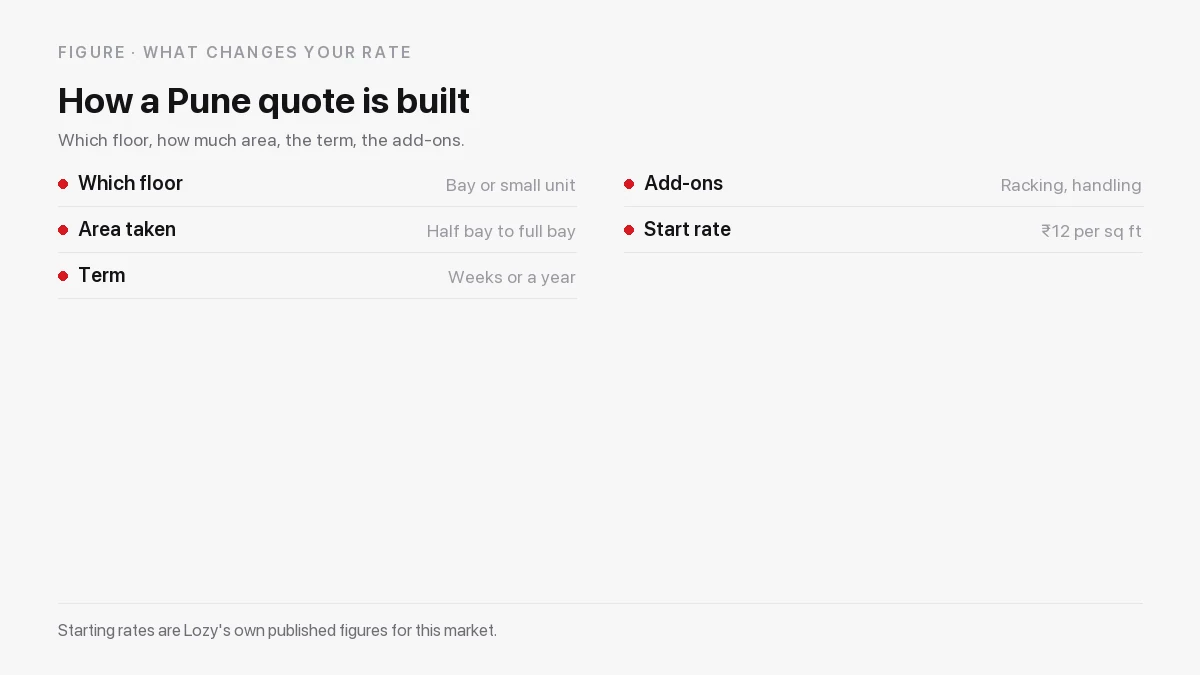
How a Pune rate is actually built
- Which floor you take. A racked bay on the industrial side and a small enclosed unit in the same facility are different products with different rents, even though the address is identical.
- How much area. Floor space is the largest single input — four pallet positions and half a bay cannot be priced off one line.
- How long you commit. A booking that runs for a few weeks and an arrangement that runs for a year carry different rates per month.
- What you add. Racking, pallet handling, climate control, packing material and insurance cover all move the figure before GST is applied.
| What you are weighing up | Monthly storage in Pune | A leased godown in Pune |
|---|---|---|
| Commitment | Month to month | Multi-year, usually with an annual escalation |
| Up-front money | Nothing beyond the first month's bill | Deposit, fit-out and racking of your own |
| When your volumes move | Add or drop footprint inside the same facility | Keep paying for floor you have stopped filling |
| Building upkeep | Security, housekeeping and pest control included | Yours to arrange, staff and pay for |
| Suits you when | Your requirement is still moving | Your requirement is flat and proven |
The Pune version of that choice comes down to production cycles more often than to a festive peak. A supplier whose customer doubles a build schedule for a quarter needs floor it can hand back afterwards, and a signed lease cannot follow that pattern. A manufacturer with a steady, proven load can lease and should — while still keeping a flexible slice for the swing, which is what business warehousing is designed for. The business warehousing guide works through that middle path in detail.
Compliance and paperwork for a Pune godown
The paperwork questions that come up in Pune are the same ones that apply across Maharashtra, and each of them is cheaper to settle before the first truck arrives than after it.
GST on storage rent in Maharashtra
Storage rent carries GST, and a registered business can claim input credit when the invoice is raised properly: your entity's name, a tax invoice rather than a receipt, and the storage and handling lines described the way your accountant needs them. The registration and credit rules themselves are published on the GST portal, and what qualifies for credit depends on how the tax invoice is raised rather than on the size of the business. Rent paid in cash with no invoice looks cheaper on the first of every month and costs more across a year, because none of the tax comes back to you.
Who approved the building
Maharashtra's industrial land and the estates built on it sit with the Maharashtra Industrial Development Corporation, and consent requirements for certain categories of goods run through the Maharashtra Pollution Control Board. The plain question to put to any operator is which authority approved the building and whether you can see the occupancy certificate and the fire clearance. An operator who has both to hand answers in a minute; one who does not is telling you something about the rest of the arrangement.
What the unit will and will not take
Ask about the accepted goods list before you sign, not on the day the truck is loaded. Flammable and hazardous material, food without the right licence and anything strongly odorous are handled differently — sometimes in a dedicated bay, sometimes not at all. On the way in, a photo inventory and a check-in list counted against your own sheet is what turns a later discrepancy into a short conversation instead of a long one.
How to choose a Pune warehouse — and the red flags
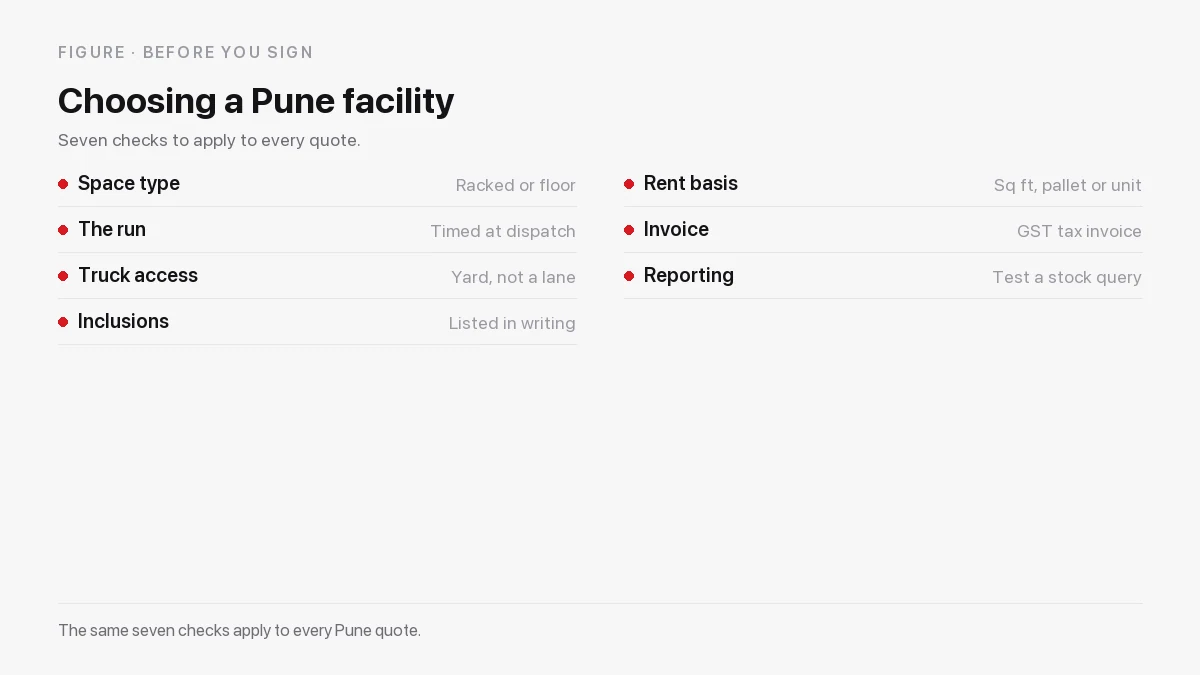
This is the checklist we would want a customer to run against us. An hour of it saves months of rent paid on the wrong unit.
- Decide which floor the goods want. Racked or open, dry or climate-controlled, a shared industrial floor or a locked unit you alone open.
- Drive the run, not the map. Time it from the unit to the factory gate or the main customer area at the hour you actually dispatch.
- Check how a truck gets in. A yard a trailer can turn in beats an approach lane with a height barrier, whatever the racking inside looks like.
- Get the inclusions in writing. Racking, trolleys, pallet trucks, security, housekeeping and pest control, listed rather than assumed.
- Nail down the rent basis and the exit. Priced per square foot, per pallet or per unit — and how much notice you must give before leaving.
- Read the invoice. A business of any size is entitled to a GST invoice, and the credit treatment does not change because you are small.
- Test the reporting. Ask what the facility will send you after check-in, and how a stock query is answered on a normal working day.
Red flags appear in a recognisable order: a quote that will not say whether GST is included; a yard you cannot picture a container trailer reversing into; an operator who cannot produce an occupancy or fire clearance; a "monthly" rate that turns out to carry a yearly minimum hidden in the terms; and a facility that cannot tell you which unit your goods will sit in until you arrive with the vehicle.
A worked example: a component supplier's buffer stock
A Pune engineering supplier was holding about 900 cartons of spares and packaging material in the corner of its own shop floor. The stock was not large, but it was in the way of everything: it blocked a loading position, it slowed every dispatch, and there was nowhere to put the buffer for the next order while the current one was still being picked.
What the supplier needed was about 1,500 sq ft of racked space with room for a working aisle, reachable from the plant in a few minutes so a shortage could be fetched the same day it was noticed. The workable answer was a racked bay at the Pune godown: cartons on racking instead of on the floor, pallet positions counted at check-in against the supplier's own list, and the buffer held a few kilometres from the plant instead of inside it.
On the published starting rate of ₹14 per sq ft per month, 1,500 sq ft works out to roughly ₹21,000 a month. Treat that as indicative only — the final figure follows the unit, the term and what is added to it — but it makes the point of the exercise: what the supplier actually bought back was the loading position it could not recreate any other way.
How Lozy helps in Pune
Lozy runs 77+ warehouses and more than one million square feet of live space, and the Pune facility holds 40,000 sq ft of godown and storage space with rack, pallet and bulk-floor options for manufacturers, suppliers and e-commerce sellers. Every unit comes with a defined racked or floor area, 24/7 CCTV, on-site security and PIN access to gates, lifts and your own storage area.
Billing is monthly on a GST invoice with no long lock-in, free doorstep pickup is included on bookings of 30 days or more, and the space can be scaled up or down inside the same facility as a requirement changes. Pune also sits on the ten-centre Maharashtra network, so a booking made here can collect from Mumbai, Bhiwandi, Nashik, Aurangabad or Nagpur without a second agreement. Everything the company offers is set out on the services page, and the Pune page lists the unit's size alongside the services bookable here.
If you would rather see the space first, browse the warehouse listing for what is available now, or talk to the team with the size and the timeline you have in mind. If your goods move beyond Maharashtra, the locations hub covers the rest of the network.
Also in Delhi NCR
Pune and Delhi NCR sit at opposite ends of a lot of supply chains, and a supplier serving both usually runs them as one arrangement rather than two. If your Pune stock feeds customers in the north, the Gurgaon guide covers the industrial belt on that side, and the older Gurgaon rent guide sets out how rates there are built. The two markets price differently because one answers to a factory and the other to a delivery promise.

Need warehouse space in Pune?
Tell us the city and the size you need — we reply with a rate and the options available now.
Get a quoteCall +91 93547 12345About the author
Lozy Editorial Desk. This guide was written by the Lozy Editorial Desk, the in-house team that covers warehousing, self storage, logistics and customs/EXIM topics for lozy.in. We write from Lozy's own facility and pricing information and from public, citable sources. We do not publish invented statistics, ratings or reviews.
Sources. Facility sizes, prices and coverage are Lozy's own. Industrial-estate and state clearance context comes from the Maharashtra Industrial Development Corporation, with the Maharashtra economic profile from IBEF and highway context from the National Highways Authority of India. Industry context comes from the Warehousing Development and Regulatory Authority, and policy releases from the Press Information Bureau. GST registration and input credit are described from the GST portal, linked above. If you want to read more before you call, the guides to warehousing in Mumbai, warehousing in Maharashtra, Bengaluru and Hyderabad cover the same ground for their markets, and the warehouse for rent guide explains how a rent basis is chosen.
Last updated: 13 October 2026. Have a question the FAQ below does not answer? Call +91 93547 12345 or email care@lozy.in.
Need warehousing or storage in India?
Request a free, tailored quote in under 2 minutes — free pickup, no lock-in.






