
Warehousing in Punjab: The Ludhiana Belt, Zirakpur and Costs
Short answer: warehousing in Punjab is decided by which end of the Delhi–Amritsar corridor your goods live at, not by the state boundary. Ludhiana is the volume address — knitwear and hosiery, bicycle and auto components, and the workshops that feed both — while Zirakpur does the work of a Chandigarh-adjacent distribution node. Lozy lists 3 collection centres in Punjab, at Chandigarh, Ludhiana and Zirakpur, inside a network of 77+ warehouses and more than a million square feet of live space. This guide covers what the state stores, the roads goods travel, what space costs and how to pick a unit that will not cost you a second move.
Key takeaways
- Punjab carries 3 collection centres in Lozy's network — Chandigarh, Ludhiana and Zirakpur — and stock can be picked up at any of them and moved into the nearest warehouse.
- Ludhiana, not the capital region, is where most of the state's storage demand originates: the knitwear and hosiery trade and the cycle and auto-component industry share the same belt.
- Warehouse and godown space for rent starts at ₹12 per sq ft per month, business warehousing at ₹14 per sq ft per month, and household or furniture storage at ₹1,499 per month, billed monthly on a GST invoice.
- The second, quieter demand pool is the NRI household: families who keep a house in Punjab and need furniture, appliances and personal effects held safely between visits.
Why warehousing in Punjab follows Ludhiana rather than the capital
Most northern states organise their warehousing around the capital region, because that is where the buyers are. Punjab does not. The state's industrial weight sits in the middle of the Delhi–Amritsar corridor at Ludhiana, and the goods that need holding — cartons of knitwear, yarn, bicycle and auto components, machine spares — are manufactured there rather than near Chandigarh. A unit placed in the Ludhiana belt is therefore close to both ends of the transaction: the factory that makes the stock and the transport trade that moves it.
Chandigarh still matters, but for a different reason. It supplies the customer base — institutional buyers, retailers, offices, households — that wants space within a short drive of the city, and Zirakpur sits on that boundary, on the Chandigarh–Delhi road, where a floor can serve Chandigarh, Mohali and Panchkula customers without paying Chandigarh rents. That is the whole reason Zirakpur exists as a storage address rather than as a manufacturing one.
The practical consequence for a buyer is that two questions settle most of the decision before price is discussed. First, which end of the corridor does your stock live at? Second, how often does a truck or a van actually leave? Everything else — the racking, the yard, the billing — is a detail on top of those two answers. The units available in the state are listed on the Punjab location page, and the wider network picture sits on the locations hub.
Ludhiana: two industries sharing one storage belt
Ludhiana is where two unrelated industries ended up in the same city. The knitwear and hosiery trade gives the state its seasonal rhythm: a build-up of finished winter stock from early autumn, yarn and packaging coming in ahead of it, and the returns and carry-over stock that appear after the season closes. The bicycle and auto-component industry runs on a different clock entirely — steadier, heavier, and demanding floor space that can take steel and cartoned parts rather than hanging garments.
For a storage unit that means the two users want different buildings. Knitwear wants clean, dry, dust-controlled space where cartons can be stacked and rotated by style and size, with enough pickable frontage to pull a specific design out without unloading a stack. Component manufacturers want a high-load floor, a wide enough door for a loaded tempo, and a yard where a truck can turn. One operator can serve both, but not in the same bay, and a landlord who quotes one rate for "warehouse space" without asking which of the two you are is a landlord who has not understood the question.
Zirakpur: the distribution address on the Chandigarh side
Zirakpur earns its place because of geography rather than industry. Sitting where the Chandigarh boundary meets the road south towards Delhi, it lets a distributor hold stock for Chandigarh, Panchkula and Mohali from one floor and still dispatch towards Ludhiana or the state line on the same morning. For a brand that sells into the Tricity through retailers, a floor here turns three delivery runs into two and removes a cross-city trip from every order.
It is also the natural place for a business that keeps inventory for both a Punjab customer base and a north Indian distributor network. The trade-off is the usual one for a boundary location: land and rent are driven up by proximity to the city, so the space you get per rupee is smaller than it would be twenty kilometres west. Choose it for delivery speed, not for bulk.
What that means when you start looking
A hosiery or knitwear seller with an office in Ludhiana should be looking at the Ludhiana belt, because moving stock twice to save a few rupees on rent costs more than the saving. A components manufacturer shipping on a schedule wants a yard and a loading dock rather than a smart facade. A retailer serving the Tricity wants Zirakpur or the Chandigarh side. And a family storing household goods does not need any of it — a dry, secure, individually locked unit is the right product, and the details of that are on the household warehousing page.
Who stores what in Punjab
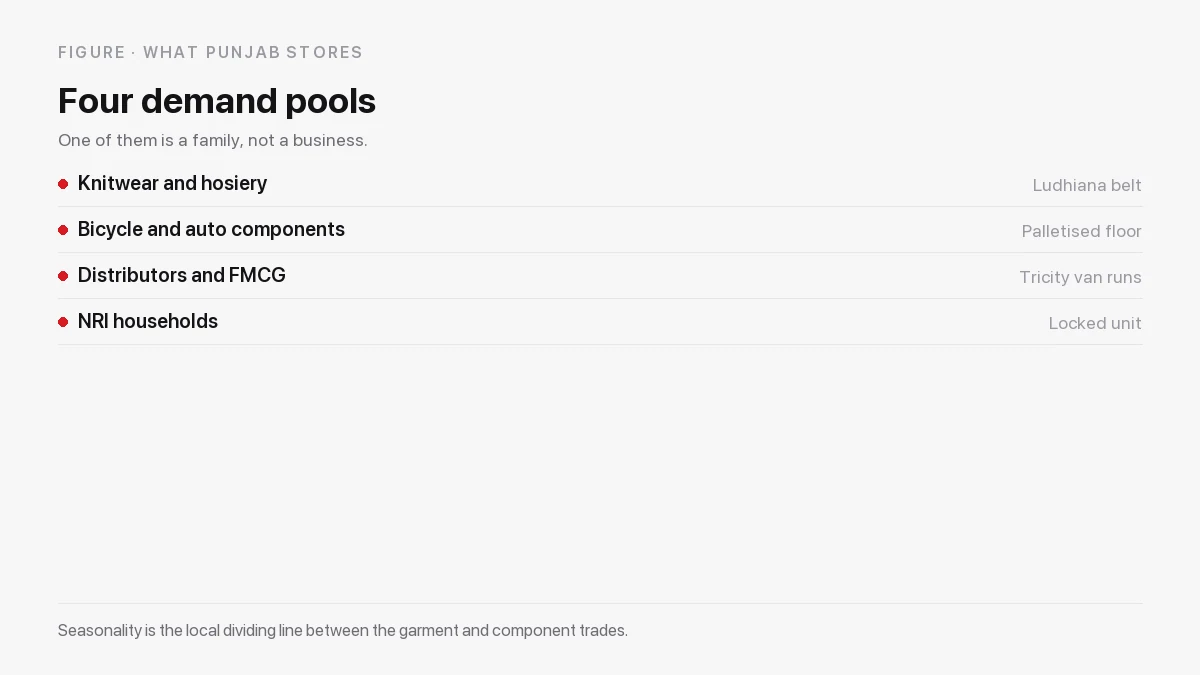
Four groups occupy most of the square feet in the state, and like everywhere else they do not want the same building. What makes Punjab different is the weight of the first two.
Knitwear, hosiery and apparel
Finished knitwear is a seasonal product, which is what makes storage here a timing decision as much as a space decision. Stock is built up ahead of the winter season, held through it, and then either sold through or carried over, and a business that has nowhere to put the build-up ends up renting expensive short-notice space at exactly the moment everyone else is looking for it. Holding the pre-season stock in a racked floor with a style-wise layout means a dispatch order can be picked the same day instead of the week after.
Cartons of knitwear also punish a bad building more than people expect. A damp floor or a leaking roof is not an inconvenience in this trade, it is written-off stock, so the condition of the shed, the height of the pallets off the floor and the airflow matter more than the paint.
Bicycle, auto components and light engineering
The component side of Ludhiana stores differently: heavier unit loads, steel and machined parts, packaging material in volume, and spares held against a service network. These goods want a solid floor, palletised storage rather than shelving, and an approach that a loaded truck can use without reversing down a lane. Component manufacturers also tend to hold consignment stock for their own customers, which makes accurate in-and-out records worth more than the cheapest rate per square foot — the details of tracked stock are set out on the inventory warehousing page.
Distributors, FMCG and retail trade
Punjab has a dense retail market across its towns and a distributor network that pushes stock into it, and that trade wants wide bays, easy pallet access and a gate a delivery van can clear without waiting. Fast-moving consumer goods also carry expiry dates, so rotation is a storage requirement in its own right: a facility that cannot tell you where the older batch sits will quietly cost you write-offs. Businesses in this category also tend to buy the managed version of a floor rather than a bare shed, which is what business warehousing covers.
NRI families and household goods
The pool that outsiders miss is the household one. Punjab has a large diaspora, and a family that keeps a house in Ludhiana, Jalandhar or the Chandigarh belt but lives abroad has a recurring storage problem: furniture, appliances, bedding, kitchenware and personal effects that cannot travel with them but must not be given away, often while a house is locked, let out or rebuilt. Household and furniture storage from ₹1,499 per month suits exactly that requirement — a locked unit, a documented inventory, and a set of access rules that let a relative or an authorised person collect something while the family is away.
The corridors goods move along
Punjab's storage geography is drawn by one road and two junctions on it. The road is NH-44, the old Grand Trunk Road, running from Amritsar through Jalandhar and Ludhiana to Ambala and on to Delhi. The junctions are Ludhiana's industrial belt and the Zirakpur–Chandigarh cluster. Where your unit sits on that line decides your transport bill far more than the finish of the building does.
NH-44: the Amritsar–Delhi spine
Almost every commercial movement in the state touches this road. A unit with a short, clean on-ramp to NH-44 can send a load south to Delhi overnight or west towards Jalandhar and Amritsar the same morning, and that flexibility is worth more to a distributor than a cheaper shed five kilometres inside a town with a narrow approach. When two units are quoted at similar rates, the one with the shorter run to the highway is normally the better buy, and the highway network's own context is published by the National Highways Authority of India.
Ludhiana's export traffic and the container terminal
The state's export cargo concentrates at the inland container depot at Ludhiana, which is why a good deal of the demand for storage there is tied to export schedules rather than to retail distribution. A knitwear or component exporter holding a consignment for a shipping date needs a floor that can be packed, marked and released against a customs timeline, and needs the paperwork to line up with the goods on the floor. Units on that side of the city serve exporters and domestic distributors at the same time, which is part of why the belt stays fully let.
Zirakpur and the Chandigarh boundary
Coming from the south, Zirakpur is the first Punjab address a Delhi truck reaches, and that position is its whole value. Stock landed here can serve the Tricity the next morning without another long run, and a business that needs to show customers in Chandigarh a physical inventory keeps it close rather than in a distant shed. The trade-off, as always on a city boundary, is rent per square foot. The units sitting on that boundary are listed on the Punjab location page.
Where the Delhi NCR handover happens
For a Punjab trader selling into the National Capital Region, the sensible arrangement is almost never to serve Delhi from Ludhiana on every order. Stock is held in Punjab for the Punjab market and a second floor is taken in NCR for the Delhi market, with a single bulk movement between them instead of a van run per order. The guides to warehousing in Haryana cover the corridor towns that sit between the two states, and warehousing in Uttarakhand covers the hill-state market that Punjab suppliers often reach through the same road network.
What warehouse space in Punjab costs
Three of Lozy's published starting rates apply to this market, and between them they cover almost everything a Punjab buyer actually asks for. Godown and warehouse floor for rent in Punjab is published from ₹12 per square foot a month. Business warehousing — the managed version of a floor, with security, housekeeping and the operational side handled — starts at ₹14 per sq ft per month. Household and furniture storage starts at ₹1,499 per month for a unit, which is the product an NRI family or a shifting household wants. Each of the three runs month by month on a GST invoice, with nothing locked in beyond the month you book.
Read these as starting points rather than quotes for your own requirement: what you actually pay follows the unit, the floor area, how long you commit and what the goods require. A high-load floor with a dock and a yard is a different product from a first-floor godown reached by a lift, even if both are described as warehouse space, and an operator who quotes one number for both is either guessing or planning to explain the difference later. How the rent line itself is built, independently of the city, is worked through in the guide to warehouse space for rent.
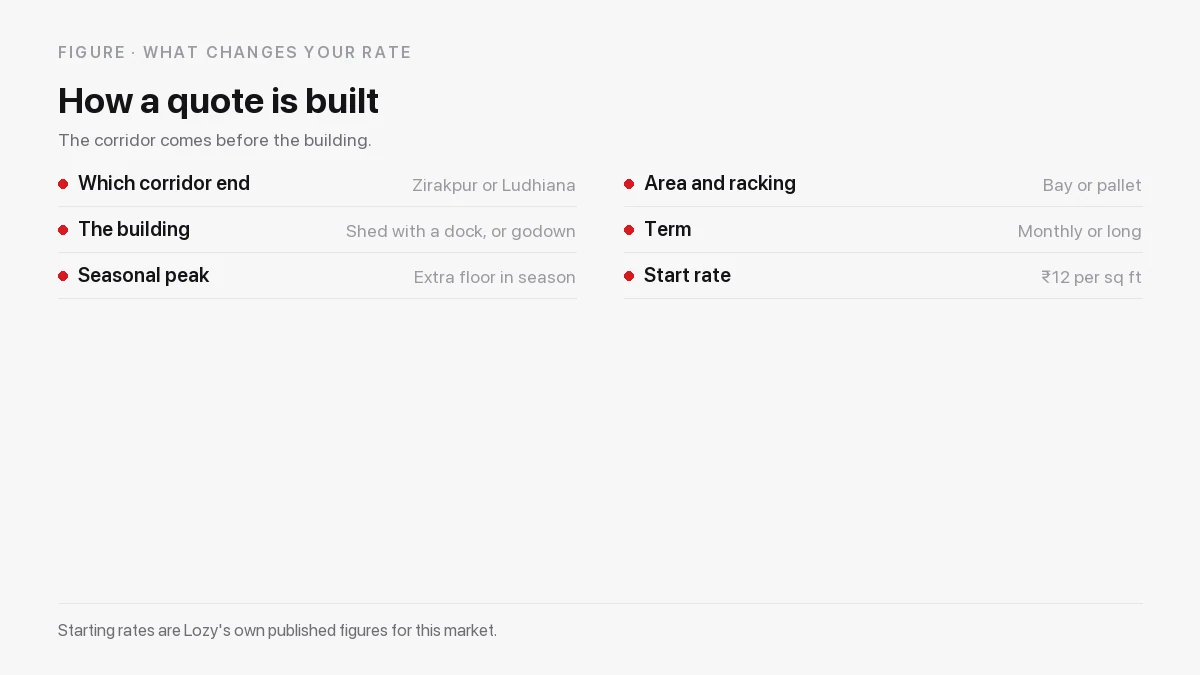
What actually moves the number in Punjab
- Which end of the corridor. Zirakpur and the Chandigarh boundary carry a proximity premium; the Ludhiana belt buys you more square feet for the same money and a shorter run to the factory gate.
- The building, not the label. A ground-floor shed with a dock and a turning yard and a first-floor godown served by a lift are two different products at two different prices.
- Whether your peak is seasonal. A knitwear business needs enough floor in October and rather less in March; a monthly basis is what makes that shape affordable.
- The term. A single month and a year-long arrangement are different products, and the longer one normally carries the lower monthly number.
| What you are deciding | Warehouse / godown floor | Business warehousing | Household & furniture storage |
|---|---|---|---|
| Published start rate | ₹12 per sq ft per month | ₹14 per sq ft per month | ₹1,499 per month |
| Priced by | Square foot of floor | Square foot, managed | The unit |
| What is included | Space, access, security | Plus housekeeping and operations | Locked unit, documented inventory |
| Who it suits | Manufacturers, distributors, 3PL | Businesses without their own floor staff | Households, NRI families |
| Typical Punjab user | Ludhiana knitwear and component trade | FMCG and retail distributors | A family whose house is shut or let |
| Billing | Monthly, GST invoice | Monthly, GST invoice | Monthly, no long lock-in |
Compliance and paperwork for storage in Punjab
Most of these questions are cheaper to settle before the first truck arrives than after it, and on this corridor three of them come up repeatedly.
GST and the invoice
Storage rent in Punjab attracts GST, and a registered business can claim input credit when the invoice is raised properly: in the entity's own name, as a tax invoice, with the storage and handling lines shown the way an accountant needs to see them. For a Ludhiana manufacturer whose margins are thin, that distinction is the difference between rent being a recoverable cost and rent being a permanent expense. Registrations and the credit mechanism are set out on the GST portal.
Who approved the building
Industrial estates and the infrastructure around them in Punjab sit with the state's industry bodies, and investment clearances run through the state's single-window route, Invest Punjab. That matters because a component or knitwear customer with an audited supply chain will ask which authority approved the premises. Ask the facility for its occupancy and fire clearances and whether they can be produced on the spot — a vague answer there is usually a preview of how the rest of the arrangement will run.
Food, drugs and restricted goods
Ordinary knitwear, components, packaging and household goods need nothing beyond a GST registration if you want the input credit. Food and beverages being stored and distributed add a licence under food safety law, and pharmaceuticals or medical devices add the wholesale drug licence, under which the premises itself is named and inspected. Solvents, flammable material and anything strongly odorous are handled differently again — sometimes in a segregated bay, sometimes not at all. Ask which licences the building carries rather than assuming a large shed carries any of them, and check the specifics with the licensing authority before committing stock.
Documents for household and NRI storage
Storing a household is mostly about proof and inventory rather than licences. A photo inventory agreed and signed at check-in, the owner's identity and address documentation, the declared value of anything insured, and a written list of who else may access the unit are the four items that turn a later disagreement into a short conversation. If a house is being rebuilt or let out, keep the storage agreement in the name of the person who will be dealing with the facility, so nobody has to prove authority twice.
How to choose a Punjab warehouse — and the red flags
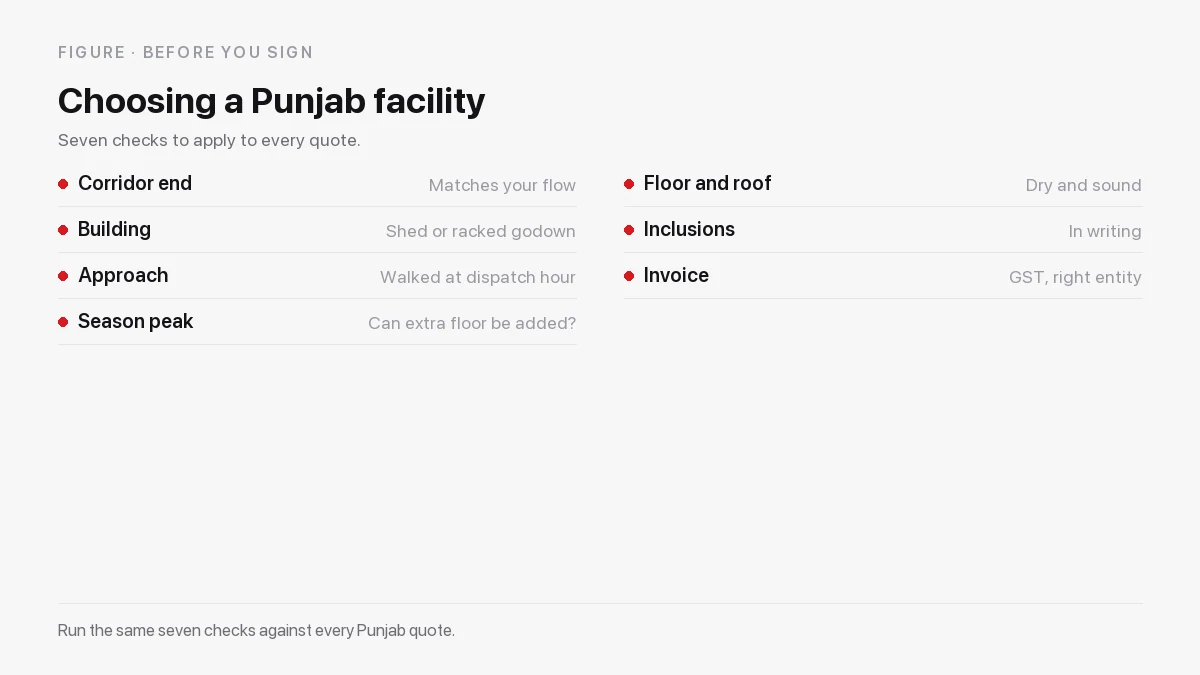
Seven checks, and about an hour of your time, will stop a seasonal peak turning into a second move later in the year.
- Fix the end of the corridor first. Ludhiana belt for goods that come off a local factory; Zirakpur or the Chandigarh side for goods that go out to the Tricity.
- Match the building to the goods. Hanging or cartoned knitwear and machined components do not share the same bay, however flexible the landlord says the shed is.
- Walk the approach at dispatch hour. Time the run from the gate to NH-44 when you would really be sending the truck, not at noon on a Sunday.
- Ask what happens at your peak. A knitwear business wants to know whether extra floor can be added for a season, and on what notice.
- Check the floor and the roof, not the paint. A damp shed is written-off stock in this trade.
- Get inclusions in writing. Racking, pallet trucks, security, housekeeping, pest control and who pays for the light and power.
- Confirm the invoice. GST shown correctly, in the right entity's name, on a monthly basis.
Warning signs, roughly in the order a Punjab buyer meets them: a rate quoted without saying whether GST sits inside it; a monthly figure that carries a yearly minimum buried in the terms; a landlord who cannot produce an occupancy or fire clearance; a shed whose roof has been patched directly above stacked cartons; a promise of extra floor in season with no answer on notice or rate; and a household storage offer with no inventory list and no written access rules.
Two worked examples: a knitwear supplier and an NRI household
A Ludhiana knitwear supplier was holding stock in three small godowns in different parts of the city. Each one was cheap on its own, and together they were costing more than the rent suggested: a single customer order could be split across two buildings, staff drove between them to check a style, and the pre-season build-up had nowhere to go except a fourth space rented in a hurry at the worst possible moment. The requirement that came out of that season was about 2,500 sq ft in one place, racked so a style could be picked without unloading a stack, with enough frontage left for the immediate overstock.
On the published starting rate of ₹12 per sq ft per month, 2,500 sq ft works out to roughly ₹30,000 a month — indicative only, because the final figure follows the unit, the racking and the term. What the supplier actually bought was one address, a racking layout that made picking a same-day job, and the ability to hold a season's stock without renting emergency space. Requirements like that start with the units listed on the Punjab location page.
The second example is smaller and just as common. A family from the Chandigarh belt, settled abroad, was keeping a locked house with furniture, appliances and personal effects inside it because nobody could decide what to do with them. Household storage from ₹1,499 per month replaced that arrangement with a documented unit, a photo inventory taken at check-in, an authorised relative able to collect an item on request, and a house that could be let or repaired without the contents becoming the obstacle. The comparison between the two products, and when each is the right one, is set out in the self storage guide.
How Lozy helps in Punjab
Lozy runs 77+ warehouses and more than a million square feet of live space nationally, and Punjab carries three collection centres inside that network: Chandigarh, Ludhiana and Zirakpur. A consignment can be collected at any of the three and moved into the nearest warehouse, which is what makes the model useful in a state where stock normally leaves a factory gate rather than a freight counter.
Each booking gets its own racked or open floor area behind 24/7 CCTV and on-site security, with unique PIN access to gates, lifts and the customer's own storage area, and billing stays monthly on a GST invoice so a knitwear season can be planned in months rather than around a lease. Bookings of 30 days or more include free doorstep pickup. The full range sits on the services page: a retailer or distributor who wants the managed floor should look at business warehousing, heavier palletised stock belongs with industrial warehousing, and a family is served by household storage.
To see the space before deciding, check the warehouse listing for what is free right now, or send the team the size, the goods and your timeline. The Punjab location page sets out the state's coverage on its own, and the locations hub covers the network beyond it if your goods travel further than the corridor.
Also in Delhi NCR
A Punjab trader supplying the National Capital Region usually keeps one floor here for the state and adds one in NCR rather than trucking every order south. The guides to warehousing in New Delhi and warehousing in Gurgaon cover the two addresses most northern buyers pick, and warehousing in Rajasthan covers the market on the other side of the NCR ring. Stock that reaches Delhi in one bulk movement and then serves orders from a city floor is generally cheaper to hold than to move consignment by consignment.
Where the rest of the country is the question, a guide to commercial warehousing sets out how shared floors are run, and the Lozy blog carries the sibling city guides for the corridors your goods travel next.

Need warehouse space in Punjab?
Tell us the city and the size you need — we reply with a rate and the options available now.
Get a quoteCall +91 93547 12345About the author
Lozy Editorial Desk. This guide was written by the Lozy Editorial Desk, the in-house team that covers warehousing, self storage, logistics and customs/EXIM topics for lozy.in. We write from Lozy's own facility and pricing information and from public, citable sources. We do not publish invented statistics, ratings or reviews.
Sources. The facility counts, rates and coverage quoted in this guide are Lozy's published figures rather than third-party estimates. Highway context comes from the National Highways Authority of India; industry context from the Warehousing Development and Regulatory Authority and IBEF's Punjab profile; state investment and industrial clearance context from Invest Punjab; policy releases from the Press Information Bureau. GST registration and input credit are described from the GST portal, linked above. A reader comparing more than one city before calling will find the same plain style across the Lozy blog, which covers warehousing, self storage and customs without the marketing gloss.
Last updated: 13 October 2026. Have a question the FAQ below does not answer? Call +91 93547 12345 or email care@lozy.in.
Need warehousing or storage in India?
Request a free, tailored quote in under 2 minutes — free pickup, no lock-in.






