Warehousing in Uttarakhand: The Haridwar, Roorkee and Rudrapur Factory Belt
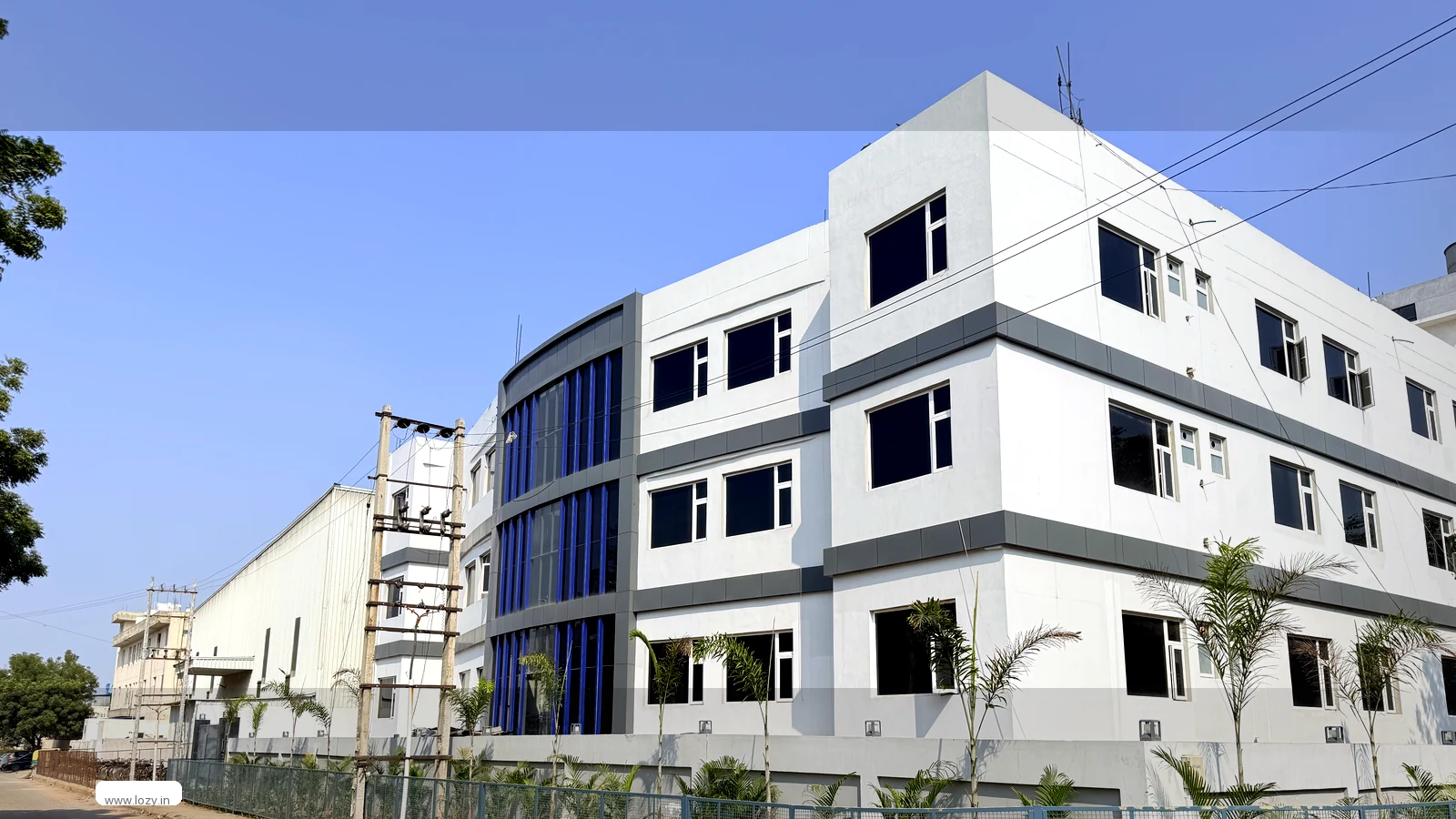
Short answer: warehousing in Uttarakhand follows the state's factories rather than its shoppers, and the factories stand in three plain-town belts — Haridwar, Roorkee and Rudrapur — where the network lists three collection centres. Space is published from ₹12 per sq ft per month. The demand behind it is pharma, ayurveda and personal care, auto components and engineering spares, and the packaging and FMCG that keep those plants and the hill towns supplied.
That is the first thing to understand about Uttarakhand as a storage market. The state has no large consumer city to build a distribution belt around. What it has is a dense concentration of manufacturing on the narrow strip of flat ground between the Himalayan foothills and the Uttar Pradesh border. The plants that arrived on that strip built supplier chains around themselves — component makers, carton printers, contract packers, clearing agents — and it is those businesses, more than retailers, that rent space here. A guide to this state therefore has to start with where the plants are, and then deal with the two things a city guide never has to mention: a hill interior that can only be supplied from the plain, and a state boundary that runs within a short drive of two of the three belts.
What follows covers why the belt exists at all, what each of the three towns is for, what the hills and the UP border do to a storage decision, and what space costs. The live inventory behind it sits on the Uttarakhand coverage page.
Key takeaways
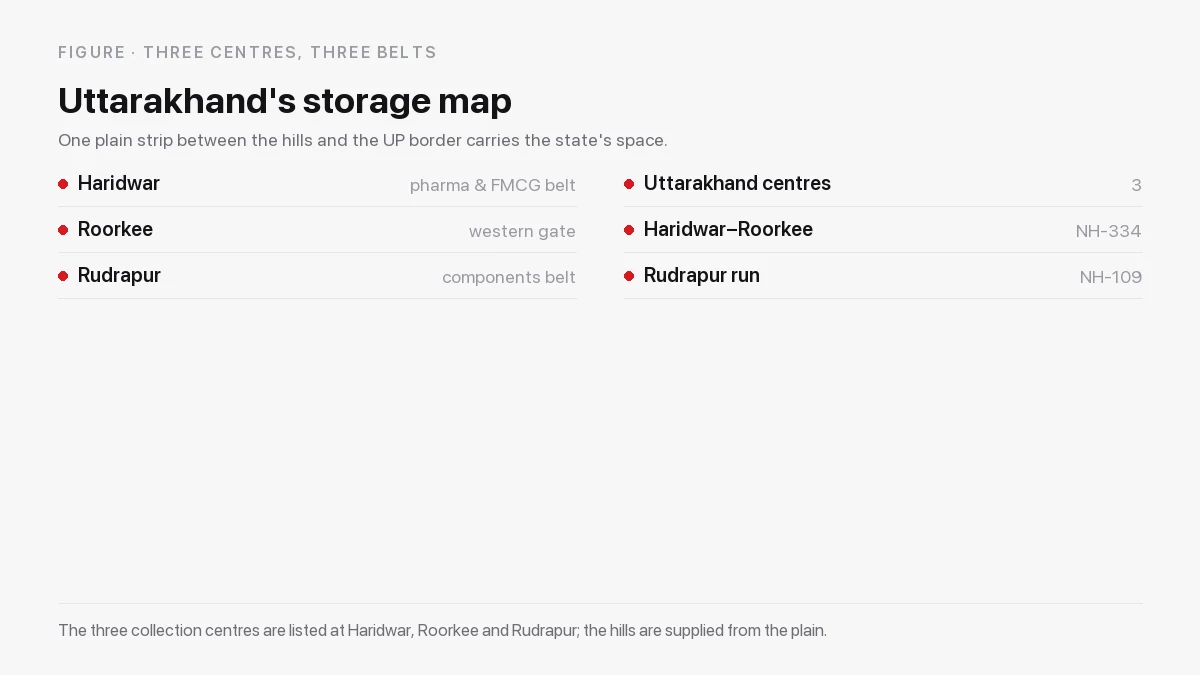
- Uttarakhand carries 3 collection centres in the network list, named at Haridwar, Roorkee and Rudrapur — the three plain-town belts where the state's manufacturing sits.
- The belt exists because of the central incentive package announced in January 2003: 100% excise duty exemption for ten years and five years of full income-tax exemption for new units set up in notified industrial estates in Uttarakhand and Himachal Pradesh.
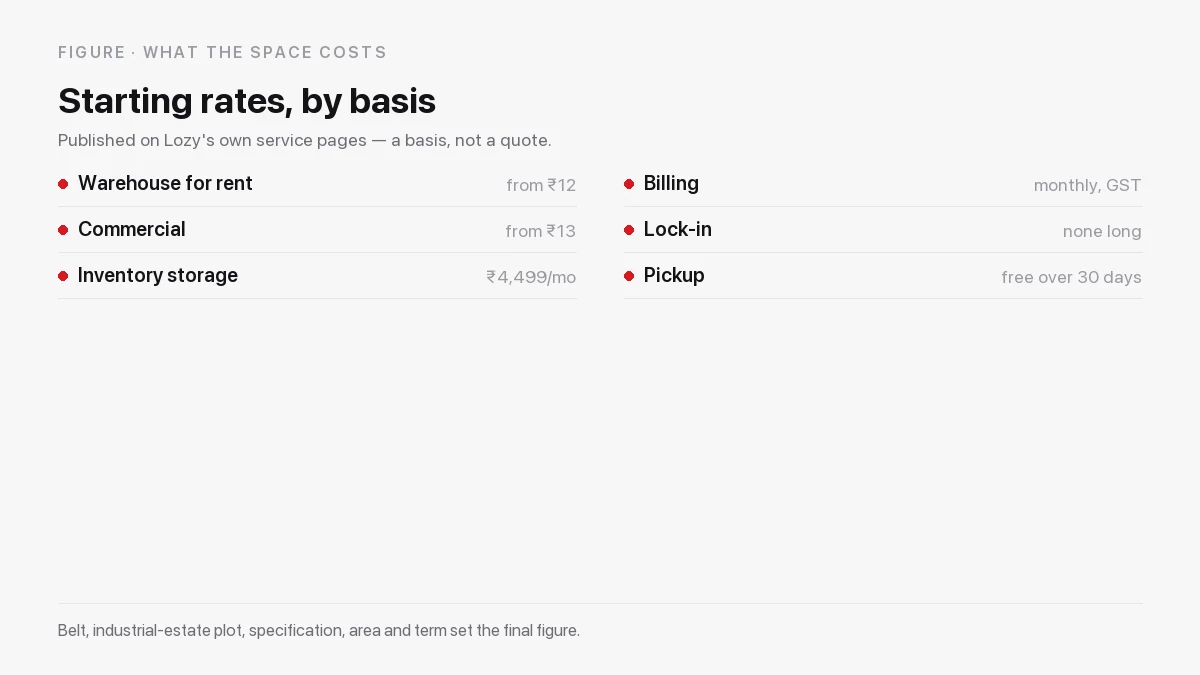
- Space for rent is published from ₹12 per sq ft per month, commercial warehousing from ₹13 per sq ft per month, and managed inventory storage from ₹4,499 a month, billed monthly on a GST invoice.
- Roorkee and Rudrapur both sit within a short drive of the Uttar Pradesh border, so one Uttarakhand floor can serve the state, western UP and a Delhi NCR delivery run off the same stock.
Why this state's storage market follows a factory, not a market
In most of northern India a warehouse is placed to reach shoppers, which is why the sheds ring the big cities. Uttarakhand inverts that. Its consumer market is small, and what there is of it is split between a handful of hill towns and the plain towns that already have the factories. Its industrial output, on the other hand, is unusually concentrated for a state of this size. Pharma, ayurveda and personal care, vehicle and engineering components, packaging, FMCG and some electrical manufacturing all sit on the same strip of plain ground, and the storage that serves them is a factory service before it is a retail one. Ask what a given shed here is for and the honest answer is usually a plant, a supplier or a distributor of plant consumables.
The 2003 package that moved the plants in
None of that was an accident of geography. In January 2003 the central government announced an industrial package for Uttaranchal and Himachal Pradesh that gave new units — and existing units making substantial expansions — set up in notified growth centres and industrial estates a 100% excise duty exemption for ten years from the date commercial production began, a full income-tax exemption for the first five years with 30% relief for companies over a further five, and a capital investment subsidy of 15% on plant and machinery up to ₹30 lakh. For a manufacturer weighing a hill state against a coastal one, that package was the whole argument, and the state government's own infrastructure corporation answered it by laying out integrated industrial estates with plots, roads, drainage and power already in place.
What followed is visible in the shape of the state's storage demand. Plants arrived in clusters, not scatter, because the incentives keyed off notified estates, and a cluster of plants immediately needs the things a plant cannot make for itself: cartons, film and labels; bearings, fasteners and fabricated parts; contract packing, quality testing and clearing. Those are the tenants of Uttarakhand's warehouses today far more often than a grocery distributor is.
What the belt kept after the exemption window closed
The ten-year windows have since run out, and the excise exemption itself was overtaken by GST in 2017 and replaced by a budgetary-support arrangement that reimbursed only part of what the exemption had been worth. A buyer looking at this state today should understand that the factories are not here because a subsidy is still running. They are here because of what a subsidy leaves behind: a trained industrial workforce that stays put, a supplier network that already delivers daily, testing and tooling businesses within a few kilometres, and industrial land that was planned, levelled, drained and road-served before anyone built on it.
That last point is worth money to a storage user. A shed standing on an allotted plot inside an integrated industrial estate inherits a land-use position, an approach road built for trucks and a power connection sized for machinery. A godown on private agricultural ground has to establish all three, and in a state where flat land is scarce, some of them cannot be established at all.
Flat land is the scarce thing in a hill state
Uttarakhand's geography changes its logistics in a way no other northern state's does. The buildable plain ends a short way north of the towns and turns into hillside, so every organised warehouse in the state stands at the bottom of a climb rather than on top of one. Shops, hospitals, hotels, schools and distributors in Dehradun's upper reaches, Pauri, Tehri, Chamoli, Uttarkashi, Almora, Bageshwar and the Kumaon interior are supplied from the plain belt below, over roads that narrow as they rise and that take a heavy-vehicle restriction or a landslide closure at points through the monsoon.
The practical consequence is that hill demand is served by holding stock low and releasing it in smaller vehicles on a planned schedule, rather than by storing it where it will be sold. A chemist in a hill town cannot keep a month of stock in a back room, and his distributor cannot rent a shed beside him and hope a truck reaches it. The goods come up in a tempo or a pickup, loaded for one or two weeks of demand, and the reserve sits in a racked, dry, secure floor in the plains. That single fact is why the three plain-town belts carry almost all of this state's organised storage.
The three belts: Haridwar, Roorkee and Rudrapur
The network's three collection centres in Uttarakhand are named at Haridwar, Roorkee and Rudrapur, and those three towns are what a storage decision here actually comes down to. The three towns are not variations on one market. Haridwar is a manufacturing town with a pilgrim economy on top of it; Roorkee is the western gate on the old Delhi road; Rudrapur is the vehicle and engineering town on the Kumaon side. Each carries a different kind of stock, and each is a different length of drive from Delhi NCR and from the Uttar Pradesh border. What is live in each of them is listed on the Uttarakhand page.
Haridwar: the pharma, ayurveda and FMCG floor
Haridwar's industrial estate is where the state's pharma, ayurveda, personal-care and food manufacturing concentrated, and that concentration decides what its warehouses hold. Expect packaging material at scale — printed cartons, labels, tubes, bottles and shrink film, held in pallet volumes because a plant consumes it every shift. Expect raw materials and excipients that must stay dry, off the floor and away from any wall that draws damp. Expect finished goods waiting for a national distributor's network rather than for a shop down the road, which means batch-wise stock, first-expiry-first-out rotation and a receiving process that records what came in before it is racked.
Temperature-sensitive lines add their own requirement: a floor that holds a stable temperature, ventilated rather than sealed, and an operator willing to record readings instead of asserting that the building is cool. Nothing here is exotic for an experienced operator, and everything about it is invisible in a rent figure. A facility handling this category will also want the goods list agreed in writing before the first pallet arrives, because pharma stock sitting beside a strong-smelling or dusty commodity is a rejected batch waiting to happen. The tracked arrangement that keeps records moving with the goods is described on the inventory warehousing page, and for smaller pharma and ayurveda firms it is usually the difference between a compliant floor and a godown that merely looks clean.
Roorkee: the western gate, closest to Delhi and Uttar Pradesh
Roorkee sits at the western end of the belt, on the highway that runs from Delhi through Muzaffarnagar and Roorkee towards Haridwar — the old NH-58 corridor, renumbered NH-334 — which is the single most useful thing about it for a storage buyer. A Roorkee floor is the one most often chosen by a business whose buyers are outside Uttarakhand, because the UP border is a short drive from the yard rather than a state crossing at the end of a working day. A truck loaded here in the evening is in Saharanpur, Muzaffarnagar or Meerut quickly and on the Delhi run without a detour.
The town also carries an engineering and academic presence that shows up in its storage demand: workshops, testing and fabrication businesses, and a steady trade in the spares and consumables that keep them running. Add a road network that reaches Saharanpur and Dehradun as easily as Haridwar, and Roorkee becomes the natural base for a business that wants to be registered in Uttarakhand but thinks of its market as northern India rather than as one state. E-commerce sellers with NCR pin codes and a Uttarakhand registration end up here for exactly that reason — the facility is real, the registration is clean, and the courier run is short.
Rudrapur and Pantnagar: vehicle components and the Kumaon run
Rudrapur, in Udham Singh Nagar, is the third of the three and the most industrial of them. The integrated industrial estate at Pantnagar beside it is where the state's vehicle and engineering manufacturing concentrated after the incentives landed, and the supplier belt that grew up around those plants — precision components, fabricated and machined parts, lubricants, tyres, tooling and the general consumables a factory runs on — is what fills the sheds. Stock here is dense, high-value and indifferent to humidity, and what it asks for instead is load-bearing floor, a wide aisle, racking that takes a heavy pallet, and a yard a trailer can enter and leave without a shunt.
Rudrapur is also a Kumaon town rather than a Garhwal one, which matters more than a map suggests. Its road links run south-east to Rampur and Moradabad across the UP border and north into Haldwani and the Kumaon hills, on the Rampur–Rudrapur–Haldwani road numbered NH-109. A warehouse here can serve the Kumaon interior and the western UP districts without touching the Haridwar–Roorkee end of the state at all — and for a Kumaon distributor, a Haridwar floor is the wrong tool however good the building is. The belt is one state but two directions, and Rudrapur is the one that faces the hills from the south-east.
When the buyer sits outside Uttarakhand
Two of the three belts are close enough to a state boundary that a large share of the stock held in them is not really for Uttarakhand at all. Getting that arithmetic right is worth more than any negotiation on rate.
The Delhi NCR run
A Haridwar or Roorkee floor is one highway movement from Delhi NCR's northern edge via the NH-334 corridor, and that makes this state a genuine option for a business that wants a northern stock position without paying NCR land prices. The economics are simple: land and rent are lower here than in any of the NCR belts, the drive is real but manageable, and the same floor can also serve Uttarakhand itself, which an NCR shed cannot easily do. What it does not do is promise same-day delivery. The distance that makes the rent cheap is the same distance that keeps a truck on the road for hours, so this configuration suits stock that turns weekly rather than stock that must reach a customer by evening.
Businesses that ship into the capital daily usually hold two positions instead of one. The Uttarakhand floor keeps the base stock, the plant-linked inventory and the hill-side reserve, while a smaller NCR floor takes the last mile. How that second position is chosen is set out in the guides to warehousing in New Delhi and warehousing in Gurgaon; businesses that run goods north-west from here tend to add a Punjab position on the same logic.
Western Uttar Pradesh and the Kumaon hills
The other direction is the one that costs Uttarakhand traders money without ever appearing on an invoice. Held in Uttarakhand, a consignment bound for a buyer in Muzaffarnagar, Saharanpur, Rampur, Moradabad or Bareilly is an inter-state movement: it needs an e-way bill, it is a separate state for GST purposes, and the receiving dealer has to handle an inter-state purchase rather than a local one. At a few truckloads a month that is paperwork. At a few trucks a day it is a reason to hold stock on the other side of the line instead.
That calculation is the honest reason the western UP towns around this belt have their own storage market, and it is covered in the guide to warehousing in Uttar Pradesh. The exception is the hill trade, which has nowhere else to go. Kumaon and the Garhwal interior are supplied from these plains belts by necessity, so the border arithmetic does not apply to hill-bound stock — it has to come up from the plain whether the seller's paperwork is local or not.
What Uttarakhand businesses actually put in storage
Five groups fill most of the organised square feet in the state, and the requirements they put on a building differ sharply.
Pharma, ayurveda and personal care
The category that shaped Haridwar's estate is also the most demanding tenant a warehouse here can have. It brings packaging material, raw materials, excipients and finished goods into the same building and expects each to be handled differently: cartons and labels on dry racking, bulk materials on a raised deck with clear air movement, finished goods in marked bays with batch identity preserved. The category also brings an audit culture. A facility that cannot show a visitor where the goods came in, who signed for them and where a given batch now sits will fail that audit regardless of how clean the shed looks on the day.
Auto components, engineering spares and packaging material
Around the Pantnagar and Rudrapur plants the demand is components and consumables: precision parts in returnable bins, fabricated sections, bearings and fasteners, lubricants, tyres, machine tooling and the PPE a shop floor consumes. It is heavy, dense stock that tolerates an ambient, ventilated floor and asks instead for load capacity, aisle width and a yard that a trailer can work in. Packaging material belongs in the same conversation, because most of these suppliers ship in cartons they have to buy, store and assemble themselves. The larger, dock-facing floor plates this flow needs are covered under industrial warehousing.
FMCG, e-commerce and household goods
The third group is the one a city reader will recognise. Distributors holding FMCG for the state's own towns and for the hill markets want stock close enough to load a vehicle daily and racked so that dates rotate; sellers running a marketplace account want a floor where orders are picked, packed and handed to a courier on a schedule instead of a scramble, which is what e-commerce warehousing sets up. Manufacturers and distributors who need a shared, managed floor rather than a private lease take it through business warehousing.
Alongside them sit households and small businesses: a family between two houses in Haridwar or Dehradun, a shop refitting, a professional office moving premises. That requirement is a lockable unit, not a rack, and the service for it is self storage. In this state the units are worth asking about specifically, because Uttarakhand's monsoon is heavy on the plains and paper, fabric and leather notice a sealed unit that never dries out. If you are unsure which unit size a two-bedroom flat's contents need, the self storage guide maps sizes to households.
What warehousing in Uttarakhand costs
Lozy publishes starting rates rather than an average, because an average quoted without its basis misleads more than it helps. On today's published figures, warehouse and godown space for rent starts at ₹12 per sq ft per month; commercial warehousing, the managed floor with security, housekeeping and reporting built in, starts at ₹13 per sq ft per month; and managed inventory storage, the arrangement where stock is received and recorded as it moves, starts at ₹4,499 a month. Every one of those is billed month by month on a GST invoice, with nothing locked in for years.
Three numbers, three different products — and mixing them up is the fastest way to a bad comparison. A per-square-foot rate buys floor or racked space inside a shed; an inventory-storage charge buys the handling and the record-keeping that goes with it. Ask any facility which basis its quote uses, and treat a quote that does not answer as incomplete. For how rent itself is structured, separately from this state, the guide to warehouse space for rent is the right starting point.
The four inputs behind an Uttarakhand rate
- Which of the three belts. Roorkee and Haridwar sit on the western highway and price partly on that access; Rudrapur prices on the Kumaon and western-UP road network instead. They are not the same product and will not quote the same.
- Whether the building sits inside an industrial estate. An allotted plot in a planned estate arrives with the approach road, drainage and power already solved, and that is reflected in what a tenant is asked to pay.
- What the stock needs. A heavy-pallet rack, a raised deck for damp-sensitive goods, a ventilated pharma bay or a lockable unit are four different specifications, and a facility that has built one of them will charge for it.
- Area, duration and billing basis. A single bay and a full floor plate are priced differently, and a monthly booking is not the same as a year-long commitment even when both are quoted per square foot.
| Belt | What it is for | The road that carries it | The watch-out |
|---|---|---|---|
| Haridwar | Pharma, ayurveda and FMCG packaging and finished goods; factory-linked stock | NH-334 west to Roorkee and on to the Delhi corridor | Damp-sensitive stock needs deck storage and air movement through the monsoon |
| Roorkee | Cross-state distribution, e-commerce with NCR pin codes, engineering and fabrication spares | NH-334 towards Muzaffarnagar and Meerut; local roads to Saharanpur and Dehradun | Inter-state paperwork for every UP movement, planned in advance rather than at the gate |
| Rudrapur and Pantnagar | Vehicle and engineering components, tooling, lubricants, tyres, plant consumables | NH-109 to Rampur, Moradabad and Haldwani | Heavy pallets and trailer turning space decide whether a floor is usable at all |
| The hill interior above all three | The demand being served, not stored: Dehradun's upper reaches and the Kumaon towns | Hill roads, restricted for heavy vehicles at points in the monsoon | Stock goes up in smaller vehicles on a schedule; there is no shed to rent up the slope |
Read the table as a routing decision rather than a menu. Haridwar holds factory-linked stock, Roorkee holds stock whose destination is outside the state, Rudrapur holds components and the Kumaon reserve, and nothing is stored in the hills if it can be held below them. Every unit behind those rows is listed on the Uttarakhand locations page.
Licences, GST and the paperwork in Uttarakhand
Two of these are state-specific and cause most of the avoidable trouble: the GST position on a border movement, and the conditions attached to a plot inside a planned industrial estate.
GST and the state line
Rent on storage in Uttarakhand carries GST, and a registered business can recover it when the paperwork is right: a tax invoice raised in the tenant's own entity name, itemising storage, handling and any other charge separately so that the accountant can post it without a query. Confirm what that document will look like before booking rather than at year-end, because a monthly invoice is what keeps rent a recoverable cost and a cash rent with no paper behind it never is. The rules on registration, additional place of business and input credit sit on the GST portal.
The border is the second half of the same question. Uttarakhand is a separate state for GST, so stock held here and delivered to a dealer in Uttar Pradesh is an inter-state supply with an e-way bill to generate and a different set of books at the receiving end. Businesses that sell mostly across the border sometimes discover this after they have taken a floor. Businesses that sell mostly within Uttarakhand — into the hill towns, into Haridwar's and Rudrapur's own retail markets — are on the simpler side of the line and should stay there.
The plot, the building and the approvals
Ask three questions at the first viewing. Which authority approved the building, and can the occupancy certificate and fire clearance be shown rather than described? Is the land industrial by allotment or by use, and if it is an allotted plot in an integrated industrial estate, what does the allotment permit and what does it require? A plot allottee's letter, the building plan approval and the conditions attached to sub-letting decide whether a warehouse can be run on that land at all, and it is far better to read them before a truck arrives than after. Uttarakhand's industrial land and investment framework is set out by Invest Uttarakhand, and the estates themselves are developed by SIIDCUL, the state's infrastructure and industrial development corporation.
On top of the building, expect the ordinary local approvals: a trade licence from the nagar nigam or nagar palika for the premises, fire clearance matched to what you intend to store, and a pollution control board consent for any activity that needs one. Food storage needs an FSSAI licence at the facility, and pharma and ayurveda stock carries its own drug-licensing obligations on the licence holder. None of this is unusual; all of it is easier to arrange before goods are inside the building than after.
What a facility will not take, and why to ask early
Ask what the unit refuses before you describe your own goods, because the honest answer tells you how the place is run. Solvents, flammables and gas cylinders, food without the matching licence, strong-smelling commodities that would taint a pharma pallet, and anything requiring pest-controlled separation are either handled in a dedicated bay or declined. For damp-sensitive lines, ask for the raised deck and the stated clearance from walls and floor, and for a pharma or ayurveda requirement ask to see a temperature and humidity reading rather than a claim about the building. What happens on the way in matters just as much: a photograph inventory checked against the tenant's own count at the door is what turns a shortage discovered three weeks later into a short email instead of an argument. Tell your insurer where the goods sit and how they are held, because a policy written for a private locked godown and a shared managed floor are not the same risk.
How to choose a Uttarakhand warehouse — and the red flags
Run this list at the viewing. All seven items can be judged on site in an hour, which is worth more here than a longer quotation.
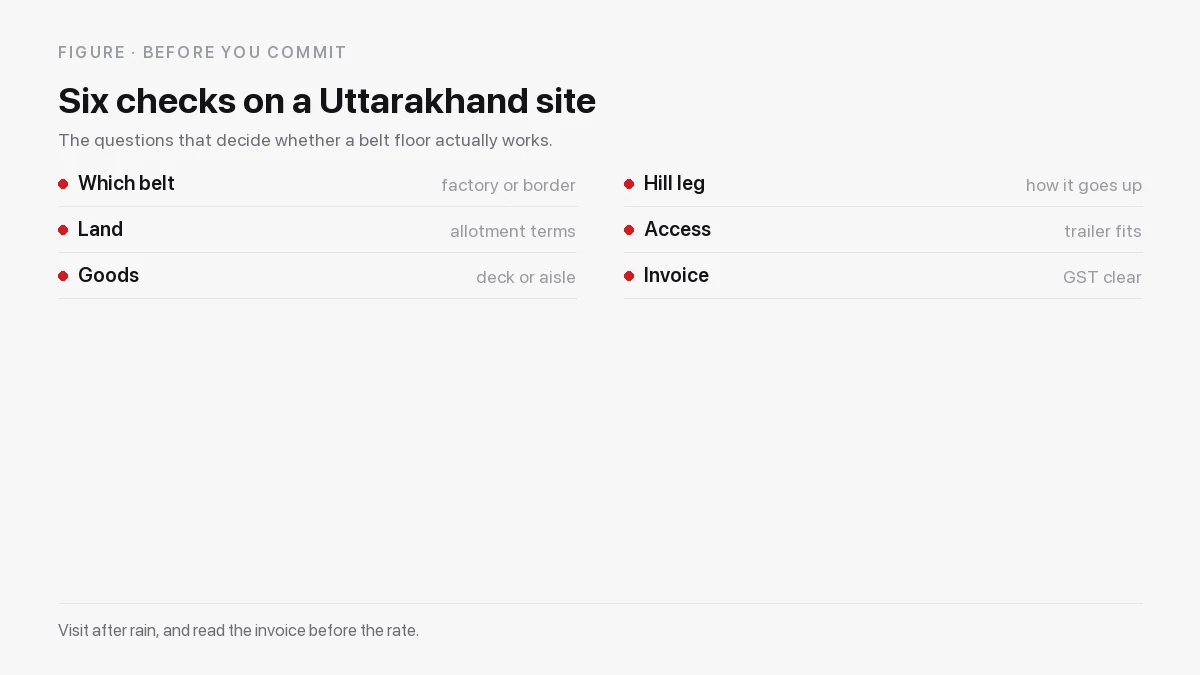
- Decide which belt before you compare rates. Factory-linked stock belongs near the plants at Haridwar or Rudrapur; stock leaving the state belongs at Roorkee, where the UP border is a short drive away.
- Confirm the land position. An allotted plot in a planned industrial estate, a converted shed on industrial ground, or a building on land that was never meant for storage — the third one is where approvals quietly fail.
- Match the building to the goods. A raised deck and air movement for cartons, paper and packaged food; load capacity and aisle width for components and bins; a ventilated bay with readings for pharma; a lockable unit for household goods.
- Test the access with the vehicle you actually use. A shed behind a lane no trailer can enter is worth less than a plainer yard a truck can turn inside, and this belt has plenty of both.
- Ask how the hill leg is served. If part of your demand is in the hills, ask when the vehicle leaves, what it can carry up, and what happens to a hill consignment during a road closure.
- Write down what the rate includes. Racking and pallet trucks, night security cover, housekeeping, pest control, power for ventilation and lighting, and who carries the bill for each.
- Ask what the monthly reporting actually contains. A sample from a live account — receipts, stock on hand, dispatches — tells you how a question gets answered mid-month.
What should stop you, roughly in the order these things surface: a rate that never says whether GST sits inside it and on which basis it is quoted; a building with no occupancy or fire clearance and a story instead; a pharma or food requirement offered a floor that has never been asked to record a temperature or a batch; a rent figure that hides an annual minimum behind a monthly number; a yard that floods in a way nobody mentions until you visit after rain; an estate plot whose allotment conditions the operator has never read; and any facility that only decides which bay is yours when the truck is already at the gate.
A worked example: a Roorkee supplier holding for two states
A supplier of fabricated parts and machine consumables had been running out of a single rented godown on the edge of Roorkee, close enough to the plants it supplied and cheap enough to ignore. The problem was not the rent. It was that the same shed was being asked to do three jobs at once: hold raw material for its own fabrication, hold finished parts waiting for a plant's weekly call-off, and act as a pick-up point for customers from Saharanpur and Muzaffarnagar who were buying across the state line.
Two things went wrong in one monsoon. Cartons of finished stock stored flat on the floor along a wall took on damp, and the parts inside needed re-inspection before the plant would accept them. Then a dealer in Uttar Pradesh asked for a delivery in a week in which the owner had not planned an e-way bill, and the truck sat for two days while the paperwork was sorted out on both sides. Neither problem was about space. Both were about a building and a process that had never been designed for what it was being used for.
The specification that came out of it was modest: about 3,000 sq ft under one roof, with the fabrication stores separated from the finished-goods bays, everything on a raised deck rather than the floor, a racked section for the consumables that move daily, an aisle a forklift can work, and a receiving routine that produces a usable stock position without anyone filling in a register afterwards. Three thousand square feet at the published starting rate of ₹12 per sq ft per month is about ₹36,000 a month before add-ons — indicative only, since the unit, its position in the belt and the term all move the final figure.
What that bought was less dramatic and more useful than a bigger shed: one address on the invoices, stock that came through a monsoon intact, and a pick-up point where a dealer from across the border could be loaded in the same visit he arrived. Requirements of that shape start with the space listed on the Uttarakhand locations page.
Also in Delhi NCR
For a business working out of Uttarakhand, NCR tends to be a second position rather than a replacement. Stock that has to reach a Delhi customer the same day belongs in New Delhi or on the south-western side of the capital near a motorway, which the Gurgaon guide covers; a distributor supplying the towns north and west of Delhi on a schedule usually does better with a Haryana shed on the Ambala road, holding the base stock here and the fast volume there. Two floors, one of them cheap, is normally the right answer, not one expensive floor in the capital.
How Lozy helps in Uttarakhand
Lozy runs 77+ warehouses and more than a million square feet of live space across its network, and Uttarakhand carries three collection centres, named at Haridwar, Roorkee and Rudrapur. A booking brings a defined racked or open floor area of your own, 24/7 CCTV, on-site security and PIN-controlled access to gates, lifts and your storage bay, and the network is arranged so that a business can scale from a small floor to a bigger one in the same belt with the same operator.
The arrangement is monthly on a GST invoice with no long lock-in, and free doorstep pickup is included on bookings of 30 days or more, so moving stock out of a rented godown or a corner of a plant does not have to interrupt production. What the company offers across its services is set out on the services page. To see availability before deciding, browse the warehouse listing and look at what is free in this state today, or contact us with the goods, the area and the dates you have in mind. If your stock moves beyond Uttarakhand, the locations hub shows the rest of the network.

Need warehouse space in Uttarakhand?
Tell us the city and the size you need — we reply with a rate and the options available now.
Get a quoteCall +91 93547 12345About the author
Lozy Editorial Desk. This guide was written by the Lozy Editorial Desk, the in-house team that covers warehousing, self storage, logistics and customs/EXIM topics for lozy.in. We write from Lozy's own facility and pricing information and from public, citable sources. We do not publish invented statistics, ratings or reviews.
Sources. Facility counts, collection-centre names, rates and coverage are Lozy's published figures rather than third-party estimates. The incentive package described in this guide is the Government of India's January 2003 industrial policy for Uttarakhand (then Uttaranchal) and Himachal Pradesh, as recorded in the office memorandum of 7 January 2003 and the consequent central excise exemption notification of 10 June 2003. Industrial land and investment context comes from Invest Uttarakhand and from SIIDCUL, the state's infrastructure and industrial development corporation; state economic context from IBEF's Uttarakhand profile; highway corridor context from the National Highways Authority of India; GST registration, place of business and input credit from the GST portal; industry context from the Warehousing Development and Regulatory Authority; and government releases from the Press Information Bureau. Readers weighing this state against another before they call will find the same plain treatment, and the same refusal to invent a number, across the Lozy blog.
Last updated: 13 October 2026. Have a question the FAQ below does not answer? Call +91 93547 12345 or email care@lozy.in.
Need warehousing or storage in India?
Request a free, tailored quote in under 2 minutes — free pickup, no lock-in.