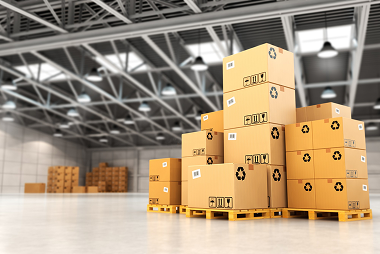
Warehousing in West Bengal: Port-Side Space, Belts and Cost
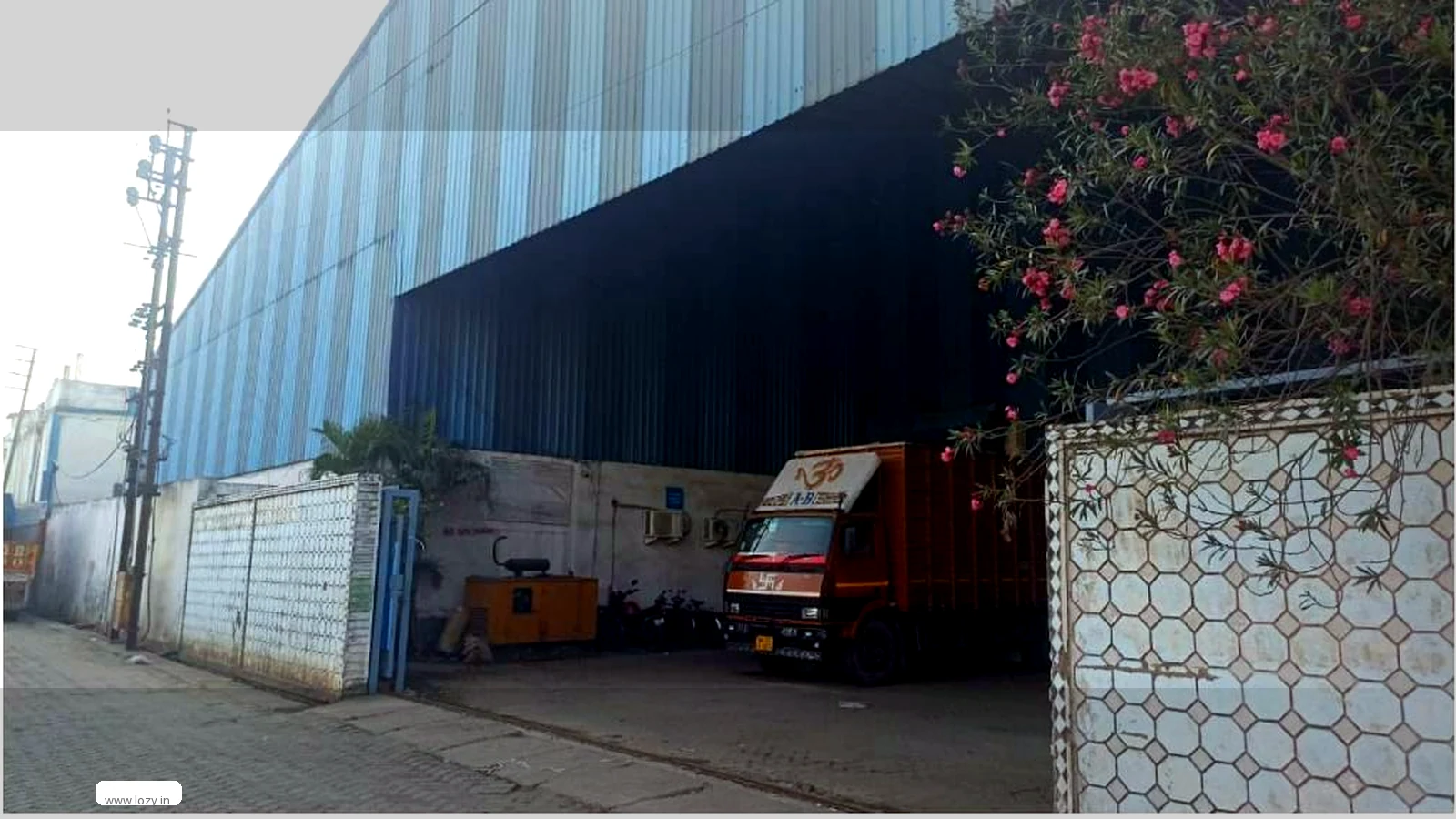
Short answer: warehousing in West Bengal is a port story before it is a city story. Kolkata is the eastern gateway, and the state's storage market is shaped by cargo moving between the docks and the depots, by the jute, tea and paper trades that have to survive Bengal's humidity, and by Siliguri acting as the funnel into the whole North-East. Lozy runs a 20,000 sq ft godown at Sankrail, Howrah, on Kolkata's port-side industrial belt, and carries four collection centres across West Bengal including Kolkata and Siliguri. This guide covers what the state stores, the corridors goods travel, what the space costs and how to choose a unit that keeps the damp out of your stock.
Key takeaways
- Lozy's West Bengal warehouse is a 20,000 sq ft godown at Sankrail, Howrah — rack and floor storage on Kolkata's port-side industrial belt, with truck access and GST-invoiced monthly billing.
- West Bengal carries 4 collection centres in Lozy's network, including Kolkata and Siliguri, and free doorstep pickup runs across both cities.
- Warehouse and godown space for rent starts at ₹12 per sq ft per month, commercial warehousing at ₹13 per sq ft per month and e-commerce fulfilment at ₹4,999 per month; short-term storage starts at ₹699 per week.
- Humidity is the local dividing line: paper, jute, tea and packaged food want a dry, ventilated, pest-controlled room, not the cheapest shed on the belt.
Why warehousing in West Bengal starts at the port
Begin with geography, because here it is not a background detail. West Bengal sits at the head of the Bay of Bengal, with the Kolkata dock system on the Hooghly and the dock complex at Haldia handling the eastern seaboard's trade. That single arrangement gives the state a storage market unlike a purely inland one: goods arrive and leave in consignments sized for ships, barges and rakes, they are cleared, unpacked, sorted and re-dispatched, and a large share of what Bengal's businesses hold in a warehouse is simply stock pausing between two of those movements.
The practical consequence for anyone shopping for a West Bengal warehouse is that the useful question is not "how far is this from the city centre" but "how close is this to the way my goods actually move". A unit near the dock-side industrial belt suits an importer, a clearing agent or a distributor feeding the port economy. A unit further out suits a seller whose stock only ever travels by road to customers. Getting that call right at the start is cheaper than relocating eighteen months later. The state's coverage is set out on the West Bengal location page, and the units themselves on the West Bengal warehouse listing.
The Sankrail–Howrah belt, where the godowns actually are
The strip on the western bank of the Hooghly across from central Kolkata is where this shows up most plainly. Sankrail, in Howrah district, sits on the port-side industrial belt — the band of godowns, factories, yards and warehouses that formed where the road and rail links towards the docks meet the edge of the city. Lozy's West Bengal facility is a 20,000 sq ft godown here, built for palletised trading stock, e-commerce inventory and distribution overflow, with rack and floor storage and truck access on the belt itself. The unit is described in detail on the Sankrail, Howrah godown page.
Two things make this belt work for a trading business. The first is access: a trailer can get in and out without threading a lane, which matters when a consignment has a cut-off. The second is that it sits between the port and the city, so a load can be held here and released either towards the docks or towards buyers in Kolkata without crossing the whole metropolis twice. For a wholesaler whose inbound is a container and whose outbound is a fleet of small deliveries, that middle position is the whole value of the address.
Siliguri, the gate into the North-East
Three hundred-odd kilometres north, at the neck of the corridor that joins the rest of India to the North-East, Siliguri plays a different role. It is the state's second collection centre in Lozy's network and the point where goods that will eventually be consumed in Assam, Meghalaya, Sikkim and beyond get consolidated, broken down and sent onward. For a seller whose customers sit east of the corridor, holding stock in Siliguri rather than in Kolkata can knock a day or more off a delivery, because the long haul happens once, in bulk, instead of on every order.
It is also a market with its own constraints. Siliguri's storage land is tighter and the road up to the corridor has a hard monsoon season, so a distributor who plans around a single peak shipment is exposed when the route closes for a week. Staging stock in Siliguri, or holding buffer stock in Kolkata and pushing it north in lots, is the usual answer. Both cities carry collection centres, and each booking is routed to the nearest one.
What West Bengal's businesses store — and why humidity decides the fit
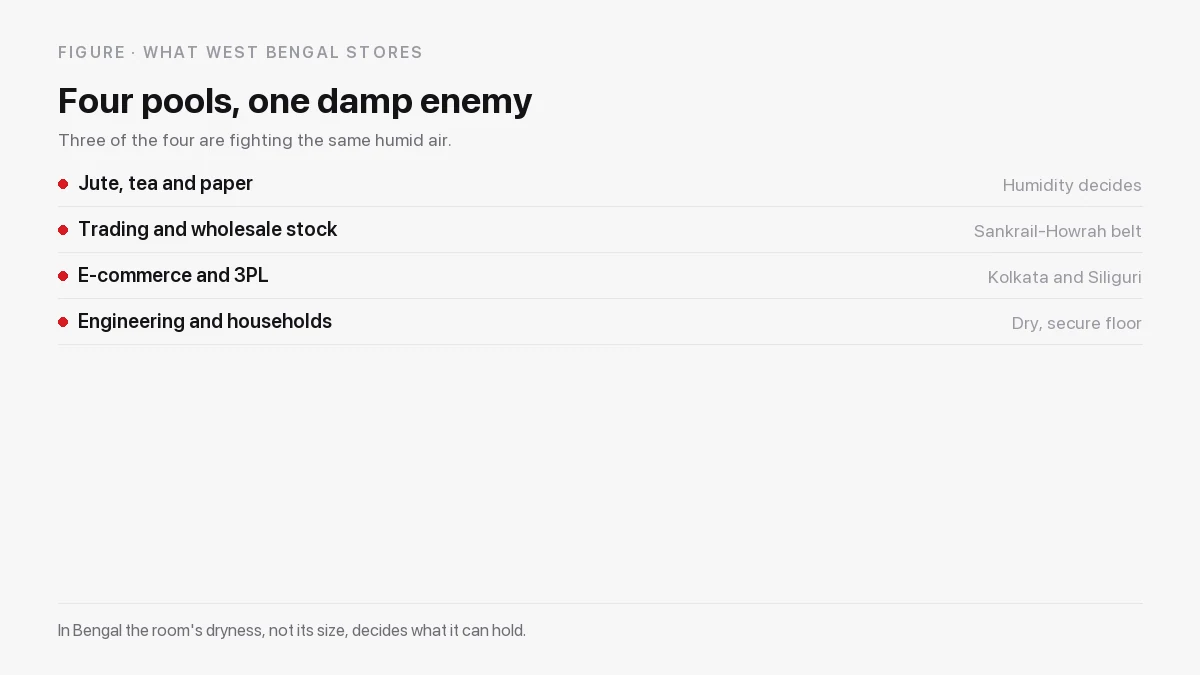
Four kinds of stock account for most of the occupied square feet in the state, and they do not want the same building. Before the list, though, one local condition decides more of it than the category does.
Jute, tea and paper: the humidity problem
Bengal's air is damp for much of the year, and that is not a comfort issue, it is a stock-loss issue. Jute goods take up moisture and then sweat, which is how a bale that left the mill sound comes out of a godown with mildew in the middle. Paper, board and packaging stock cockle and stick when the room swings with the weather; tea loses its cup quality if it sits in a room that breathes; and packaged food, spices and biscuits go soft long before any date on the carton says they should. None of these goods needs refrigeration. All of them need a floor that stays dry, keeps air moving and is treated for pests on a schedule.
This is the single most useful thing to ask about when you view a West Bengal godown. Ask about the height of the plinth above the surrounding ground, whether the roof has been checked for leaks before the monsoon rather than after, how the room is ventilated, whether goods sit on pallets rather than straight on the floor, and what the pest-control schedule is. A shed that looks solid on a dry February afternoon can be the wrong shed entirely by July, and the goods in it will not tell you until it is too late.
Trading stock, e-commerce and distribution overflow
Kolkata's trading economy is the state's largest source of storage demand. Wholesalers and distributors bringing goods in by road, rail and container need somewhere to break bulk, hold buffer stock and feed a dense retail market, and they typically want palletised floor space with easy truck access rather than a serviced unit with a reception desk. Alongside them sits a fast-growing set of online sellers who want a floor where stock is received, barcoded and shelved pick-ready, then picked, packed and handed to a courier without a queue at the gate. The published basis for that service, from ₹4,999 per month on a starting catalogue, is on the e-commerce warehousing page.
Engineering goods, leather and household moves
A fourth pool is the least glamorous and the steadiest. Fabricated metal, machine parts, spare sets and leather goods — a trade Bengal has run for generations — need nothing more exotic than a dry, secure, accessible floor. So do the households and small offices moving between addresses in and around Kolkata, who need furniture, appliances and boxed belongings held somewhere safe between two dates. Plain warehousing and per-unit self storage exist to serve exactly this demand, and neither needs a long agreement to be worth taking.
The corridors goods actually move along
Which road your unit sits on decides your delivery times far more than the building's finish does. West Bengal's storage map is drawn by three of them, and the units on offer are listed on the West Bengal location page.
Down the NH-16 towards the Haldia dock belt
The southern approach to the docks — the NH-16 run out of Kolkata towards Haldia — is the corridor for anything tied to port traffic. Importers, container freight handlers and industrial suppliers cluster along it because a load that has to be at a berth, or that has just come off one, cannot afford a cross-city crawl. If your inbound is a container and your outbound is a factory or a yard, this is the axis your unit should sit on, and the access question to ask is how quickly a trailer reaches the gate road from the site, not how many kilometres away the port is on a map.
North-east through Siliguri
The second corridor runs out of the state towards the North-East, and Siliguri is its hinge. Freight for the seven sisters is consolidated before it makes the climb, which is why a warehouse here works as a staging point for a national brand rather than as a local godown. Plan for the monsoon on this route: a distributor holding only just-in-time stock at the far end is exposed every year, and a buffer held in Siliguri or Kolkata is the cheap insurance against it.
The last mile in Kolkata and Howrah
The third question is not a highway at all, it is how the last few kilometres work. Central Kolkata's roads are narrow, timed and busy, and a delivery run that starts at seven in the morning looks nothing like one that starts at eleven. Ask a prospective facility what its dispatch window is, how riders or vans are scheduled, and whether they queue. For a seller moving to a fulfilment floor, that single detail decides whether an order placed in the afternoon leaves the same day — and it is worth timing the run yourself rather than accepting a description of it.
What warehouse space in West Bengal costs
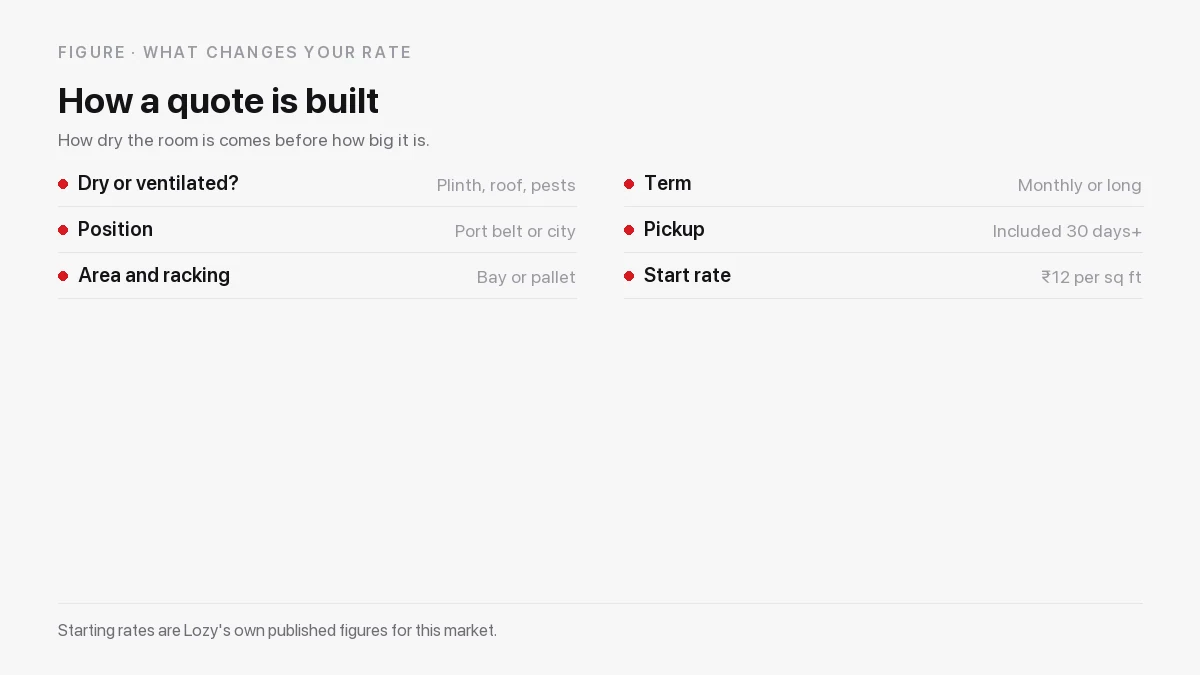
Three of Lozy's published starting rates apply directly to warehousing in West Bengal. A plain warehouse or godown floor on rent starts at ₹12 per sq ft per month. Commercial warehousing, the managed version with security and housekeeping included, starts at ₹13 per sq ft per month. E-commerce fulfilment, where your stock is stored, picked, packed and dispatched, starts at ₹4,999 per month for a starting catalogue. Everything is billed monthly on a GST invoice, with no long lock-in, and short-term storage is available from ₹699 per week when you only need the space for a few weeks.
Be clear about what those numbers are: starting rates, not quotes. What you actually pay follows the unit, the floor area, the term and what your goods need from the building. A humidity-controlled, palletised room costs more to run than an open shed, and in Bengal that difference is not optional for paper, jute or tea. The mechanics of rent itself, apart from the city, are explained in the guide to warehouse space for rent.
What actually moves a West Bengal rate
- How dry and how controlled. The largest single difference in the state. A ventilated room with a raised plinth, pest control and a checked roof is a different product from a bare shed, and the rate says so.
- Position on the belt. Dock-adjacent space in the Sankrail–Howrah belt and a unit deep in a residential pocket are not comparable, and rent reflects the access before anyone explains it.
- Area and racking. A whole bay priced against four pallet positions is not a like-for-like comparison. Ask what is included, not what is covered.
- The term. A monthly booking and a year-long arrangement are different products, and the longer one usually carries the lower monthly figure.
| What you are deciding | Your own rented godown | Space in a managed facility |
|---|---|---|
| What you sign | A lease, usually with a deposit and a lock-in | A monthly plan with no long lock-in |
| Security | You arrange and pay for it | 24/7 CCTV, on-site security, PIN access |
| Housekeeping and pest control | Your problem, on your schedule | Included, and recorded |
| Scaling up or down | Hard — you hold the whole floor | Add or release space as stock changes |
| Cash flow | Deposit plus rent plus fit-out | Monthly GST invoice, recoverable input credit |
| Suits | Steady, high-volume, single-purpose stock | Trading stock, e-commerce, overflow, short runs |
Licences and paperwork for a West Bengal godown
Settle the paperwork before the first truck arrives rather than after it leaves. In West Bengal two items matter more than the rest, and both concern the building rather than the goods.
GST, the invoice and input credit
Storage rent in West Bengal attracts GST, and a registered business can claim input credit when the invoice is raised properly: in the entity's own name, as a tax invoice, with the storage and handling lines shown the way an accountant needs them. Get the invoice raised correctly and the rent returns to you as input credit; take a landlord's plain receipt instead and the same money becomes a dead cost no return can recover. How registration and input credit actually work is set out on the GST portal.
Fire clearance, the trade licence and who approved the building
West Bengal's godowns are inspected, and the two documents a serious buyer should ask to see are the fire clearance for the premises and the trade licence the operator runs under. Neither is decorative: a building without a current fire clearance is a building that can be closed while your stock is inside it, and an operator who cannot produce the licence is telling you something about how the rest of the arrangement will run. Beyond those, ask which authority approved the premises and whether occupancy papers can be produced on the spot. Where the state's industrial infrastructure is involved, the context sits with the West Bengal Industrial Development Corporation.
What the facility will and will not accept
Ask about the goods list before you sign. Flammable and solvent material, food without the matching licence, strong odours and anything needing pest-segregated bays are handled differently — sometimes in a separate room, sometimes not at all. Jute and tea carry their own handling expectations precisely because of the climate. Returned or damaged stock is its own category with its own rules. On the way in, a photo inventory and a check-in list counted against your own paperwork is what turns a later discrepancy into a short conversation instead of a long argument.
Choosing a West Bengal facility — and the red flags to watch
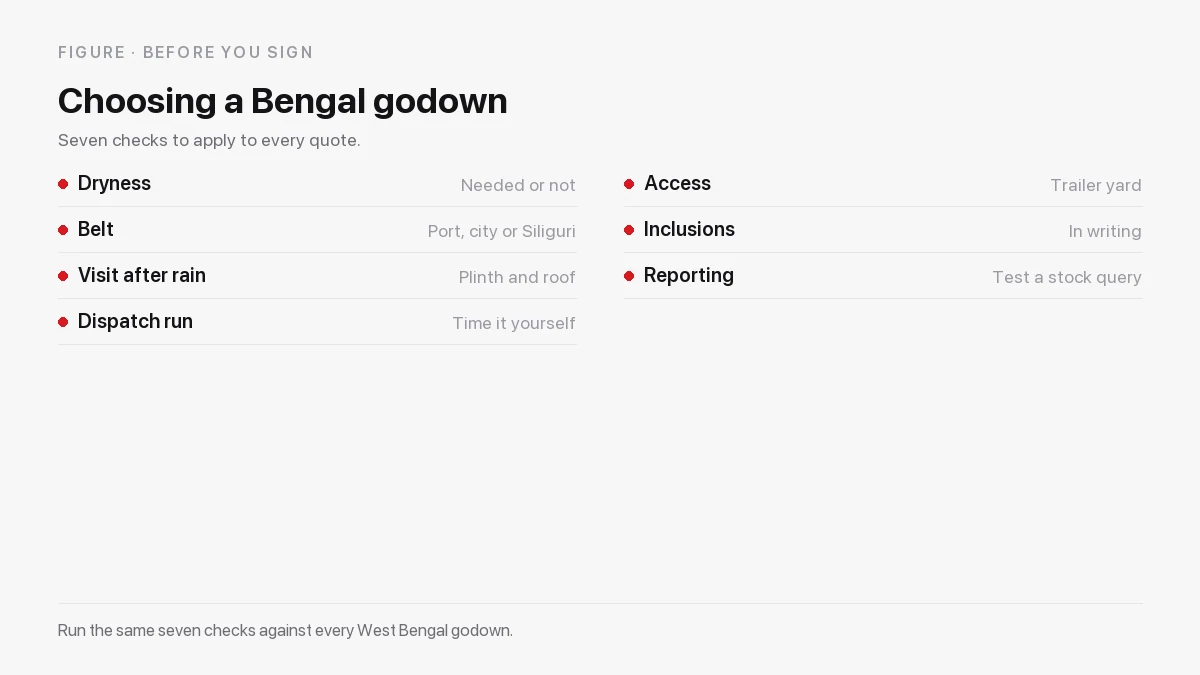
Run this list against us the way you would against any operator on the belt. An hour of checking here saves months of explaining later.
- Decide how dry the room has to be. Paper, jute, tea, packaged food and leather need a controlled, ventilated floor. Machinery, metal and furniture do not, and you should not pay for one you do not need.
- Match the belt to the flow. Port-linked cargo argues for the Sankrail–Howrah belt; North-East distribution argues for a staging point at Siliguri; a purely local seller can sit anywhere with a clean last mile.
- Visit after rain, not before. Look at the plinth height, the roof, the drainage outside the gate and where the water went last monsoon.
- Time the dispatch run yourself. Drive the route at the hour you would really be sending the truck, not at noon on a Sunday.
- Check access, not just the address. A yard a trailer can reverse into beats a godown down a lane with a height barrier, whatever the racking looks like.
- Get inclusions in writing. Racking, pallet trucks, security, housekeeping, pest control, and who pays for the power the ventilation consumes.
- Test the reporting. Ask for a sample stock report and send one query you would genuinely send in week one, then judge how long the answer takes to come back.
Red flags, roughly as they tend to surface: a quote that will not say whether GST is included; a claim of a "dry" godown with goods stacked straight on the floor and no pest schedule; an operator who cannot produce a fire clearance or a trade licence; a monthly rate that turns out to carry a yearly minimum; a facility that cannot tell you which room your pallets will sit in until you arrive with the truck; and a price that is well below everything else on the belt for no stated reason.
A worked example: a jute-goods trader consolidating three godowns
A Howrah trader in jute bags and sacking kept stock spread over three small rented godowns, no two of them in the same lane. Each lease looked reasonable in isolation. Added up, they were costing more than the rent column admitted. One buyer order could be split across two rooms, the supervisor burned a morning driving between them to count stock, and the monsoon left its mark once a year: bales in a low-lying room came out with damp patches and were sold down at a loss.
The requirement that came out of that bad season was about 3,000 sq ft in one place, on pallets rather than on the floor, with a raised plinth, a roof that had been checked before the rains, and a pest-control schedule that was written down rather than promised. Loading access mattered too, because the goods left on trucks rather than in vans, and the address had to stay on the port-side belt so the inland container runs did not change.
On the published starting rate of ₹12 per sq ft per month, 3,000 sq ft works out to roughly ₹36,000 a month — read it as indicative only, since the real figure follows the unit, the term and the services you add. What the trader actually bought was one address on the paperwork, a stock position that could be counted without a drive, and a monsoon that no longer wrote off a corner of the year's margin. Requirements like that start with the units listed on the Sankrail, Howrah godown page.
How Lozy helps in West Bengal
Lozy runs 77+ warehouses and more than a million square feet of live space, and West Bengal carries four collection centres in the network, including Kolkata and Siliguri. The state's anchor facility is a 20,000 sq ft godown at Sankrail, Howrah, with rack and floor storage for palletised trading stock, e-commerce inventory and distribution overflow, and truck access on the port-side industrial belt. Each booking gives you a defined floor or racked area of your own, 24/7 CCTV cover, on-site security and PIN access at the gate and at your bay.
Billing is monthly on a GST invoice with no long lock-in, and free doorstep pickup is included on bookings of 30 days or more across Kolkata and Siliguri, so shifting out of a rented godown or a factory corner does not have to pause the business. Everything the company runs is set out on the services page; a business that wants the managed version of a floor should start with business warehousing, those with a heavier palletised requirement with industrial warehousing, and anyone tracking stock lot by lot with inventory warehousing.
Prefer to see the space before you commit? Browse what is free right now, or send the team your goods type, the rough area and the week you need to move.
The West Bengal location page shows the state's own coverage, and the locations hub covers the rest of the network if your goods move beyond Bengal.
Also in Delhi NCR
A Kolkata seller who starts shipping north usually keeps the Sankrail floor and adds one in NCR rather than hauling stock up the Grand Trunk route per order. The guides to warehousing in New Delhi and the NCR city posts cover the addresses northern buyers pick most, and holding once in the north is generally cheaper than moving every parcel.
The sibling guides cover the neighbours: warehousing in Odisha on the east-coast corridor towards Paradip and Bhubaneswar, Bihar as the northern link on the same route, Jharkhand for the mineral belt west of Bengal, and Assam at the far end of the Siliguri corridor. For how shared floors are run, see the guide to commercial warehousing, and tracked-lot storage is explained in the guide to inventory warehousing. A few-weeks booking and a household move are both served by the monthly plans on the self storage side.

Need warehouse space in West Bengal?
Tell us the city and the size you need — we reply with a rate and the options available now.
Get a quoteCall +91 93547 12345About the author
Lozy Editorial Desk. This guide was written by the Lozy Editorial Desk, the in-house team that covers warehousing, self storage, logistics and customs/EXIM topics for lozy.in. We write from Lozy's own facility and pricing information and from public, citable sources. We do not publish invented statistics, ratings or reviews.
Sources. The facility counts, rates and coverage quoted here are Lozy's published figures rather than third-party estimates. Port and shipping context comes from the Ministry of Ports, Shipping and Waterways; state industry context from the West Bengal Industrial Development Corporation and IBEF's West Bengal profile; commodity context for jute and tea from the Office of the Jute Commissioner and the Tea Board of India. GST registration and input credit are described from the GST portal, and industry representation from the Warehousing Development and Regulatory Authority. Readers weighing up more than one state before they call will find the same no-gloss approach across the Lozy blog.
Last updated: 13 October 2026. Have a question the FAQ below does not answer? Call +91 93547 12345 or email care@lozy.in.
Need warehousing or storage in India?
Request a free, tailored quote in under 2 minutes — free pickup, no lock-in.