Warehousing in Jharkhand: The Ranchi Belt, Steel Stock and the Port Run
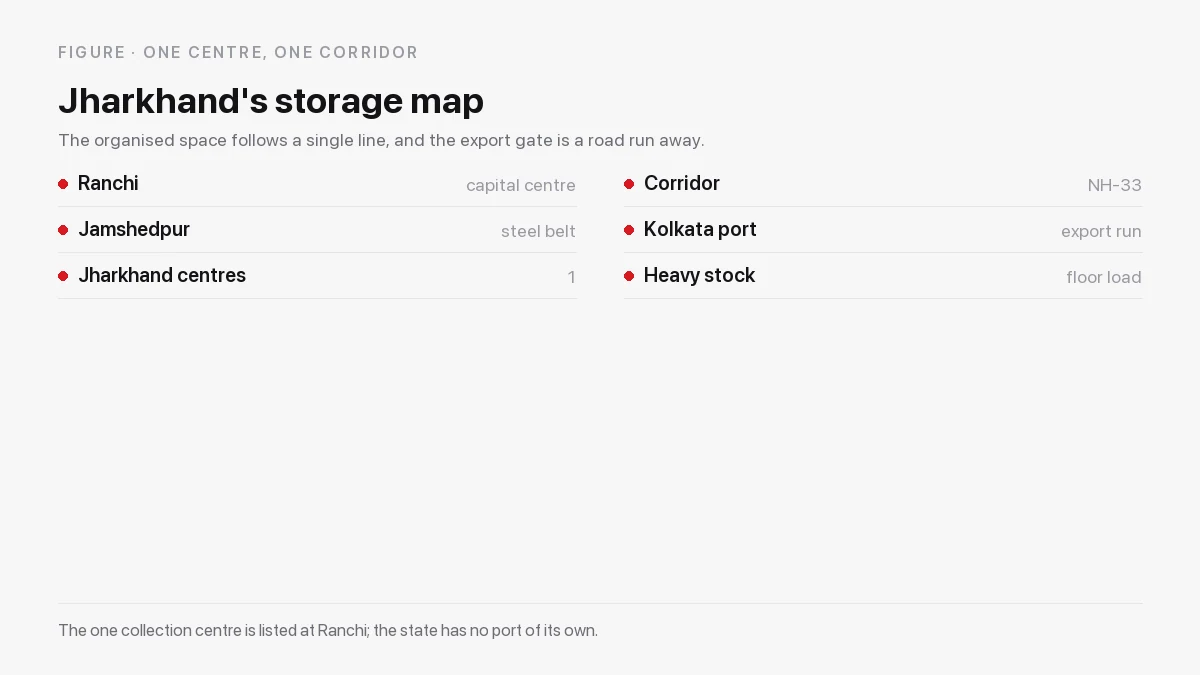
Short answer: warehousing in Jharkhand comes down to one corridor and one export gate. The state's industrial demand runs along the Ranchi–Jamshedpur belt, where steel, mining and plant supply chains need heavy, accessible floor space, while the finished goods that leave Jharkhand for overseas buyers mostly travel east by road towards the port complex at Kolkata. Lozy serves the state through 1 collection centre, listed at Ranchi — which is why one well-placed godown in the capital does more work here than several scattered sheds would. This guide covers the belts, what Jharkhand stores, the paperwork and what the space costs.
Key takeaways
- Jharkhand carries 1 collection centre in Lozy's network, listed at Ranchi, and it acts as the pickup point for the whole state rather than for a single district.
- Demand concentrates on the Ranchi–Jamshedpur corridor along NH-33 — the steel and heavy-engineering belt where sections, coils and plant spares fill most of the organised floor space.
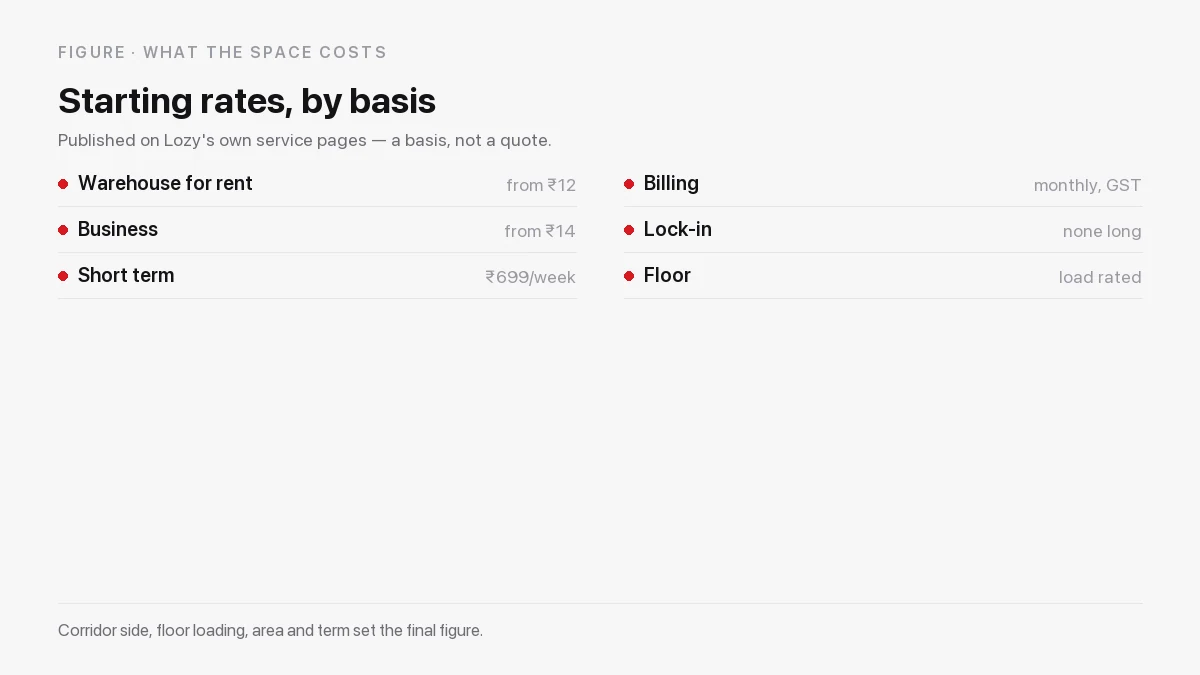
- Space for rent is published from ₹12 per sq ft per month, a managed business floor from ₹14 per sq ft per month and short-term storage from ₹699 per week, each billed monthly on a GST invoice.
- Jharkhand has no port of its own, so export stock is positioned on the corridor and moved east on a scheduled road run towards Kolkata rather than held at a terminal.
Why warehousing in Jharkhand comes down to one corridor
Most states hand a storage buyer several separate markets to weigh against each other. Jharkhand hands you a line. The state's industry was built along a single axis — the road and rail spine that joins the capital, Ranchi, to the steel city of Jamshedpur — and almost every organised storage requirement in the state is really a question about where you sit on that line. Get the position right and the rest follows; get it wrong and you end up trucking goods across the state to reach customers who were never far away.
The reason the belt holds is industrial rather than administrative. Jharkhand's economy rests on minerals and metals — iron ore, coal, bauxite and the plants that convert them into steel, alloys and heavy engineering — and those plants and their supplier networks are clustered along the Ranchi–Jamshedpur corridor. A warehouse serving that economy is buying proximity to the customer, not a postcode, and that is a different kind of decision from renting a shed in a state where the customers are households.
What the corridor does to your access
NH-33 carries the bulk of the road freight between the two cities, and it is the single most useful piece of geography for a Jharkhand storage decision. A unit on the Ranchi side is a short run from the capital's trading houses and its consumer market, while a unit nearer Jamshedpur sits closer to the steel plants and the engineering units that supply them. Both are workable. What is not workable is a shed that looks cheap on paper because it sits in a district with no freight passing through it. Confirm what is genuinely available on the Jharkhand coverage page before you let a headline rate decide it for you.
There is a second, quieter reason the corridor matters. Jharkhand's land and power are cheaper than in the metros, and its industrial land has been developed for exactly this kind of use, so the constraint on a storage plan here is rarely the cost of the building — it is the cost of moving stock to and from the wrong side of the state. Buy the position, and the rent usually takes care of itself.
The Ranchi belt: the state's one collection centre
Ranchi is Jharkhand's capital and its largest consumer market, and it is the single collection centre Lozy lists in the state. That matters more than the number suggests. Because pickup and first-mile movement in Jharkhand are routed through Ranchi, a business anywhere from the Hazaribagh side to the southern districts can have stock collected in the capital and moved into the unit that suits it, instead of having to open a godown in every district it happens to sell into.
The capital's own storage demand has two faces. One is trade: wholesale, FMCG distribution and building material serving the capital region all want a floor close to the market and reachable by a small truck several times a day. The other is institutional and administrative: files, records and equipment that public offices and private firms in a capital city generate continuously need a secure, dry place to sit. Neither of those needs a container yard, and both are better served by a compact, well-run unit than by a large floor on the edge of town.
Why the capital holds the network thread
Ranchi earns its place as the state's node for a practical reason rather than a symbolic one. It sits at the junction of the roads that fan out across the state, it has the rail and air links, and it is the only Jharkhand city with a genuinely broad local consumption base on top of its industrial role. A collection centre here is not competing with Jamshedpur's factories for space; it is doing the collection, holding and distribution job that a state capital naturally does. If your requirement is stock that has to be counted in, held safely and released in small lots, the Ranchi side is where it belongs.
The Jamshedpur steel belt and the state's heavy stock
Jamshedpur is the second anchor of the corridor and the heavier end of the state's economy. The city grew around steel, and the supply chain that still surrounds it is what fills the industrial floor space on this side. What arrives at a Jharkhand warehouse is almost never the ore itself — it is the finished and semi-finished output of that chain: sections, plates, coils, alloy and aluminium stock, and the enormous consumable tail a plant runs on. Drill bits, conveyor belting, crusher and mill liners, electrodes, refractory bricks, lubricants and the tyres that only a mine haul truck uses.
That stock is dense, high-value and largely indifferent to humidity, which is the opposite of the problem a coastal state has to solve. Its requirement is capacity and access: a floor that can carry the weight, aisles wide enough for a forklift to work a full pallet, and a yard a trailer can enter and turn inside without a shunt. For a supplier holding mixed palletised stock — a few spares here, a rack of consumables there — the useful specification is load-bearing rather than climate-controlled. That is the demand that settles on the Jamshedpur side of the corridor, and the service built for the larger floor plates it needs is described on the industrial warehousing page.
The consumables tail, and why it wants a rack
The least glamorous part of the belt is also the steadiest. Every plant in and around the corridor buys small parts continuously — fasteners, seals, bearings, filters, hoses, instrumentation, safety kit — and a distributor who serves them holds thousands of lines rather than a few pallets of one product. That is a racked-storage requirement, not a floor requirement, and it rewards a unit where each line has a fixed position and a stock figure that can be produced on a working day rather than reconstructed at month end. Tracked, lot-level storage of exactly this kind is what the inventory warehousing product is built around.
The export run: Jharkhand has no port, so the port is a road decision
Jharkhand is landlocked, and that shapes its export logistics more than any single road does. There is no terminal inside the state to hold stock against, so the port a Jharkhand exporter actually uses is the complex at Kolkata, reached by road and rail to the east. The practical consequence for storage is that shipment-ready stock is normally held on the corridor rather than anywhere near a quay: the goods, the documents and the sales office stay in one town, and a truck leaves when a vessel position firms up. Nobody pays port-side rent for the weeks in between.
Getting that arrangement right is mostly about the question you ask a prospective warehouse. Two matter more than the rate. How long does the run towards the port really take on a working day, once the corridor's traffic is factored in? And has the facility handled loading a container or consolidating a consignment before? A shed that has never prepared an export load will learn on your cargo the first time one is due, which is the wrong time to find out. For stock that will be assessed for duty on entry rather than cleared on arrival, the arrangements are different again, and the customs bonded warehousing route is the one to read.
Who stores what in Jharkhand
Four pools account for most of the occupied floor space in the state, and no two of them want the same building. The good news for anyone comparing Jharkhand with a coastal market is that only one of the four cares about the weather at all.
Steel, alloy and heavy-engineering stock
This is the largest single driver of industrial storage in Jharkhand, and it follows the belt. Sections, plates, coils, billets and alloy stock, together with the semi-finished material that moves between plants, all need an ambient floor with genuine load-bearing capacity rather than a controlled climate. What it asks for instead is width and height: aisles that let a forklift work a full pallet, a roof high enough to stack, and a yard that a trailer can use without a shunt. A unit that cannot state its floor loading in writing is not a unit for this stock, whatever the racking looks like.
FMCG and consumer distribution into the districts
Jharkhand's retail trade runs out of the capital region into the districts, and a distributor's problem here is a route problem as much as a space problem. Stock has to be held close enough to Ranchi to serve daily trade and far enough out to load a district van without fighting city traffic. Fast-moving goods also carry dates, so rotation decides whether storage is a cost or a write-off: a facility that cannot show which batch is older will cost a distributor money it never attributes to the warehouse.
E-commerce and small-business storage
The state's online sellers sit alongside the traditional trade, and their requirement is the smallest and the most precisely defined in the market. Stock is received, barcoded and racked pick-ready, then each order is picked, packed and handed to a courier on a schedule rather than a scramble. A seller running a marketplace account and its own storefront wants one floor feeding both channels, with a stock view it can check on any working day. For households and small firms moving between addresses, the need is simpler still — a dry, secure, individually accessible unit booked for months rather than years, which is what the per-unit product on the self storage page exists to serve.
What warehouse space in Jharkhand costs
Three of Lozy's published starting rates cover what a Jharkhand requirement normally turns out to be. Godown and warehouse space on rent is listed from ₹12 per sq ft per month. A managed business floor — security, housekeeping and reporting built in rather than left to you — begins at ₹14 per sq ft per month. Short-term storage, for a shipment window or a few weeks of overflow, is published from ₹699 per week. Billing is monthly on a GST invoice, and nothing here carries a long lock-in.
Read those as starting points and not as quotes. What a Jharkhand unit actually costs follows the position on the corridor, the floor area and the term, and a heavy-stock unit with extra floor loading is a different product from a light storage bay of the same size. For how storage rent itself is structured, apart from the state, the guide to warehouse space for rent is the closer read.
The four things that move a Jharkhand rate
- Which side of the corridor. Ranchi-side space is priced partly on city access and daily distribution; Jamshedpur-side space is priced on proximity to the plants and the yard a heavy load needs. They are not the same product.
- What the floor can carry. A slab rated for stacked steel and a floor suited to light pallets cost different amounts to build, and a facility that has invested in the heavier one knows it.
- What the area is measured on. Compare one bay against one bay and a quoted floor area against a racked position, rather than a headline rate against a headline rate.
- How long you commit for. A one-month booking and a twelve-month arrangement are priced on different bases, and the longer commitment usually brings the lower monthly number.
| Where the unit sits | What it suits | The route that carries it |
|---|---|---|
| Ranchi and the roads out of the capital | FMCG and retail distribution, e-commerce fulfilment, wholesale trade, household and business storage | NH-33 and the capital's own consumer market |
| The corridor between Ranchi and Jamshedpur | Steel and alloy stock, plant and mine spares, consolidation before shipment, larger floor plates | NH-33, with a short run to either city |
| The Jamshedpur industrial edge | Heavy-engineering stock, fabrication and consumables, plant-to-warehouse movement | Plant roads and the belt's own freight network |
| Consolidation before an export run | Shipment-ready stock and container staging heading east | The corridor road run towards the Kolkata port complex |
Treat that table as a routing decision rather than a menu. Ranchi does the collection and the last mile, the middle of the corridor does the holding and the heavy stock, and the export arithmetic only makes sense if the unit is positioned for the run towards Kolkata instead of against it. Every unit behind those options sits on the Jharkhand locations page.
Licences, GST and the paperwork in Jharkhand
Get these straight before the first truck is loaded rather than after, because two of them behave differently in a state with heavy industry and no port.
GST, the invoice and input credit
Rent on storage in Jharkhand carries GST, and a registered business can recover that tax when the paperwork is right: the invoice raised in your own entity's name, as a tax invoice rather than a receipt or a cash memo, itemising storage and handling separately so an accountant can post it without a query. Confirm what that document will look like before you book, not at year-end. A clean monthly tax invoice is what keeps storage rent recoverable; rent paid in cash with nothing behind it stays a permanent cost. The registration thresholds and the input-credit conditions a Jharkhand business has to meet are set out on the GST portal.
Approvals, fire clearance and the goods list
Three things deserve an answer before anything else is discussed. Who approved the building, and can the occupancy and fire clearances actually be produced? Organised industrial land in Jharkhand is developed and allotted by the state, so a unit inside an approved estate inherits a land-use position that a standalone shed on private ground has to establish on its own; the state's own administration publishes its industrial and governance information through the Government of Jharkhand. Next, establish what the facility declines to take. Solvents and flammables, food without its licence, strong-smelling goods and anything that needs a pest-separated bay are either given a dedicated bay or turned away — learn which on the phone, not at the gate.
Cover, inventory records and receiving
The receiving step is where most storage disputes are actually created. A photographic inventory, checked against your own count at the door, is what turns a shortage discovered three weeks later into a short email rather than an argument. Tell your insurer where the goods sit and how they are held: a policy written for a locked godown of your own and one written for a shared managed floor are different risks, and the facilities in this state hold everything from light cartons to stacked steel. Where the stock is high-value or regulated, the batch- or SKU-level tracked model is set out on the inventory warehousing page.
How to choose a Jharkhand warehouse — and the red flags
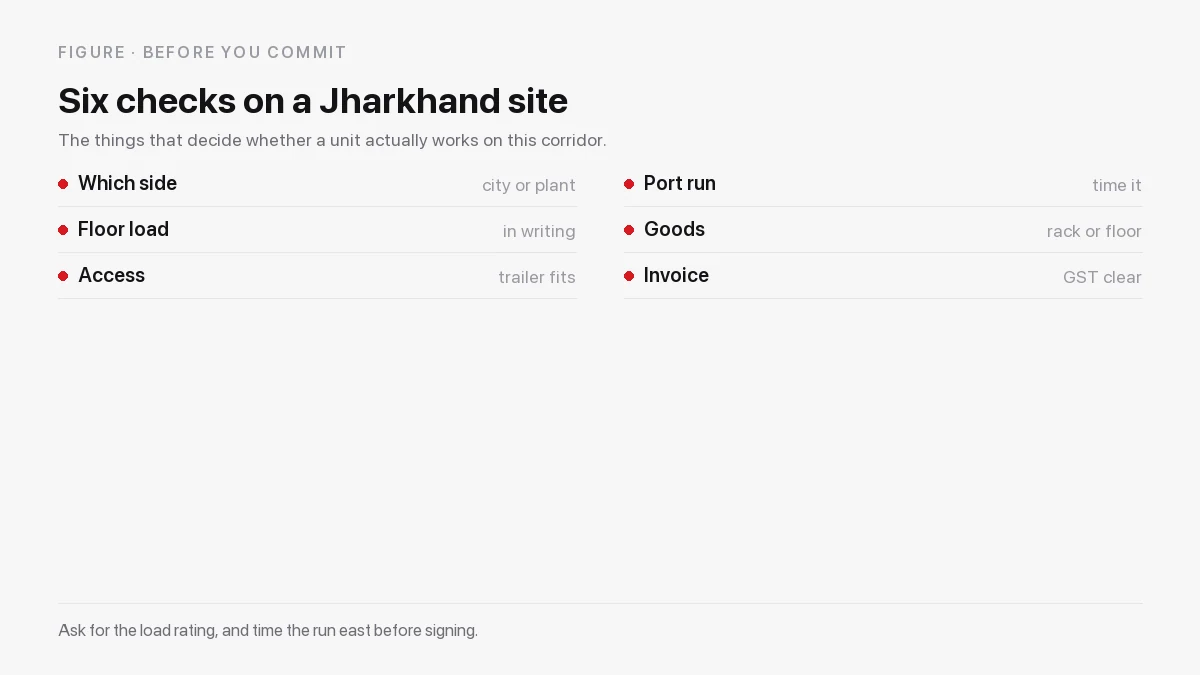
Run this list at the viewing. Everything on it is visible on site, which is why an hour in the yard is worth more here than a longer quotation.
- Fix your side of the corridor first. Stock that serves shops, households and offices inside the capital region belongs on the Ranchi side; steel, plant consumables and heavy engineering stock belong nearer Jamshedpur.
- Ask for the floor loading in writing. Coils, sections and palletised spares are dense, and a slab that has never carried them should say so before you stack anything on it.
- Walk the yard before you believe the map. What matters is whether a loaded trailer can enter and turn inside; around Ranchi and Jamshedpur plenty of sheds read well on paper and fail at the gate.
- Time the run towards the port. If part of your volume ships east, drive the route at the hour your truck would really leave, and ask when the terminal stops taking entries.
- Match the goods to the floor. Racked positions for a long consumables list, open floor for stacked steel and bulk pallets, and a clean bay for anything whose smell or dust cannot mix.
- Write down what the rate includes. Racking and pallet trucks, night security cover, housekeeping, pest control, and who carries the power bill for lighting and ventilation.
- Ask what arrives after a receipt. A written stock note and a named person who answers mid-month is worth more than a glossy brochure, especially when stock sits in two states.
What should stop you, roughly in the order these things surface: a rate that never says whether GST sits inside it; a floor marked for stacked steel with no stated load rating; a facility that only decides which bay is yours when the truck is already at the gate; missing occupancy or fire clearance; a monthly figure that hides an annual minimum; an operator who has never prepared an export load but quotes confidently on port timings; and a yard whose approach a loaded trailer has clearly never used.
A worked example: a Ranchi supplier out of two godowns
A Ranchi-based distributor of steel consumables and plant spares held stock in two rented godowns on opposite sides of the city. Each looked cheap by itself. Together they were expensive in ways the rent column never showed: one order could be split across both buildings, an accountant spent mornings reconciling two handwritten registers into one stock figure, and the fast-moving lines were always in the wrong shed for the day's deliveries.
What that arrangement finally produced was a specification rather than a wish. Roughly 2,500 sq ft under one roof, a racked section with a fixed position for every line, an open bay for the heavier palletised stock, an aisle wide enough for a forklift, and a receiving process that leaves a usable stock position behind it without anyone filling in a register afterwards.
Two and a half thousand square feet at the published starting rate of ₹12 per sq ft per month comes to about ₹30,000 a month before any add-ons — indicative only, since the unit, the access and the term all move the final figure. What the distributor gained was harder to price: one address on the invoices, a count that could be trusted on any working day, and no more shuttling between two sides of the city to confirm what was in stock. Requirements like that one begin with the space listed on the Jharkhand locations page.
How Lozy helps in Jharkhand
Lozy runs 77+ warehouses and more than a million square feet of live space, and Jharkhand carries one collection centre in the network, listed at Ranchi — the state's live inventory sits on the Jharkhand coverage page. A booking brings a defined racked or open floor area of your own, 24/7 CCTV, on-site security and PIN-controlled access to gates, lifts and your storage bay, and the network is arranged so a business can move from a small floor to a bigger one in the same state with the same operator. Larger distribution capacity in the wider network, such as the multi-bay Jamalpur distribution centre, is what a Jharkhand exporter leans on when stock is consolidated before it heads east.
The arrangement is monthly on a GST invoice, with no long lock-in and free doorstep pickup included on bookings of 30 days or more — so moving out of a rented godown or a corner of a factory does not have to interrupt trade. What the company offers across its services is set out on the services page, with business warehousing for the managed floor a distributor usually needs, warehouse for rent for a plain godown floor, and short-term storage for a few weeks rather than a year. To check availability before deciding, look through the warehouse listing for what is free in the state right now, or send us the goods type, the approximate area and the week you want to move. If your stock moves beyond Jharkhand, the locations hub shows the rest of the network.
Also in Delhi NCR
A Jharkhand business that starts shipping to northern buyers usually keeps its Ranchi floor and adds one in NCR rather than trucking northern demand up the corridor on every order. Warehousing in New Delhi covers the capital's own market and Uttar Pradesh the neighbouring state; on this side of the map, West Bengal carries the port traffic, Bihar the northern link on the same road, and Odisha the coast to the south. Shared-floor operations are explained in the guide to commercial warehousing, and the per-unit model a household or small business books is covered under self storage.

Need warehouse space in Jharkhand?
Tell us the city and the size you need — we reply with a rate and the options available now.
Get a quoteCall +91 93547 12345About the author
Lozy Editorial Desk. This guide was written by the Lozy Editorial Desk, the in-house team that covers warehousing, self storage, logistics and customs/EXIM topics for lozy.in. We write from Lozy's own facility and pricing information and from public, citable sources. We do not publish invented statistics, ratings or reviews.
Sources. Every count, rate and coverage figure quoted in this article is one of Lozy's own published numbers rather than a borrowed third-party estimate. State economic context comes from IBEF's Jharkhand profile; highway corridor context from the National Highways Authority of India; state governance and industrial context from the Government of Jharkhand; industry context from the Warehousing Development and Regulatory Authority; and policy releases from the Press Information Bureau. GST registration and input credit are described from the GST portal, linked above. Anyone comparing Jharkhand with a neighbouring state before making the call will find the same plain treatment across the Lozy blog, which covers warehousing, self storage and customs.
Last updated: 13 October 2026. Have a question the FAQ below does not answer? Call +91 93547 12345 or email care@lozy.in.
Need warehousing or storage in India?
Request a free, tailored quote in under 2 minutes — free pickup, no lock-in.