Warehousing in Jammu and Kashmir: The Jammu-Srinagar Split and the Seasonal Road
Short answer: warehousing in Jammu and Kashmir is not one market but two, joined by a single hill road. Jammu sits at the foothills, where the climb into the mountains begins; Srinagar sits inside the valley, at the far end of the same road. Lozy lists 2 collection centres in the state, one at each end, inside a network of 77+ warehouses and more than a million square feet of live space. This guide covers what each end stores, the fruit and handicraft seasons that set the local calendar, how a closed road changes a stock plan, and what space costs.
Key takeaways
- Jammu and Kashmir carries 2 collection centres in Lozy's network, named at Jammu and Srinagar — one on the foothills, one inside the valley, both reached by the same NH-44 run.
- The two ends hold different goods: Jammu stores foothill wholesale and inventory staged for or arriving from the plains, while Srinagar holds valley trade, horticulture and handicraft stock that cannot be replaced mid-season.
- Warehouse and godown floor for rent is published from ₹12 per sq ft per month, a commercial floor from ₹13 per sq ft per month and household storage from ₹1,499 per month, each billed monthly on a GST invoice.
- The planning risk here is the road rather than the rent: the hill section can close for landslides in the monsoon and for snow in winter, so valley stock is built up before those windows instead of being ordered through them.
Why warehousing in Jammu and Kashmir is two markets, not one
Most states arrange their storage around a single belt, and the buyer's only question is where inside that belt to sit. Jammu and Kashmir does not work that way. Its two collection centres are separated by a mountain road rather than by a few kilometres of one city, and the goods held on either side are largely different goods bought by different trades. A storage decision here is first a decision about which side of the mountain your inventory belongs on.
The road is part of the supply chain here rather than a line on a map. Everything moving between the two cities uses the same hill section, so both markets carry a transport risk that no amount of square feet can insulate a business from. A trader holding stock at each end is not hedging on sentiment; the second floor is what keeps the shop open on the days when nothing moves through the pass.
Stock that serves the plains-side market, or that is waiting for a valley order to firm up, belongs at the Jammu end where the network's road connections run south; stock that must be on a shelf in the valley through a closed road belongs in Srinagar, and no cheaper rate in Jammu is a substitute for it. The state's coverage is set out on the locations hub, and the road that feeds it is described in the neighbouring guide to Punjab coverage.
Jammu: the foothill end and the first stop north
Jammu is where the plains end. Consignments arriving from Punjab and the wider northern network land here first, and a good share of them are broken down, re-lotted and sent on again rather than travelling through untouched. That gives the city a distribution character rather than a manufacturing one: wholesale trade for the Jammu region and the districts around it, building material, FMCG and consumer stock for the local market, and inventory held deliberately on the plains side by an owner who wants a northern address without committing the whole of the stock to the valley.
It is also the sensible place for a business whose valley demand swings through the year. Stock can be accumulated here, released up the road when the highway is clean and held back when it is not, without the goods ever being stranded at the wrong end of a blocked route.
Srinagar: the valley end, where stock cannot wait for the road
Srinagar serves a market that sits a long way from every alternative source. With the hill section open, a truck up from Jammu is roughly a day's run; with it closed, the valley trades on what is already inside. That single fact gives a valley floor its value. Distributors, retailers, fruit packhouses and handicraft exporters all hold more stock, and hold it earlier, than a plains business turning over the same volume would. The extra holding is not inefficiency — it is the local cost of distance, and cheaper than the alternative of running out.
The valley also stores goods the plains network rarely sees. Fruit and its packaging, handicrafts, handloom and the material all three consume shape a Srinagar requirement, and none of them behaves like a general merchandise floor. That, more than the rent, is why the choice between the two ends is rarely a close call. Availability at either end is confirmed through the locations hub rather than assumed from a listing.
The seasonal road: why a stock plan here starts with the calendar
Ask a Jammu and Kashmir business what constrains its storage and the answer is usually not space and not price. It is the two windows in the year when the hill road becomes unreliable. Through the monsoon the risk is landslides and slope failure on the mountain section; in winter it is snow and ice. Neither is an emergency in the way a flood is — both are regular enough to plan around — and the businesses that find this state easy to operate in are the ones who treat the season as a storage input from the start.
The fruit season sets the valley calendar
Horticulture is the valley's largest single storage story, and it is a timing business before it is a space business. The valley harvest runs through the autumn, and the grading, packing and dispatch that follow compress into the same few weeks before the road turns difficult. Cartons, trays, liners and packing machinery build up ahead of the season and clear during it, so a facility serving the trade at the valley end needs flexible floor rather than a fixed allocation: the same bay can hold packaging in one month and graded fruit in the next. Anything an exporter wants out before the passes close must be planned backwards from that cut-off.
The winter window and the stock kept for it
From roughly December into March the arithmetic changes completely. A valley retailer wants enough cover in hand to keep trading through a shut road, which means weeks of stock rather than days; a household wants somewhere to put what it is not using; a distributor wants a position in Srinagar that does not depend on the next convoy getting through. Floor taken in the valley for the whole of that window is doing a different job from floor taken for a single month in summer, and it is worth saying so when you ask for a rate, because the facility is planning its own occupancy around the same calendar.
The monsoon on the hill section
The summer risk is the shorter and less predictable of the two. A slope failure can stop the highway for a day or a week with little warning, and the effect is felt at both ends at once — a stock-out in the valley and a stranded consignment on the plains. The answer to both seasons is the same: hold inventory at both ends where the volume justifies it, or at least have an arrangement at the foothill end that lets a valley-bound consignment wait safely indoors until the road clears.
Who stores what in Jammu and Kashmir
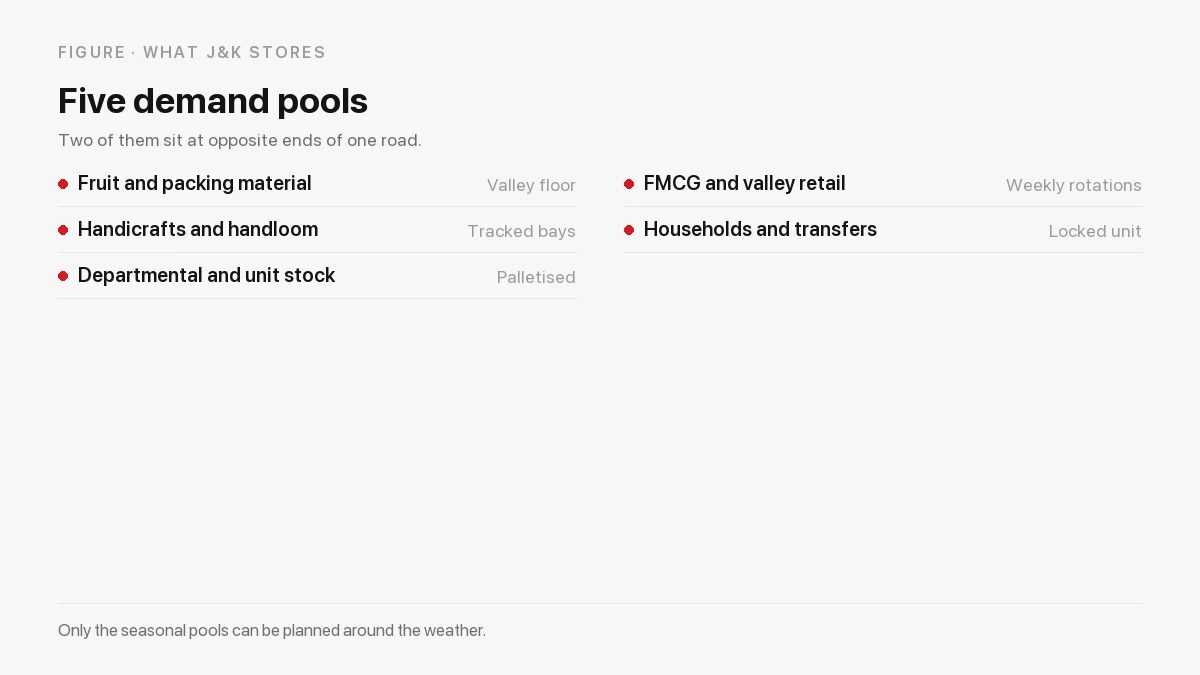
Five groups occupy most of the organised square feet across the two ends of the state, and few of them would recognise another's requirement as their own.
Fruit, horticulture and the packing trade that feeds it
The fruit trade is the valley's biggest consumer of covered floor and its most seasonal one. An orchardist, a commission agent and a packhouse each hold something different: graded fruit waiting on a buyer, consignment stock moving through to a mandi, and the cartons, trays, liners and paper that all of it is packed in. None of it tolerates a damp floor, and stacked cartons lose their compression strength long before anything feels wet, so a raised deck and a stated clearance from the walls matter more here than the finish of the building. The season cannot be pushed back if the space is not ready, which is why valley packing material is normally bought into stock months early.
Handicrafts, handloom and export consignments
Handicraft and handloom stock behaves like nothing else on a warehouse floor. The valley's output is high value per kilogram, often fragile or crush-sensitive, and frequently held against an order rather than a season, which makes an accurate record of what sits in which bay worth more than a cheap rate. Export consignments add a second layer: goods waiting on a buyer's inspection, a payment or a shipping date must be identifiable and releasable on demand, and the paperwork has to match what actually leaves. That is the case for tracked stock rather than a bare floor at either end of the state, described on the inventory warehousing page.
Posted families, unit stores and departmental supply
A large share of the state's population is here on a posting rather than permanently, and that shapes storage in a way most markets never have to think about. Households move in and out on transfer cycles, so furniture, appliances, winter kit and personal effects need a home between two addresses, while institutional and departmental stores hold consumables, uniforms, spares and ration-type stock against long routes. These requirements are steady, palletised and rotation-driven, and they reward a facility that can hold several small allocations under one roof.
FMCG, retail and e-commerce for the valley
The valley's retail trade runs on stock manufactured hundreds of kilometres away, so a distributor's problem is replenishment before it is space. Valley stock has to sit close enough to the city to service modern trade and general trade weekly, and deep enough that a closed road does not empty the shelves. Fast-moving goods also carry dates, which makes rotation a storage requirement in its own right: a facility that cannot show where the older batch sits will quietly cost a distributor write-offs it never attributes to storage.
Households, transfers and self storage
The smallest requirement in the state is also the most common one: a household that needs furniture, appliances, documents, bedding or shop fixtures kept somewhere dry and secure for a few months, not a container yard for a few years. None of it needs an industrial floor, and all of it needs a unit in Jammu or Srinagar that can be locked, accessed without an appointment and paid for by the month. Household storage from ₹1,499 per month is the product built for exactly that pattern, and the details sit on the household warehousing page.
The corridors goods move along
Three movements matter in this state, and the same highway carries all three.
NH-44 and the approach from Punjab
Almost every commercial consignment entering the state comes up NH-44 from the Punjab side and reaches Jammu before anything else happens to it. That is why the foothill end behaves like a distribution hub: it is the last place on the route where a load can be split, re-labelled or held before the climb has begun. A unit with a short, clean run to the highway can send goods south overnight and release a valley consignment the same morning. For the supply side of that route, the Punjab state guide covers where northern stock is held before it starts moving.
The hill section and the cost of a closed road
Beyond Jammu the road climbs, and this is the stretch that makes the state's storage market unusual. Its condition varies with the season, and the one thing a business can rely on is that the route will be interrupted at some point in the year. A warehouse cannot solve that, but it can absorb it: a floor at the foothill end lets a consignment wait indoors and load the moment the route reopens, which is the difference between losing a few days and losing the sale. If your volume supports one position only, put it where your customers are rather than where the rent is lowest.
The valley end and distribution inside it
Inside the valley the pattern is familiar: a city floor serving modern trade and general trade, a packhouse-facing position for the fruit trade, and a secure unit for a household or a small business. Delivery runs are short by national standards, so the deciding question in Srinagar is rarely distance and usually access — whether a loaded truck can reach the door and turn, and whether goods are released at the hour your customer needs them. Both ends of the state are listed through the locations hub.
What warehouse space in Jammu and Kashmir costs
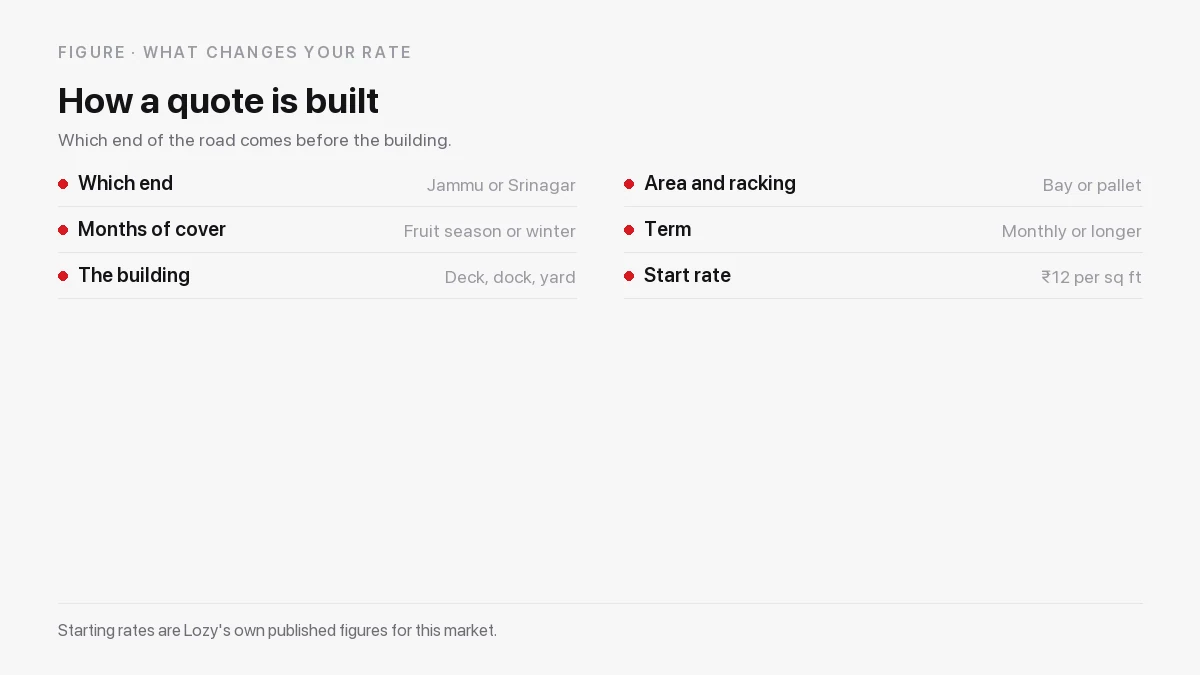
Three of Lozy's published starting rates cover what a requirement in this state usually turns out to be. Godown and warehouse floor for rent here is published from ₹12 per sq ft per month. A commercial floor — the managed version taken by a distributor or a trading business rather than a bulk user — starts at ₹13 per sq ft per month. Household storage, the per-unit product a family or a posted officer books, begins at ₹1,499 a month. Every rate here is billed monthly on a GST invoice, and none of the three carries a lock-in beyond the month you take.
Treat all three as starting points for a specific bay in Jammu or Srinagar rather than as quotes. What you actually pay here follows the unit, the floor area, the term and what the goods need from the building. A ground-floor bay a 32-ft truck can enter and turn in, and a first-floor godown reached by a lift and a narrow lane, are two different products at two different numbers. How the rent line itself is built, independently of this state, is worked through in the guide to warehouse space for rent.
What actually moves the number here
- Which end of the road. Jammu space is bought for proximity to the plains network; Srinagar space carries the extra weeks of holding that a closed road forces on the tenant. They are priced as two separate markets because they behave as two.
- How long you hold it. A valley retailer covering a winter needs four or five months, a packhouse needs the harvest weeks, and a household needs as long as a posting lasts. The same bay at different terms is a different price.
- The building and the yard. A floor a loaded truck can enter and turn in, with a raised deck and a drain that carries water away from the door, is worth more than a larger shed behind a lane nothing can reverse out of.
- The goods. Fruit, cartons and handloom want a dry floor and clearance from the walls; building material, machinery and departmental stock want load capacity, wide aisles and a yard.
| Where the unit sits | What it suits | The road that carries it |
|---|---|---|
| Jammu and the foothill belt | Foothill and regional wholesale, FMCG and building material, inventory staged for or arriving from the plains | NH-44 south to Punjab and the northern network |
| Srinagar and the valley floor | Fruit and packhouse material, handicrafts and handloom, valley retail and distribution | NH-44 over the hill section, then the valley's own roads |
| A holding position at the foothill end | Consignments waiting for the hill road to clear, consolidation before the climb | The same highway, with the wait planned into the schedule |
| A household unit at either end | Furniture, appliances, documents and personal effects held while a house is shut or a posting runs | Local collection only — no hill run required |
Use the table as a routing decision rather than a price list. The foothill end does the holding and the breaking down, the valley end does the valley's own trade, and a waiting position at Jammu only earns its place if part of your volume genuinely waits on the road. Every unit behind that table is on the locations hub.
Licences, GST and the paperwork in J&K
Settle these before the first truck is loaded rather than after, because two of them behave differently in a state whose stock arrives over a single highway.
GST and the invoice
Rent on storage in Jammu and Kashmir carries GST, and a registered business can recover that tax when the paperwork is right: the invoice raised in your own entity's name, as a tax invoice rather than a receipt, with the storage and handling lines itemised the way an accountant needs to post them. Confirm what that document will look like before booking in Jammu or Srinagar, not at year end, because a proper monthly invoice is the difference between rent being a recoverable input and rent being a permanent expense. Registration and the credit mechanism are set out on the GST portal.
Premises, land and clearances
Two questions belong in the first conversation. Ask which authority approved the building, and whether the occupancy and fire clearances can be shown as documents rather than described in words. An organised unit here normally sits inside land developed and allotted by the state, so a facility on approved ground inherits a land-use position a standalone shed on private land must establish for itself. Ask any operator in the state to see the papers rather than hear about them. The state's economic picture is published by IBEF's Jammu and Kashmir profile, and policy releases come through the Press Information Bureau.
Regulated goods and what a shed will not take
Ordinary trade goods, packing material and household effects need nothing beyond the premises' own approvals. Packaged food being stored and distributed adds a food-safety licence; pharmaceuticals and medical devices add the wholesale drug licence, under which the premises itself is named and inspected. Horticulture consignments moving for export carry their own certification and inspection requirements, handled by the agencies under APEDA and the National Horticulture Board. Then ask what a unit in this state will not accept: solvents and flammables, strong-smelling goods, and anything needing pest-controlled separation are either handled in a dedicated bay or refused, and it is better to learn which on the phone than at the gate.
Documents for household and family storage
Storing a household in Jammu or Srinagar is a question of proof and inventory rather than licensing. Four items do the work: a photograph inventory countersigned when the goods go in, the depositor's identity and address papers, the declared value of anything insured, and a written note of who else may take things out. Where a family is posted away and a relative will collect an item, put the arrangement in the name of the person who will actually deal with the facility, so authority never has to be proved twice.
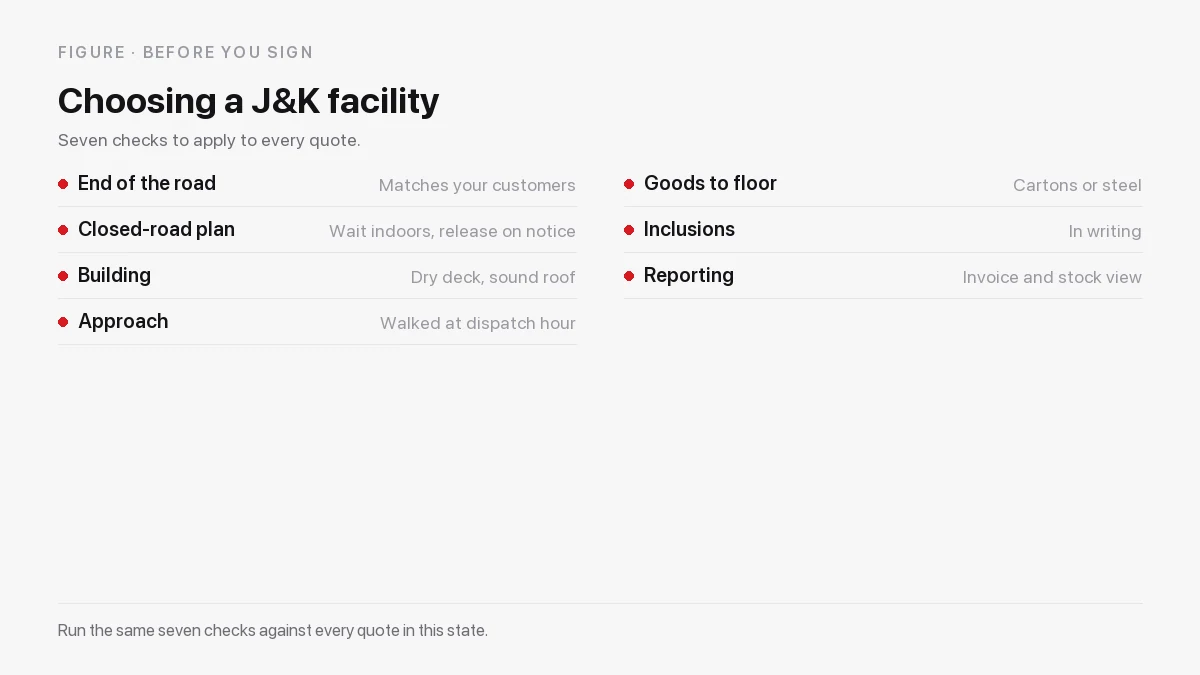
How to choose a J&K warehouse — and the red flags
Seven checks, and about an hour on site in either city, will stop the state's seasonal peak turning into a second move later in the year. All seven are visible if you go and look.
- Fix your end of the road first. Stock serving the plains-side market, or waiting on a valley order, belongs at the foothill end. Stock that has to be on a valley shelf through a closed road belongs in Srinagar.
- Ask how the facility behaves when the highway shuts. Whether a consignment can wait indoors, at what rate, and on what notice it can be released the moment the route reopens.
- Match the building to the goods. Fruit, cartons and handloom need a dry floor and wall clearance on the valley side; building material, machinery and departmental stock need load capacity and aisle width at the foothill end.
- Time the approach at dispatch hour. Drive the run from the gate to the highway at the hour your truck would really leave, and check a loaded vehicle can turn inside the yard rather than reversing into traffic.
- Walk the floor and the roof, not the paint. Plinth height, roof fixing, drainage and where the water went during the last heavy spell are the four things a wet month exposes.
- Write down what the rate includes. Racking and pallet trucks, night security cover, housekeeping, pest control, and who pays the electricity for ventilation and lighting.
- See what a stock report looks like before you sign. Ask what reaches you after a consignment is received, and how a question about stock is answered when the highway is closed.
What should stop you, roughly in the order these things surface: a rate that never says whether GST sits inside it; a monthly figure with a seasonal minimum buried in the terms; a valley facility with no plan for a closed road; missing occupancy or fire clearance; a damp floor under stacked cartons; a household storage offer with no inventory list or access rules; and a landlord who only decides which bay is yours once the truck is at the gate.
Worked examples: a valley packhouse and a handicraft exporter
A fruit packhouse working out of the valley had been taking its cartons, trays and liners into a rented shed that was cheap, low and unpaved. The arithmetic looked fine until a wet autumn. Cartons stacked against the wall drew damp, the bottom two layers of a pallet lost their stacking strength, and the loss was found on a customer's floor rather than in the shed. The specification that came out of that season was modest but specific: about 4,000 sq ft of valley floor on a raised deck, a wall clearance the operator would actually keep, a racked section for packing material, and a door a loaded truck could reach without crossing loose ground.
At the published starting rate of ₹12 per sq ft per month, 4,000 sq ft comes to roughly ₹48,000 a month before any add-ons — indicative only for a valley bay, since the access, the racking and the term move the final figure. What the packhouse was actually buying was a season that did not have to be re-run: packaging that arrived dry, cartons that held their strength, and one dispatch address instead of a shed and a line in two places.
The second example is smaller. A Srinagar handicraft exporter was holding finished stock, and goods awaiting a buyer's inspection, in a spare room and then in a rented godown across town, because orders arrived in bursts and there was nowhere else to put them. Assembling one consignment across two buildings cost a day of driving round Srinagar each time, and the paperwork never quite matched what left. What replaced it was a single tracked allocation with a bay per consignment, so a shipping date could be met out of one Srinagar location with a record that matched the goods. Requirements like that begin with the space listed on the locations hub, and the supply road behind them is covered in the guide to Punjab coverage.
How Lozy helps in Jammu and Kashmir
Lozy runs 77+ warehouses and more than a million square feet of live space nationally, and Jammu and Kashmir carries 2 collection centres inside that network, named at Jammu and Srinagar. A consignment can be collected at either end and moved into the nearest warehouse, which matters in a state where stock normally arrives over one highway rather than through a choice of freight corridors.
Each booking brings a defined racked or open floor area of your own, 24/7 CCTV, on-site security and PIN-controlled access to gates, lifts and your own storage bay, and the arrangement is monthly on a GST invoice with no long lock-in — so a fruit season, a posting or a winter of cover can all be planned in months rather than around a lease. Free doorstep pickup is included on any booking running 30 days or longer. The full range sits on the services page: a distributor or trader who wants the managed floor should look at business warehousing, a family is served by household warehousing, and a unit-sized requirement at either end is covered by self storage.
To see the space before deciding, browse the warehouse listing for what is free right now, or contact us with the area, the goods and the months you have in mind. The locations hub shows the network beyond this state if your goods travel further than the hill road.
Also in Delhi NCR
A trader here selling into the National Capital Region rarely serves Delhi from the valley, because every order would clear the hill road and then run the length of Punjab. The usual answer is a floor in the state for local demand and a second one in NCR, with one bulk movement between them. Warehousing in New Delhi and warehousing in Gurgaon cover the two addresses most northern buyers pick, Haryana covers the corridor towns in between, and Uttarakhand covers the hill market reached on the same road network. For the per-unit model a household wants, the self storage guide is the closer read.

Need warehouse space in Jammu and Kashmir?
Tell us the city and the size you need — we reply with a rate and the options available now.
Get a quoteCall +91 93547 12345About the author
Lozy Editorial Desk. This guide was written by the Lozy Editorial Desk, the in-house team that covers warehousing, self storage, logistics and customs/EXIM topics for lozy.in. We write from Lozy's own facility and pricing information and from public, citable sources. We do not publish invented statistics, ratings or reviews.
Sources. The facility counts, rates and coverage quoted in this guide are Lozy's published figures rather than third-party estimates. Highway and corridor context comes from the National Highways Authority of India; the state's economic and industry picture from IBEF's Jammu and Kashmir profile; horticulture and export certification from APEDA and the National Horticulture Board; industry context from the Warehousing Development and Regulatory Authority; and policy releases from the Press Information Bureau. GST registration and input credit are described from the GST portal, linked above. Anyone comparing states before calling will find more of the same plain style across the Lozy blog.
Last updated: 13 October 2026. Have a question the FAQ below does not answer? Call +91 93547 12345 or email care@lozy.in.
Need warehousing or storage in India?
Request a free, tailored quote in under 2 minutes — free pickup, no lock-in.