
Warehousing in Assam: The Corridor, the Tea and the Monsoon
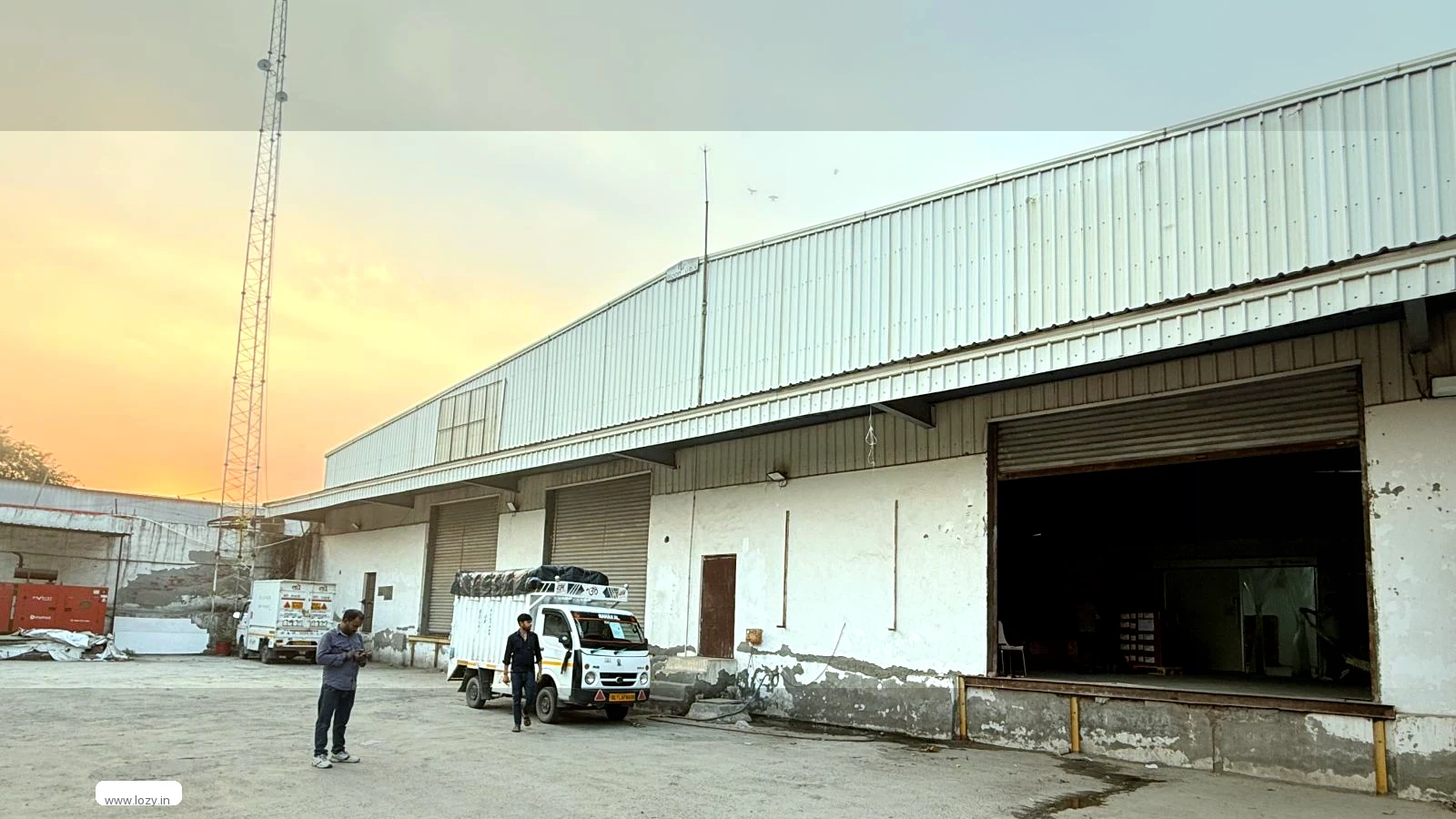
Short answer: warehousing in Assam is a corridor decision before it is a rent decision. The North-East hangs off the rest of India by one strip of land in West Bengal, so every trailer and rake supplying seven states enters through it, and a storage node at Guwahati buys that distance back for the whole region while Jorhat serves the tea and agro trade up the valley. Lozy lists 2 collection centres in Assam, named at Guwahati and Jorhat. This guide covers what the state stores, what the monsoon does to a specification, what space costs and how to choose a unit.
Key takeaways
- Assam carries 2 collection centres in Lozy's network list, named at Guwahati and Jorhat — one at the corridor's inner mouth, one in the tea belt up the valley.
- Every consignment into or out of the seven North-Eastern states passes the narrow Siliguri corridor, which is why a Guwahati node shortens the last leg instead of duplicating a Kolkata one.
- Space for rent is published from ₹12 per sq ft per month, commercial warehousing from ₹13 per sq ft per month and self storage from ₹999 per month, each billed monthly on a GST invoice.
- The two costs that catch people out locally are monsoon humidity on tea, paper and packaging, and the stretch of the year when the valley road and the corridor both slow down.
Why warehousing in Assam is a corridor question first
Begin with the shape of the map, because in Assam it settles more than it looks like it should. The North-East hangs off the rest of the country by a strip of West Bengal that is, at its narrowest, barely wider than the road and rail lines running through it. That is the only land route in and out, every truck supplying seven states uses it, and no amount of warehousing inside Assam removes it. What a warehouse in Assam can do is take the final leg off the long haul, and it is worth being precise about why that is worth paying for.
A Kolkata depot and a Guwahati depot are not the same product, however similar the two buildings look. Stock held in Kolkata still has to travel the whole corridor before it reaches a customer in the valley, and the last several hours of that journey are the least predictable part of it. Stock held at Guwahati is already inside the region: the trip to a buyer in the city, or to a distributor four hours up the valley, is a local movement rather than a national one. That is the entire commercial case for a second and smaller node closer to the customer, and it holds equally for a national brand, a state distributor and an online seller.
What the corridor does to a delivery promise
The corridor's practical effect is variability rather than distance. Washouts and landslips on the hill sections, blockades, and the sheer concentration of freight through a single road make it hard to promise a day for a consignment travelling from the west into the North-East with the confidence that a Mumbai–Pune run allows. What businesses actually do about it is hold cover on this side of the corridor rather than promise faster road. A unit at Guwahati lets a distributor keep two to four weeks of stock inside the region and refill it in bulk from a western depot, which converts an unpredictable journey into a predictable one at the point where the customer feels it.
The monsoon is a specification, not a season
Assam takes the south-west monsoon head-on from roughly May into September and is among the wettest large regions in the world; the Brahmaputra and its tributaries spread across the floodplain in that window as a matter of routine. For a storage buyer that becomes a short, concrete list rather than a weather conversation. A plinth raised above the surrounding grade. A concrete or tiled floor instead of packed earth. Stock on pallets rather than flat on the slab. Roof sheeting mechanically fixed rather than laid loose over purlins. A drain that carries water away from the building rather than past its door. Each of those is cheap to specify and expensive to discover missing, and none of them is visible in a photograph taken in January.
The two points: Guwahati and Jorhat
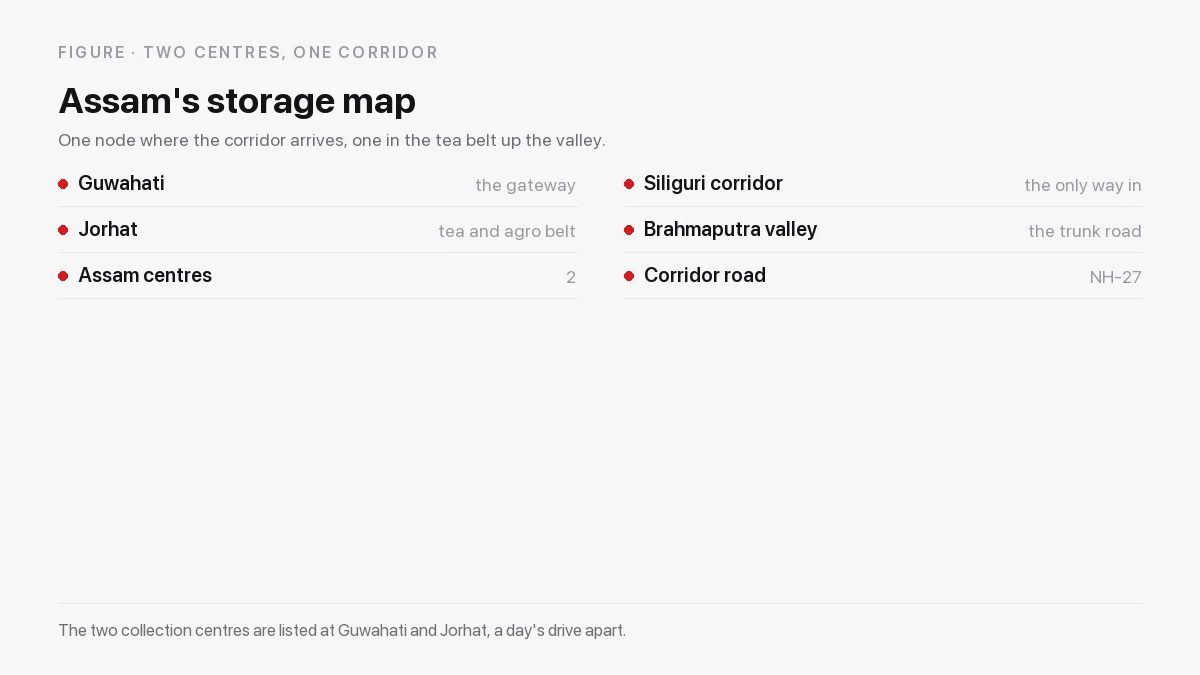
Lozy lists 2 collection centres in Assam, named at Guwahati and Jorhat, and the Assam coverage page sets out both. They sit at opposite ends of the state's usable valley, roughly a day's drive apart, and they do genuinely different jobs. Choosing between them is usually a question about where your customer is rather than about which one is better.
Guwahati, the gateway to the North-East
Guwahati sits on the south bank of the Brahmaputra at the point where the corridor road from the west finally arrives in the valley. That position has made the city the region's administrative and trading capital rather than simply a state capital, and it is where a national brand's North-East stock almost inevitably has to sit at some stage. From here a consignment reaches the city's own market, the larger towns up and down the valley, and the trans-shipment points that serve Meghalaya, Nagaland, Manipur, Mizoram, Tripura and Arunachal Pradesh. The city also carries the region's principal air freight and most of its courier network, so for anything that has to arrive quickly, or leave by air, this is the only realistic node in the state.
A Guwahati unit is the right choice for three requirements in particular: retail and FMCG distribution into the region, e-commerce fulfilment where an origin scan inside the region saves a transit day, and any stock that has to be re-dispatched to several states from one address. What the city is not is cheap land. Its usable industrial ground is bounded by the river, the hills and the floodplain, so a Guwahati rate usually reflects access and scarcity at the same time. Availability at this end is listed on the Assam locations page.
Jorhat, up the valley in the tea and agro belt
Run east for the better part of a day along the valley and you reach Jorhat, the second collection centre and the natural centre of upper Assam. The local economy is agricultural and the town's name is inseparable from tea: the district and the districts around it hold a large share of the state's gardens, and the movement of made tea, tea chests, packaging and garden inputs is the trade the place exists on. Jorhat also serves the wider agro economy of the upper valley — rice, pulses, oilseeds, horticulture and the perishable produce that has to move quickly once it is harvested.
For a business whose stock is sourced in upper Assam rather than sold there, this is the more useful end of the state. A buyer of made tea gathering lots from several gardens, a packer who needs chests and plywood near the gardens, or an agro trader consolidating produce for the run west will usually find that holding stock at Jorhat shortens the first mile — and the first mile is where leaf and produce lose both weight and quality. Note the direction of the argument: Jorhat is a sourcing-side location and Guwahati a distribution-side one, so a business doing both often ends up with a small floor at each rather than one large floor in the middle.
Who stores what in Assam
Assam's storage demand is narrower than a large western state's and much more specific about what a building has to do. Four requirements account for most of it.
Tea, and everything that moves with it
Tea is the state's signature trade and its most demanding cargo. Made tea is hygroscopic: it takes moisture out of the air around it, and once it has, the cup changes, the leaf cakes and the lot loses value long before any damage is visible on the outside of a chest. That single property dictates the specification for the whole trade — a floor that is genuinely dry through the monsoon, air that moves rather than sits, stock on pallets and clear of the walls, and pest control on a written schedule rather than on request. Alongside the made tea sit the things that travel with it: plywood and foil-lined chests, laminates, cartons and pouches, printed labels, and the machinery spares the factories run on. All of it belongs in the same dry room.
FMCG and distribution into the seven states
The single largest consumer of organised floor space in Assam is the distribution trade. A national brand selling into the North-East has to serve a market spread across seven states over a road network that narrows to one corridor at its western end, and the standard answer is a regional stock point at Guwahati with onward despatch to state-level distributors. The work is unglamorous and precise: receive in bulk, hold at a pallet level that roughly matches demand, rotate by date, and load a fleet of smaller vehicles on a schedule rather than on demand. A distributor who cannot show where the older batch sits will carry write-offs that never get attributed to storage.
E-commerce sellers and courier reach
Online retail in the North-East is normally served from a distance, which is precisely why a node inside the region changes the arithmetic. A seller shipping into Assam, Meghalaya or Nagaland from Delhi adds two to four days to every parcel and pays the longest zone in the courier tariff; a seller holding stock at Guwahati dispatches on a local zone and, in many cases, on a next-day promise the warehouse makes possible. The requirement is a floor where stock is received, barcoded and racked pick-ready, and where orders are picked, packed and handed to a courier against a fixed cut-off. Sellers running a marketplace account alongside their own storefront want both fed from one floor rather than two.
Households, offices and small business
The quietest demand is also the steadiest. Guwahati's professional and administrative economy produces a constant stream of households and small offices moving between two addresses — furniture, appliances, files, shop fixtures and equipment that needs a secure home for a few months rather than an industrial floor for a year. None of it needs a forklift; all of it needs a dry, individually accessible unit with a person's name on it. In a state this humid, the difference between a ventilated unit and a sealed one shows up quickly in paper, fabric and leather, so it is worth asking how a room breathes before booking the cheapest one on the list. That per-unit product is what the self storage pages describe.
What warehouse space in Assam costs
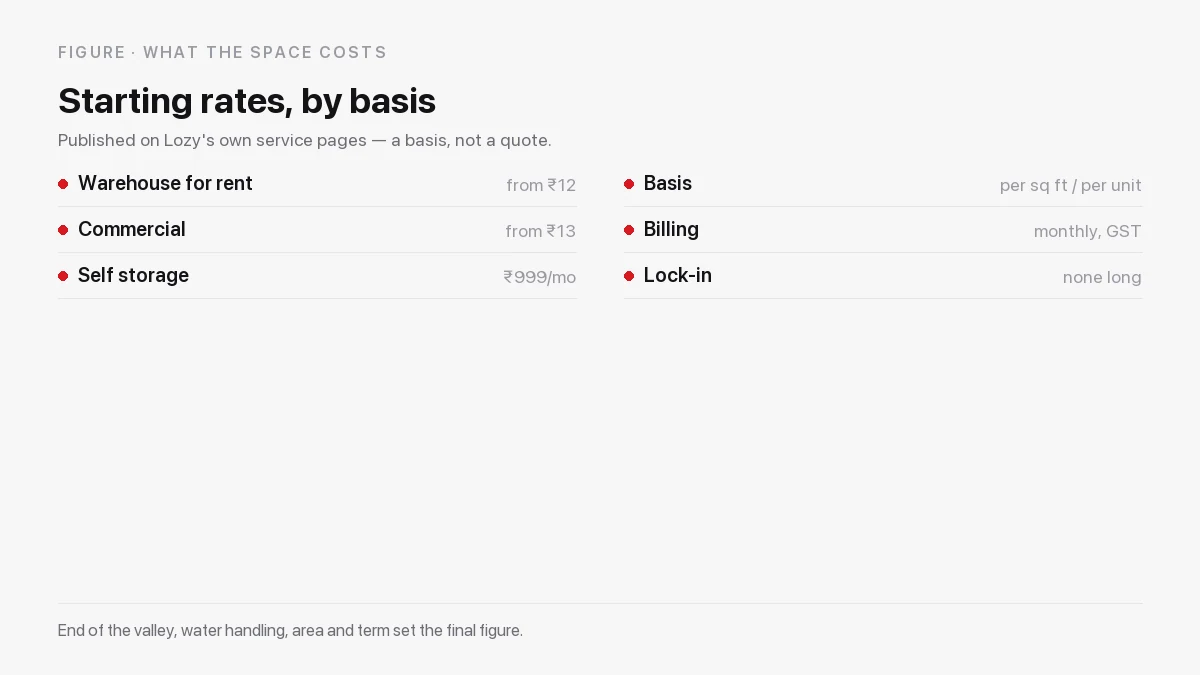
Three of Lozy's published starting rates cover what an Assam requirement normally turns out to be. Warehouse and godown space for rent is published from ₹12 per sq ft per month. Commercial warehousing, the managed version with security, housekeeping and reporting built in, from ₹13 per sq ft per month. Self storage, the per-unit product a household or small office books, from ₹999 per month. Everything is billed monthly on a GST invoice with no long lock-in attached, and all three are starting rates rather than quotes.
The four things that move an Assam rate
- Which end of the valley you book into. Guwahati ground is scarce and its rate carries the city's access; Jorhat is a sourcing-side market where land is easier and the pull is the gardens rather than the shopper.
- How the building handles water. Plinth height, floor finish, roof fixing and drainage are the difference between a shed that holds tea and packaging through a monsoon and one that does not, and a facility that has paid for them prices accordingly.
- Area, and the basis it is quoted on. A whole bay and four racked pallet positions are not comparable products. Compare one basis against the same basis.
- How long you commit for. A monthly booking and a year-long arrangement are priced differently, and the longer one normally carries the lower monthly figure.
| Where the unit sits | What it suits | What it buys you |
|---|---|---|
| Guwahati and its industrial edges | FMCG and retail distribution into the region, e-commerce fulfilment, household and office self storage | Courier origin scans and air freight inside the region, with the city's own market on the doorstep |
| Jorhat and the upper valley | Made tea, chests and packaging, agro lots, garden and factory inputs | A short first mile from the gardens and the processing units it serves |
| Guwahati and Jorhat as a pair | A business that sources in upper Assam and sells out of Guwahati | Each leg done from the right end instead of hauling everything through one yard |
| Anywhere else in the state, today | A requirement that would need a third node | An honest answer about coverage rather than a promise to be arranged later |
Read the table as a routing decision rather than a menu of options. A tea buyer belongs near the gardens, a distributor belongs in the city, and a business doing both should expect two small floors rather than one large one that is wrong for half its volume. Every unit behind that table sits on the Assam locations page. For how rent itself is structured, separately from this state, start with the guide to warehouse space for rent.
Licences, GST and the paperwork in Assam
Two items in this section behave differently in a state at the far end of a corridor, and both are worth settling before the first truck is loaded.
GST, the invoice and input credit
Rent on storage in Assam carries GST, and a registered business recovers it when the paperwork is right: an invoice raised in your own entity's name, as a tax invoice rather than a receipt or a cash memo, with the storage and handling lines shown the way your accountant needs to post them. Confirm what that document will look like before booking rather than at year-end. A proper monthly tax invoice keeps rent a recoverable cost; a cash arrangement with no paper behind it turns the same money into a dead expense. The rules on registration and input credit sit on the GST portal.
Premises approvals, fire and the goods list
Ask which authority approved the building, and whether the occupancy and fire clearances can be produced rather than described. Urban premises in Assam fall to the municipal corporation or the local town committee for their trade licence, and the site itself has to be on land whose use permits storage; a unit inside a state-developed industrial estate inherits that position while a standalone shed on private ground has to establish it, and the state's own industry department is the reference point at Assam's Industries and Commerce department. Then ask what the facility will not accept: solvents and flammables, food without the matching licence, strong-smelling goods, and anything needing pest-segregated bays. Tea and packaged food deserve that question specifically, and so does anything moving under a bonded arrangement.
Insurance, inventory and the way in
The third item is what happens when goods arrive. A photographic inventory checked against your own count at the door is what turns a shortage found three weeks later into a short email rather than an argument. Tell your insurer where the stock sits and how it is held, because a policy written for a locked godown of your own and a shared managed floor are different risks. For high-value or regulated cargo the tracked model, with records kept as goods move at batch or SKU level, is described on the inventory warehousing page.
How to choose an Assam warehouse — and the red flags
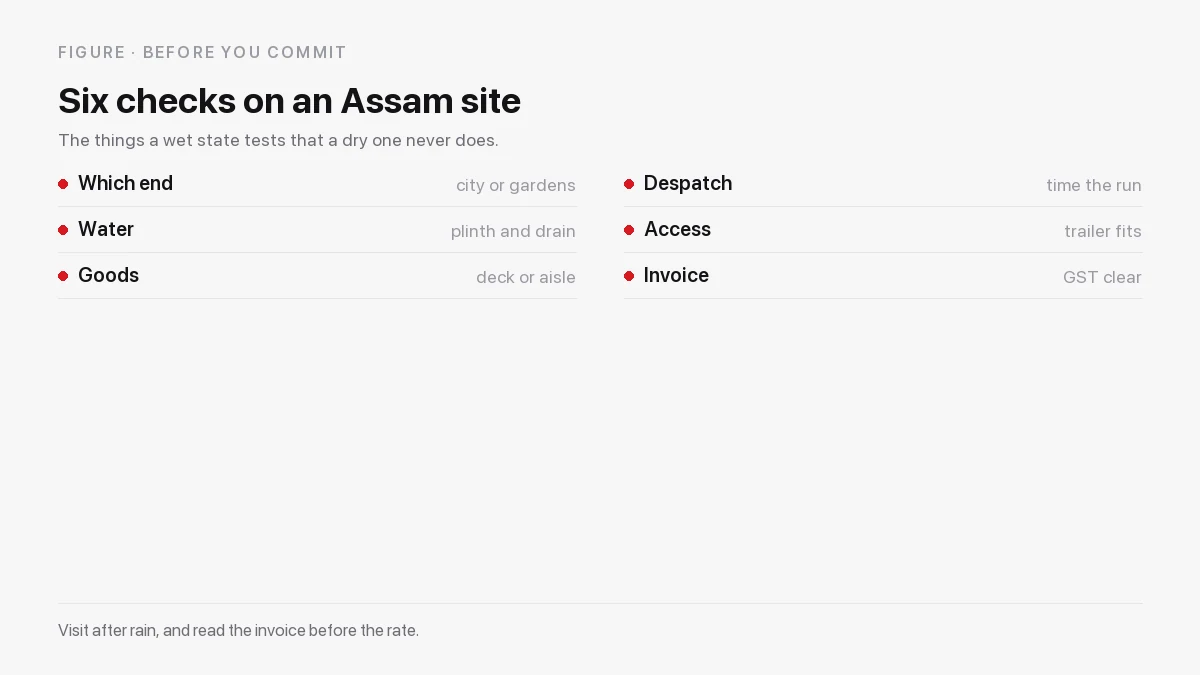
Run this list at the viewing. Every item is visible on site, which is why an hour in the yard here is worth more than a longer quotation, and it matters more in a wet state than in a dry one.
- Decide which end of the valley your goods belong to. Distribution into the seven states argues for Guwahati; tea, chests and agro lots argue for Jorhat. The wrong end costs a day on every movement, every week.
- Test the building against water rather than weather. Plinth height, floor finish, roof fixing, and where the drain actually discharges. Walk the yard and find where the water went in the last heavy spell.
- Sort your cargo into a floor specification. Made tea, paper, packaging and packaged food want a raised deck and air that moves. Machinery, spares and building material want load capacity and aisle width instead.
- Drive the leg that decides your promise. If stock leaves for four states, time the despatch route at the hour your van would really leave; if it comes off the corridor, ask what the gate wait looks like at the busiest end of the week.
- Walk the last kilometre to the gate. A yard a trailer can turn inside beats a better-looking shed up a lane a trailer cannot enter at all, and in the valley that lane is usually the whole constraint.
- Get the rate's inclusions itemised in writing. Racking and pallet trucks, night security cover, housekeeping, pest control, and who carries the power bill for lighting and air movement.
- Request a stock report before you sign. Then see what document reaches your inbox when goods are received, and how a quantity query is handled mid-month.
What should stop you, roughly in the order these things surface: a rate that never says whether GST sits inside it; a floor at or below the level of the yard around it; a humidity claim with no ventilation and no readings behind it; missing occupancy or fire clearance; a monthly figure that hides an annual minimum; a facility that decides which bay is yours only when the truck is already at the gate; and a tea or food storage offer from an operator who has never been asked what happens to the goods in a wet September.
A worked example: a Guwahati distributor serving four states
A distributor of household and personal-care brands ran its North-East business out of a Kolkata depot with a small rented room at Guwahati as a staging point, and the room showed. Stock for four states was being dispatched from Kolkata whenever a local distributor ordered, so every order carried the corridor's two-to-four-day variability, and the Guwahati room was too small to hold enough cover to absorb it. In a good month the arrangement worked. In a month when the corridor was blocked it did not.
What that season produced was a specification rather than a wish: about 4,000 sq ft at Guwahati on a raised deck, a racked section for the fast-moving lines, a loading face a 20-ft truck could reach without a shunt, and a receiving process that left a usable stock position behind it without anyone filling in a register afterwards.
Four thousand square feet at the published starting rate of ₹12 per sq ft per month comes to about ₹48,000 a month before any add-ons — indicative only, since the unit, the access and the term all move the final figure. What the distributor bought for it was the ability to hold three weeks of cover inside the region and to promise a delivery date to a distributor in Meghalaya without first explaining the corridor. Requirements like that begin with the space listed on the Assam locations page.
How Lozy helps in Assam
Lozy runs 77+ warehouses and more than a million square feet of live space, and Assam carries 2 collection centres in that network, named at Guwahati and Jorhat. A booking brings a defined racked or open floor area of your own, 24/7 CCTV, on-site security and PIN-controlled access to the gate and to your bay, and the network is arranged so a business can move from a small floor to a bigger one in the same city with the same operator as its volume grows.
The arrangement is monthly on a GST invoice with no long lock-in, and free doorstep pickup is included on bookings of 30 days or more, so relocating out of a rented godown or a corner of a factory does not have to interrupt trade. What the company offers across its services is set out on the services page, with business warehousing for the managed floor a distributor usually needs and self storage for a unit-sized household or office requirement. To see availability before deciding, browse the warehouse listing and look at what is free in the state today, or contact us with the goods, the area and the dates you have in mind. If your stock moves beyond Assam, the locations hub shows the rest of the network.
Also in Delhi NCR
A distributor serving the North-East almost always ends up holding stock at both ends of the country rather than one. The corridor run starts far to the west of Guwahati, and the northern stock points are where the bulk replenishment originates — the capital's own market covered by warehousing in New Delhi, the industrial belt in Haryana, and the NCR cities from Gurgaon to Noida. The same logic runs east along the road in: West Bengal holds the corridor's western mouth, Bihar and Jharkhand sit on the route, and Odisha carries the east-coast alternative. For how a shared floor is actually run, the guide to commercial warehousing is the closer read.

Need warehouse space in Assam?
Tell us the city and the size you need — we reply with a rate and the options available now.
Get a quoteCall +91 93547 12345About the author
Lozy Editorial Desk. This guide was written by the Lozy Editorial Desk, the in-house team that covers warehousing, self storage, logistics and customs/EXIM topics for lozy.in. We write from Lozy's own facility and pricing information and from public, citable sources. We do not publish invented statistics, ratings or reviews.
Sources. The facility counts, rates and coverage quoted in this guide are Lozy's published figures rather than third-party estimates. Corridor and highway context comes from the National Highways Authority of India; rail and regional connectivity from the Northeast Frontier Railway; state industrial policy from Assam's Industries and Commerce department; economic context from IBEF's Assam profile; tea trade context from the Tea Board of India; industry representation from the Warehousing Development and Regulatory Authority; and policy releases from the Press Information Bureau. GST registration and input credit are described from the GST portal, linked above. Anyone weighing a second state before making a call will find the same no-gloss approach across the Lozy blog, which covers warehousing, self storage and customs.
Last updated: 13 October 2026. Have a question the FAQ below does not answer? Call +91 93547 12345 or email care@lozy.in.
Need warehousing or storage in India?
Request a free, tailored quote in under 2 minutes — free pickup, no lock-in.






