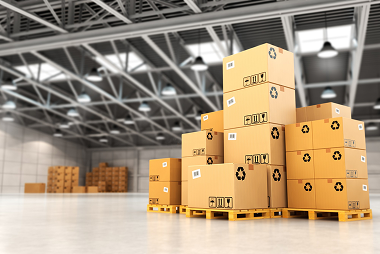
Warehousing in Rajasthan: Jaipur's Sikar Road Belt and the Festive Peak
Short answer: warehousing in Rajasthan narrows to a single city in practice. The network's own list carries one collection centre for the whole state, and it is the Jaipur unit in the VKI Area on Sikar Road — a working industrial belt on the city's north-western side, with truck access straight off the road. Lozy runs 77+ warehouses and more than a million square feet of live space across the country. This guide covers what Jaipur's trades actually store, why a godown here usually beats hauling every pallet down from Delhi NCR, how the festive export window rewrites the arithmetic each year, and what the space costs.
Key takeaways
- Rajasthan carries 1 collection centre in Lozy's network list, listed at Jaipur in the VKI Area on Sikar Road, with rack, pallet and bulk-floor space and truck access off the road.
- Godown and warehouse space for rent starts at ₹12 per sq ft per month, self storage at ₹999 per month and seasonal storage at ₹1,299 per month — all monthly, GST-invoiced, with no long lock-in.
- Jaipur is the first big city on the Delhi–Mumbai corridor, so stock can sit here at Rajasthan rates and still reach Delhi NCR buyers quickly instead of paying NCR rent for it all year.
- The festive export season squeezes a year of dispatch into a few weeks. Monthly billing is what lets a Jaipur exporter take extra floor for that window and hand it back afterwards.
Why warehousing in Rajasthan is really a Jaipur decision
Rajasthan's storage demand is not spread evenly across the state, and the collection-centre list is an honest picture of that: one centre, at Jaipur. The reason is not coverage policy. Jaipur holds the trading houses, the wholesale markets and the exporters, and it is the city the Delhi–Mumbai corridor actually crosses on its way out of northern India. A unit on the north-western industrial edge can be reached from the main commercial districts in one run, and that is the difference between a warehouse a business uses every week and one it visits once a quarter.
The question a Jaipur business actually asks is therefore never which city. It is which floor, how much of it, and for how long — and the three answers are all available at one address. The city's own coverage, services and unit mix are set out on the Rajasthan warehouse page.
The Sikar Road belt and the VKI Area
The Rajasthan unit sits in the VKI Area on Sikar Road, an established industrial belt on Jaipur's north-western side, where a truck reaches the gate off the road itself rather than through a residential lane. Inside, the three options a Jaipur trader actually asks for are all on offer: racked positions, pallet storage and bulk floor. Palletised trading stock and distribution overflow go on the floor; slower-moving cartons go on the rack, where they can be counted without shifting a pallet to find them.
The location earns its keep on the inbound leg more than the outbound one. Free doorstep pickup across Jaipur means goods are collected from the shop, the home or the unit where they already sit and brought in by the operator, so a business whose own premises have no loading bay can still use a proper warehouse. That matters in a city whose older commercial streets were never laid out with a trailer in mind.
What a single collection centre actually covers
One centre sounds thin until you look at what it moves. Nearly every load a Rajasthan trader, exporter or household needs to park is going to or coming from Jaipur anyway — a trading family's stock between two selling seasons, an exporter's cartons waiting on a booking, a household's furniture between two addresses. The pickup radius does the rest of the work: goods are collected where they already are, so the warehouse does not have to be next door to be useful.
The limitation is worth stating plainly instead of burying. A single centre is a single point of access, so everything depends on its road position and its capacity at your own peak. Those are the two things to inspect before booking, and they are the reasoning behind the checks further down this page. The unit itself — its sizes, its access and what is free today — is set out on the Rajasthan warehouse page.
Who stores what in and around Jaipur
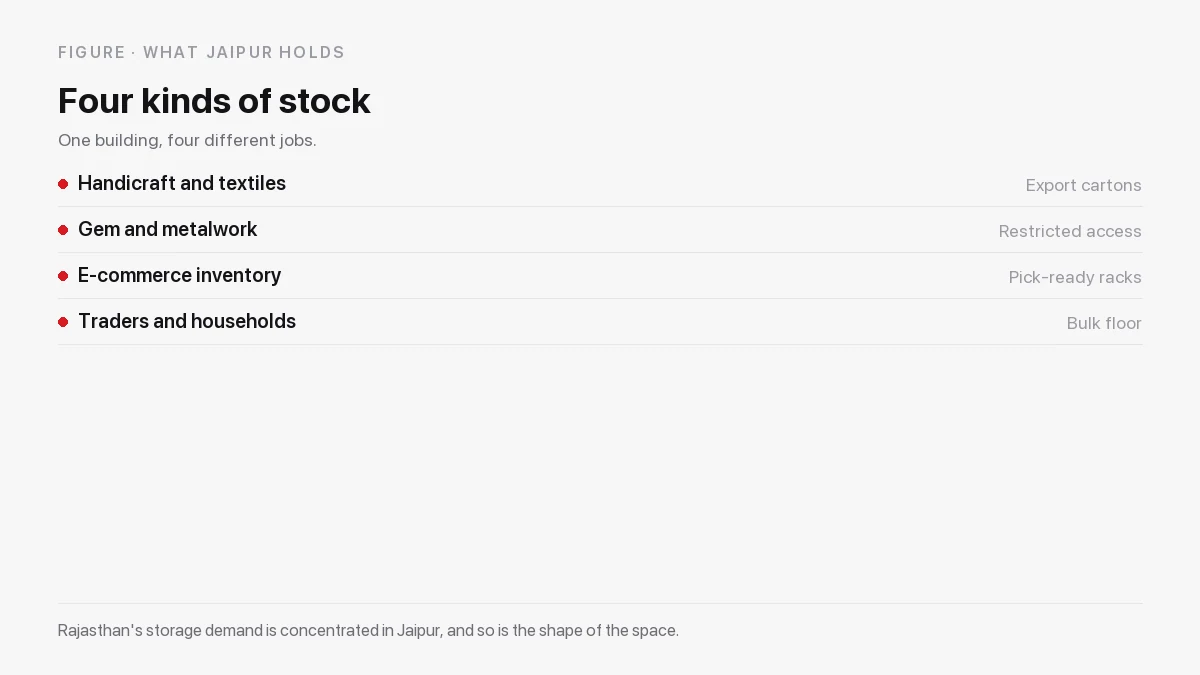
Four kinds of stock account for most of the occupied space in the state, and they want different things from the same building.
Handicraft, textile and home-goods exporters
Jaipur's export trade runs on fabric and finished home goods, and the storage problem it creates is volume that arrives in a rush and leaves in a rush. An order is bought, made and packed within a few weeks, then waits while the shipping window comes round. In that gap the goods need to be off the workshop floor, dry, and in one place — so they can be packed and loaded as a single consignment instead of being reassembled from three addresses on the day the container arrives.
Bulk floor and pallet positions suit that pattern better than fine racking, because the unit of movement is a carton on a pallet rather than a single item. What such a customer needs to confirm is clear height and whether a loaded pallet can be staged near the shutter on loading day; between them, those two details decide how long a dispatch really takes.
Gem, jewellery and light precision stock
Jaipur's gem and metal trade handles values that are high relative to their volume, which inverts the usual priority. Square footage is not the constraint; control is. Small consignments, boxes opened and closed repeatedly, and a paper record that matches what is on the floor are the requirements. The features that answer them are a restricted-access section, a check-in and check-out list signed against your own count, and camera coverage of the aisle your stock sits in — not just of the main gate.
E-commerce sellers shipping out of Rajasthan
A Jaipur-based online seller has one structural problem: courier pickups are faster and cheaper where the volume is, and the volume is not in Rajasthan. Holding inventory on a racked, pick-ready floor in the city solves the local half of it cleanly — receive, barcode and shelve, then pick, pack and hand over at a quiet hour rather than during an evening rush. Whether that floor is worth taking depends on catalogue size and daily order count, and the service basis is described on the e-commerce warehousing page.
Traders, distributors and households
The largest group is also the plainest: shopkeepers who need last season's stock out of the shop, distributors holding a buffer ahead of a scheme, and households between two homes. None of it needs a controlled room, and all of it needs a dry, secure floor without a lease attached. Furniture, appliances, wardrobes and seasonal items are the part of that demand the per-unit product serves, and how it works is set out on the self storage page.
The corridor: why a Jaipur godown beats hauling from NCR
The case for holding stock in Rajasthan rather than in Delhi NCR is a road, not a rent list. Jaipur is the first large city on the Delhi–Mumbai corridor, which leaves it close enough to serve northern buyers and far enough out to cost materially less per square foot. Every pallet held here is a pallet not paying an NCR rate, and nothing about the pickup, the billing or the paperwork changes because the address did.
Position on the corridor
Look at the run in both directions and the Jaipur unit stops being a local convenience. Westwards the corridor continues into Gujarat, where the network sits at Ahmedabad, Vapi and Ankleshwar, and then into Maharashtra's belt at Pune, Nashik, Nagpur and Bhiwandi, the address most national brands use to reach Mumbai. A Jaipur trader buying from the coast can therefore receive into Rajasthan, check and label there, and dispatch north — instead of carrying the goods all the way to NCR in one hop and sorting them at the far end. The guide to warehousing in Gujarat covers that western leg, and Madhya Pradesh covers the central one, with the network's centre at Indore.
The northern leg
North-east of the city the same map is well covered: Punjab's network at Ludhiana, Zirakpur and Chandigarh sits on the route out of the region, so stock moving to or from the northern markets has a node at each end of the trip. A Jaipur manufacturer selling into Punjab or the hill states can keep finished goods here and let the destination node handle the last leg, which is usually cheaper than moving one consolidated consignment onward and breaking it locally. The Punjab guide sets out how that end operates.
When Delhi NCR is still the right base
None of this argues against NCR. If your customers, your returns address and your courier volume all sit there, a Rajasthan floor adds a day to every order and saves you a rent you were not really paying. For a business with genuine demand on both sides, the sensible arrangement is one floor in each, with stock allocated to the side that needs it rather than both cities carrying the same pallets.
The festive export window, and how to plan around it
Rajasthan's export calendar has a shape, and the shape is a spike. Buyers place orders for the overseas festive and holiday season with Jaipur's makers, production runs through the monsoon months, and dispatch concentrates into the weeks when the shipping line's window opens. The effect on storage is a queue rather than a steady flow: finished goods accumulate faster than they leave, and the floor that was ample in March is not the floor you need in September.
Two things make that survivable. The first is a booking model that moves — floor can be added for the peak and released once the containers have gone, and there is a product built for exactly that pattern, priced from ₹1,299 per month and described on the seasonal warehousing page. The second is knowing your staging capacity before you need it: how many pallets can queue near the shutter at once, and whether a loaded vehicle can be filled and turned inside one working day.
There is a monsoon dimension as well, and it is the one Jaipur exporters tend to learn the hard way. Finished fabric and paper goods that have sat dry all summer can be lost to a leaking roof and standing water in a single week, so the questions to ask are about the roof, the apron and the drainage — asked before the rain, not during it. A racked position two feet off the floor costs nothing extra and removes most of that risk on its own.
What warehouse space in Rajasthan costs
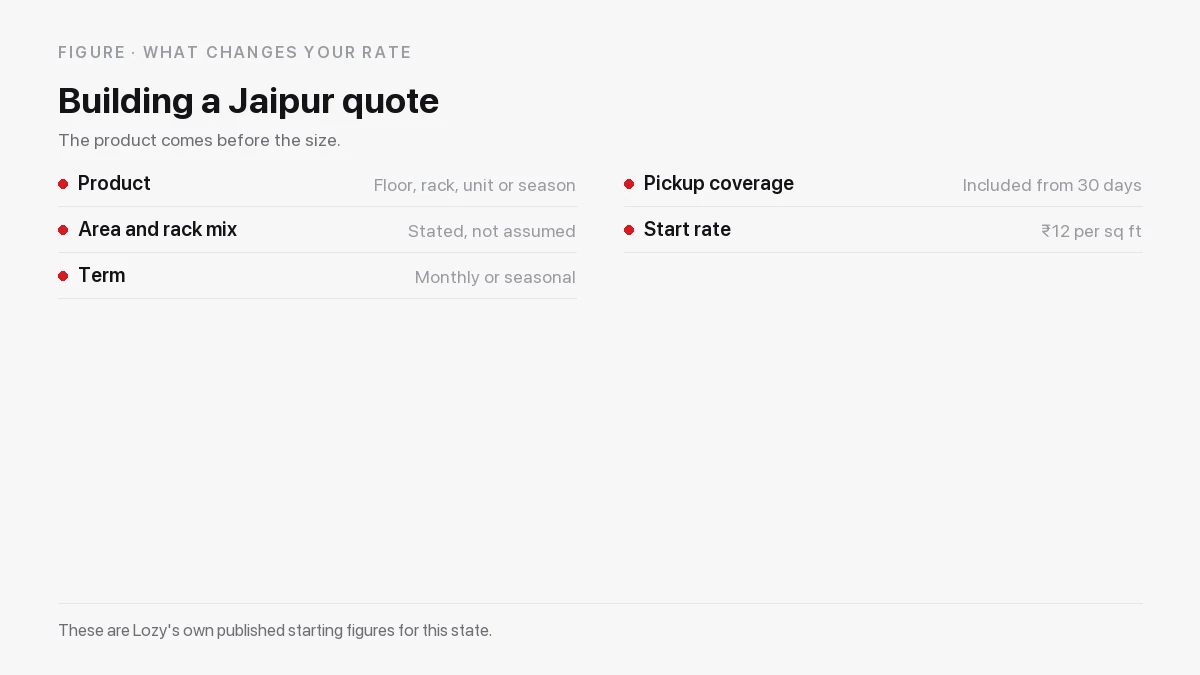
Three of the company's published starting rates cover what a Jaipur business is most likely to want. Warehouse and godown space for rent starts at ₹12 per sq ft per month, the bulk basis priced for palletised storage on the floor. Self storage, the lockable per-unit product a household or a small trader books, starts at ₹999 per month. Seasonal warehousing, sized around a defined season rather than a year, starts at ₹1,299 per month. Each of them bills monthly on a GST invoice with no long lock-in.
Say the obvious thing about those figures: they are starting rates, not quotes, and the distance between the two is worth understanding before numbers are discussed. Two thousand square feet of open floor and two thousand square feet of racked, high-turnover positions are not the same purchase at the same price. What moves a Jaipur figure most is not the city — it is which of the three products you are actually buying. The generic mechanics of rent, apart from this state, are set out in the guide to warehouse space for rent.
What moves the number
- Which product. Bulk floor, racked positions, a lockable self-storage unit and a seasonal plan are four different prices. The published starting figures belong to different products, so compare like with like rather than a headline square-foot figure against a per-month one.
- Area and the rack-versus-floor mix. Ask for a rate against a stated area and a stated racking arrangement; a per sq ft number that assumes neither is not a quote.
- The term. Monthly, seasonal and longer bookings price differently, and the longer commitment normally carries the lower monthly figure.
- Pickup and handling. Free doorstep pickup is included on bookings of 30 days or more; a one-week requirement or a collection from outside Jaipur is priced on what it actually takes.
Jaipur against the other addresses a Rajasthan business weighs
| What you are deciding | Jaipur — Sikar Road, VKI Area | Delhi NCR | Bhiwandi / Mumbai |
|---|---|---|---|
| Cost basis | From ₹12 per sq ft per month | Higher NCR rates, address-dependent | Port-side rates on the western coast |
| Suits best | Trading stock, handicraft and textile exports, local households | Serving NCR buyers and northern distribution | Import-export flows and national-brand distribution |
| Corridor position | The Jaipur leg of the Delhi–Mumbai corridor | Northern end of the same corridor | Western end, beside the port |
| Pickup coverage | Free doorstep pickup across Jaipur | Per-city centre coverage | Metropolitan coverage |
| Right when | Your goods, your maker or your home is in Rajasthan | Your customer and your returns address are both there | Your freight moves by sea |
Compliance and paperwork for a Rajasthan godown
Most of what follows is cheaper to settle before the first truck arrives than after it.
GST, and the invoice that makes rent recoverable
Storage rent in Rajasthan attracts GST, and a registered business can claim input credit when the invoice is a genuine tax invoice raised in the entity's own name: rent becomes a recoverable cost rather than a permanent one. If you are registered in another state and storing in Rajasthan, agree the invoice details in writing before the first billing month, because correcting them afterwards is an accountant's problem rather than a five-minute fix. Whether the GST charged on that rent is recoverable depends on the invoice being raised correctly from the start, and the conditions are set out on the GST portal.
Who approved the building
Rajasthan's industrial estates are developed and managed by the Rajasthan State Industrial Development and Investment Corporation, and a plot's approvals — occupancy, fire, and the estate's own conditions — follow from that. Ask which authority approved the premises and whether the fire and occupancy clearances can be produced on the spot. A vague answer there usually previews how the rest of the arrangement will run. The state's industrial and investment context is published by RIICO and summarised in IBEF's Rajasthan profile.
What a unit will and will not take
Ask about the goods list before signing, not after. Paint, solvents and other flammable material, food without the matching licence, strong odours, and anything needing pest-controlled segregation are handled differently or not at all. If your business needs tracked, batch-wise stock rather than plain storage, that is a different product again and what it involves is set out on the inventory warehousing page. On the way in, a photo inventory checked against your own count is what turns a later discrepancy into a short conversation instead of a long one.
How to choose a Jaipur warehouse — and the red flags
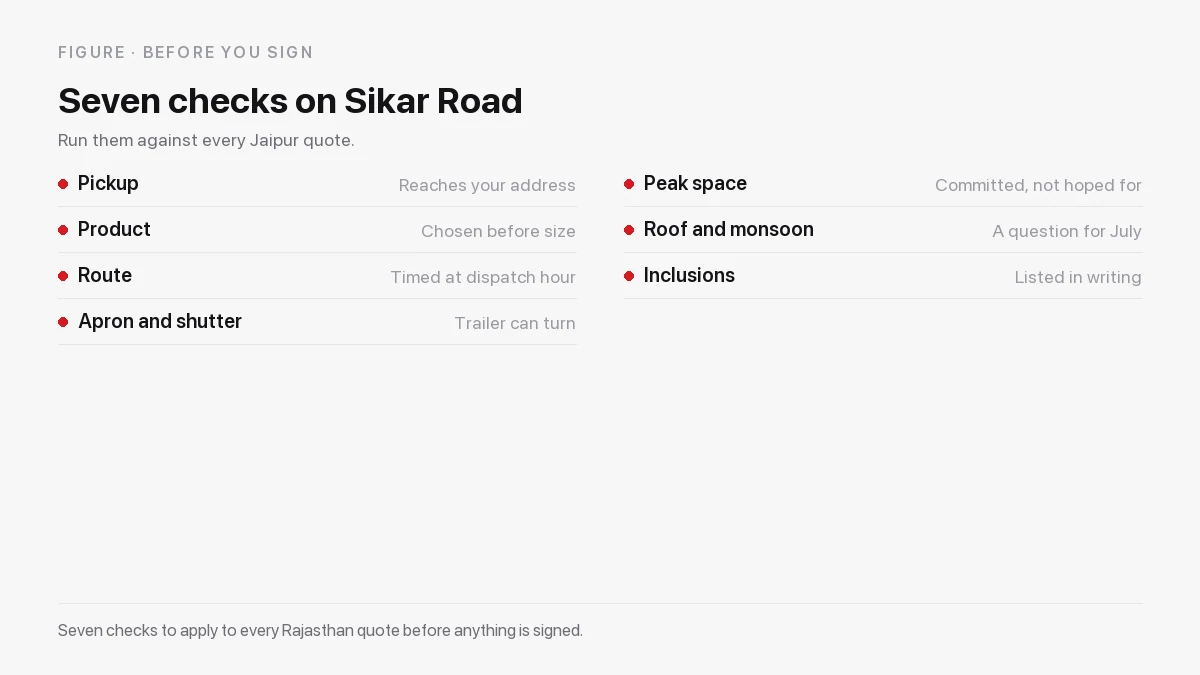
- Confirm the pickup actually reaches you. Free doorstep pickup across Jaipur is only useful if your address sits inside the covered area and a vehicle can stop outside it. Ask for the nearest collection point to your shop before you commit.
- Pick the product before the size. Decide whether you are buying bulk floor, racked positions, a lockable unit or a seasonal plan, then price the area inside it. Comparing a headline rate against a different product is how businesses overpay without noticing.
- Walk the route at dispatch hour. Time the run from Sikar Road to your main customer area when you would really be sending goods, not at noon on a Sunday.
- Check the apron and the shutter. A yard a truck can reverse into, and a shutter a loaded pallet clears, beats a better-looking shed with a height barrier in front of it.
- Ask what happens at the peak. If your floor is being scaled up for the festive window, confirm the space is committed rather than expected, and get the answer in writing.
- Ask about the roof and the monsoon. Where finished goods sit through the rains, water is a bigger risk than theft. Find out who inspects the roof and how often.
- Get the inclusions listed. Racking, trolleys and pallet trucks, security, housekeeping, pest control, and what a stock query is answered with on an ordinary Tuesday.
Red flags, roughly in the order they show up: a rate that will not say whether GST is included; a per sq ft figure quoted without stating the area it applies to; a seasonal plan with a yearly minimum hidden inside it; a pickup that turns out to mean "you deliver to us"; a goods list that gets decided after the truck has already arrived; and round-the-clock dispatch support claimed by a facility with one shutter.
A worked example: buying floor for the festive peak
A Jaipur exporter of printed home textiles ran last year's season out of the workshop floor and a friend's spare godown. Nothing went missing, but the cost surfaced elsewhere: packing for one container took three days because cartons were stacked in four places, a consignment got split across two loading points, and a buyer's inspection had to be pushed back because nobody could produce a single stock list on the spot.
This year the plan is different. Roughly 2,500 sq ft of bulk floor for the two months when finished goods queue for dispatch, racking kept for the cartons that stay longest, and a check-in process that produces a pallet-level list as a by-product of receiving rather than as a Friday afternoon job. On the published starting rate of ₹12 per sq ft per month, 2,500 sq ft works out to about ₹30,000 for the month — treat that as indicative only, because the rack-and-floor mix, the area and the term all move the final figure, and a seasonal plan is priced on its own basis.
What the exporter is buying is not really square feet. It is a dispatch that takes one day instead of three, one address on the paperwork, and a stock position that can be answered while the buyer is still on the phone. Requirements like that one start with the units listed on the Rajasthan warehouse page.
How Lozy helps in Rajasthan
Lozy runs 77+ warehouses and more than a million square feet of live space, and Rajasthan carries one collection centre in the network, at Jaipur in the VKI Area on Sikar Road. Every unit comes with a dedicated racked or floor area, 24/7 CCTV, on-site security and unique PIN access to gates and to your own storage area, so stock is not sitting in an open shed behind a padlock. Billing is monthly on a GST invoice with no long lock-in, and free doorstep pickup is included on bookings of 30 days or more.
What the network adds beyond the one unit is an option: the same operator, the same billing and the same way of working at the other end of the corridor when goods start moving north or west. Everything the company runs sits on the services page; a business that wants the managed version of a floor should start with business warehousing, and a heavier palletised requirement with industrial warehousing.
If you would rather see the space first, browse the warehouse listing for what is free right now, or talk to the team with the size, the goods and the timeline in mind. The Rajasthan page covers the city's own unit, and the locations hub maps the rest of the network if your goods move beyond the state.
Also in Delhi NCR
A Jaipur exporter whose buyers sit in the north usually keeps one floor here and adds one in NCR, rather than paying northern rent for stock that only arrives from Rajasthan. The guides to warehousing in New Delhi and warehousing in Haryana cover the two addresses most northern buyers pick — Delhi's own centres, and the Haryana belt at Sonipat, Faridabad, Garhi Harsaru, Dharuhera, Ambala and Jamalpur. And where the requirement is smaller than a full unit, the guide to commercial warehousing explains how shared floors are run.

Need warehouse space in Rajasthan?
Tell us the city and the size you need — we reply with a rate and the options available now.
Get a quoteCall +91 93547 12345About the author
Lozy Editorial Desk. This guide was written by the Lozy Editorial Desk, the in-house team that covers warehousing, self storage, logistics and customs/EXIM topics for lozy.in. We write from Lozy's own facility and pricing information and from public, citable sources. We do not publish invented statistics, ratings or reviews.
Sources. The facility counts, rates and coverage quoted in this guide are Lozy's published figures rather than third-party estimates. Highway and corridor context comes from the National Highways Authority of India; industry context from the Warehousing Development and Regulatory Authority and IBEF's Rajasthan profile; and policy releases from the Press Information Bureau. GST registration and input credit are described from the GST portal, and Rajasthan's industrial context from RIICO. A reader comparing more than one city before calling will find the same plain style across the Lozy blog, which covers warehousing, self storage and customs without the marketing gloss.
Last updated: 13 October 2026. Have a question the FAQ below does not answer? Call +91 93547 12345 or email care@lozy.in.
Need warehousing or storage in India?
Request a free, tailored quote in under 2 minutes — free pickup, no lock-in.