Warehousing in Greater Noida: Grade-A Sheds, the Airport Corridor and What Space Costs (2026 Guide)
Short answer: Warehousing in Greater Noida is a new-build market. Almost every shed a tenant can actually take today sits along the Yamuna Expressway or the Noida–Greater Noida Expressway, finished within the last few years rather than inherited from an older godown cluster. So the decision here is less "where do I find four walls" and more "do I take a ready grade-A building or wait for a build-to-suit" — with space in the Lozy network advertised from ₹12 per sq ft per month.
Key takeaways
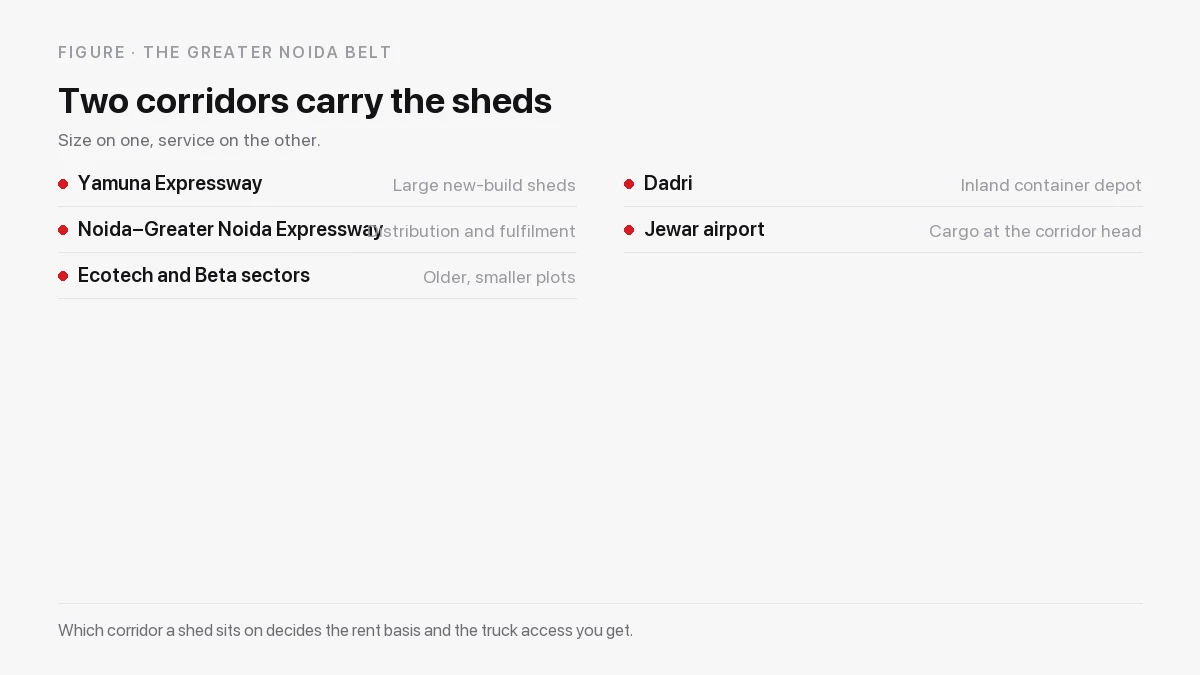
- Shed capacity is concentrated on two corridors — the Yamuna Expressway belt and the Noida–Greater Noida Expressway corridor — while the Ecotech and Beta sector belts hold the earlier industrial plots.
- Space is advertised from ₹12 per sq ft per month for warehouse and godown space, ₹13 for commercial warehousing and ₹14 for business or on-demand space, billed monthly on a GST invoice.
- Uttar Pradesh runs on 8 collection centres, with Noida and Ghaziabad on the NCR side and Lucknow and Ballia further east, plus a 30,000 sq ft commercial and 3PL warehouse at Bisnoli, Dadri on the Greater Noida industrial stretch.
- Noida International Airport began commercial operations in June 2026 and its cargo terminal followed within days, so air freight that once meant a run to Delhi now starts at the head of the Yamuna Expressway.
Greater Noida was planned rather than inherited, and that one fact explains most of what a tenant meets here: roads laid out before the traffic arrived, industrial sectors cut into blocks instead of lanes, and a shed market that has grown up almost entirely in the last few years. In an older NCR belt you negotiate building by building; on the eastern edge of Gautam Buddha Nagar the product is far more consistent — and the location argument is increasingly about the corridor outside the gate rather than the distance to Delhi.
Why warehousing in Greater Noida is a new-build market
Ask for 50,000 sq ft in Greater Noida and you will mostly be shown buildings that were commissioned recently, often on land allotted for industrial use and built to a specification the occupant specified. Ask the same question a belt further west and the answers are mixed: a good modern shed, then a 20-year-old godown with a low eave and one gate. That difference is the first thing to understand about this market, because it decides what you negotiate about — racking and throughput here, roof repairs and floor loading there.
The two corridors that carry the stock
The Yamuna Expressway takes the large floorplates. It starts at Greater Noida and heads south out of the district, and the planned industrial land either side of it is where the big new-build product has gone up: long sheds with dock-height loading, wide aprons and space inside the gate for a trailer to turn. This is where a manufacturer or a national 3PL looks when it wants a single building of real size rather than two half-buildings in different places.
The Noida–Greater Noida Expressway carries the rest. It is the link that ties the two cities together, and the sheds along it tend to be smaller and more service-oriented — distribution units, 3PL blocks and fulfilment space that feed the sectors and the residential catchments on either side. For a business whose customers are in Noida and Ghaziabad as much as in Greater Noida, this corridor is usually the more practical address even when the rent per square foot is not the lowest on offer.
Ecotech, Beta and the first-generation plots
The Ecotech and Beta sector belts are where Greater Noida's industrial story actually began, and they still do a job the new corridors cannot. Plots there are smaller, buildings are older, and access is tighter — but you also find workshop-plus-store combinations, in-plot offices and smaller units at rents the big sheds do not compete with. A trader handling building material, hardware or bulky low-value stock often does better in these belts than in a dock-height building designed for pallets.
Lozy's own Uttar Pradesh coverage sits on this side of the map: the Uttar Pradesh locations page sets out a 30,000 sq ft commercial and 3PL warehouse at Bisnoli, Dadri, on the industrial stretch that carries Greater Noida's freight east, with pickup running through Noida and Ghaziabad on the NCR side. That is worth noting if your requirement is a defined block rather than a whole building — the belt's mix of sizes is wider than its reputation suggests.
Why new-build changes the negotiation
When the building is new, the arguing moves. Clear height, floor flatness, power backup, fire provision, compound security and insulation are usually already settled, so the discussion turns to rent per square foot, escalation, deposit and the notice period. That is a healthier negotiation than the alternative, where a tenant funds somebody else's repairs and then discovers the roof leaks in July.
It also raises the floor. A new shed on planned industrial land carries a rent the older belts cannot match, and there is no way around that — the only question is whether the corridor outside it earns the difference back in truck hours. For a fulfilment operation that ships daily, it usually does. For stock that moves twice a season, it often does not.
The airport corridor: what Jewar changes for storage
Noida International Airport began commercial operations in June 2026 and started cargo flights within days, with a dedicated cargo terminal at the head of the Yamuna Expressway. The passenger story is Delhi's business, but the freight story belongs to Greater Noida, and it is the single biggest change to this belt's storage map in years.
Cargo first, passengers second
Until the airport opened, an exporter or an electronics brand moving goods by air planned the journey around Delhi. Now a freighter can be loaded roughly where the warehouse already is, on a corridor that already handles containers — the inland container depot at Dadri sits on the same side of the district, and the Eastern Peripheral Expressway lets a truck cross to the Haryana belts without entering the city. Two freight modes a short drive apart, on land that was planned for industry, is a stronger proposition than either one alone.
Who should move closer
Air freight economics suit high-value and time-critical stock: electronics and spares, components feeding an assembly line, branded D2C inventory, and anything whose value per kilogram makes a fast lane worth paying for. If your goods fly, the case for storing them within the airport corridor is straightforward and the case for storing them two hours away is hard to defend. If your goods arrive by road and leave by road, the airport is a backdrop rather than a reason — and you should choose the belt on customer distance instead.
What the airport does not do is remove the need for the basics. A shed on a good corridor still needs truck access inside the gate, an approved use of land and a rate that survives your volumes. The corridor decides which tenants win; the building decides whether the operation works. Buyers who read this wrong pay a corridor premium for a building they cannot use properly.
What typically gets stored in Greater Noida
Three kinds of requirement dominate this belt, and each wants something different from a building.
Manufacturers and their suppliers
Greater Noida's industrial sectors put plants and their storage within a few minutes of each other, which is exactly what a factory wants: packaging material, components, spares and finished goods held close to the line rather than across the city. A supplier that runs buffer stock for a plant nearby can take industrial and bulk warehousing space and treat it as an extension of the plant, without buying land or signing a long industrial lease for the peak season.
E-commerce and D2C fulfilment
The second group is online sellers who need a North India node: pick and pack, dispatch, returns handling and somewhere to hold fast-moving stock within a day of Noida, Ghaziabad and Delhi. Fulfilment space behaves differently from storage space — it needs pick faces, packing benches, a returns corner and space for a courier to load — and it needs to scale fast in the weeks before a festive sale. e-commerce warehousing plans are built for that shape of demand rather than for pallets that sit still.
Distributors and traders
The third is the ordinary trading economy: FMCG, building material, hardware and electrical stock held for a catchment that runs across the district and into Ghaziabad. These tenants usually want floor space rather than dense racking, a gate wide enough for a loaded truck, and a rate that makes sense for goods turning over slowly. Many of them split the difference — racking for the fast lines near the door, bulk floor bays behind — and change the split as the season moves.
Ready grade-A shed or build-to-suit
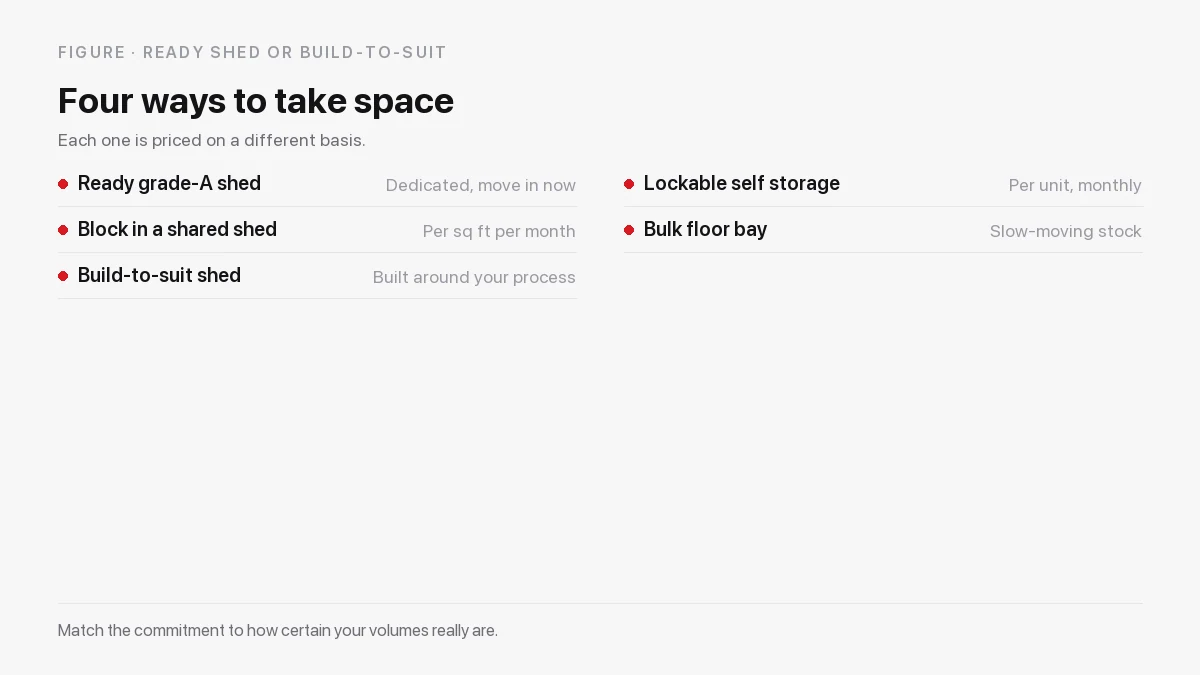
A tenant arriving from an older market is often surprised to find both options on the table. The right answer depends on how certain your volumes are, not on which sounds more impressive.
What grade-A means in plain terms
Strip the jargon and a grade-A shed is one a modern operation can be dropped into without construction work: enough clear height to rack rather than stack, a level floor rated for racking legs and stackers, column spacing wide enough to move a pallet truck without a slalom, loading at dock or ramp height, an apron where a trailer can turn inside the gate, power backup, fire provision, an insulated roof that keeps a North Indian summer manageable inside, and a compound with controlled entry. Any building missing two of those items will cost you in labour or in throughput every single day.
When build-to-suit earns its wait
Build-to-suit means the shed is built around your requirement rather than you fitting into it — usually on industrial land allotted for the purpose, with the tenant committing to a long term. It suits a manufacturer with a ten-year view, a distributor whose throughput justifies custom dock configuration, or a company whose product genuinely needs unusual height, power or temperature. It does not suit a business still finding its shape: the wait for construction and the length of the commitment both assume you already know what you will be doing in 2035.
The middle option: a defined block in a shared shed
Between the two sits the arrangement most mid-sized tenants actually take — a defined block inside a managed warehouse, with shared handling and shared services, billed by the square foot per month. You get a new building and modern loading without paying for floor you cannot fill, and you can add a bay for a peak and step back down afterwards. That flexibility is what business warehousing is, and in a belt where the buildings are this new it is often the fastest route to a working address.
What warehouse space in Greater Noida costs
Published rates for the network start at warehouse and godown space for rent from ₹12 per sq ft per month. commercial warehousing starts at ₹13 per sq ft per month, and business or on-demand warehouse space starts at ₹14 per sq ft per month. All of it is billed monthly, invoiced with GST, and carries no long lock-in.
Treat those as starting rates and not as a quote for a specific shed on a specific corridor. In this belt the spread between the cheapest and dearest square foot is driven by the building itself — its clear height, its loading, its compound — and by the corridor it sits on. A rate quoted for the older Ecotech side and a rate quoted for a new build on the expressway belt are not competing products, so comparing them line by line tells you very little.
What moves the number
- Size. The area you take is the biggest single input, and a small block inside a shared shed is priced differently from a whole dedicated building.
- Corridor. Land along the expressway belts was allotted and built for industry, and the rent reflects that; older sector plots rent for less because they are older and harder to work in.
- Specification. Clear height, floor loading, dock provision, power backup and insulation all move the rate.
- Term. A monthly block and a multi-year commitment are different products, and the longer one is normally cheaper per month.
- Services. Racking, handling, labelling and returns processing are separate line items on a 3PL arrangement and must be priced before you compare two quotes.
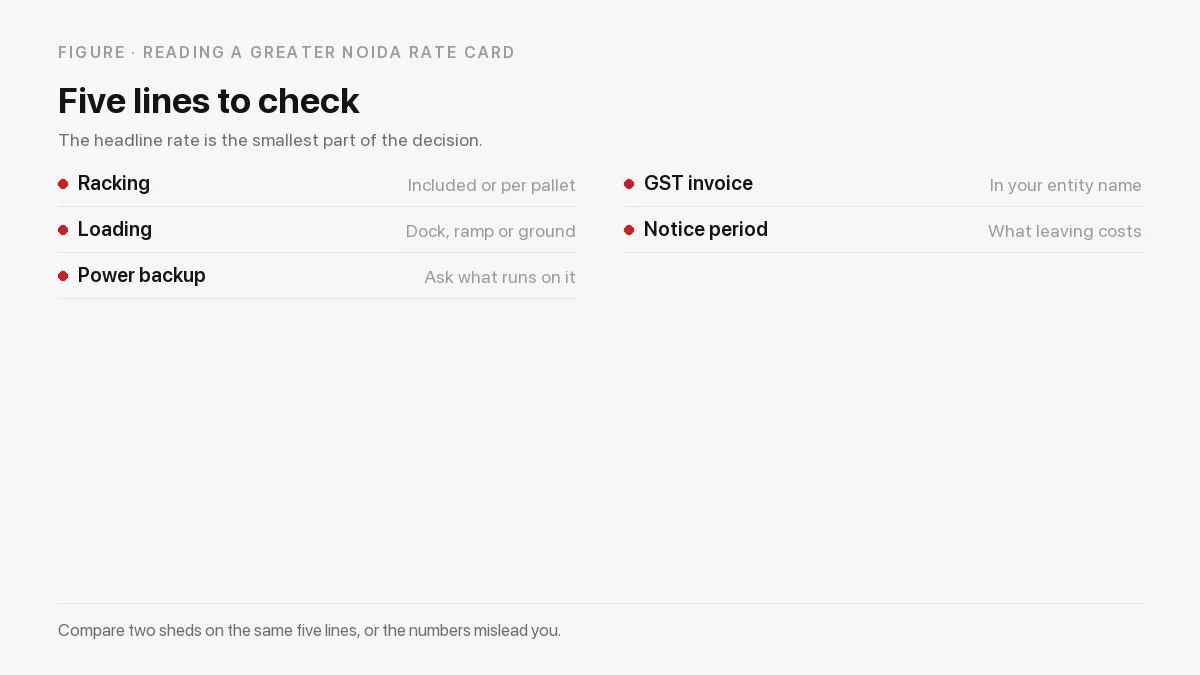
Ask every operator the same three questions before the numbers go on a spreadsheet: is the rate for bare floor or with racking, is GST charged on top or included, and what exactly must be paid to walk away. An invoice that is not a tax invoice in your own entity's name quietly costs you the input credit — the rules are published on the GST portal, and your accountant can confirm in a minute how they apply to you.
Greater Noida, Noida or Ghaziabad?
These three belts sit within about an hour of each other and are often quoted against one another by the same broker in the same call. They are not substitutes, and the differences that matter are structural rather than a matter of taste.
| What you are weighing | Greater Noida belt | Noida / Ghaziabad |
|---|---|---|
| Age of the shed stock | New-build, planned industrial land | Mixed, with older godowns |
| Floorplate you can get | Large single buildings | Smaller, more fragmented |
| Nearest freight node | Airport and Dadri container depot | City markets and GT Road side |
| Best fit | Manufacturers and fulfilment | City delivery and trading stock |
| Truck access inside the gate | Designed in | Varies plot by plot |
The practical read: choose Greater Noida when you need a new building of real size, air or container freight, or a fulfilment node serving NCR and beyond. Choose the Noida or Ghaziabad side when your deliveries are short-haul and your stock is small and fast. A distributor with one van and a regular market run is rarely better off on the expressway belt, however good the building looks on a site visit. The sibling guides to warehousing in Noida and warehousing in Ghaziabad take those two markets apart in the same detail, and the Uttar Pradesh locations page lists where the collection centres and the Dadri facility actually sit.
How to choose — the checks that matter
Work through these before you sign anything, and insist on answers in writing rather than on a walkthrough:
- Measure the gate, not the floor. A trailer that cannot enter or turn inside the compound makes a beautiful shed useless. Ask what vehicle the site was built for.
- Check the land use and the fire clearance. Industrial land use and a valid fire clearance are the two approvals that decide whether a shed can be operated at all; an unapproved godown can be sealed with your inventory inside it.
- Confirm what the rate includes. Racking, handling, power, security, housekeeping and pest control all appear somewhere in the final bill.
- Test the drive to your customers, not to your office. In this belt the difference between two sites can be twenty minutes on a truck, twice a day.
- Ask how you scale. Whether a second bay or a larger block is available in the same facility decides what happens when your volumes double.
- Look at the paperwork you will receive. Check-in records, a stock report and a GST tax invoice are the three documents that make a warehouse manageable at year end.
Red flags
- A rate quoted without saying whether racking is included, because the two numbers are not comparable.
- A building shown as commercial space with no approval documents to show for it.
- A long lock-in offered on a first booking, when a monthly arrangement would settle your requirement first.
- No clear answer about who pays when a consignment is damaged, or about insurance cover.
- Access described as "good" without anyone naming the road and the turning point.
Worked example: 8,000 sq ft for an appliance distributor
Consider a distributor who supplies appliance and electrical stock to dealers across the district and needs a Greater Noida address with room for racking plus bulk floor bays. The requirement is 8,000 sq ft, with a peak in the festive quarter.
Two options are on the table. The first is a 12,000 sq ft dedicated building on the expressway belt at ₹14 per sq ft per month, which comes to ₹1,68,000 a month — including 4,000 sq ft the distributor will not fill for most of the year. The second is an 8,000 sq ft block inside a managed facility at the same rate, which comes to ₹1,12,000 a month, with a bay added for the peak and released afterwards.
The second option saves ₹56,000 a month on the floor alone, and it keeps the growth decision open: if a second product line arrives, the space grows with it, and if the season is soft, the cost does not. Over a year the saving on unused floor runs into several lakh, which is roughly what the distributor would otherwise spend on racking and handling for the whole operation. That is the pattern worth copying in this market — take the new building and the modern loading, but buy only the floor your stock actually occupies.
Also in Delhi NCR
If your customers sit on the other side of Delhi, the sibling guides to warehousing in New Delhi, Gurgaon and Faridabad cover the belts where those deliveries land, and the state-level Uttar Pradesh guide places Greater Noida inside the wider state network. Businesses moving goods between the Yamuna Expressway and the Haryana side generally end up running two smaller units rather than one large one — and paying less for the privilege.
How Lozy helps
Lozy's Uttar Pradesh warehouse is a 30,000 sq ft commercial and 3PL facility at Bisnoli, Dadri, on the Greater Noida industrial stretch, with rack, pallet and bulk-floor storage and dispatch support for e-commerce and distribution. It sits within a network of 77+ warehouses and more than a million square feet of live space, billed monthly on GST invoices with no long lock-in.
Doorstep pickup runs through eight collection centres across the state — Noida and Ghaziabad on the NCR side, with Lucknow and Ballia further east — so stock can start the journey wherever it actually is. If your requirement is a defined block, an on-demand arrangement or business warehousing space is usually the place to start, and larger floorplates are handled through industrial and bulk warehousing.
Before you decide on a belt, it helps to read how rates are built. The business warehousing guide, the industrial warehousing guide and the warehouse for rent guide cover the same ground from the tenant's side, and the services page lists every arrangement Lozy runs. You can also browse the warehouse listing for what is available now, or see the full locations map, including Uttar Pradesh.

Need warehouse space in Greater Noida?
Tell us the city and the size you need — we reply with a rate and the options available now.
Get a quoteCall +91 93547 12345About the author
Lozy Editorial Desk. This guide was written by the Lozy Editorial Desk, the in-house team that covers warehousing, self storage, logistics and customs/EXIM topics for lozy.in. We write from Lozy's own facility and pricing information and from public, citable sources. We do not publish invented statistics, ratings or reviews.
Sources. Pricing and facility details are Lozy's own, set out on the Uttar Pradesh locations page. Industrial land and single-window approvals in the state are described from Invest UP and its Nivesh Mitra portal; the Yamuna Expressway belt's planning context comes from the Yamuna Expressway Industrial Development Authority; airport and cargo details from Noida International Airport; GST registration and input credit from the GST portal; warehousing and logistics market context from IBEF and government releases carried by PIB.
Last updated: 13 October 2026. Have a question the FAQ below does not answer? Call +91 93547 12345 or email care@lozy.in.
Need warehousing or storage in India?
Request a free, tailored quote in under 2 minutes — free pickup, no lock-in.