Contract Logistics in India: What a Contract Actually Covers (2026 Guide)
Contract logistics in India is a storage agreement with a scope, a minimum and an end date, and the clauses in it decide more than the rate does. A dedicated contract commits you to a named area or volume for a fixed term; a shared arrangement commits you only to the position you occupy and the handling your stock generates. What you sign settles what a quiet month costs, who answers for damage, how the rate moves next year, and how you leave.
Key takeaways
- A dedicated bay, a shared racked position and on-demand space differ mainly in who carries the cost of an empty month.
- Seven clauses decide the money: the minimum storage commitment, the handling tariff, escalation, billing, notice, the early-exit charge and the liability cap.
- The stock stays yours, so the insurance on it stays yours. An operator's cover answers its own liability, and its cap per incident is often far below the value sitting inside.
- Published Lozy floors: ₹12 per sq ft per month for warehouse and godown space, ₹14 on business warehousing, inventory-led plans from ₹4,499 a month - each a floor on a basis, not a quotation.
Almost every argument about a warehouse contract is really about two things: what you committed to use, and what the operator committed to do. Racking, dock access, security and the daily cut-off all hang off those two, which is why comparisons built on the headline rate alone fail so often - two proposals reading ₹12 and ₹16 can cost the same once you see what each one prices. In India the phrase stretches from a single bay on a twelve-month term to a fully outsourced supply chain, and the document is the only place that says which one you are looking at. Corridor context behind the location decisions comes from the National Highways Authority of India, not the proposal.
What contract logistics in India means, and what it does not
Take the phrase apart and contract logistics in India is an agreement to hold, handle and release your stock under a written scope, for a period, at a price with a stated basis. The contract version is the one where commitments run both ways and either side can point at a paragraph when something goes wrong.
Widest, the phrase covers the whole outsourced chain - inbound freight, warehousing, order management, outbound distribution. In the storage market it has narrowed to the warehouse agreement itself: a defined area or volume, a term, and the handling priced alongside it - which is why a rate per square foot per month says nothing about who pays for a relabel or a dock slot at nine in the evening.
The carrying and forwarding agent is the ancestor of this model
For decades Indian manufacturers distributed through a carrying and forwarding agent, who held the company's stock and invoiced the trade on its behalf. Contract logistics is that relationship with the discretion removed: the buyer gets a written scope, a handling tariff per activity, and a service level with a name against each line. The older model rewarded trust; this one is built to keep working after the person you trusted has left the company.
What a contract is not
It is not a licence, and not an insurance policy over your goods whatever the operator's own cover says. It is not a promise of capacity at your peak unless a clause states how many pallets and dock slots are reserved, and it is not a freight rate. Which activities transfer to an operator and which stay on your desk is worked through in the 3PL warehousing guide for Delhi NCR; this post stays with the terms. Where the provider category itself is still open, the types of warehousing company in Delhi NCR are set out side by side.
Dedicated, shared and on-demand: the three shapes of commitment
The most useful question to ask of any proposal is who carries the cost of an empty month. The three shapes answer it differently, and the table below is the comparison in one place.
| What the arrangement settles | Dedicated contract | Shared racked position | On-demand space |
|---|---|---|---|
| What you occupy | A named bay, block or building, reserved | Rack levels or pallet positions on a common floor | Whatever you take this month, released when you stop |
| Who carries an empty month | You: the area is billed whether it holds stock or air | Partly you: reserved positions are usually billed even when unfilled | The operator: you pay for what you occupy and use |
| Rate basis | Per sq ft per month, or a monthly sum for the reserved area | Per pallet position per month, racking often included | A published starting rate per sq ft per month or per unit |
| Labour | Separate line: a dedicated crew only if it is written in | The operator's crew, charged as a handling tariff | Basic handling, metered per movement |
| Term and exit | A stated minimum term, a notice period, often an early-exit charge | Rolling, on one billing cycle of notice | Monthly, with no long lock-in |
| Best fit | Stable volume and goods that need your own layout, process or security | Standard palletised stock whose volume swings | A first warehouse, a peak, or an overflow position |
Read the empty-month row first. A dedicated contract is not a dearer version of shared space; it is a different allocation of risk. You take the risk that the bay sits half idle and in exchange get certainty: the area cannot be handed to another client in February, the layout is built around your SKUs, and the rate is held for the term. Shared space runs the other way - you pay for positions rather than ground, and the operator carries the utilisation risk across a floor of clients, which is why a shared rate always arrives with a handling tariff that follows your volume. The third shape commits neither side to much; its billing model is explained in the monthly warehousing explainer.
What dedicated actually changes on the floor
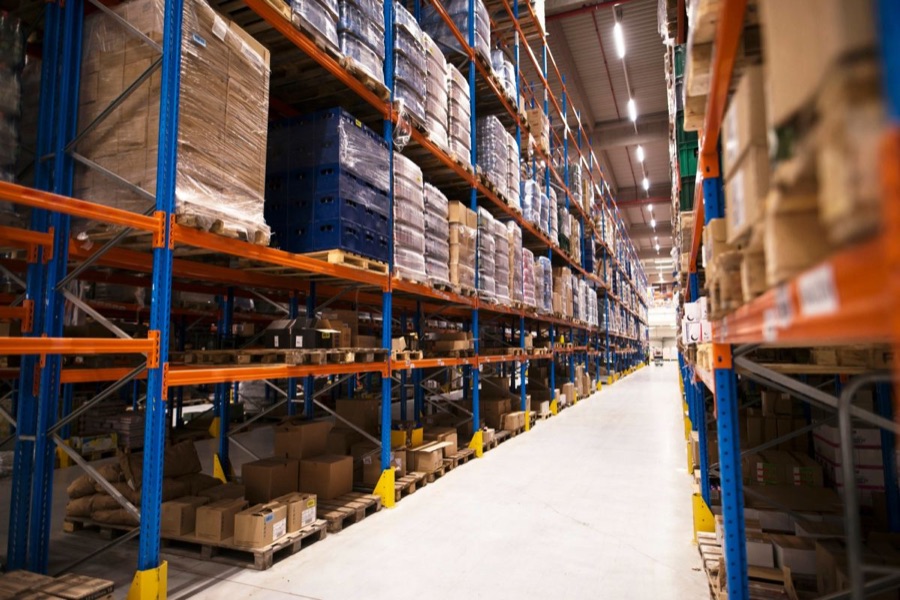
Your layout stops being a suggestion. Aisle widths, rack heights, where the returns corner sits and how a vehicle reaches the dock can only be decided once the area is yours. That is the real product - a room built to your operation rather than an operation bent to an available room - and it is why a dedicated fit-out takes longer than a shared booking.
Two things the word does not promise. The first is a dedicated crew: in most facilities the bay is yours while the people who service it are the operator's shared team, so continuity of supervisor or picker belongs in the agreement as its own line if your stock needs it. The second is silence on the idle area - a business holding 6,000 sq ft and filling 4,000 pays for 2,000 sq ft of air every month of the term.
What a minimum storage commitment buys you
A minimum storage commitment - take-or-pay, in the language of the trade - is the floor below which your invoice does not fall. It is written three ways, and the difference matters more than it looks.
- A reserved area. A stated square footage or a named bay, billed in full whether it is stacked to the roof or half empty. This is the classic dedicated arrangement, suited to an operation with its own layout or goods that cannot be mixed with anyone else's.
- A reserved volume. A number of pallet positions or cubic capacity, filled or not. It reconciles more easily against a stock report, which is why racked facilities prefer it.
- A minimum monthly spend. No area is ring-fenced; you commit to a rupee floor across storage and handling. It is the most flexible version and the hardest to set beside a rate per square foot.
What the commitment buys, and what it does not cover
A commitment is not only a concession to the operator. It is the consideration you give for things a rolling booking cannot offer: the area held against other enquiries for the whole term, a rack layout and aisle width built around your pallet sizes rather than a standard template, a rate fixed for the agreed period, and a dock slot reserved at your peak hour. What it does not cover is the work: labelling, kitting, repacking, overtime dock use and special handling sit outside the minimum and are priced per activity.
The clauses to negotiate, clause by clause
Most warehouse agreements are unremarkable and most work. The ones that go wrong were signed with the rate agreed and everything else left to good faith. These are the clauses worth reading line by line.
Commercial clauses: rate, minimum, escalation, billing
- The storage rate and its basis. Per square foot per month, per pallet position, or a monthly plan. Without the basis the number means nothing.
- The minimum commitment and how it is measured. If it is a volume or a spend, name the measurement date and the report it is measured from; a minimum with no measurement method is a monthly argument.
- The escalation clause. An open-ended "market rate, to be discussed annually" commits nobody and leaves the side holding your pallets in the stronger seat at every review. The versions worth signing are a fixed percentage from a named date, or an increase tied to a published index over a stated period with a floor and ceiling. The trade and cost context behind warehousing rates is summarised by IBEF. Whichever you take, settle when the first increase applies and whether it covers the handling schedule as well as the storage line.
- Billing cycle and payment terms. Monthly in advance or in arrears, the due date, what a late payment triggers, and whether a deposit is held. Lozy bills monthly on a GST invoice; whatever the cycle, the invoice should name the period it covers.
The handling tariff belongs in an annexure
Ask for the tariff as a schedule: inward handling, outward handling, picking per line, packing material, labelling, kitting, repacking, overtime dock use, and any charge for a vehicle arriving outside the agreed window. Two details are worth insisting on: whether handling is charged on actual or volumetric weight, since for light bulky goods the volumetric basis can double the effective rate; and whether a return or a repack is charged as an inward movement and again as an outward one, because a well-priced single touch becomes three that way.
The risk clauses: insurance, liability, security
Three clauses carry the risk, and the ordinary position surprises people. In a normal storage arrangement the goods remain your property and the risk of loss or damage remains yours: the operator insures the building, its equipment and its own exposure, not the value of your inventory. So the policy answering for a fire, a flood or a handling accident is the one you place on your own stock at declared value, written to cover goods held at a third-party location. The number that decides what a claim is worth is the liability cap, often a multiple of the monthly fee or a figure per incident, which on a bad day can be a small fraction of what is inside. Check whether it is per incident or for the whole term, whether the agreement says reasonable care or holds the operator to a bailee's standard, and if the cap sits far below your peak stock value, treat the gap as yours to fill with your own cover. Warehouse regulation and, where an operator issues tradable receipts, the receipts framework sit with the Warehousing Development and Regulatory Authority. The security clause should say what surveillance exists, how long footage is retained and how access is controlled.
Notice, exit and the leaving schedule
Every contract ends, and the ending is decided long before it arrives.
How notice usually works
Notice is normally tied to the billing cycle, so a monthly arrangement typically needs one full cycle in writing while a longer contract might ask for sixty or ninety days. Pin down at signature whether notice must be in writing and to whom, whether a part-notice is valid, and whether notice can be served only after a stated minimum period has run. Verbal notice is the commonest failure: a message to the supervisor who runs your account is not notice to the company.
Early exit, and what it costs
Where a minimum commitment is in force, leaving early normally means paying out the commitment for the balance of the term or a stated early-exit charge, whichever the clause names. This is the clause to negotiate hardest: few businesses know their volumes eighteen months ahead. Three versions are worth asking for, in order of preference: a break option at a stated date on the normal notice period; a buy-out on the commitment actually unused rather than the whole remaining term; and a transfer option letting the commitment move to another facility in the operator's network if your geography shifts. A contract with none of the three has a fixed exit price, and that price belongs in the decision.
The leaving schedule
The mechanics are the same whether the contract ended by notice or by completion, and they are worth writing as a schedule at signature rather than inventing at the end. Serve notice in writing and get the acknowledgement, agree the withdrawal window and who bears the exit movement cost, and agree in advance what a variance at the closing count triggers. Ask for your stock data as a full export, and test the format while the agreement is still live. Then the small print: racking you installed is yours to remove or the operator's to buy, accrued handling is invoiced, and a deposit has a defined refund timeline.
What contract logistics costs in India
There is no single market rate for a warehouse contract. What can be checked is the published floor for each basis Lozy operates, taken from the service pages rather than an average:
- Warehouse and godown space for rent - from ₹12 per sq ft per month on the warehouse and godown space for rent page. The floor-area basis a dedicated contract is built on.
- Commercial storage space - from ₹13 per sq ft per month on the commercial warehousing page, for racked positions built for businesses that buy and sell.
- Business warehousing - from ₹14 per sq ft per month on the business warehousing page, for managed space with handling inside the plan.
- Long-term storage - from ₹1,199 per month on the long-term warehousing page, where a small footprint needs a long horizon.
- Inventory-led plans - from ₹4,499 per month on the inventory warehousing page, where the bill follows stock and movement.
Every figure above is a starting floor rather than a quotation, and each belongs to one basis. A dedicated contract is usually negotiated from the first or the third, for a stated area, term and scope. The industrial warehousing page carries the bulk floorplates and dock access; where the need is a seasonal spike rather than a steady term, the seasonal warehousing guide describes the shape that fits better than a committed bay. All the published bases sit together on the Lozy pricing page.
A worked example: a Ghaziabad components maker contracts west
Take a representative case rather than a real account. A maker of electrical hardware in Ghaziabad's industrial belt ships to dealers across Haryana, Rajasthan and western Uttar Pradesh, holds about 300 standard pallets, expects to add forty a year, and sees its dealer base drift west. Three routes are open: keep the Ghaziabad godown and staff it, take a shared racked position with a handling tariff, or sign a dedicated contract for a bay west of the region.
The arithmetic on a published floor does not decide it on its own. A 4,000 sq ft bay at the ₹14 per sq ft business warehousing floor is about ₹56,000 a month before handling - arithmetic on a published floor, not a quote, since node, racking and term all move it. The Ghaziabad godown only looks cheapest until the supervisor's salary, the racking and the runs that begin on the wrong side of the city are counted. Place names are not decoration either - a bay at Manesar or Kherki Daula shortens the run to the Haryana and Rajasthan dealers through the NH-48 corridor, while Faridabad or Greater Noida would suit a brief whose volumes stayed east. The Gurgaon warehousing guide takes the western belt apart, and a manufacturer weighing the storage side of the same decision should read the warehousing for manufacturers guide alongside this one.
What moves the number
- The node. Land and rent differ between the belts of Delhi NCR, and the gap appears in the rate before it appears in your transport bill. The city-wise per sq ft guide shows how far one basis spreads between markets.
- The escalation clause. A named index with a floor and ceiling prices three years more predictably than a fixed percentage compounding quietly.
What people get wrong about a warehouse contract
- Negotiating the rate and ignoring the minimum. The cost of an underused commitment can exceed the saving on the headline rate within a quarter, and it is fixed for the term.
- Leaving the handling tariff as "to be agreed". Everything a fast-moving range generates sits there, so an article not written at signature gets written later on terms you did not choose.
- Reading "dedicated facility" as "dedicated team". The bay can be yours while the crew is shared. If continuity of people matters, it needs its own line in the agreement.
- Accepting a liability cap below the stock value. A cap set at a multiple of the monthly fee can be a fraction of what is inside at peak, so measure the gap and cover it yourself.
- Forgetting the escalation on the day it applies. Fix the first review date, the reference it uses, and whether the increase touches the handling schedule; a clause nobody diarises arrives as a surprise invoice.
- Planning the exit in the final week. Notice, withdrawal window, closing count, data export and deposit refund are cheap at signature and expensive at the end.
How Lozy fits, using only its published figures
Lozy runs storage and managed warehouse space rather than a freight fleet, so it sits on the operator side of everything above - and a committed contract is not right for every business. Where volume swings widely, or the need is a first warehouse or an overflow position, space taken month by month is simpler, and Lozy publishes that route openly: 77+ warehouses and more than one million square feet of live space, based in Delhi NCR and extending across India, billed monthly on a GST invoice with no long lock-in on the monthly plans.
Where a contract does fit - steady volume, a layout built around unusual goods, a fixed term at a held rate - the published floors are the starting point: ₹12 per sq ft per month for warehouse and godown space, ₹14 for business warehousing, and inventory-led plans from ₹4,499 per month where a requirement is better priced on movement than on floor area. Each is a basis rather than a quotation, and each carries the GST invoice a business needs for input credit. Lozy will also say plainly that a business wanting a bare shell for several years and its own crew is better served by a conventional lease.
The facilities are readable before any conversation: the Lozy locations index maps every site, browsing the warehouse listing shows what is open now, and everything Lozy operates is listed on the services page. Bring your pallet count, the term in mind and the goods, and the FAQ with the contact page is where the reply comes back: a rate on a stated basis, what a minimum commitment would buy at your volume, and an honest answer on whether a shared position would serve you better.

Related guides
- 3PL warehousing in Delhi NCR
- warehousing for 3PL partners
- warehouse management services
- warehousing for manufacturers
Reading a storage proposal and not sure what it commits you to?
Send the requirement, the term you can live with and the goods - we will come back with a rate on a stated basis, what a minimum commitment would buy at your volume, and the clauses we would want in the agreement.
Get a quoteCall +91 93547 12345Sources. Rates, network counts and facility details are Lozy's own published information. GST registration, invoicing and input credit rules come from the GST portal; warehouse regulation and the negotiable warehouse receipt framework from the Warehousing Development and Regulatory Authority; trade and sector context from IBEF and DPIIT; highway context in Delhi NCR from the National Highways Authority of India; and small-business outsourcing guidance from the Ministry of MSME. No price or statistic outside Lozy's published figures appears in this guide.
Last updated: 14 October 2026. Have a question the FAQ below does not answer? Call +91 93547 12345 or email care@lozy.in.
Need warehousing or storage in India?
Request a free, tailored quote in under 2 minutes — free pickup, no lock-in.