Electrical Goods Warehousing: How Electrical and Hardware Stock Is Stored, Costed and Dispatched (2026 Guide)
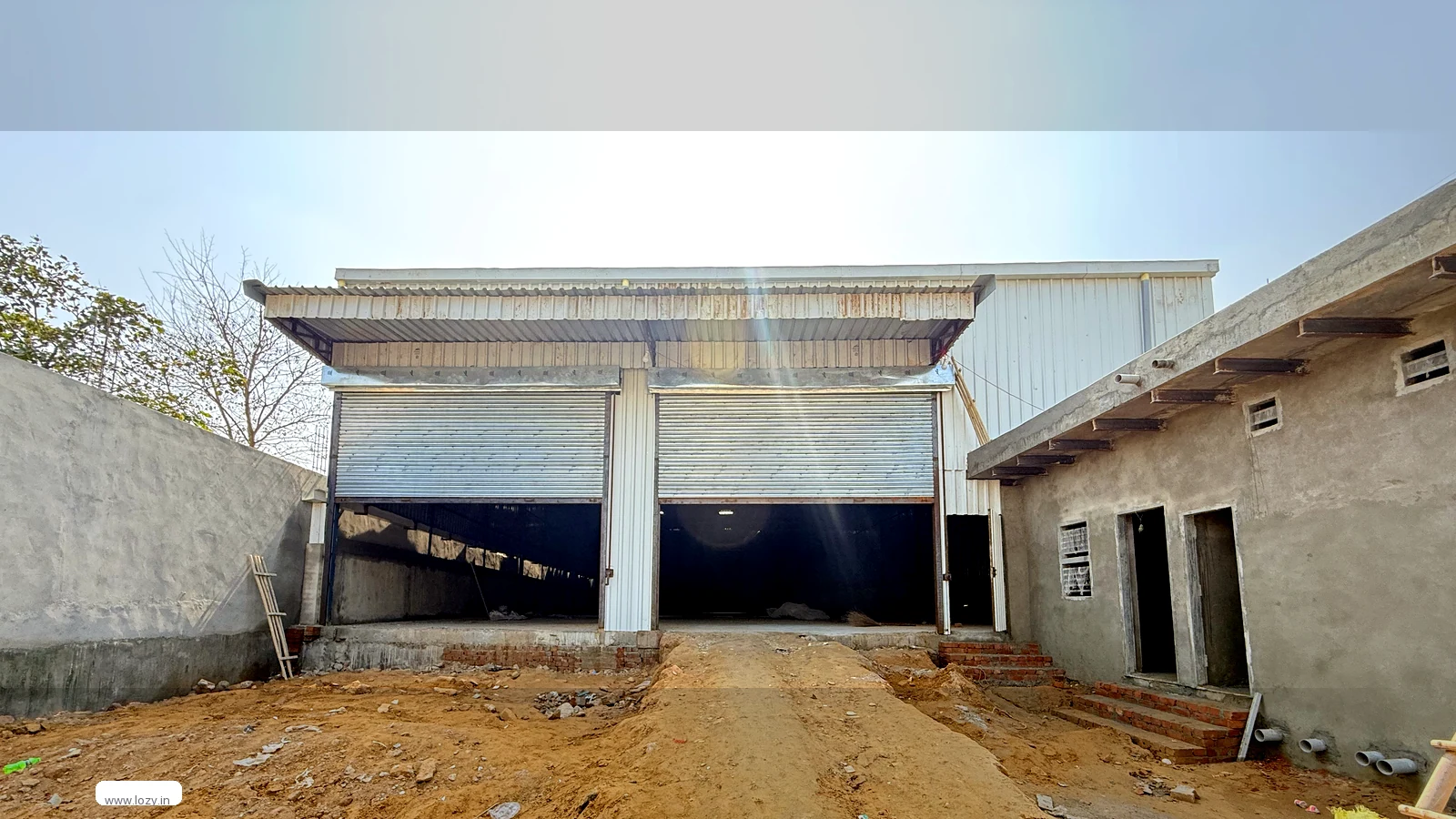
Electrical goods warehousing is the storage of a trade that moves in two incompatible shapes under one roof: heavy coils, cable drums and switchgear cartons on one side, and thousands of small fittings, fasteners and tools on the other. Lozy racks and floors both for electrical dealers, contractors and hardware distributors, recording stock as it arrives and leaves. Space starts at ₹12 per sq ft per month, billed monthly with a GST invoice and no lock-in.
Key takeaways
- A coil of house wire, a 500-metre LT drum and a box of MCBs share nothing except one requirement: the bay has to stay dry, because a damp floor corrodes copper and contact points long before the goods reach a counter.
- Lozy runs 77+ warehouses and more than a million square feet of live space, and electrical and hardware stock sits in the Manesar, Faridabad and New Delhi belts of Delhi NCR.
- Space for rent starts at ₹12 per sq ft per month and business storage at ₹14; inventory-tracked storage starts at ₹4,499 per month and a long-term booking at ₹1,199 per month.
- The layout that works separates drums from cartons, keeps coils off the concrete on dunnage or racking, and puts fast-moving fittings at the pick face.
Most electrical businesses do not set out to rent a warehouse; a shipment forces the decision. A cable consignment lands before the shop can take it, a project order arrives weeks ahead of the slabs it will be fitted into, or the counter has simply run out of floor. What follows is a layout built for a trade that combines heavy, round, corrosion-prone goods with the fiddliness of a tobacconist's shelf — and how that layout is priced, chosen and run.
What electrical goods warehousing really involves
An electrical goods warehouse is two storage problems running in parallel, and they pull the layout in opposite directions. The heavy end — LT cable drums, house-wire coils, GI conduit bundles, distribution boards — rolls, sags and corrodes, and does not want to be lifted onto a high shelf. The light end — MCBs, modular plates, sockets, junction boxes, lugs, screws, drill bits and hand tools — is flat, small and dense in count, worth racking in labelled positions so a picker can find one item among four thousand.
A single bay handles one shape well and the other badly. That is why electrical goods warehousing at Lozy is a mixed layout: racked bays for cartons and boxes, and demarcated floor positions for drums, coils and conduit lengths worked by hand and trolley rather than by the pallet.
The four SKU shapes that decide your layout
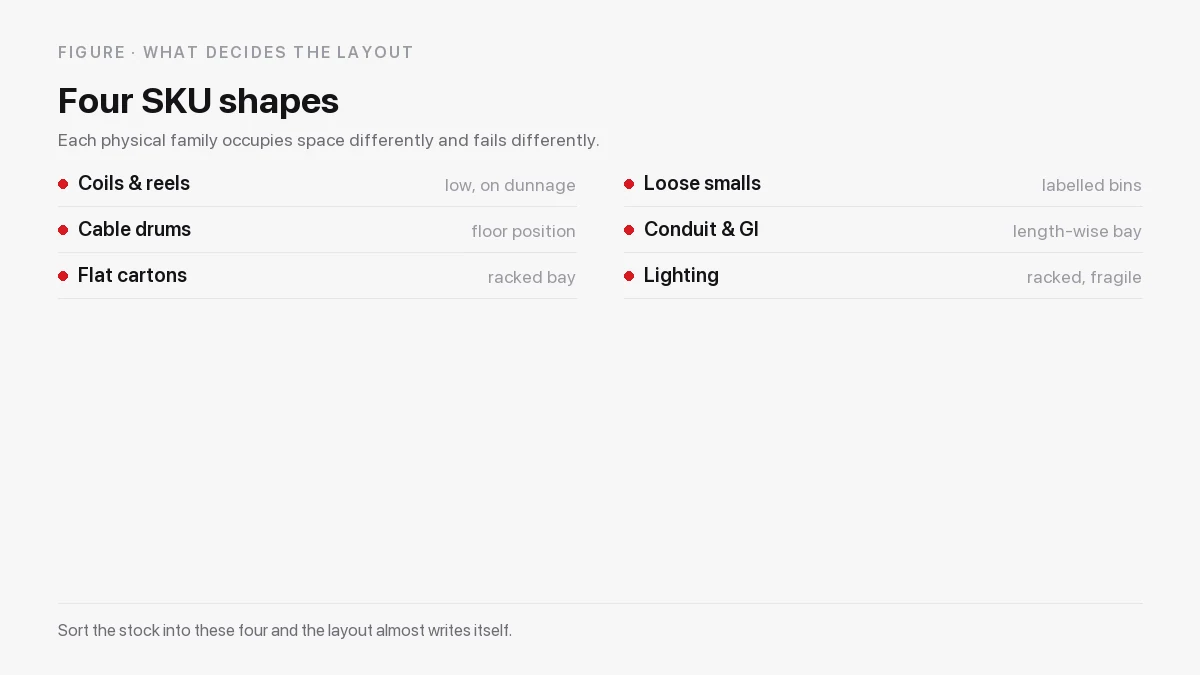
Sort the stock into four physical families before any plan is drawn; each occupies space differently and each fails differently if the storage is wrong.
- Coils and reels. House wire and flexible cable in 90-metre and 180-metre reels. Heavy for their size, round, and liable to climb a rack and roll off it. They want low positions, dunnage underneath, and a dry floor.
- Drums. 500-metre and 1,000-metre cable drums arriving on their own flanges. Bulky, slow-turning, rolled rather than carried. They occupy floor, not rack, and block an aisle if the bay is planned as if they were cartons.
- Flat cartons and trays. Switchgear, MCBs and RCCBs, modular plates, socket outlets, junction boxes and luminaires. Rectangular, stackable, and picked piece-wise against an order.
- Loose smalls and tools. Fasteners, lugs, glands, tapes, drill bits, spanners and testers. They take bins and labels rather than cube, and need a pick face close enough to the packing table that a counter order is assembled in minutes.
Sort the stock those four ways and the layout almost writes itself. Get it wrong and the cost shows up quietly in handling time rather than in rent — the drum moved twice to reach a carton, the coil buried behind the conduit, the fitting that takes ten minutes to find.
How electrical stock moves through the warehouse
The route is a loop rather than a line, and it changes shape with the trade. Counter stock turns weekly and comes back as a repeat order; project material sits until a site is ready and then leaves in a disciplined consignment. One bay has to hold both rhythms without letting one slow the other.
Inward: drums, coils and cartons arrive on three different vehicles
- Factory and depot loads arrive as mixed pallets — cartons on top, coils at the base, and a couple of drums on a separate vehicle because their weight rules out mixing.
- Distributor transfers arrive in smaller, often part-pallet lots, and are the loads most likely to be short-counted if the check-in is casual.
- Returns and project material come back as loose goods, part-drums and opened boxes, none of which can join live stock without being inspected first.
Every one arrives with a piece count that has to be reconciled at the gate. Electrical stock is high value by volume, so a discrepancy in one carton of MCBs is a real loss, not a rounding error. Check-in against the delivery note, item by item, before the goods are racked, is what keeps the record honest.
Outward: wire-cut, length-wise and counter-style picking
Very little leaves an electrical warehouse as a full pallet. Orders are built to a counter or a site and the picking is specific: a cut length of cable as well as a coil, a particular drum flange as well as a box of fittings, a kit of switches for one floor of a building. For storage for electrical dealers, the pick face is planned around the order type — a counter lane that never goes empty, and a project lane where sealed cartons are staged together so a consignment leaves as one unit rather than in dribs.
Part-drums and part-reels are the awkward middle: still saleable, still worth money, but taking a handling position of their own. Without a home for them they end up in the aisle, which is exactly where electrical stock gets damaged.
What electrical goods cost to store
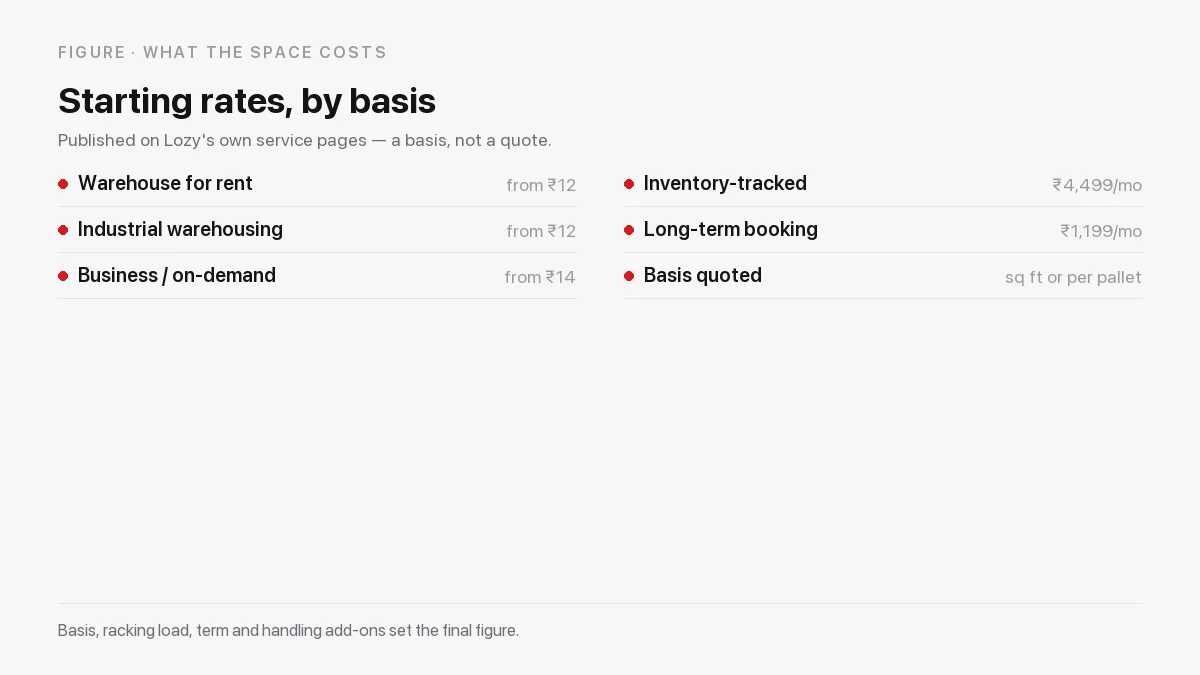
Lozy publishes starting rates on its own service pages rather than a single national average, because an average without its basis tells an electrical dealer very little. The figures that apply to this trade are these, each attached to the service it belongs to:
- Warehouse for rent — from ₹12 per sq ft per month on the warehouse and godown space for rent page, the basis for pricing a floorplate by area.
- Industrial warehousing — from ₹12 per sq ft per month on the industrial and bulk warehousing page, for large racked or bulk floor areas with dock access.
- Business warehousing — from ₹14 per sq ft per month on the business warehousing page, for racked or floor space taken month by month with security, handling and invoicing included.
- On-demand space — from ₹14 per sq ft per month on the on-demand warehouse space page, for a short, surge-shaped requirement.
- Inventory-tracked storage — from ₹4,499 per month on the inventory warehousing page, the route to take when you want stock carried as a running ledger rather than as a space.
- Long-term warehousing — from ₹1,199 per month on the long-term warehousing page, for a fixed smaller footprint held over a longer commitment.
All six are starting rates, not quotes. Every charge is billed monthly and invoiced with GST, and none carries a long lock-in, so a business can take a larger bay for a project surge and step back down afterwards. The full basis behind a quote, including what sits inside the rate, is on the Lozy pricing page.
What actually moves an electrical storage rate
- The basis quoted. A drum sitting on eight square feet of floor is not the same product as a racked pallet position of switchgear, and mixing the two bases is the fastest route to a misleading comparison.
- Weight and racking load. A coil rack has to be rated for the weight in it; where a bay needs heavier-rated racking for coils and drums, that is a real input to the figure.
- Height used. Racked storage costs more per square foot and less per item, because it uses the building's height; floor storage is simpler and often cheaper for goods that turn slowly.
- Term. A monthly booking and a long-term commitment price differently, and the longer one is usually cheaper per month for the same footprint.
- Handling and add-ons. Cut lengths, re-packing, out-of-hours dispatch and insurance each move the total, and describing the goods accurately keeps the extras to the ones you need.
Three ways to hold electrical stock
There are only three realistic ways an electrical business holds stock off its own premises, and they differ far less in headline rate than in what they demand of you.
| What you are deciding | Own godown | Shared / rented warehouse | 3PL-run storage |
|---|---|---|---|
| Capital up front | Deposit, fit-out, racking and flooring bought outright | Monthly rate; racking and handling equipment on site | Monthly rate plus a per-transaction handling charge |
| Damp and dust control | Yours to solve — plinth, floor and roofing all on you | Operated floor, plinth and roofing maintained by the operator | Operated, with housekeeping part of the agreement |
| Drum and coil handling | You buy the drum trolley and the rated racking | Trolleys and pallet trucks available at the facility | Handled to a rate card, charged per movement |
| Small-parts security | Yours to staff; least controlled when the shop is busy | 24/7 CCTV, PIN access and a documented check-in | Controlled, with stock reports on a cycle |
| When a project surges | You overflow to a second godown and pay twice | Add a bay or a floor position and step back down after | Scalable, but every extra movement is billed |
| Invoice and credit | Capex and municipal charges, not simple rent | Monthly GST tax invoice, claimable as input credit | Monthly invoice with storage and handling split out |
| A sensible choice when | Your requirement is large, proven and permanent | Your stock turns with the season and the project book | You want the goods moved and picked by someone else |
The pattern in this trade is a split. A dealer with a permanent core of fast-moving stock often keeps a small owned base for the counter lines and rents shared space for the drums, project material and seasonal stock that would otherwise bulge the godown twice a year.
How to choose a warehouse for electrical goods
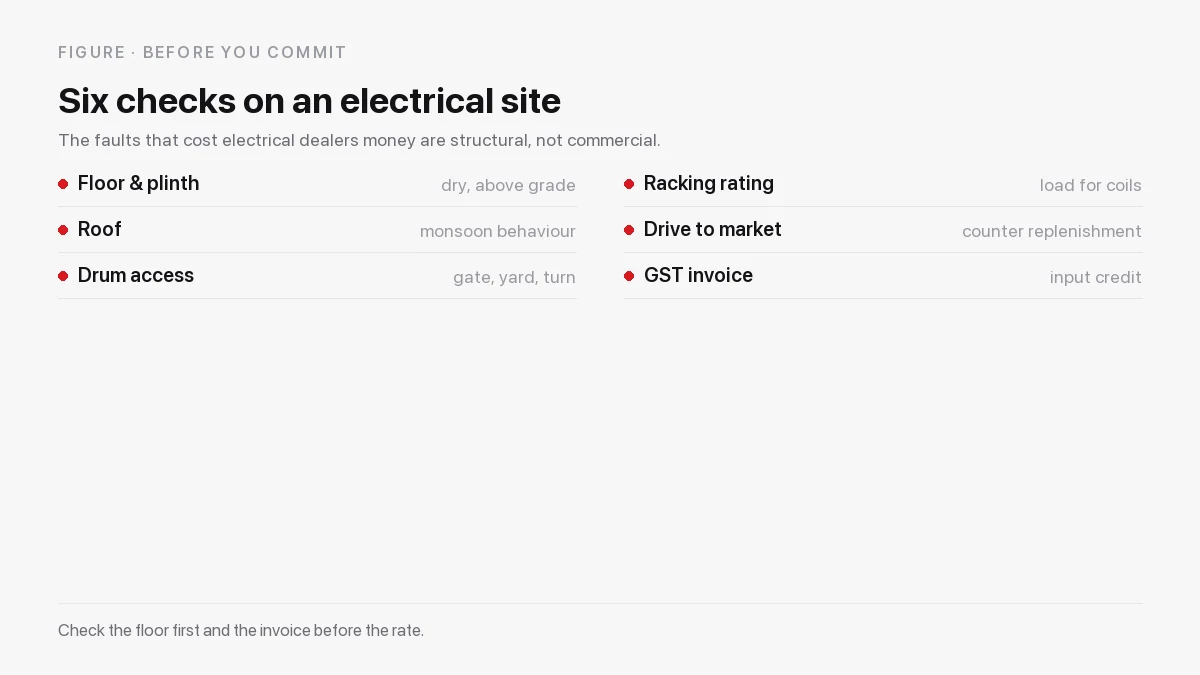
Electrical stock punishes the wrong building more than most categories, because the two things that damage it — water and dust — are the two things a cheap shed usually has. Work these checks on site, before any rate is discussed.
- Look at the floor and the plinth, not the racking. Is the slab concrete rather than packed earth, above the surrounding grade, and free of water staining at the edges? A damp floor is the most expensive fault in an electrical warehouse, because it corrodes coils and contacts invisibly, inside the packing, before dispatch.
- Ask how the roof behaves in July and August. Corrugated sheeting with no insulation sweats in a monsoon, and a leaking sheet over a rack of switchgear is a claim waiting to happen. Look for staining on the sheeting and the trusses.
- Check a drum can actually reach the bay. Electrical loads arrive on vehicles that need a gate wide enough, a yard hard enough and a turn large enough. A bay that needs a drum hand-rolled fifty metres across loose ground will be used badly.
- Confirm the racking is rated for what you store. Coils and part-drums are heavy for their footprint; racking installed for light cartons is not the same structure, and the difference is a safety question, not a cost one.
- Measure the drive to the market you supply. For a Delhi NCR dealer that is usually the drive to the trade market at the hour the vehicle actually leaves, not the drive from home.
- Settle the invoice before the rate. Ask whether GST is charged and on what basis, whether the document is a tax invoice in your entity's name, and whether storage and handling appear as separate lines.
Red flags in an electrical storage deal
- A bare or patched earth floor. Painted concrete is fine; a floor repaired where it flooded is not, and coils stored on it will rust.
- No answer on humidity or monsoon. An operator who has run the building through a monsoon knows where the water comes from. One who cannot say has probably not watched.
- Racking described as "good for cartons". Ask for the load rating. If nobody can produce it, do not put coils or drums on it.
- Dock count given as "plenty". Ask for a number; it governs how many vehicles can load at once the day a project consignment has to leave.
- Part-drums with no home in the plan. Without a position for part-reels and opened boxes, they will live in the aisle and get walked into.
- Cash rent with no tax invoice. Cheaper in the month, dearer over the year, because none of it comes back as input credit.
- and no room to expand on the same site. Ask what the next bay looks like and where it is; a dealer who outgrows a site and has to move pays twice.
Worked example: a switchgear and cable dealer in Delhi NCR
Take a representative case rather than a named customer. A wholesale electrical dealer in the Bhagirath Palace belt of Old Delhi sells counter stock — wires, MCBs, modular fittings, switches — to smaller shops across the city, and separately supplies project material to contractors on a large commercial build in Greater Noida. Volumes have grown past what the shop's rear room can hold, and the counter staff spend part of every morning digging out fittings for walk-in customers.
The dealer shortlists two Lozy positions: a bay in the New Delhi belt close to the market, and a larger floor position on the Manesar side, where more space is available for less. Both are quoted on a starting basis of ₹12 per sq ft per month for warehouse space, and once the sizes are matched the rate difference decides nothing.
Written down, the comparison resolves on the goods rather than the rent. The counter lines are replenished two or three times a week, so the bay closest to the Bhagirath Palace belt wins the counter stock outright — the drive time is the recurring cost, and it repeats weekly. The drum stock and the Greater Noida consignment are pure storage with one dispatch, so they go to the larger Manesar-side position, where the floor area holds the drums without blocking an aisle. Splitting the stock by rhythm rather than keeping it all in one place is what makes the arrangement cheaper than the single bay the dealer first asked for.
The reverse case is just as common. A contractor's store linked to a site in Noida is better served by space on the Noida or Uttar Pradesh side, because project material moves to one destination on one schedule, and distance to that site is the only distance that matters.
Seasonality and the dispatch rhythm of the trade
Electrical demand in India is not flat, and a warehouse holding this stock has to be planned around three separate calendars.
The monsoon window, June to September
This is the season that decides whether a site was worth taking. Humidity is the enemy of everything on the shelf — copper corrodes, contact strips tarnish, packing softens — and a floor that takes in water in July costs more than the rent saved in the other eight months. Site work also slows, so project material accumulates in storage just as the building is most vulnerable. Visit a candidate site after rain if you can, and ask how the yard and the doors behaved last monsoon.
The construction and electrification push, October to March
Once the rains pass, building and fitting-out accelerate, and electrical material moves from storage to site in a rush. A bay that already holds the conduit, wire and switchgear for a project lets the consignment leave in one planned dispatch instead of trickling out of a shop back room over three weeks. This is also the window when extra space is most often needed at short notice.
Festive retail restocking, September to November
Wiring, lighting and small electrical goods sell hardest around the festival season, when homes are repaired, decorated and fitted out. Retail demand pulls stock forward from dealer to shop, and counter lines turn fastest of all in these weeks. A plan that can add a racked position for a month and release it afterwards is worth more in this window than a cheaper rate somewhere further out.
The practical rhythm that follows runs on two cycles: counter lines replenished a few times a week, project material dispatched in planned consignment batches matched to the site's progress. When those two cycles share one bay without a plan, the fast-moving stock is always the one that gets blocked in.
How Lozy handles electrical and hardware stock
Lozy provides electrical goods warehousing with Lozy for dealers, contractors, distributors and hardware traders, backed by 77+ warehouses and more than one million square feet of live space. A unit for this trade combines racked bays for cartons and switchgear with demarcated floor positions for cable drums, coils and conduit lengths, alongside 24/7 CCTV, PIN access, pest control and monthly billing with GST-compliant invoicing.
The discipline around the goods is what matters most. Coils and part-drums are stored off the concrete, drums are kept in their own floor positions rather than mixed into carton aisles, and dust and moisture are handled as routine housekeeping rather than as a fix after the fact. Inventory is recorded as it moves — checked in against the delivery note item by item, with a photo record behind the count — so a dealer can answer what is where in minutes rather than by walking the racks.
When the requirement changes, the space changes with it: extra positions are added in the same facility for a project surge and released once the consignment has gone. Stock that needs to run as a live ledger rather than simply be held, a bulk floorplate with dock access, and a requirement held over a longer horizon each have their own service page in the list above.
Where the space is, and what to read next
Lozy's network covers 77+ warehouses and over one million square feet of live space across nine city hubs, and the Delhi NCR belt is the deepest part of it for a trade this region concentrates: the Manesar cluster, the Faridabad industrial estates and the New Delhi locations all hold electrical and hardware stock. The electrical and hardware warehousing page carries the live service detail, and everything Lozy runs sits under Lozy's services.
For the region, the state and city posts put the corridors in context: the Haryana warehousing guide covers the NH-44 and NH-48 belts, the Uttar Pradesh guide the eastern side, and the New Delhi and Noida guides the positions inside and just outside the boundary. Trades whose storage overlaps with this one are covered by the manufacturers guide, the auto components guide and the solar equipment guide.
For the general principles, the commercial warehousing guide, the industrial warehousing guide and the inventory warehousing guide set out how space, racking and stock records work across categories. When you have a size, a city and a date, the contact page gets you a rate and the available options, usually the same working day.

Related guides
Storing switchgear, coils or building hardware? Get a rate
Tell us what you store and roughly how much space it needs — we reply with availability and a price, usually the same working day.
Get a quoteCall +91 93547 12345Sources. Rates, facility details and network figures come from Lozy's own published pages. Standards for wires, cables and switchgear are published by the Bureau of Indian Standards; GST registration, invoicing and input credit are described from the GST portal; sector context comes from the Indian Electrical & Electronics Manufacturers' Association and the Central Electricity Authority; export context for electrical goods from EEPC India.
Last updated: 14 October 2026. Have a question the FAQ below does not answer? Call +91 93547 12345 or email care@lozy.in.
Need warehousing or storage in India?
Request a free, tailored quote in under 2 minutes — free pickup, no lock-in.