
Food and Beverage Warehousing in Delhi NCR: Cost, Date Codes and Site Checks (2026 Guide)
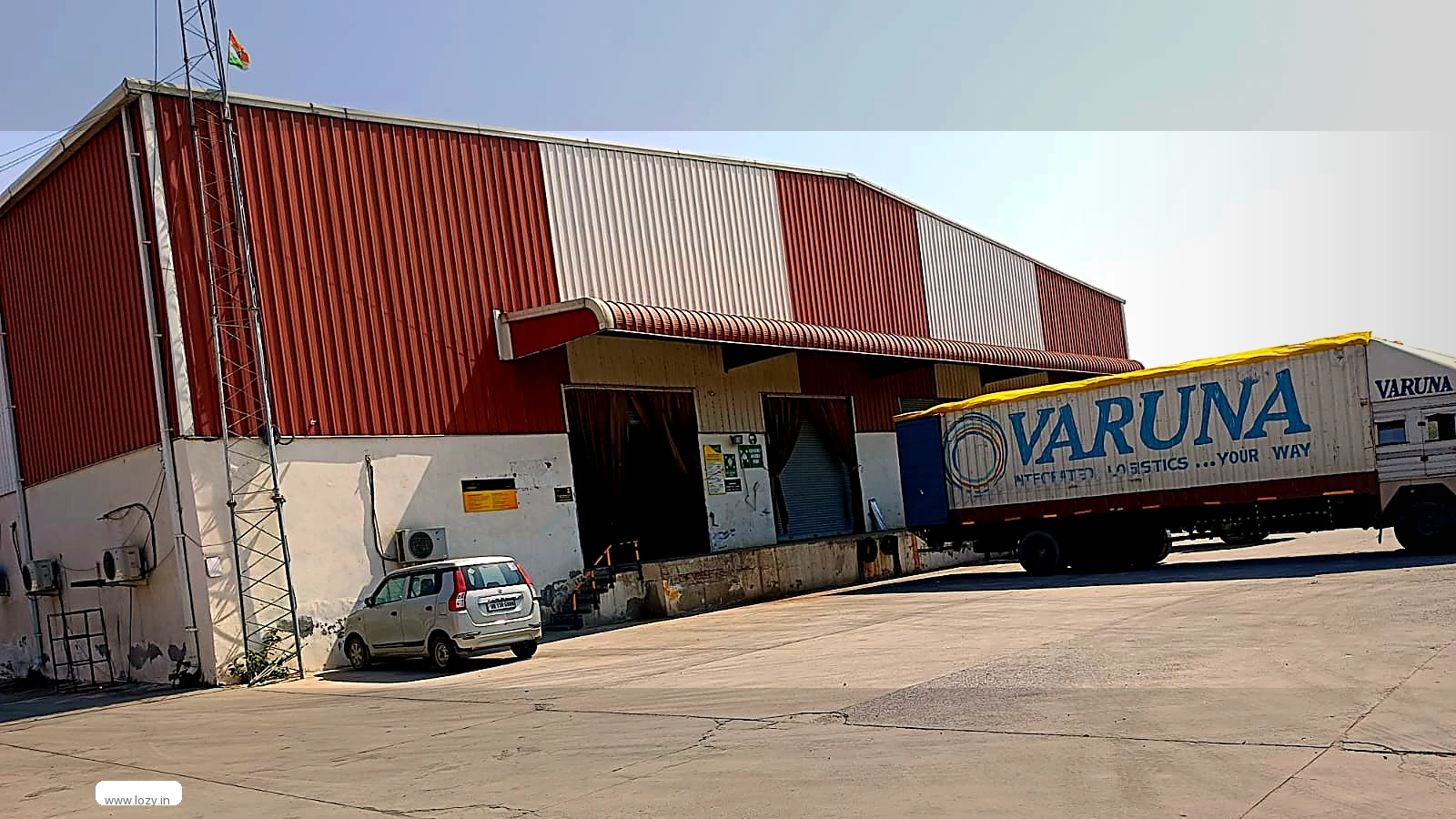
Food and beverage warehousing is the business of holding packaged food and drink — snack cartons, staple sacks, tea, coffee, edible oils and beverage cases — in a dry, monitored facility and letting it out again on the dates the labels carry. Food and beverage warehousing with Lozy runs on monthly billing from ₹14 per sq ft per month, GST-invoiced and without a lock-in, from a Delhi NCR base across a PAN-India network. The sections below cover the operational side a buyer wants before calling: what builds the rate, how dates are read and rotated, what to inspect on a site visit, and where ambient food storage goes wrong.
Key takeaways
- Packaged food moves to a calendar and to a date code: biscuits, namkeen, staples, tea and bottled drinks all need a written rotation rule — first-expiry-first-out, batch-wise or consignment-wise — agreed before the first carton is racked.
- Lozy publishes this trade's starting bases: ₹14 per sq ft per month for racked business warehousing and ₹12 per sq ft per month for straight warehouse space, both billed monthly on a GST tax invoice.
- The network runs 77+ warehouses and over one million square feet of live space, deepest on the Delhi NCR belt: Dwarka and Ghevra, Manesar and Kherki Daula, Jamalpur, Faridabad's DLF estates and Murthal in Sonipat district.
- Festive gifting, the summer beverage run and wedding-season orders each last a few weeks, so monthly space sized for the peak costs less across a year than a leased godown sized for it.
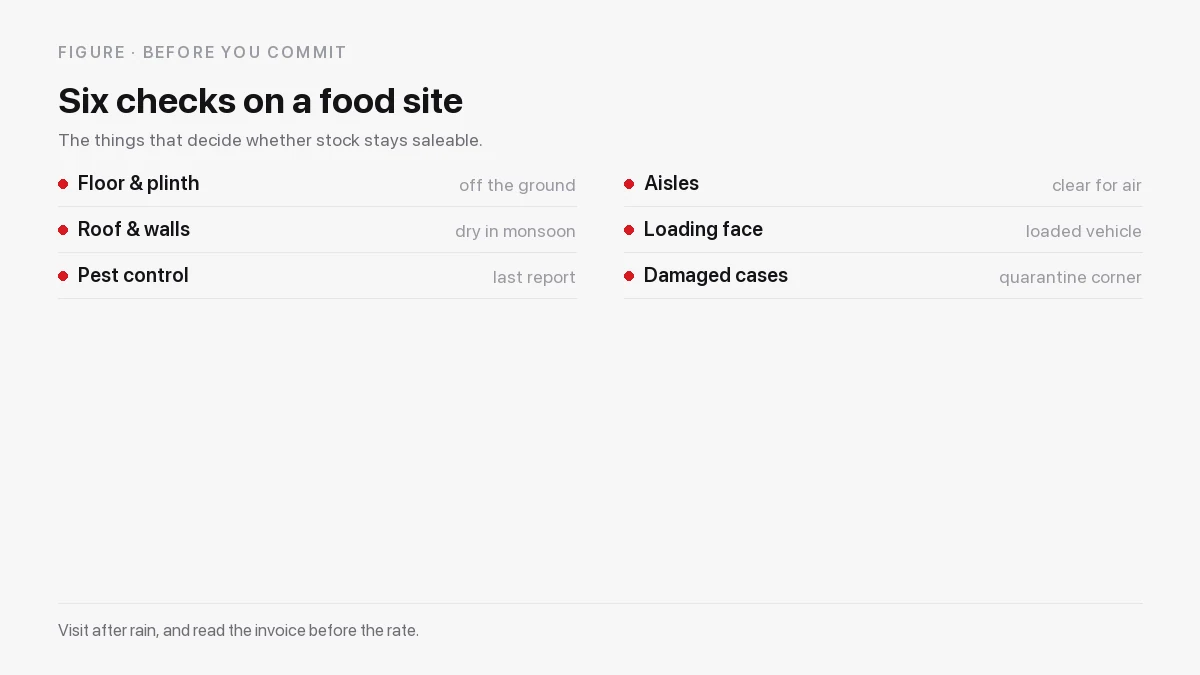
Packaged food is the most ordinary stock in Indian warehousing and the least forgiving. A carton of biscuits carries a date that decides whether it can be sold at all, a case of bottled drinks weighs more than the pallet under it wants to carry, and a festive hamper earns its shelf space for six weeks of the year. Ambient storage for this trade is therefore less about floor area than about routine: how goods are received, how the dates are read off the outer carton, and the order in which cases leave.
This guide deals with dry, shelf-stable stock held in a managed facility — the cartons, crates, sacks and trays that move through a distributor's week. Frozen and chilled lines are a different business run by cold-chain operators, so a brand carrying both ends of that split needs two conversations, not one warehouse.
How packaged food stock moves through the warehouse
A food warehouse is a loop that runs from the vehicle at the gate back to the vehicle at the gate. The work in between — the steps that food and beverage storage clients pay for — is where dates are protected or quietly lost, and it happens in three movements.
Intake: the date is read before the count is agreed
A food consignment is checked in twice — once against the case count on the delivery note, and once against the date code on every outer carton. The second check decides the value of what has just been stored. Cartons with crushed corners, split shrink wrap or a damp patch are pulled aside at the door and reported the same day, instead of surfacing three months later as a claim.
Intake is also where the batch number enters the record. A rack tag carrying batch, best-before and location is worth more than any assurance about rotation, because it is the line a picker reads at the rack and an auditor reads at the end of a quarter. Ask for a filled-in sample of that tag before your first vehicle arrives.
Rotation: a rule in writing, not a habit
Food rotation is first-expiry-first-out, batch-wise or consignment-wise, and the choice belongs to the brand rather than the warehouse. What matters is that the instruction reaches the rack in writing before the goods do, and that promotional stock, distributor returns and saleable stock are never merged into the same aisle. A facility that leaves rotation to a picker's judgement will eventually send out a case that should have gone first — not from carelessness, but because nobody wrote the rule down.
Two habits carry it. Slow lines are reviewed on a fixed rhythm rather than when a shelf empties, and short-dated stock is flagged while it can still be sold at full price. Both are cheap, and both depend on one thing: the dates were recorded at intake.
Dispatch: the gate is where the season is decided
Food distribution moves in small, frequent loads — a stockist's indent this week, a supermarket depot next, a wholesale counter the week after. Cases come off labelled locations, are built into mixed pallets with fragile snack cartons kept off the bottom layer, and load in the order the vehicle will drop them. A vehicle standing at the gate while the right batch is hunted for among mixed stock costs more of a trading day than a month of rent does.
Lozy holds this kind of stock in racked and floor areas across 77+ warehouses and over a million square feet of live space, with monthly billing and a GST invoice on every booking. Where a brand wants the count kept as a running record rather than a periodic surprise, the ledger itself becomes the deliverable — which is what most distributor audits actually ask for.
What food and beverage warehousing costs
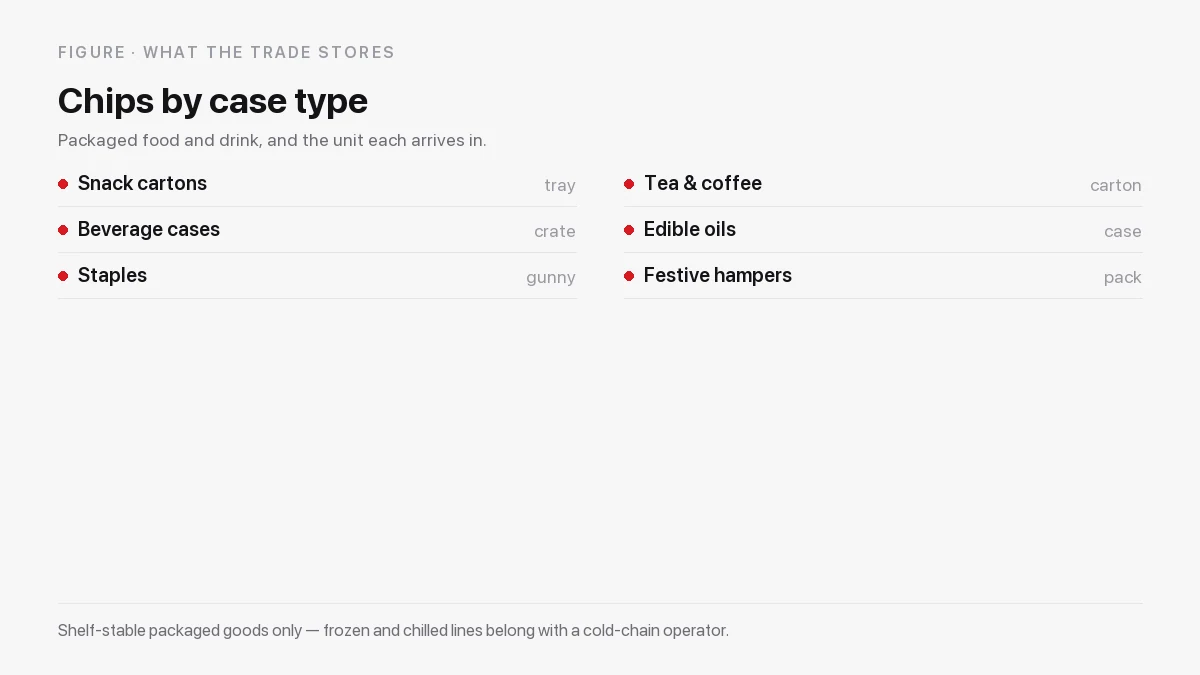
Lozy publishes starting bases rather than one national rate, because two food requirements of the same size price differently the moment the racking or the node changes. The published figures that apply to this trade, each attached to the service page it belongs to:
- ₹14 per sq ft per month is the starting basis for racked and floor space taken month to month on the business warehousing page, with handling, security and invoicing inside the plan.
- ₹12 per sq ft per month is the starting basis for straight warehouse and godown space, on warehouse and godown space for rent — the figure to use when you are pricing a floorplate by area.
- ₹4,499 per month is the entry plan on inventory warehousing, where stock is held as a running count rather than checked periodically.
- ₹1,299 per month is the starting plan on seasonal warehousing, for stock that arrives and leaves with the calendar.
- ₹699 per month is the starting plan on short-term storage, sized for weeks rather than for a season.
- ₹14 per sq ft per month is the basis on on-demand warehouse space, for capacity switched on around a campaign or a consignment that landed early.
Every one of those is a starting figure and belongs to the page it is quoted from; the bases are not interchangeable, and comparing a per-pallet quote against a per-square-foot one is the most common way a food business ends up with a rate it cannot reconcile. The final number follows a short requirement check on your product mix, case sizes and preferred node.
What moves your monthly figure
- Case weight and stack height. Beverage crates want floor positions and low rack levels; a thousand snack cartons of similar value can live four levels up. The same tonnage can need very different space, and weight decides which.
- Space type. Racked positions cost more per square foot and less per case; floor bays look cheaper and use more of both.
- The node. A shed on the Haryana belt and a unit inside the capital stand on land of different value, and the rent carries that difference long before your transport bill does.
- The term. A monthly booking and a long commitment are different products, and the longer one is normally cheaper per month for the same footprint.
- Handling and rotation. Batch-wise picks, label checks and repacking all take time, and time is a line inside the rate rather than a favour.
- Packing material. Shrink film, cartons and trays are either supplied or charged — settle which, in writing, before the first dispatch.
GST, FSSAI and the paper behind a food booking
Two documents matter more in food than in most categories. The first is the tax invoice. Warehouse rent attracts GST, and a company holding the invoice in its own entity's name can claim the input credit; a cash rent with no document looks cheaper in the month and costs more across the year. Ask whether handling will appear as a separate line, and check the rules on the GST portal.
The second is the licence position. Storage is a food business activity in India, and the regime is published by the Food Safety and Standards Authority of India, with applications and renewals handled through FoSCoS. Confirm in writing whose licence the premises operates under, and how a distributor's audit will read that answer. For brands bringing in imported tea, coffee, oils or preserved foods, the consignment also carries customs paperwork — the point at which customs services and storage become one conversation rather than two.
Own godown, shared warehouse or 3PL
Most food businesses begin with a room behind the shop, outgrow it, and then pick between three shapes of space. Run the comparison on your own numbers, not the headline rate.
| What you are weighing | Own godown | Shared racked warehouse | Full 3PL |
|---|---|---|---|
| Who runs the operation | Your own staff and supervisor | The facility runs the space and handling; picks follow your instructions | The partner owns stock movement and your order file |
| Cash up front | Deposit, fit-out, racking, pest control, security | Monthly billing with no fit-out and no lock-in | Setup plus handling charges on every order |
| How space is priced | The whole premises, filled or not | Racked positions or floor bays by area | Throughput rather than floor area |
| Rotation discipline | Depends on whoever you appoint | Run to a written instruction, dated at intake | Run to the partner's own procedure |
| Festive and summer peaks | Fixed; the quiet quarter is paid for anyway | Add a bay for the peak and release it after | Scales with order volume |
| Best fit when | Volumes are steady and the premises genuinely earns its keep | Demand swings and the stock stays under your control | You want fulfilment and last-mile handled too |
There is a fourth route worth testing before committing to any of the three: keep the room behind the counter and take extra space only for the weeks that overflow. It is the least expensive way to learn whether off-site storage suits your lines, because the answer arrives with one month's bill instead of a lease. In this market the shortlist usually includes operators such as Warehousing Express advertising commodity and food storage, and the cold-chain specialists who own the frozen end — a reminder that ambient food storage is a distinct product, not a corner of a frozen operation.
How to choose a facility for food stock
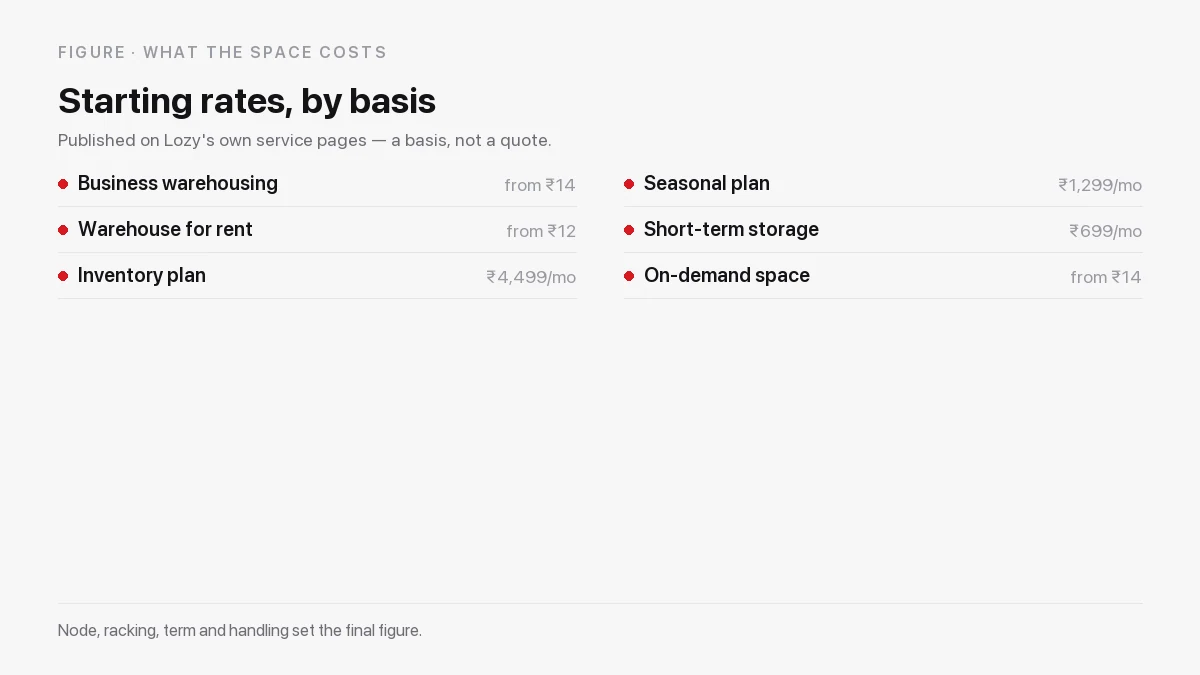
For packaged food the deciding factor is rarely the racking or the rate. It is whether the building stays dry through a monsoon, whether anything is living in it, and whether a loaded vehicle can reach the loading face.
What to inspect on the visit
- Floors, plinths and how stock sits. Cartons on the floor, especially against a wall, is where damp and pest damage begins. Look at the racking, and ask what happens to stock that will not fit a rack.
- Roof and walls. Staining under the roof, tide marks along a wall and the state of the yard after rain tell you more than fresh paint does.
- The pest-control record. A food facility should produce a treatment schedule and the last report without arranging a meeting.
- Aisles and air movement. Clear aisles do more for dry storage than any fan; cases stacked tight against a wall sweat from the inside out.
- Approach road and loading face. A loaded beverage vehicle is heavy; check the turn and whether the dock takes the vehicle you actually send.
- Where damaged stock goes. Ask to see the quarantine corner; the answer shows how the facility behaves the day something leaks.
Red flags in a food storage deal
- Dates not recorded at intake. If the check-in list counts cases and nothing else, rotation is a promise rather than a process.
- Floor storage against a wall. The most expensive free choice in food storage: this is the exact point where damp, pests and crushed cases begin.
- One rack for every kind of stock. Promotional, returned and saleable cases in the same aisle end up as stock whose dates nobody trusts.
- A rate quoted per pallet on one page and per square foot on the next. Mixed bases produce a comparison that means nothing, however careful the arithmetic.
- Nobody named on the account. Food moves weekly; an operator reachable only through a chain of calls will slow every indent.
- A vague answer on the invoice. If GST treatment is unclear before you sign, it stays unclear after your first dispatch.
If you are still choosing between kinds of space rather than between facilities, the Lozy storage FAQ answers the common versions of these questions in short form, and the full services list shows which page each product sits on.
The packaged food calendar
Food demand follows the Indian year more closely than almost any other category, and the storage plan has to follow it too. Three periods decide how much space a brand is really buying.
Summer belongs to beverages
From March the beverage lines take over: heavy cases that stack low and leave in full vehicles rather than mixed pallets. A brand whose racking was sized for snack cartons in January often needs floor bays by April, so the summer capacity conversation belongs in February, not in the middle of the run.
The festive quarter is hamper-shaped
Diwali gifting changes the shape of the stock as well as its volume. Dry fruits, premium snack packs and hampers are bulky, light and short-lived: they consume floor space for weeks and then disappear. The build-up starts well before the selling period, so the space is needed earlier than most first-time buyers expect.
The quiet quarter is where the cost is decided
Every category has a lull, and the lull is where a storage decision is won or lost. A leased shed sits half-empty through it and bills the same; a monthly plan can shrink to the core of fast-moving lines and grow again before the next peak. That is the practical difference between a seasonal booking and a year-round commitment, and it is why seasonal storage for festive food stock is priced the way it is — you read it in the seasonal warehousing guide before signing anything sized for your best month.
What goes wrong in the first month
The failures in a new food storage arrangement are repetitive, and nearly all of them are visible in week one.
- Cartons end up on the floor against a wall because the racking was planned for an average week and the pre-season consignment did not fit. Once stock sits on the ground beside a wall, damp and pest damage have a starting point.
- Rotation was agreed in conversation. The instruction never reached the rack, so the first pick goes by whatever is nearest the aisle.
- Everything is stored in one rack. Promotional packs, slow movers and fast lines share an aisle, and the fast lines age behind stock that will not move for a season.
- Leakers are not separated. A single split bottle can soak a pallet of packaging; without a quarantine corner and same-day reporting, one case becomes a claim.
- The first count is trusted. Nobody reconciles the opening stock list against what arrived, and the gap surfaces at the first distributor audit instead.
- The first monsoon is a surprise. Sites are usually signed in dry weather and tested in July, which is why a visit after rain, or a direct question about last August, is worth more than any brochure.
- No one owns the relationship. Week-one problems are small and fixable when there is a named person on both sides; by week eight they are habits.
A worked example: a snack and staples distributor on NH-44
Take a representative case rather than a named customer. A Delhi-based distributor of packaged snacks and staples has been holding stock in a rented basement godown in the Karol Bagh trade area, with the office at the same address. The basement takes the year-round stock, but the pre-season build for the festive quarter arrives by the trailer-load, and the trucks collecting from the basement spend their first hour getting out of central Delhi.
Two options are on the table: keep the basement and add space, or move the bulk of the stock out and hold only a working quantity in the city. The second option is priced on the ₹14 per sq ft per month business warehousing basis at a racked bay on the Murthal side of Sonipat district, where NH-44 leaves the capital region in the direction the distributor's stockists actually sit — Panipat, Karnal, Ambala and, on a good run, Ludhiana.
Written down, the arithmetic is not about rent. Most of the destination towns sit north of Delhi on NH-44, so a Murthal-side bay removes the cross-city leg from the start of every northbound run and lets the vehicle leave before the capital's traffic restrictions bite. The basement stays on as a working buffer: fast lines in the city, bulk and pre-season stock on the highway, with the outside footprint dropping to a smaller monthly position in the quiet quarter.
For an exporter or an importer of food lines, the same exercise runs on the container depot rather than the highway: distance to the depot sets the drayage bill, which in this trade is often larger than the difference between two rents. The food and beverage warehousing page carries the service detail, and a short requirement check is what turns either version of the example into a real number.
How Lozy helps with food and beverage stock
Lozy provides warehousing for packaged foods, snacks, staples and beverages from a Delhi NCR base with a PAN-India network — 77+ warehouses and over one million square feet of live space, billed monthly on a GST invoice with no lock-in. Stock sits in racked or floor areas kept dry, dated at intake, and picked to the rotation rule the brand supplies. Snack and beverage brands use it as dry storage for packaged foods in Delhi NCR; staple, tea and oil distributors use the same space as a godown for their trade that they can hand back when the season turns. Facilities you can ask about by name include Lozy Jamalpur Distribution Center, the Dwarka warehouses for business and 3PL, Ghevra Metro in New Delhi, the Manesar and Kherki Daula sheds and Faridabad's DLF Industrial Area 2. The warehouse listing shows what is free at each today.
For a distributor's day-to-day stock, racked business space is the usual starting point; for a brand whose count has to survive an audit, the record is the product. Read alongside this guide, the business warehousing guide covers what a shared unit includes, and the inventory warehousing guide covers how a running count is kept between audits.
Food stock also travels with its neighbours in the trade. The FMCG warehousing guide covers the same shelf-stable categories at distributor scale, and the e-commerce brands guide covers the D2C snack and beverage sellers who ship cases one parcel at a time. On the city side, the Uttar Pradesh warehousing guide covers the Noida and Ghaziabad belt serving east Delhi's food trade, the Haryana guide works through the NH-44 and NH-48 sheds that northbound food trucks actually load from, the New Delhi guide deals with space inside the capital boundary, and the Mumbai guide covers the western market where imported food lines land.

Related guides
Storing packaged food and beverage stock?
Tell us your product mix, case sizes and the weeks you peak — we reply with a rate and the space available now.
Get a quoteCall +91 93547 12345Sources. Rates, facility names and network figures are Lozy's own published information. Licensing and the storage category are described from the FSSAI regime and its FoSCoS licensing portal, and GST registration and input credit from the GST portal, each linked above. Processed food policy context comes from the Ministry of Food Processing Industries and IBEF's food processing profile; export and import context for food consignments from APEDA.
Last updated: 14 October 2026. If your question is not among the FAQs above, call +91 93547 12345 or write to care@lozy.in.
Need warehousing or storage in India?
Request a free, tailored quote in under 2 minutes — free pickup, no lock-in.






